
James Kachadorian
Author of The Passive Solar House
About the Author
James Kachadorian is a civil engineer with degrees from the Massachusetts Institute of Technology and Worcester Polytechnic Institute
Works by James Kachadorian
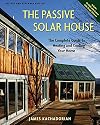
Passive Solar House: The Complete Guide to Heating and Cooling Your Home (2006) 50 copies, 3 reviews
Tagged
Common Knowledge
- Gender
- male
Members
Reviews
Describes some original thinking into solar houses: This is the first book on solar house design that I've seen where the author is a professional engineer who worked in the housing industry. He built houses of the conventional design when energy was cheap. When the price of energy started going up he began looking into solar heated homes and eventually got a patent on a passive system that is remarkably inexpensive when compared with other systems.
Basically he designed a large mass of show more concrete that acts as a big heat sink. That is, when the house is warmer than the concrete, heat flows into the concrete, cooling the house. When the house is cooler. Heat flows out from the concrete, warming the house.
There are a lot of solar systems that work this way, the advantage of his is that it uses standard, i.e. cheap, concrete blocks and a poured slab. He further designs the layout of this concrete so that air would flow through passages in the concrete blocks without the necessity of having blowers to force the air through.
All in all, the book contains some very clever ideas, and has both simple explanations of how it works with enough theory and mathematics to enable you to design your own house. This is made easier through using the software contained on the CD supplied with the book. Here is a fairly complete, fairly simple design tool that will allow you to do a lot of the basic design work of your own solar home. This is not the style of your home, it is the design of the solar aspects.
Anyone thinking of a solar home would be foolish to not spend the few dollars this book costs to get and understand Mr. Kachadorian's concepts. show less
Basically he designed a large mass of show more concrete that acts as a big heat sink. That is, when the house is warmer than the concrete, heat flows into the concrete, cooling the house. When the house is cooler. Heat flows out from the concrete, warming the house.
There are a lot of solar systems that work this way, the advantage of his is that it uses standard, i.e. cheap, concrete blocks and a poured slab. He further designs the layout of this concrete so that air would flow through passages in the concrete blocks without the necessity of having blowers to force the air through.
All in all, the book contains some very clever ideas, and has both simple explanations of how it works with enough theory and mathematics to enable you to design your own house. This is made easier through using the software contained on the CD supplied with the book. Here is a fairly complete, fairly simple design tool that will allow you to do a lot of the basic design work of your own solar home. This is not the style of your home, it is the design of the solar aspects.
Anyone thinking of a solar home would be foolish to not spend the few dollars this book costs to get and understand Mr. Kachadorian's concepts. show less
I’ve long been fascinated by Earthships, so when I saw this book on an Earth Day display at the library, I thought it might be time to broaden my understanding of environment integrated building. Which the first few chapters were rather interesting reading to the layperson, it turns out that the book is largely directed at the home builder specialist, with at least half the volume focused on worksheets and tables for calculating heat load, cooling needs, window performance, back-up systems show more and so forth. Clearly, my local librarians have underdeveloped PR skills. Still, it was worth a few hours of consideration for those interested in home building and design.
The genesis of the book came from Kachadorian’s experience with the oil crisis in the 1970s and believing a partial solution to the energy crisis could be addressed with better home design. Unfortunately, then, as now, many people have reservations about how comfortable a home can be using solar heat, as well as concerns about more eccentric-looking design. His solution was to use concepts of improved home siting, stressing integration of home design with the specifics of the site–latitude, orientation to sun, and consideration of how the sun moves through the year. He then added a passive collection device, similar to a design called a Trombe wall, which collects heat through the principle of mass absorbing solar radiation, then releasing the warmed air during the evening as the mass cools.
Kachadorian’s system uses concrete ducts under a concrete slab under the house as the passive heat collector and air flow system.
solar_slabGeneral design concerns seem to center on moisture issues and potential radon issues (a rather serious issue in the midwest). I didn’t realize it while reading, but Kachadorian makes a point in to address those issues in a small section on “Soil Considerations” in an early chapter. Key to the system is a radon venting drain pipe, and soil preparation beforehand to minimize water collection.
One aspect many people will undoubtedly find attractive is that his designs seem to be based on more ‘traditional’ style housing, particularly a New England saltbox as well as a longer shotgun-style house. However, to floor plan geeks like myself, there’s far too little of house design, and far too much calculating heat loss, etc. The basement is lost in this concept, a potential detraction, particularly for midwesterners used to having basement storage, furnace, laundry, water heating–and tornado escape. I had hopes for more design insight from a chapter called “Three Projects” which shows three different passive solar houses: one in Colorado, one in North Carolina and a Canadian ‘retrofit.’ Unfortunately, although it was likely intended to protect the privacy of the owners, information on the projects largely consists of two or three photos with a testimonial from the homeowner. However, a chapter on a “Sidehill Variation” actually walks the reader through a building plan with step-by step instructions on the full set of worksheets, which seems like it would be useful for a reader who would be interested in implementing the design. The edition I borrowed also had a CD with open-source design software and a photo tour of the homes.
There’s also a short chapter on interior design for the solar home. Given the prevalence of worksheets and calculations, I’m not sure if that was an effort to appeal to the more casual reader, or a way of padding the book. Regardless, largely unnecessary and better suited to a different style book.
Overall, I don’t know that I’d recommend it except for someone who had more experience in the field and could approach it with a more discerning eye than my own. I’d certainly welcome commentary from any design friends as I have a sense it is not as simple as Kachadorian would have the reader believe. Nonetheless, I appreciate his willingness to share his concept and release it as an open-source resource.
cross-posted at https://clsiewert.wordpress.com/2014/06/27/the-passive-solar-house-by-james-kach... with helpful links to Earthships and photos of Trombe walls and the Kachadorian design. show less
The genesis of the book came from Kachadorian’s experience with the oil crisis in the 1970s and believing a partial solution to the energy crisis could be addressed with better home design. Unfortunately, then, as now, many people have reservations about how comfortable a home can be using solar heat, as well as concerns about more eccentric-looking design. His solution was to use concepts of improved home siting, stressing integration of home design with the specifics of the site–latitude, orientation to sun, and consideration of how the sun moves through the year. He then added a passive collection device, similar to a design called a Trombe wall, which collects heat through the principle of mass absorbing solar radiation, then releasing the warmed air during the evening as the mass cools.
Kachadorian’s system uses concrete ducts under a concrete slab under the house as the passive heat collector and air flow system.
solar_slabGeneral design concerns seem to center on moisture issues and potential radon issues (a rather serious issue in the midwest). I didn’t realize it while reading, but Kachadorian makes a point in to address those issues in a small section on “Soil Considerations” in an early chapter. Key to the system is a radon venting drain pipe, and soil preparation beforehand to minimize water collection.
One aspect many people will undoubtedly find attractive is that his designs seem to be based on more ‘traditional’ style housing, particularly a New England saltbox as well as a longer shotgun-style house. However, to floor plan geeks like myself, there’s far too little of house design, and far too much calculating heat loss, etc. The basement is lost in this concept, a potential detraction, particularly for midwesterners used to having basement storage, furnace, laundry, water heating–and tornado escape. I had hopes for more design insight from a chapter called “Three Projects” which shows three different passive solar houses: one in Colorado, one in North Carolina and a Canadian ‘retrofit.’ Unfortunately, although it was likely intended to protect the privacy of the owners, information on the projects largely consists of two or three photos with a testimonial from the homeowner. However, a chapter on a “Sidehill Variation” actually walks the reader through a building plan with step-by step instructions on the full set of worksheets, which seems like it would be useful for a reader who would be interested in implementing the design. The edition I borrowed also had a CD with open-source design software and a photo tour of the homes.
There’s also a short chapter on interior design for the solar home. Given the prevalence of worksheets and calculations, I’m not sure if that was an effort to appeal to the more casual reader, or a way of padding the book. Regardless, largely unnecessary and better suited to a different style book.
Overall, I don’t know that I’d recommend it except for someone who had more experience in the field and could approach it with a more discerning eye than my own. I’d certainly welcome commentary from any design friends as I have a sense it is not as simple as Kachadorian would have the reader believe. Nonetheless, I appreciate his willingness to share his concept and release it as an open-source resource.
cross-posted at https://clsiewert.wordpress.com/2014/06/27/the-passive-solar-house-by-james-kach... with helpful links to Earthships and photos of Trombe walls and the Kachadorian design. show less
intruction on building "Solar Slab" heat sink foundation w.concrete block
Statistics
- Works
- 2
- Members
- 128
- Popularity
- #157,244
- Rating
- 3.4
- Reviews
- 3
- ISBNs
- 3