
Katharine Whitehorn (1928–2021)
Author of Cooking in a Bedsitter
About the Author
Works by Katharine Whitehorn
Associated Works
Shared Values for a Troubled World: Conversations with Men and Women of Conscience (1994) — Contributor — 28 copies
Tagged
Common Knowledge
- Birthdate
- 1928-03-17
- Date of death
- 2021-01-08
- Gender
- female
- Education
- Roedean School
Glasgow School for Girls
University of Cambridge (Newnham College) - Occupations
- journalist
- Organizations
- Observer (columnist|1960-2017)
Patients Association (vice-president|1983-1996)
Saga Magazine (columnist from|1997) - Awards and honors
- St Andrews University (rector|1982-1985)
Order of the British Empire (Commander, services to journalism|2014) - Relationships
- Lyall, Gavin (husband)
- Cause of death
- Alzheimer's disease
- Nationality
- UK
- Birthplace
- Hendon, England, UK
- Associated Place (for map)
- England, UK
Members
Reviews

For those of a certain age this book is a time machine to take you back to the days when fish and spinach usually came in frozen bricks, fridges were hard to come by and you could get a bottle of Spanish red - "implies the rough peasant touch" - for 6/6d (32 and a half pence, that is) .
There is still useful advice for the culinary naif but times change and there are better books with a more contemporary touch available. As a nostalgia trip, Whitehorn's writing remains pithy and to the point show more and younger generations might enjoy finding out what their parents got up to. show less
There is still useful advice for the culinary naif but times change and there are better books with a more contemporary touch available. As a nostalgia trip, Whitehorn's writing remains pithy and to the point show more and younger generations might enjoy finding out what their parents got up to. show less
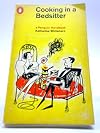
A bedsitter is a single room without plumbing, as one might inhabit when living thriftily in a shared house. I've always had kitchen-sharing rights when I lived in one of these, but I certainly remember being nervous of the kitchen or of my housemates. Whitehorn writes as though one was not allowed to do more than boil tea or heat soup in one's room but also wasn't allowed to use the real kitchen. Of course, if you're poor enough to live in a bedsit, you aren't going to eat at restaurants show more very often. This extremely slender, practical cookbook is full of advice on hiding the smells of cooking, keeping an asbestos mat under the bed, doing the washing-up in a shared bathroom. The comedy is innate.
She also makes one of the most sensible defenses of traditional English cuisine I've ever read, while abandoning it as impractical.
Indeed, if you have an Aga (vast thermal mass, will cook gallons of food at once) in a house with a country garden (fresh truck and eggs, the best thing to do is not fuss over it too much) you would produce... something a lot like the Pacific Coast standard of fresh, seasonal, and varied. But if you have one small, weak fire, and can't chop more than one thing at a time:
Whitehorn was, therefore, working with more technical constraints than was [Edouard de Pomiane]. She recommends reheating rice or potatoes every few days instead of cooking them fresh, or eating bread as a filler (perhaps that went without saying for someone in France). Casseroles work, eggs work, green salads are the easiest veg, and there's simply nothing to be done about the smells.
That said, she has practical instructions for casseroles, fried fritters, many soups, creamed this and that, and parties from the raucous and artistic to the calculatedly intimate to the truly difficult: one's protective parents.
This is more of a curiosity than a cookbook, now, and a current version would surely abandon the heating element for a microwave -- perhaps disguised as a TV. Whitehorn's voice is delightful, though, and anyone who likes [Peg Bracken] might enjoy this. show less
She also makes one of the most sensible defenses of traditional English cuisine I've ever read, while abandoning it as impractical.
"The principles of English cooking demand that first-class food should be cooked as simply as possible, and that a number of different foods should be cooked separately and served together."
Indeed, if you have an Aga (vast thermal mass, will cook gallons of food at once) in a house with a country garden (fresh truck and eggs, the best thing to do is not fuss over it too much) you would produce... something a lot like the Pacific Coast standard of fresh, seasonal, and varied. But if you have one small, weak fire, and can't chop more than one thing at a time:
"...bedsitter people have far more natural kinship with nomads brewing up in the desert over a small fire of camel dung, or impoverished Italian peasants eking out three shrimps and lump of cheese with half a cartload of spaghetti."
Whitehorn was, therefore, working with more technical constraints than was [Edouard de Pomiane]. She recommends reheating rice or potatoes every few days instead of cooking them fresh, or eating bread as a filler (perhaps that went without saying for someone in France). Casseroles work, eggs work, green salads are the easiest veg, and there's simply nothing to be done about the smells.
That said, she has practical instructions for casseroles, fried fritters, many soups, creamed this and that, and parties from the raucous and artistic to the calculatedly intimate to the truly difficult: one's protective parents.
This is more of a curiosity than a cookbook, now, and a current version would surely abandon the heating element for a microwave -- perhaps disguised as a TV. Whitehorn's voice is delightful, though, and anyone who likes [Peg Bracken] might enjoy this. show less

I've come to the conclusion that I'm not a big fan of autobiographies, and I think I've worked out why. If the author has spent his or her life doing something in which I have no interest at all (eg being married to a footballer), then I'm bored silly. If, on the other hand, the author seems to have been living in a whirl of Doing Interesting Things then I sit there in a haze of wistful envy and get demoralised.
Katherine Whitehorn comes across as a woman I would very much like to polish off show more a bottle or two of wine with one summer's evening, as she has wit, common sense, and a lifetime of Doing Interesting Things to talk about. I also very much hope that if I ever go through a bereavement I have even half her self-awareness and practicality. But after some time spent perusing her life I feel rather depressed, because I have achieved very little in comparison.
You can tell it's a columnist's autobiography, as it has a tendency to fall into article-sized chunks which get a bit irritating. The other problem is the one it shares with ever other autobiography I can ever remember having come across, which is that it's a lot more vividly-painted and interesting when it talks about childhood than most of the rest of the time. It's as if everyone who embarks on the task of writing their life dives more enthusiastically into recreating that part of the past, even if the years in question weren't particularly happy. I have a theory about this, which is that it's more socially acceptable to discuss one's childhood in company than it is to discuss the first five years of one's marriage, or the decade where your job was going really well. This is possibly because we all had a childhood, whereas we can't necessarily connect to other life experiences.
She's an interesting woman to spend time with, so if none of the above caveats bother you, go for it. show less
Katherine Whitehorn comes across as a woman I would very much like to polish off show more a bottle or two of wine with one summer's evening, as she has wit, common sense, and a lifetime of Doing Interesting Things to talk about. I also very much hope that if I ever go through a bereavement I have even half her self-awareness and practicality. But after some time spent perusing her life I feel rather depressed, because I have achieved very little in comparison.
You can tell it's a columnist's autobiography, as it has a tendency to fall into article-sized chunks which get a bit irritating. The other problem is the one it shares with ever other autobiography I can ever remember having come across, which is that it's a lot more vividly-painted and interesting when it talks about childhood than most of the rest of the time. It's as if everyone who embarks on the task of writing their life dives more enthusiastically into recreating that part of the past, even if the years in question weren't particularly happy. I have a theory about this, which is that it's more socially acceptable to discuss one's childhood in company than it is to discuss the first five years of one's marriage, or the decade where your job was going really well. This is possibly because we all had a childhood, whereas we can't necessarily connect to other life experiences.
She's an interesting woman to spend time with, so if none of the above caveats bother you, go for it. show less

This book got me started when I could do little more than heat a can of soup and make toast. As well as providing recipes that can be followed by the most lazy and incompetent undergraduate student, it is full of hilarious and perceptive remarks about the difficulty of self-catering in student digs or the like. As Whitehorn says, "Cooking in a bedsitter is not just a matter of finding something that can be cooked on a single ring. It is a problem of finding somewhere to put down the fork show more while you take the lid off the saucepan, and then finding somewhere else to put the lid. ... It is cooking at floor level, in a hurry, with nowhere to put the salad but the washing-up bowl, which in any case is full of socks." Even though I probably only used about a dozen or so of the recipes more than once, this book was a huge delight: wittier than Delia Smith, and with a great understanding of the needs of the hungry troglodyte. I've only taken off half a star because it was originally written in 1961, long before the vegetarian revolution or the discovery of wholefoods, and even as revised, it offers little guidance on these topics. MB 14-vi-2007 show less
Lists
You May Also Like


Associated Authors
Statistics
- Works
- 12
- Also by
- 3
- Members
- 245
- Popularity
- #92,909
- Rating
- 3.9
- Reviews
- 10
- ISBNs
- 19
