
Anselm Berrigan
Author of Notes from Irrelevance
Works by Anselm Berrigan
What is Poetry? (Just kidding, I know you know): Interviews from The Poetry Project Newsletter (1983 - 2009) (2017) 17 copies
Have a Good One 2 copies
Poems and Things 1 copy
Don't Forget to Love Me 1 copy
Associated Works
Talisman: A Journal of Contemporary Poetry and Poetics, Number 13, The Anne Waldman Issue — Contributor — 1 copy
Tagged
Common Knowledge
Members
Reviews
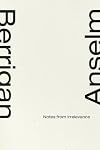
Notes from Irrelevance is a single stanza, a montage with some of the joins quite apparent. It opens with a flat recitation of one-off phrases or observations, some word play ("a stain on the soul of the off-looker"), strung together as a single sentence. A bit more of that, and then a shift as though the poet pauses, almost reflects on that opening but not by commenting directly on the previous lines so much as unspooling longer, more connected lines (page 9, "I've not met an alien ..."). show more Not a sharp transition, the poet uses the first person throughout, at times declamatory, and at others more conversational.
The touchstone for me is the Burroughs cut-up, though Berrigan is here less thematically coherent. I'm not left with a sense of character development or narrative arc, rather a snapshot reveal of ... thoughts and images, a media stream.
So instead of a narrative thread, I focused on snippets or aphorisms, and in parallel process found myself wondering by what criteria Berrigan edited any given passage: when is it clear to add a section, refine a phrase, trim a section, smooth a transition or leave the abrupt shift without even a line break? Or when a concept is omitted, how did he recognise that, find something appropriate to fit it in? When and how to end the poem? It's the classic curiosity of the creative process, largely unanswered because my creative process doesn't seem to apply to this sort of writing -- one of the main reasons to read it.
A guiding excerpt:
I at some point decided
to be -- or became,
understanding later --
influenced by, potentially,
anything. Alignment with
lineage or historical arc
felt superfluous after that.
There are no conscious
connections within me
at all: my phone doltish
on purpose, all thinking
made of remarks, inhabiting
a borrowed consciousness
till human voices wake
me.
The Eliot quote ("till human voices wake me") is wry and loops back nicely to the "influenced by ... anything" line, I wonder what other allusions are peppered throughout. Berrigan's poem lends itself to re-reading, like Tarot in that the ideas it prompts in me are more interesting than what is written on the page / on the upturned card -- or anywise, seems so at first blush.
//
I don't have the same confidence reading poetry / verse as I do novels or essays. Certainly I'm not as deeply read in verse, but I wonder to what extent the hesitation on my part, the lack of confidence, is unwarranted. Or perhaps: the extent to which my confidence in reading prose is misleading. So: turn that to my advantage, capture what the text prompts in me, bypass questions of what I might be missing. show less
The touchstone for me is the Burroughs cut-up, though Berrigan is here less thematically coherent. I'm not left with a sense of character development or narrative arc, rather a snapshot reveal of ... thoughts and images, a media stream.
So instead of a narrative thread, I focused on snippets or aphorisms, and in parallel process found myself wondering by what criteria Berrigan edited any given passage: when is it clear to add a section, refine a phrase, trim a section, smooth a transition or leave the abrupt shift without even a line break? Or when a concept is omitted, how did he recognise that, find something appropriate to fit it in? When and how to end the poem? It's the classic curiosity of the creative process, largely unanswered because my creative process doesn't seem to apply to this sort of writing -- one of the main reasons to read it.
A guiding excerpt:
I at some point decided
to be -- or became,
understanding later --
influenced by, potentially,
anything. Alignment with
lineage or historical arc
felt superfluous after that.
There are no conscious
connections within me
at all: my phone doltish
on purpose, all thinking
made of remarks, inhabiting
a borrowed consciousness
till human voices wake
me.
The Eliot quote ("till human voices wake me") is wry and loops back nicely to the "influenced by ... anything" line, I wonder what other allusions are peppered throughout. Berrigan's poem lends itself to re-reading, like Tarot in that the ideas it prompts in me are more interesting than what is written on the page / on the upturned card -- or anywise, seems so at first blush.
//
I don't have the same confidence reading poetry / verse as I do novels or essays. Certainly I'm not as deeply read in verse, but I wonder to what extent the hesitation on my part, the lack of confidence, is unwarranted. Or perhaps: the extent to which my confidence in reading prose is misleading. So: turn that to my advantage, capture what the text prompts in me, bypass questions of what I might be missing. show less
 This review was written for LibraryThing Early Reviewers.
"Look & pierce us with
the pang & arrow of
our condition on the
plain of life..."
--Jack Kerouac
I savored this book of poetry from the moment it arrived in the mail. The cover design is sublime and the paper and font choice are perfect compliments to the text. Berrigan Anselm. His backwards name lodged itself in my brain for weeks.
Even though the book was only 65 pages, it was not a quick or easy read. It was a maze, a bed of nails, a jar of molasses. Insidious, heavy, confusing, intriguing, show more challenging. Coy even. I tiptoed through the pages, wanting to know more but yet strangely on guard.
Berrigan is an analyzer, an internalizer, a P.I. whose client is himself. His trenchant words crackle with angst and yearning, cynicism and intuitiveness. There are no rainbows in this poem, but there is a mighty search for meaning and identity and maybe even absolution.
My only complaint is the use -- a la Kerouac -- of "yr" for "your." Had that sort of literary shorthand been used in other instances in the text, it might not have stood out as much.
I thoroughly enjoyed this book. An unusual and precocious treat. show less
the pang & arrow of
our condition on the
plain of life..."
--Jack Kerouac
I savored this book of poetry from the moment it arrived in the mail. The cover design is sublime and the paper and font choice are perfect compliments to the text. Berrigan Anselm. His backwards name lodged itself in my brain for weeks.
Even though the book was only 65 pages, it was not a quick or easy read. It was a maze, a bed of nails, a jar of molasses. Insidious, heavy, confusing, intriguing, show more challenging. Coy even. I tiptoed through the pages, wanting to know more but yet strangely on guard.
Berrigan is an analyzer, an internalizer, a P.I. whose client is himself. His trenchant words crackle with angst and yearning, cynicism and intuitiveness. There are no rainbows in this poem, but there is a mighty search for meaning and identity and maybe even absolution.
My only complaint is the use -- a la Kerouac -- of "yr" for "your." Had that sort of literary shorthand been used in other instances in the text, it might not have stood out as much.
I thoroughly enjoyed this book. An unusual and precocious treat. show less
This review was written for LibraryThing Early Reviewers.Notes from Irrelevance, by Anselm Berrigan
Genealogy
Anselm Berrigan comes from an esteemed family. The son of poet Ted Berrigan and poet Alice Notley, his brother is the poet and songwriter Edmund Berrigan. Anselm’s wife Karen Weiser also works as a poet. Notes from Irrelevance shows that Anselm didn’t get his book deal by trading on his father’s name. (America, despite its populist and egalitarian posturing, has a yen for dynasties and nepotism. See: the Presidency, Ford Motor Company, show more etc.)
Content
Notes from Irrelevance could easily bear the subtitle, “One man’s search for meaning in the second decade of the 21st century.” Throughout the short volume, Anselm contends with the Big Issues: existence, meaning, faith, family, and literature. Written as a single book-length stanza, the concept brings to mind the single-paragraph-as-book tirades by Thomas Bernhard or Molly Bloom’s ecstatic run-on sentence that concludes Ulysses.
By turns demotic, snarky, and self-referential, Notes from Irrelevance both charms and challenges the reader.
“ The computer,
not the quesadilla,
told me about a moment,
wherein my father,
talking to an old friend,
waxed nostalgic for a
moment they cohabited,
an extended moment,
and a fellow who heard
the rap from above got
mad and thirty-two years
later related his anger
in a comment box as way
of saying he couldn’t
deal with the sadness
he perceived in Ted’s
poetry.”
In the end, after the attempts to stave off his own irrelevance, Anselm dissects his own writing with cynical precision and acidic wit:
“Cosmic intercon-
nection of all beings? Check.
futility of pain management as source
of humor in outlook? Check. Controllable
vices for purposes
of secondary level
of interior life, an echo
of conscience trailing
out? Check.”
The question and answer format calls to attention that poetry is a language-making process. The book demands the reader to contend with the language. Long run-on sentences, sometimes tied into knots of clauses and sub-clauses, suddenly vanish in a spat of. Small. One or two word. Sentence fragments. Beautifully polished phrases collide with unexpected bursts of vulgarity. An occasional pop culture reference pops up (Internet comment boards, the movie Apollo 13, etc.) making the reader realize the poet lives in the real world and is a real person. The real-life aspect of the poet is a challenge for the reader, since the poet is the son of a famous poet. Leaving the shadow of one’s father (especially a famous one) forces one to contend with the harsh sunlight of reality. The Shadow of Fame drove Hamlet crazy and has been the reason countless kids of celebrities went from crèche to rehab.
Reading the book took little over an hour, but re-evaluating the images and the language will require me to revisit the text many more times.
Production
Wave Books is a small press specializing in poetry and operates from Seattle, Washington. The book itself possesses a sturdy yet delicate feel. A slim 64 pages give Notes from Irrelevance a chapbook appearance, an aura of the homemade. On many pages, there are small imperfections, tiny flaws in the paper itself. The text is printed on sturdy paper, just shy of good cardstock, while the front cover is devoid of any decoration except the poet’s name, each letter sliced and the title itself hunkered down on the lower right, almost an afterthought.
Wave Books puts out a great product, superior materials with stunning content. Granted that sounds a bit dry and anemic, with all the personality of a State Department press release, but Notes from Irrelevance effects one on an intellectual and emotional level while the book itself feels good in the hands. (Best accompanied in the morning with a cup of coffee.)
http://driftlessareareview.wordpress.com/2011/09/20/notes-from-irrelevance-by-an... show less
Genealogy
Anselm Berrigan comes from an esteemed family. The son of poet Ted Berrigan and poet Alice Notley, his brother is the poet and songwriter Edmund Berrigan. Anselm’s wife Karen Weiser also works as a poet. Notes from Irrelevance shows that Anselm didn’t get his book deal by trading on his father’s name. (America, despite its populist and egalitarian posturing, has a yen for dynasties and nepotism. See: the Presidency, Ford Motor Company, show more etc.)
Content
Notes from Irrelevance could easily bear the subtitle, “One man’s search for meaning in the second decade of the 21st century.” Throughout the short volume, Anselm contends with the Big Issues: existence, meaning, faith, family, and literature. Written as a single book-length stanza, the concept brings to mind the single-paragraph-as-book tirades by Thomas Bernhard or Molly Bloom’s ecstatic run-on sentence that concludes Ulysses.
By turns demotic, snarky, and self-referential, Notes from Irrelevance both charms and challenges the reader.
“ The computer,
not the quesadilla,
told me about a moment,
wherein my father,
talking to an old friend,
waxed nostalgic for a
moment they cohabited,
an extended moment,
and a fellow who heard
the rap from above got
mad and thirty-two years
later related his anger
in a comment box as way
of saying he couldn’t
deal with the sadness
he perceived in Ted’s
poetry.”
In the end, after the attempts to stave off his own irrelevance, Anselm dissects his own writing with cynical precision and acidic wit:
“Cosmic intercon-
nection of all beings? Check.
futility of pain management as source
of humor in outlook? Check. Controllable
vices for purposes
of secondary level
of interior life, an echo
of conscience trailing
out? Check.”
The question and answer format calls to attention that poetry is a language-making process. The book demands the reader to contend with the language. Long run-on sentences, sometimes tied into knots of clauses and sub-clauses, suddenly vanish in a spat of. Small. One or two word. Sentence fragments. Beautifully polished phrases collide with unexpected bursts of vulgarity. An occasional pop culture reference pops up (Internet comment boards, the movie Apollo 13, etc.) making the reader realize the poet lives in the real world and is a real person. The real-life aspect of the poet is a challenge for the reader, since the poet is the son of a famous poet. Leaving the shadow of one’s father (especially a famous one) forces one to contend with the harsh sunlight of reality. The Shadow of Fame drove Hamlet crazy and has been the reason countless kids of celebrities went from crèche to rehab.
Reading the book took little over an hour, but re-evaluating the images and the language will require me to revisit the text many more times.
Production
Wave Books is a small press specializing in poetry and operates from Seattle, Washington. The book itself possesses a sturdy yet delicate feel. A slim 64 pages give Notes from Irrelevance a chapbook appearance, an aura of the homemade. On many pages, there are small imperfections, tiny flaws in the paper itself. The text is printed on sturdy paper, just shy of good cardstock, while the front cover is devoid of any decoration except the poet’s name, each letter sliced and the title itself hunkered down on the lower right, almost an afterthought.
Wave Books puts out a great product, superior materials with stunning content. Granted that sounds a bit dry and anemic, with all the personality of a State Department press release, but Notes from Irrelevance effects one on an intellectual and emotional level while the book itself feels good in the hands. (Best accompanied in the morning with a cup of coffee.)
http://driftlessareareview.wordpress.com/2011/09/20/notes-from-irrelevance-by-an... show less
This review was written for LibraryThing Early Reviewers.[book:Notes From Irrelevance|11175859] by [author:Anselm Berrigan|110691] is an 80-page poem which I read and reread over several sittings. In the interest of transparency, I'll state that I won the book through LibraryThing, but the experience of reading it would have been well worth the price of the book. I need to reread it at least one more time before I can feel like I've even begun to digest it. I found it soothing and provocative, with fragmented jumps that were sometimes irritating show more but more often woke me up and moved me to greater focus and attention to both the work before me and the world around me.
The book gives glimpses of the poet's experience of the world and himself in it. The language reflects and refracts this experience and recreates it, creating a resonance in the reader allowing both a brief connection with the poet and a new connection with the world and her experience of it.
I found the work exhilarating. I strongly recommend it to all lovers of language. show less
The book gives glimpses of the poet's experience of the world and himself in it. The language reflects and refracts this experience and recreates it, creating a resonance in the reader allowing both a brief connection with the poet and a new connection with the world and her experience of it.
I found the work exhilarating. I strongly recommend it to all lovers of language. show less
This review was written for LibraryThing Early Reviewers.Lists
You May Also Like
Associated Authors
Statistics
- Works
- 19
- Also by
- 3
- Members
- 161
- Popularity
- #131,050
- Rating
- 3.7
- Reviews
- 9
- ISBNs
- 19
