
Helen Small
Author of The Value of the Humanities
About the Author
Helen Small argues that if we want to understand old age, we have to think more fundamentally about what it means to be a person, to have a life, to have (or lead) a good life, to be part of a just society. What did Plato mean when he suggested that old age was the best place from which to practice show more philosophy, or Thomas Mann when he defined old age as the best time to be a writer-and were they right? If we think, as Aristotle did, that a good life requires the active pursuit of virtue, how will our view of later life be affected? If we think that lives and persons are unified, much as stories are said to be unified, how will our view of old age differ from that of someone who thinks that lives and/or persons can be strongly discontinuous? What constitutes a fair distribution of social resources between young and old? And should recent developments in evolutionary theory have any impact on our answers to these questions? show less
Works by Helen Small
Wuthering Heights 1 copy
Associated Works
Tagged
Common Knowledge
- Gender
- female
- Education
- Queen Margaret College, Wellington, New Zealand
Victoria University of Wellington, New Zealand
University of Cambridge - Occupations
- professor of English Literature
- Organizations
- Oxford University (Pembroke College)
- Awards and honors
- Fellow of Pembroke College, Oxford University
Leverhulme Research Fellowship - Nationality
- New Zealand
- Birthplace
- New Zealand
- Places of residence
- Wellington, New Zealand
England, UK - Associated Place (for map)
- New Zealand
Members
Reviews
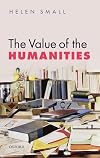
If a humanist makes an argument for the value of the humanities, it's only right that she uses the humanist research method: relate what other people have written on the subject and build your own argument from there. Unfortunately the author of this book never really reaches the "build" stage. Pages where she presents stand-alone arguments constitute less than 10% of the book. In the remaining 90% she defers to earlier authorities and presents their views, sometimes in numbing detail. For show more instance, in describing what culture is, she spends almost 10 pages on one worthless definition; "sweetness and light", coined by Matthew Arnold in the nineteenth century. In the chapter on happiness she returns again and again to J.S. Mill's mental state in 1827 when he experienced some sort of literary epiphany. Even a dedicated humanist must surely agree that these disquisitions are peripheral, boring and irrelevant to the subject.
Fortunately most of the other sections have been written in a general tone. The author does possess broad learning and a good touch for clear argumentation, but she exhibits it much too reluctantly and always prioritizes earlier literature over her personal arguments. Her analysis actually becomes unintentionally ironic towards the end. After all, what could possibly be a better way of demonstrating the disutility of the humanities than a humanities book which defends the humanities with bizarre sentences such as this one from p.139: "We do not have to endorse Hardt and Negri's 'inebriate' vision of 'power through [political] faith' (I quote Tom Nairn), to claim, contra Baier, that the humanities might be, as it were, a large collective gadfly, for example by reminding present-day society of inconvenient but pertinent facts about its past and its cultural heritage."
So if you're looking for a defense of the humanities I would not recommend this book. Even so, its main points are valid and they are summarized in clear language on pages 174-175: (1) humanities do a distinctive kind of work which produces qualitative understanding of knowledge inextricable from human subjectivity, (2) the humanities assist in preservation and curation of cultures and the skills for interpreting them, (3) they contribute to individual happiness, (4) humanist faculties are centres for higher study and practice of the skills of critical reasoning, debate and evaluation of ideas, and (5) humanism has value for its own sake. show less
Fortunately most of the other sections have been written in a general tone. The author does possess broad learning and a good touch for clear argumentation, but she exhibits it much too reluctantly and always prioritizes earlier literature over her personal arguments. Her analysis actually becomes unintentionally ironic towards the end. After all, what could possibly be a better way of demonstrating the disutility of the humanities than a humanities book which defends the humanities with bizarre sentences such as this one from p.139: "We do not have to endorse Hardt and Negri's 'inebriate' vision of 'power through [political] faith' (I quote Tom Nairn), to claim, contra Baier, that the humanities might be, as it were, a large collective gadfly, for example by reminding present-day society of inconvenient but pertinent facts about its past and its cultural heritage."
So if you're looking for a defense of the humanities I would not recommend this book. Even so, its main points are valid and they are summarized in clear language on pages 174-175: (1) humanities do a distinctive kind of work which produces qualitative understanding of knowledge inextricable from human subjectivity, (2) the humanities assist in preservation and curation of cultures and the skills for interpreting them, (3) they contribute to individual happiness, (4) humanist faculties are centres for higher study and practice of the skills of critical reasoning, debate and evaluation of ideas, and (5) humanism has value for its own sake. show less
Awards


Statistics
- Works
- 8
- Also by
- 4
- Members
- 92
- Popularity
- #202,475
- Rating
- 3.9
- Reviews
- 1
- ISBNs
- 21