
Brian Nelson (1)
Author of The Cambridge Companion to Zola
For other authors named Brian Nelson, see the disambiguation page.
Works by Brian Nelson
Associated Works
The Belly of Paris (1873) — Translator, some editions; Introduction, some editions — 1,354 copies, 34 reviews
The Fortune of the Rougons (1871) — Translator, some editions; Introduction, some editions — 1,039 copies, 33 reviews
Tagged
Common Knowledge
- Nationality
- United Kingdom
- Associated Place (for map)
- United Kingdom
Members
Reviews

There are good reasons to read this book: if you know nothing about Émile Zola, Brian Nelson's Very Short Introduction will convince you to add Zola to your TBR; and if you've read Zola in a general reader's kind of way, the VSI enhances your knowledge of the author and his books, making you want to read or re-read more of this author.
This VSI also explains why you might not want to read the Rougon-Macquart cycle in the chronological order that I used, because themes reveal themselves show more differently if you read the novels in publication order. The VSI also provides the historical context for the novels in a way that you might not have understood if you don't have the OUP editions with their excellent introductions. (Some of the novels were not available in OUP editions when I first started reading Zola, a problem since rectified. See my post 'The Art of Book Introductions, or Why You Should Always Buy the Oxford Editions of Zola'.)
Brian Nelson, Emeritus Professor of French Studies and Translation Studies at Monash University here in Melbourne, translated some of the recent editions of the Rougon-Macquart cycle, and wrote the introductions. His style, as you will know if you have read the OUP editions that he translated, is clear, free of pedantry and academic jargon, and easy for a general reader to enjoy. I was really pleased to add this edition to my collections of VSIs.
Zola, (1840-1902) like his predecessor Balzac (1799-1850), used storytelling to examine his society, but Zola's focus was the changing cultural landscapes of the late 19th century. He was a novelist of modernity driven by industrial capitalism. He was interested in the new shapes of the city, new forms of social practice and economic organisation, and the heightened political pressures of the era. One of the innovative features of his novels is the portrayal of crowds, a feature of the emerging mass society.
Committed to a literature of truth, and to a new freedom of expression, he introduced a new realm of subjects: urban poverty and the working class; class consciousness and class relations; sexuality and gender. Truth, for him, was not just a matter of personal integrity, but also an aesthetic principle. He believed in telling it like it is, with no aspect of human experience out of bounds. He believed [and I do too] that a writer plays a social role. What Zola shows is the lives of ordinary people but within the context of change: how they were affected by the growth of the city, by the abuse of power, by the growth of consumer culture, by banking, crime, poverty and prostitution.
His style was not documentary but ironic and satiric. Zola was provocative, combative, critical and subversive. He was the most criticised and maligned writer of his day, but also the most popular. Today he is recognised as a narrative artist, a craftsman, a storyteller and a fabulist.
To read the rest of my review please visit https://anzlitlovers.com/2021/02/18/emile-zola-a-very-short-introduction-by-bria... show less
This VSI also explains why you might not want to read the Rougon-Macquart cycle in the chronological order that I used, because themes reveal themselves show more differently if you read the novels in publication order. The VSI also provides the historical context for the novels in a way that you might not have understood if you don't have the OUP editions with their excellent introductions. (Some of the novels were not available in OUP editions when I first started reading Zola, a problem since rectified. See my post 'The Art of Book Introductions, or Why You Should Always Buy the Oxford Editions of Zola'.)
Brian Nelson, Emeritus Professor of French Studies and Translation Studies at Monash University here in Melbourne, translated some of the recent editions of the Rougon-Macquart cycle, and wrote the introductions. His style, as you will know if you have read the OUP editions that he translated, is clear, free of pedantry and academic jargon, and easy for a general reader to enjoy. I was really pleased to add this edition to my collections of VSIs.
Zola, (1840-1902) like his predecessor Balzac (1799-1850), used storytelling to examine his society, but Zola's focus was the changing cultural landscapes of the late 19th century. He was a novelist of modernity driven by industrial capitalism. He was interested in the new shapes of the city, new forms of social practice and economic organisation, and the heightened political pressures of the era. One of the innovative features of his novels is the portrayal of crowds, a feature of the emerging mass society.
Committed to a literature of truth, and to a new freedom of expression, he introduced a new realm of subjects: urban poverty and the working class; class consciousness and class relations; sexuality and gender. Truth, for him, was not just a matter of personal integrity, but also an aesthetic principle. He believed in telling it like it is, with no aspect of human experience out of bounds. He believed [and I do too] that a writer plays a social role. What Zola shows is the lives of ordinary people but within the context of change: how they were affected by the growth of the city, by the abuse of power, by the growth of consumer culture, by banking, crime, poverty and prostitution.
His style was not documentary but ironic and satiric. Zola was provocative, combative, critical and subversive. He was the most criticised and maligned writer of his day, but also the most popular. Today he is recognised as a narrative artist, a craftsman, a storyteller and a fabulist.
To read the rest of my review please visit https://anzlitlovers.com/2021/02/18/emile-zola-a-very-short-introduction-by-bria... show less
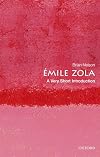
This is one in a series of author biographies published by Oxford Press. The author is also a translator of Zola. I felt this biography was very insightful as it gave context to what else was happening at the time Zola was writing and what influenced his writings. A lot of time is spent on Zola's naturalistic approach, which he also felt was scientific in nature. Nelson analyzes three of Zola's novels (none of which I have yet read) as well as a lot of coverage on the Dreyfuss Affair and show more Zola's penchant for political activism. Interesting to note that at the same time Zola was writing more graphically about real subjects, artists were also leaving rural landscapes for more gritty urban paintings. Zola's writing are also take place in urban settings, for the most part. A great, shorter biography! 162 pages show less
Statistics
- Works
- 10
- Also by
- 11
- Members
- 68
- Popularity
- #253,410
- Rating
- 3.9
- Reviews
- 2
- ISBNs
- 51
- Languages
- 2