
Josephine Herbst (1892–1969)
Author of The starched blue sky of Spain, and other memoirs
About the Author
Image credit: Josephine Herbst
Series
Works by Josephine Herbst
Somewhere the tempest fell 2 copies
Associated Works
Years of Protest: A Collection of American Writings of the 1930's (1967) — Contributor — 44 copies, 1 review
The Best Short Stories of 1931 and the Yearbook of the American Short Story (1931) — Contributor — 7 copies, 1 review
Tagged
Common Knowledge
- Other names
- Geet, Carlotta (pseudonym)
- Birthdate
- 1892-03-05
- Date of death
- 1969-01-28
- Gender
- female
- Education
- University of California, Berkeley
Morningside College
University of Iowa
University of Washington - Occupations
- novelist
historian
biographer
journalist
autobiographer
literary critic - Awards and honors
- American Academy of Arts and Letters Academy Award (Literature, 1966)
- Relationships
- Anderson, Maxwell (lover)
Herrmann, John (husband) - Short biography
- Josephine Herbst was born in Iowa and raised in near-poverty. She spent eight years attending college between working stints, finally graduating from the University of California-Berkeley in 1918. She moved to New York City, where she joined a circle of radical and creative people that included Max Eastman, Louise Bryant, and Dorothy Day. She wrote articles for the radical publication The Liberator, and published short stories under the pseudonym Carlotta Geet in American Mercury and Smart Set, then edited by H.L. Mencken. She also worked for Mencken as a publicity writer and editorial reader. In 1922, following an unhappy affair, Herbst went to Europe, traveling around before settling in Berlin. There she met and fell in love with John Herrmann, a writer eight years her junior. They returned to the USA to marry and live in a rural farmhouse in Connecticut, but Herrmann was an alcoholic and the marriage ended after a few years. Herbst moved to Pennsylvania, where she wrote several novels, including Nothing Is Sacred (1928), Money for Love (1929), and Pity Is not Enough (1933). She also contributed to radical magazines such as New Masses and The Nation. In 1935, she went to Nazi Germany as a special correspondent for the New York Post. In 1937, Herbst was one of the few women permitted to go to Spain to report on the Civil War there; she became a passionate advocate of the Spanish Republican cause. After returning to the USA, she published Satan's Sergeants (1941). After the start of World War II, Herbst got a job as a writer for the Office of the Coordinator of Information, a forerunner of the CIA, but was fired after a background check by the FBI found that she had written about voting for the American Communist Party. She died in obscurity but is now considered one of the great American writers of her era.
- Nationality
- USA
- Birthplace
- Sioux City, Iowa, USA
- Places of residence
- Berlin, Germany
New Preston, Connecticut, USA
Erwinna, Pennsylvania, USA - Place of death
- New York, New York, USA
- Burial location
- Graceland Cemetery, Sioux City, Iowa, USA
- Associated Place (for map)
- USA
Members
Reviews
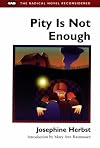
4905. Pity Is Not Enough, by Josephine Herbst (read 24 Feb 2012) The author was born on Mar 5, 1892, in Sioux City and is the subject of an excellent biography by Elinor Langer , which I read with much appreciation on May 25, 1985. But this is the first book of Herbst's which I have read. It tells of a family:of a mother and six children: Joe, Catherine, Aaron, Hortense, Anne, and David. Joe goes to Georgia and gets mixed up with carpetbaggers and commits fraud--which dogs him for years but show more of which he never is convicted . None of the boys are admirable, but the mother and the girls are hard workers and always loyal to the non-admirable boys. The prose is somewhat choppy and the author sometimes tells what will happen in the future, thus lessening one's interest in the account as it proceeds. Most of the family is dogged by poverty and the book is pretty doleful. But I think I may read the next volume in the trilogy, The Executioner Waits. show less
You May Also Like
Associated Authors
Statistics
- Works
- 8
- Also by
- 5
- Members
- 150
- Popularity
- #138,699
- Rating
- 3.0
- Reviews
- 1
- ISBNs
- 11