
Kiki Petrosino
Author of White Blood: A Lyric of Virginia
Works by Kiki Petrosino
The Dark is Here 2 copies
Associated Works
The Best American Poetry 2014 (The Best American Poetry series) (2014) — Contributor — 89 copies, 1 review
Tagged
Common Knowledge
- Canonical name
- Petrosino, Kiki
Members
Reviews
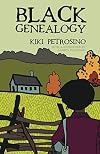
A haunting cry across the chasms of time and injustice.
(Full disclosure: I received a free electronic ARC for review through Edelweiss.)
You want to know who owned us & where.
But when you type, your searches return no results.
Slavery was grown folks’ business, then old folks’.
We saw no reason to hum Old Master’s name
to our grandchildren, or point out his overgrown gates
but you want to know who owned us & where
we got free. You keep typing our names into oblongs
of digital white. You plant show more a unicode tree & climb up
into grown folks’ business. You know old folks
don’t want you rummaging here, so you pile sweet jam
in your prettiest dish. You light candles & pray:
Tell me who owned you & where
I might find your graves. Little child, we’re at rest
in the acres we purchased. Those days of
slavery were old folks’ business. The grown folks
buried us deep. Only a few of our names survive.
We left you that much, sudden glints in the grass.
The rest is grown folks’ business we say. Yet
you still want to know. Who owned us? Where?
###
In Black Genealogy: Poems, Kiki Petrosino explores her attempts to name and locate her ancestors - a matter made all the more complicated and frustrating for the descendants of slaves. Dehumanized, objectified, and stripped of their personhood, scant records exist to reaffirm the individuality, the bonds, the very humanity and being of kidnapped, trafficked, and enslaved humans. Of her search, Petrosino laments: "For a whole page, instead of talking about H, Old Master counts his glass decanters from France." And so her journey is arduous, frustrating - at times, even harrowing.
In the second half of the book, Petrosino's ancestors answer her call. They are angry, amused, loving: everything you imagine an aged great-grandmother to be. They cry out to her across the chasms of time and injustice, both delighting in and envying her living, breathing body.
Bookending and separating these two pieces are several untitled comics, visual adaptations of Petrosino's poems by illustrator Lauren Haldeman. Petrosino is haunted by a Confederate reenactor, and his Cheshire cat-like like grin.
The three parts of the book - Petrosino's prose, her ancestors' poetry, and Haldeman's drawings - work wonderfully together. While I do love the poems best, the various components complement each other in a way that I can only describe as masterful. The result is alternately beautiful, sorrowful, and downright chilling, as with this more-than-vaguely threatening exchange Petrosino shares with the soldier:
The essays - okay, more like modestly-sized paragraphs - in Part I are sometimes confusing but, to be fair, I think this is supposed to echo the journey of Black Genealogy: the reader's experience is meant to mirror that of the author.
A strong 4.5 stars, rounded up to 5 where necessary.
Read it with: Octavia Butler's Kindred. For some reason, the illustrations really reminded me of the graphic novel adaptation. I blame it on the lingering, sinister grin.
http://www.easyvegan.info/2018/01/26/black-genealogy-poems-by-kiki-petrosino/ show less
(Full disclosure: I received a free electronic ARC for review through Edelweiss.)
You want to know who owned us & where.
But when you type, your searches return no results.
Slavery was grown folks’ business, then old folks’.
We saw no reason to hum Old Master’s name
to our grandchildren, or point out his overgrown gates
but you want to know who owned us & where
we got free. You keep typing our names into oblongs
of digital white. You plant show more a unicode tree & climb up
into grown folks’ business. You know old folks
don’t want you rummaging here, so you pile sweet jam
in your prettiest dish. You light candles & pray:
Tell me who owned you & where
I might find your graves. Little child, we’re at rest
in the acres we purchased. Those days of
slavery were old folks’ business. The grown folks
buried us deep. Only a few of our names survive.
We left you that much, sudden glints in the grass.
The rest is grown folks’ business we say. Yet
you still want to know. Who owned us? Where?
###
In Black Genealogy: Poems, Kiki Petrosino explores her attempts to name and locate her ancestors - a matter made all the more complicated and frustrating for the descendants of slaves. Dehumanized, objectified, and stripped of their personhood, scant records exist to reaffirm the individuality, the bonds, the very humanity and being of kidnapped, trafficked, and enslaved humans. Of her search, Petrosino laments: "For a whole page, instead of talking about H, Old Master counts his glass decanters from France." And so her journey is arduous, frustrating - at times, even harrowing.
In the second half of the book, Petrosino's ancestors answer her call. They are angry, amused, loving: everything you imagine an aged great-grandmother to be. They cry out to her across the chasms of time and injustice, both delighting in and envying her living, breathing body.
Bookending and separating these two pieces are several untitled comics, visual adaptations of Petrosino's poems by illustrator Lauren Haldeman. Petrosino is haunted by a Confederate reenactor, and his Cheshire cat-like like grin.
The three parts of the book - Petrosino's prose, her ancestors' poetry, and Haldeman's drawings - work wonderfully together. While I do love the poems best, the various components complement each other in a way that I can only describe as masterful. The result is alternately beautiful, sorrowful, and downright chilling, as with this more-than-vaguely threatening exchange Petrosino shares with the soldier:
The essays - okay, more like modestly-sized paragraphs - in Part I are sometimes confusing but, to be fair, I think this is supposed to echo the journey of Black Genealogy: the reader's experience is meant to mirror that of the author.
A strong 4.5 stars, rounded up to 5 where necessary.
Read it with: Octavia Butler's Kindred. For some reason, the illustrations really reminded me of the graphic novel adaptation. I blame it on the lingering, sinister grin.
http://www.easyvegan.info/2018/01/26/black-genealogy-poems-by-kiki-petrosino/ show less
I'm trying to find words to describe this collection, and so far "lovely" and "ambivalent" come to mind. Petrosino uses repetition and startling images to describe her relationship to an (ever present) past. There's a sense of the author mediating between conflicting narratives, heritages, ways of understanding.
I wish I'd come to this book with a better knowledge of what I will term the Monticello-Industrial Complex, but certainly I've spent enough years living in the Upper South to get the show more gist. My favorite poems were "Happiness," which is beautiful and distressing and warrants a few rereads, and a series of villanelles titled "Message From the Free Smiths of Louisa County," which address gaps in the historical record. Petrosino reads these omissions as their own kind of resistance, but the resulting absences are nonetheless baffling and heartbreaking. Until reading these poems I'd never realized how much genealogy research feels like playing three-dimensional chess with dead people. show less
I wish I'd come to this book with a better knowledge of what I will term the Monticello-Industrial Complex, but certainly I've spent enough years living in the Upper South to get the show more gist. My favorite poems were "Happiness," which is beautiful and distressing and warrants a few rereads, and a series of villanelles titled "Message From the Free Smiths of Louisa County," which address gaps in the historical record. Petrosino reads these omissions as their own kind of resistance, but the resulting absences are nonetheless baffling and heartbreaking. Until reading these poems I'd never realized how much genealogy research feels like playing three-dimensional chess with dead people. show less
This bruise dazzles.
It is rare enough to find poems that use form, sound, meter, and image gracefully. To do so while pushing out the edges is notable. Almost never can the parts come together, all at once, and be enjoyable. Fair warning, some words are uncommon and some references may require digging. Delightful and astonishing.
It is rare enough to find poems that use form, sound, meter, and image gracefully. To do so while pushing out the edges is notable. Almost never can the parts come together, all at once, and be enjoyable. Fair warning, some words are uncommon and some references may require digging. Delightful and astonishing.
Wouldn't have expected to like a section of poems focused on an imagined romantic relationship with Robert Redford, but they're surprisingly touching in their tenderness and the subject's wistful distance from the dominant culture, a distance repeatedly symbolized by her natural afro. But the middle section was all about wordplay and complicated Escher-like poems, and the last section a too-casual pop culture referential melange, neither my cup of tea.
Lists
Awards


You May Also Like
Associated Authors
Statistics
- Works
- 7
- Also by
- 3
- Members
- 128
- Popularity
- #157,244
- Rating
- 3.7
- Reviews
- 7
- ISBNs
- 13