
Revised Standard Version
Author of Holy Bible (Revised Standard Version)
About the Author
Disambiguation Notice:
Revised Standard Version (RSV), not to be confused with earlier the Revised Version (RV) or English Revised Version (ERV), or with its immediate successor, the New Revised Standard Version (NRSV).
Works by Revised Standard Version
The New Oxford Annotated Bible with the Apocrypha, Revised Standard Version (1973) 1,065 copies, 2 reviews
The New Testament of Our Lord and Savior Jesus Christ: Revised Standard Version Catholic Edition (1965) 24 copies
Comparative Bible New Testament Edition in Four Complete Versions (King James, American Standard, Revised Standard, & Confraternity) (1969) 12 copies
The Holy Bible: The Old Testament: Vol. I Genesis-Nehemiah: Revised Standard Version (1952) 7 copies
The New Covenant, Commonly Called The New Testament of Our Lord and Savior Jesus Christ, Revised Standard Edition (1946) 2 copies
Old Testament Vol. 2 2 copies
The New Testament : Revised Standard Version & Japanese Colloquial Version (bilingual) (1955) 2 copies
Greek-English New Testament 1 copy
Tagged
Common Knowledge
- Canonical name
- Revised Standard Version
- Other names
- RSV
- Gender
- n/a
- Disambiguation notice
- Revised Standard Version (RSV), not to be confused with earlier the Revised Version (RV) or English Revised Version (ERV), or with its immediate successor, the New Revised Standard Version (NRSV).
Members
Reviews
The Holy Bible, containing the Old and New Testaments. Revised standard version. Translated from the original tongues, b by Anonymous
http://nwhyte.livejournal.com/2011647.html
http://nwhyte.livejournal.com/2047769.html
First off, I don't think I actually would recommend reading the Old Testament (or indeed the Bible) through from start to finish as I did. It wasn't written or compiled to be read in that way, and it doesn't do the text any services to read as if it were a novel, a short story collection, or a book of essays and meditations. I chose this approach because I wanted to feel that I had control of what I was show more reading, and that I was not missing anything, but if you want to get a fair flavour of it, it's probably better to follow one of the many reading guides available online and elsewhere, which are designed both to showcase the good bits and to keep the reader interested.
Second, a lot of it is pretty dull, actually. 2 Chronicles in particular comes close to Mark Twain's description of the Book of Mormon, as "choroform in print". Large chunks of the Pentateuch are lists of laws and, even less exciting, census returns. The historical bits have an awful lot of tediously horrible ethnic cleansing and dynastic struggle, leavened by the occasional good bit (the Saul/David/Solomon succession in particular). The prophets are rather indistinguishable in tone of outrage. I recommend finding some way of skipping the dull bits.
Third, the good bits are indeed good. I've singled out the Book of Job in a previous post; I found the Psalms generally inspiring and uplifting, and I've always been a fan of Ecclesiastes. The narrative histories, which I thought I knew fairly well, still had some surprises for me - in Numbers 12, God smites Moses' sister with leprosy for racism towards Moses' black wife, for instance. There are some fun bits in the prophets - Jonah, and the deuterocanonical addenda to Daniel (Susanna, and Bel and the Dragon). I also rather liked Sirach, aka Ecclesiasticus, which again is deuterocanonical. And 2 Maccabees is a fairly lucid, if brutal, historical note to finish on.
Fourth, there were indeed a few themes running through the entire OT whose importance I hadn't perhaps fully grasped: the importance of God's endowing his people with the land, the importance of the cult of the Temple, and the trauma of the Babylonian exile (which of course shaped most of the text we have very directly). I'm not saying that these are the only or even the main main themes, but that these are the ones whose importance was enhanced for me by reading through the entire thing.
As for the New Testament: it falls rather naturally into three sections. The Gospels and Acts are among the most readable narratives in the Bible; the most striking things are that the three synoptic gospels are so very close to each other, leaving John as the outlier, and that Luke's better Greek prose style comes through in almost any translation of his gospel and Acts. I am also struck every time that the Feeding of the Five Thousand is the only miracle other than the Resurrection reported in all four gospels.
I was much less familiar with the various epistles. They are not as easy to read as the gospels, combining as they do advice on local disputed, personal salutations, declarations about correct practice and belief, and attempts to put words on the ineffable (Hebrews in particular is an attempt at a theological manifesto avant la lettre). I was struck by how hardline Paul is, particularly in the early letters, on the issues that hardliners still stick to today, and also on the question of justification by faith; but there is a significant counterbalance from some of the later letters, especially 1 Peter which seems to be a direct response in some ways. (And the Epistle of Jude seems strangely familiar after 2 Peter ch 2...)
Finally, Revelation is the most Old Testament-y of the New Testament books. (There is nothing like the letters in the Old Testament, and the gospels and Acts are quite different in style from the OT historical books.) Again, Revelation is an attempt to express in words that which cannot be expressed in words; it is clearly not meant to be taken literally, but as one person's attempt to concretise the underlying truths. show less
http://nwhyte.livejournal.com/2047769.html
First off, I don't think I actually would recommend reading the Old Testament (or indeed the Bible) through from start to finish as I did. It wasn't written or compiled to be read in that way, and it doesn't do the text any services to read as if it were a novel, a short story collection, or a book of essays and meditations. I chose this approach because I wanted to feel that I had control of what I was show more reading, and that I was not missing anything, but if you want to get a fair flavour of it, it's probably better to follow one of the many reading guides available online and elsewhere, which are designed both to showcase the good bits and to keep the reader interested.
Second, a lot of it is pretty dull, actually. 2 Chronicles in particular comes close to Mark Twain's description of the Book of Mormon, as "choroform in print". Large chunks of the Pentateuch are lists of laws and, even less exciting, census returns. The historical bits have an awful lot of tediously horrible ethnic cleansing and dynastic struggle, leavened by the occasional good bit (the Saul/David/Solomon succession in particular). The prophets are rather indistinguishable in tone of outrage. I recommend finding some way of skipping the dull bits.
Third, the good bits are indeed good. I've singled out the Book of Job in a previous post; I found the Psalms generally inspiring and uplifting, and I've always been a fan of Ecclesiastes. The narrative histories, which I thought I knew fairly well, still had some surprises for me - in Numbers 12, God smites Moses' sister with leprosy for racism towards Moses' black wife, for instance. There are some fun bits in the prophets - Jonah, and the deuterocanonical addenda to Daniel (Susanna, and Bel and the Dragon). I also rather liked Sirach, aka Ecclesiasticus, which again is deuterocanonical. And 2 Maccabees is a fairly lucid, if brutal, historical note to finish on.
Fourth, there were indeed a few themes running through the entire OT whose importance I hadn't perhaps fully grasped: the importance of God's endowing his people with the land, the importance of the cult of the Temple, and the trauma of the Babylonian exile (which of course shaped most of the text we have very directly). I'm not saying that these are the only or even the main main themes, but that these are the ones whose importance was enhanced for me by reading through the entire thing.
As for the New Testament: it falls rather naturally into three sections. The Gospels and Acts are among the most readable narratives in the Bible; the most striking things are that the three synoptic gospels are so very close to each other, leaving John as the outlier, and that Luke's better Greek prose style comes through in almost any translation of his gospel and Acts. I am also struck every time that the Feeding of the Five Thousand is the only miracle other than the Resurrection reported in all four gospels.
I was much less familiar with the various epistles. They are not as easy to read as the gospels, combining as they do advice on local disputed, personal salutations, declarations about correct practice and belief, and attempts to put words on the ineffable (Hebrews in particular is an attempt at a theological manifesto avant la lettre). I was struck by how hardline Paul is, particularly in the early letters, on the issues that hardliners still stick to today, and also on the question of justification by faith; but there is a significant counterbalance from some of the later letters, especially 1 Peter which seems to be a direct response in some ways. (And the Epistle of Jude seems strangely familiar after 2 Peter ch 2...)
Finally, Revelation is the most Old Testament-y of the New Testament books. (There is nothing like the letters in the Old Testament, and the gospels and Acts are quite different in style from the OT historical books.) Again, Revelation is an attempt to express in words that which cannot be expressed in words; it is clearly not meant to be taken literally, but as one person's attempt to concretise the underlying truths. show less
I started reading the Bible when I was 5 years old - random readings. I was a 'born again' Christian by the age of 15 years old. Then as a young adult, I started studying the Bible via church leaders and scholars. I participated fully in church and church related activities. Took many courses from seminaries and bible schools. Then in my thirties, I found the need to read the Bible without outside influence. So, I read it cover to cover -- Gen. 1:1 to Rev. 22:21 -- six times from 1980 to show more 1986. I filled dozens of spiral notebooks with my findings, feelings and thoughts. About half-way through my 7th reading I discovered I had become an atheist -- a lack of belief in god(s). The Bible and all religious tomes (I have read the major ones) have stories, proverbs and parables that can offer insight into the kinder, gentler side of humanity. They also show us how fear, power and prejudice can cause people to assign responsibility for these 'failings' to a god or gods. So yes, I think the Bible is worth reading but not just the 'feel good' parts -- read all of it if you are going to read it. show less

I don't hate it. It's purportedly a "modern English" version intended to appeal to both Catholics and Protestants, but the "modern English" on offer seems to trend to the weirdly archaic, and less pretty than the KJV. So I guess if you're not that good a reader, but like it to seem ancient and numinous, and don't get irritated by those stress accents on all the names, this one's fine.
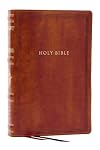
RSV Personal Size Bible with Cross References, Brown Leathersoft, (Sovereign Collection) by Anonymous
Start date: December 30, 2025
End date: March 9, 2026
In the beginning God created the heavens and the earth. The earth was without form and void, and darkness was upon the face of the deep; and the Spirit of God was moving over the face of the waters. Genesis 1:1-2
About the RSV: The Revised Standard Version was a revision of the American Standard Version of 1901. The New Testament was released as early as 1946. The Old and New Testaments together were published in 1952. The translation went show more through several updates becoming finalized, I believe, in 1977.
According to Wikipedia, the VERY first copy of the RSV to come off the press was given to Harry S. Truman in September 1946. It was released to the general public a few days later.
Not every Christian embraced this new translation especially regarding the Old Testament. A strong reaction against this NEW translation in part led to a King-James-Only Movement. The fuss was over how Isaiah 7:14 was translated.
Therefore the Lord himself will give you a sign. Behold, a young woman shall conceive and bear a son, and shall call his name Immanuel. Isaiah 7:14
Some pastors preached sermons and wrote pamphlets against this "horrid" "modern" translation. A few even made a spectacle of themselves by burning it.
The RSV has been the basis for two different revisions: the NRSV (1989) and the ESV (2001).
My thoughts: I was not aware of the controversy before I started reading it! I didn't always love, love, love how they translated particular verses. But I wouldn't have been an angry protester, at least I don't think! But then again, I did get quite upset with the Common English Bible over how they translated a verse in Genesis, so maybe I would have been.
I CAN ONLY IMAGINE the fuss that would have resulted if the MESSAGE had been published in 1952. It would actually be a little fun to imagine the uproar.
I have read the RSV three perhaps four times. It is not my favorite translation. It is not my least favorite translation.
The method I used to read this one was to start with TWO ribbons--or bookmarks--with one in Genesis and one in Revelation. To read forwards from one and backwards from the other. (Revelation, Jude, 3 John, 2 John, etc. and Genesis, Exodus, Leviticus, etc.) I was curious WHERE I would meet in my read through. I ended up meeting in Isaiah.
The Sovereign was a nice printing of the RSV for the most part. Sometimes the verse numbers are too close to the verse. BUT I love the size and weight of the Sovereign collection. show less
End date: March 9, 2026
In the beginning God created the heavens and the earth. The earth was without form and void, and darkness was upon the face of the deep; and the Spirit of God was moving over the face of the waters. Genesis 1:1-2
About the RSV: The Revised Standard Version was a revision of the American Standard Version of 1901. The New Testament was released as early as 1946. The Old and New Testaments together were published in 1952. The translation went show more through several updates becoming finalized, I believe, in 1977.
According to Wikipedia, the VERY first copy of the RSV to come off the press was given to Harry S. Truman in September 1946. It was released to the general public a few days later.
Not every Christian embraced this new translation especially regarding the Old Testament. A strong reaction against this NEW translation in part led to a King-James-Only Movement. The fuss was over how Isaiah 7:14 was translated.
Therefore the Lord himself will give you a sign. Behold, a young woman shall conceive and bear a son, and shall call his name Immanuel. Isaiah 7:14
Some pastors preached sermons and wrote pamphlets against this "horrid" "modern" translation. A few even made a spectacle of themselves by burning it.
The RSV has been the basis for two different revisions: the NRSV (1989) and the ESV (2001).
My thoughts: I was not aware of the controversy before I started reading it! I didn't always love, love, love how they translated particular verses. But I wouldn't have been an angry protester, at least I don't think! But then again, I did get quite upset with the Common English Bible over how they translated a verse in Genesis, so maybe I would have been.
I CAN ONLY IMAGINE the fuss that would have resulted if the MESSAGE had been published in 1952. It would actually be a little fun to imagine the uproar.
I have read the RSV three perhaps four times. It is not my favorite translation. It is not my least favorite translation.
The method I used to read this one was to start with TWO ribbons--or bookmarks--with one in Genesis and one in Revelation. To read forwards from one and backwards from the other. (Revelation, Jude, 3 John, 2 John, etc. and Genesis, Exodus, Leviticus, etc.) I was curious WHERE I would meet in my read through. I ended up meeting in Isaiah.
The Sovereign was a nice printing of the RSV for the most part. Sometimes the verse numbers are too close to the verse. BUT I love the size and weight of the Sovereign collection. show less
Lists
Awards


You May Also Like
Associated Authors
Statistics
- Works
- 26
- Members
- 6,276
- Popularity
- #3,908
- Rating
- 4.3
- Reviews
- 37
- ISBNs
- 130
- Languages
- 1