
Bernette Ford (1950–2021)
Author of Bright Eyes, Brown Skin
About the Author
Bernette G. Ford was an African American children's book author and editor. She was born on June 30, 1950 in Brooklyn, NY and grew up in Uniondale on Long Island. She was a graduate of Connecticut College (1972). She worked as an editorial assistant at Random House, and went on to become an editor, show more then senior editor, and later editorial director of children's books at Grosset & Dunlap. In 1989 she joined Scholastic. She was the author of Ballet Kitty (2007), No More Pacifier for Piggy! (2008), No More Bottles for Bunny! (2008), No More Blanket for Lambkin! (2009), No More Hitting for Little Hamster (2011), No More Biting for Billy Goat! (2013), Bright Eyes, Brown Skin (1990) and was co-written with Cheryl Willis Hudson. She also created and wrote several titles in the series, Just for You. Bernette G. Ford died on June 20, 2021 at her Brooklyn home. She was 63. (Bowker Author Biography) show less
Image credit: via Children's Book Council
Works by Bernette Ford
Floaters 3 copies
No More Bottlers for Bunny! 1 copy
No More Bittles for Bunny! 1 copy
A Black Cat (an ABC book) 1 copy
Associated Works
Tagged
Common Knowledge
- Legal name
- Ford, Bernette Goldsen
- Other names
- Goldsen, Bernette (birth name)
- Birthdate
- 1950-06-30
- Date of death
- 2021-06-20
- Gender
- female
- Education
- Connecticut College (1972)
- Occupations
- author
editor
publisher
editorial assistant - Organizations
- Grosset & Dunlap
Scholastic Books
Color-Bridge Books (Founder)
Random House - Cause of death
- lung cancer
- Nationality
- USA
- Birthplace
- Brooklyn, New York, USA
- Places of residence
- Uniondale, New York, USA
- Place of death
- Brooklyn, New York, USA
- Associated Place (for map)
- New York, USA
Members
Reviews
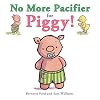
Piggy and Ducky are playing hide and seek, but Piggy keeps getting distracted by his pacifier falling out. Will he be able to keep having fun?
This is another picture book in a series from Ford and Williams that aims to help toddlers/young preschoolers move away from babyish behaviors. The goal in this book is for young kids to stop walking around with pacifiers all day long. This is a worthy goal, giving that prolonged use of pacifiers can lead to speech and dental problems, which are show more difficult long-term effects to explain to small children.
However, I feel like this book doesn't necessarily do a great job of discouraging children from wanting to use a pacifier. In the book, the main problem with the pacifier is that Piggy can't smile or laugh when he has it in his mouth. While it's not uncommon to see a pacifier pop out of the mouth of small infants when they smile or laugh, older kids (aka the audience for this book) are usually pretty adept at holding on to the pacifier when smiling or even when laughing. So this "impediment" caused by the pacifier in the story is not really one that is applicable to real life.
Furthermore, when Piggy starts to cry because he's dropped his pacifier after laughing and now it's too dirty to put back in his mouth, his tears immediately stop when Ducky re-initiates their game of hide and seek. Kids who use pacifiers past babyhood generally do so because it is a way to comfort themselves when they get upset; they would be very unlikely to quickly stop crying just because someone says so. Yes, they can eventually be distracted but it's not as easy as it's made out to be here. And if the way for a child to self comfort is taken away with the only replacement being comfort from an outside source (i.e., a friend), then this is not a helpful lesson in what to do to better deal with strong emotions.
I understand this is a book of fiction and it's designed for a very young audience, so it makes sense in a way for it to be a simplistic book in which a condensed version of the problem and the solution are presented. But it just seems to me that this book won't really help a kid who is attached to their pacifier long past its best by date, as neither the problem nor the "solution" will be recognizable to the child. For that reason, I would not necessarily recommend this book as a useful tool in a parent or caregivers battle to get rid of the pacifier. show less
This is another picture book in a series from Ford and Williams that aims to help toddlers/young preschoolers move away from babyish behaviors. The goal in this book is for young kids to stop walking around with pacifiers all day long. This is a worthy goal, giving that prolonged use of pacifiers can lead to speech and dental problems, which are show more difficult long-term effects to explain to small children.
However, I feel like this book doesn't necessarily do a great job of discouraging children from wanting to use a pacifier. In the book, the main problem with the pacifier is that Piggy can't smile or laugh when he has it in his mouth. While it's not uncommon to see a pacifier pop out of the mouth of small infants when they smile or laugh, older kids (aka the audience for this book) are usually pretty adept at holding on to the pacifier when smiling or even when laughing. So this "impediment" caused by the pacifier in the story is not really one that is applicable to real life.
Furthermore, when Piggy starts to cry because he's dropped his pacifier after laughing and now it's too dirty to put back in his mouth, his tears immediately stop when Ducky re-initiates their game of hide and seek. Kids who use pacifiers past babyhood generally do so because it is a way to comfort themselves when they get upset; they would be very unlikely to quickly stop crying just because someone says so. Yes, they can eventually be distracted but it's not as easy as it's made out to be here. And if the way for a child to self comfort is taken away with the only replacement being comfort from an outside source (i.e., a friend), then this is not a helpful lesson in what to do to better deal with strong emotions.
I understand this is a book of fiction and it's designed for a very young audience, so it makes sense in a way for it to be a simplistic book in which a condensed version of the problem and the solution are presented. But it just seems to me that this book won't really help a kid who is attached to their pacifier long past its best by date, as neither the problem nor the "solution" will be recognizable to the child. For that reason, I would not necessarily recommend this book as a useful tool in a parent or caregivers battle to get rid of the pacifier. show less
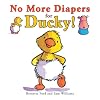
Ducky wants to play with Piggy, but Piggy is using the potty. When Ducky's diaper starts to feel cold and wet, she wants to use the potty, too!
This book is one of a series of books written by Bernette Ford and illustrated by Sam Williams that talk about moving from babyhood to the world of toddlers, including giving up a pacifier, a bottle, etc. I've found that some of these books are more effective than others.
No More Diapers for Ducky! seems like one of the less effective ones to me. For show more the beginning half of the book, Ducky plays alone while Piggy sits and sits and sits on the potty. Later, Piggy plays alone while Ducky sits on the potty. This doesn't give kids the impression that going on the potty is a particularly interesting thing - indeed, going on the potty means someone else is having fun without you, by the logic of this book. For many young kids, that's the exact reason they don't want to go on the potty - it means interrupting a task they are currently engaged in, a task that is usually play.
Yes, going on the potty is not glamorous, but at least the authors could have made a bigger deal out of how Piggy gets to read his book while he sits on the potty. Reading books is an activity, by the way, that Ducky is doing just outside the bathroom door as well; there is a lost opportunity here to note how you don't necessarily have to give up having fun just because you have to go use the toilet.
Overall, I suppose this book wouldn't be a bad tool to use as you talk to your children about potty training, along with an arsenal of the other kid-friendly potty-training books out there. But I don't think it's the best one by a long shot, and I'd skip it if you have a limited budget or time to read with your kids. show less
This book is one of a series of books written by Bernette Ford and illustrated by Sam Williams that talk about moving from babyhood to the world of toddlers, including giving up a pacifier, a bottle, etc. I've found that some of these books are more effective than others.
No More Diapers for Ducky! seems like one of the less effective ones to me. For show more the beginning half of the book, Ducky plays alone while Piggy sits and sits and sits on the potty. Later, Piggy plays alone while Ducky sits on the potty. This doesn't give kids the impression that going on the potty is a particularly interesting thing - indeed, going on the potty means someone else is having fun without you, by the logic of this book. For many young kids, that's the exact reason they don't want to go on the potty - it means interrupting a task they are currently engaged in, a task that is usually play.
Yes, going on the potty is not glamorous, but at least the authors could have made a bigger deal out of how Piggy gets to read his book while he sits on the potty. Reading books is an activity, by the way, that Ducky is doing just outside the bathroom door as well; there is a lost opportunity here to note how you don't necessarily have to give up having fun just because you have to go use the toilet.
Overall, I suppose this book wouldn't be a bad tool to use as you talk to your children about potty training, along with an arsenal of the other kid-friendly potty-training books out there. But I don't think it's the best one by a long shot, and I'd skip it if you have a limited budget or time to read with your kids. show less
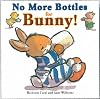
Bunny is always drinking his bottle but when Ducky and Piggy have a tea party, he realizes how the bottle hampers his ability to play.
I thought that the book No More Biting for Billy Goat by the same author-illustrator duo did a really good job of dealing with the problem of that particular aggressive behavior in a clear and concise way that children could relate to and understand. When I saw they also had this title, I thought this would be good to share with my class where I have a child show more who uses a cup at school but still drinks out of a bottle at home. Unfortunately, I was disappointed with this book. It is clearly designed for toddlers but the situation presented here is one of a character who constantly walks around with the bottle, even when playing. This may be the case for some children in real life, but the problem I've observed most tends to be more about meal times and even more so about naptime/bedtime. Kids have gotten used to having their bottles as part of their sleep routine, and they give tired and exhausted parents a hard time about it. The situation presented here seems like any a child would choose - give up the bottle in order to play - whereas the real-life situation is trickier. This book also seems to include a lot of shaming as part of the move to cups - bottles are for babies is the refrain Bunny hears. There must be more effective ways to teach a child to move on to more appropriate toddler behaviors. show less
I thought that the book No More Biting for Billy Goat by the same author-illustrator duo did a really good job of dealing with the problem of that particular aggressive behavior in a clear and concise way that children could relate to and understand. When I saw they also had this title, I thought this would be good to share with my class where I have a child show more who uses a cup at school but still drinks out of a bottle at home. Unfortunately, I was disappointed with this book. It is clearly designed for toddlers but the situation presented here is one of a character who constantly walks around with the bottle, even when playing. This may be the case for some children in real life, but the problem I've observed most tends to be more about meal times and even more so about naptime/bedtime. Kids have gotten used to having their bottles as part of their sleep routine, and they give tired and exhausted parents a hard time about it. The situation presented here seems like any a child would choose - give up the bottle in order to play - whereas the real-life situation is trickier. This book also seems to include a lot of shaming as part of the move to cups - bottles are for babies is the refrain Bunny hears. There must be more effective ways to teach a child to move on to more appropriate toddler behaviors. show less
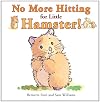
Hamster just wants to play with his friends, but everyone keeps saying no because he always hits them. This makes him so angry that he starts hitting everyone!
This book is one of a series of books written by Bernette Ford and illustrated by Sam Williams that talk about topics related to moving from babyhood to the world of toddlers, including giving up a pacifier, a bottle, etc. I've found that some of these books are more effective than others. No More Hitting for Little Hamster! strays show more from the standard path a little more as the hitting problem follows many kids into the toddler and preschool years and even the elementary ones. Nevertheless, I find this title to be one of the more effective ones from the creative duo.
One of the things that is so good about this title compared to some of the others is that the underlying motives are explored - sure, it's still in a simple way kids can understand, but it's definitely there. The text clearly explains how Little Hamster gets so angry that he lashes out by hitting, thus helping children to understand why hitting happens. Meanwhile, the characters who are hit by Little Hamster expressly state that hitting hurts them, thus explaining to children why hitting is bad, even if you are very angry.
Best of all, Bunny manages to defuse the situation by showing Little Hamster how to keep his hands busy (and thus not hitting) by playing with toys and also holds Little Hamster to his promise of not hitting his friends when they agree to play with him. show less
This book is one of a series of books written by Bernette Ford and illustrated by Sam Williams that talk about topics related to moving from babyhood to the world of toddlers, including giving up a pacifier, a bottle, etc. I've found that some of these books are more effective than others. No More Hitting for Little Hamster! strays show more from the standard path a little more as the hitting problem follows many kids into the toddler and preschool years and even the elementary ones. Nevertheless, I find this title to be one of the more effective ones from the creative duo.
One of the things that is so good about this title compared to some of the others is that the underlying motives are explored - sure, it's still in a simple way kids can understand, but it's definitely there. The text clearly explains how Little Hamster gets so angry that he lashes out by hitting, thus helping children to understand why hitting happens. Meanwhile, the characters who are hit by Little Hamster expressly state that hitting hurts them, thus explaining to children why hitting is bad, even if you are very angry.
Best of all, Bunny manages to defuse the situation by showing Little Hamster how to keep his hands busy (and thus not hitting) by playing with toys and also holds Little Hamster to his promise of not hitting his friends when they agree to play with him. show less
Lists
Awards


You May Also Like


Associated Authors
Statistics
- Works
- 39
- Also by
- 1
- Members
- 2,959
- Popularity
- #8,623
- Rating
- 3.7
- Reviews
- 54
- ISBNs
- 146
- Languages
- 4
- Favorited
- 1