
Robert A. Nisbet (1913–1996)
Author of The quest for community
Robert A. Nisbet is Robert Nisbet (1). For other authors named Robert Nisbet, see the disambiguation page.
Robert A. Nisbet (1) has been aliased into Robert A. Nisbet.
About the Author
Image credit: Picture: Phillip Clarke
Works by Robert A. Nisbet
Works have been aliased into Robert A. Nisbet.
Making of Modern Society 1 copy
Associated Works
Works have been aliased into Robert A. Nisbet.
Tagged
Common Knowledge
- Legal name
- Nisbet, Robert Alexander
- Birthdate
- 1913-09-30
- Date of death
- 1996-09-09
- Gender
- male
- Education
- University of California, Berkeley (AB|1936)
University of California, Berkeley (MA|1937)
University of California, Berkeley (PhD|Sociology|1939) - Occupations
- sociologist
professor
historian
U.S. Army, 1943-45 - Organizations
- Institut Internationale de Sociologie
American Academy of Arts and Sciences
American Philosophical Society
Society of American Historians
Societe de Culture Europeene
Columbia Society of Fellows (show all 19)
Phi Beta Kappa
Golden Bear Society
University of California, Berkeley
University of California, Riverside
Columbia University
American Enterprise Institute
American Council of Learned Societies
National Council of Humanities
Parkman Prize Commission
New York State Governor's Health Advisory Commission
Random House
Appleton-Century-Crofts
United States Army - Awards and honors
- Award of Merit of Republic of Italy
Guggenheim fellow
Berkeley Citation
L.H.D., Hofstra University
Rockefeller Foundation grant
Ingersoll Prize (show all 7)
Jefferson Lecture (1988) - Nationality
- USA
- Birthplace
- Los Angeles, California, USA
- Associated Place (for map)
- California, USA
Members
Reviews

Perhaps your have read Voltaire's Philosophical Dictionary, or at least excerpts since Peter Gay's translation from the early 1960s runs more than 650 pages. I mention this famous work because the title of Nisbet's substantial but slighter volume invokes Voltaire. And in his conservative outlook he suggests Burke, who advocated the rational exploitation of prejudice as a method of social inquiry. Nisbet presents 70-odd reflections on various topics, however, the prejudices are more of the show more acerbic, Mencken variety. Thus Nisbet assails egalitarianism under a variety of headings, including "Envy" and "Genius." He argues against an Egalitarianism that represents a pathological way of thinking. His solution: a heavy dose of "liberty", with Burkean limits, that would "make acceptable the differences of strength, talent, and will which are as natural to the social as to the biological order. Related to this is his entry on "Victimology" in which he decries the creation of victims by do-gooders with the assist of the Leviathan state (written in 1982 these words are prescient).
Reflecting current preoccupations are sections on "Abortion" (Nisbet calls out the excessive moralism of both sides); "Environmentalism"--now a "redemptive movement" that has become, "without losing its eliteness of temper, a mass socialist movement of, not fools, but sun worshippers, macrobiotics, forest druids, and nature freaks generally, committed by course if not yet by fully shared intent to the destruction of capitalism" and further one more addition to the Leviathan state; and "Judicial Activism"--itself a symptom of the fact that our government is not democratic, "that is, fully responsive to the considered will of the people". Under the heading of "Tyranny" comes a meditation on the Jonestown episode; under the rubric of "Ideology," a discussion of the reaction to Three Mile Island ("No casualties, then or since, but the ranks of the nuclear doom-sayers have greatly enlarged since the nonevent at Three Mile Island").
I enjoyed his discussions of the humanities in sections including: "Genius", "Golden Ages", "Metaphor", "Originality", and "Humanities". The last of these he sees as an unfortunately pale reflection of what it once was, and area of thought in need of a renaissance. His reflections on these and other topics are not without flaws, but refreshing in comparison to the lack of reflection that is prevalent in the twenty-first century. Critics of these essays might take a moment to reconsider their own prejudices. show less
Reflecting current preoccupations are sections on "Abortion" (Nisbet calls out the excessive moralism of both sides); "Environmentalism"--now a "redemptive movement" that has become, "without losing its eliteness of temper, a mass socialist movement of, not fools, but sun worshippers, macrobiotics, forest druids, and nature freaks generally, committed by course if not yet by fully shared intent to the destruction of capitalism" and further one more addition to the Leviathan state; and "Judicial Activism"--itself a symptom of the fact that our government is not democratic, "that is, fully responsive to the considered will of the people". Under the heading of "Tyranny" comes a meditation on the Jonestown episode; under the rubric of "Ideology," a discussion of the reaction to Three Mile Island ("No casualties, then or since, but the ranks of the nuclear doom-sayers have greatly enlarged since the nonevent at Three Mile Island").
I enjoyed his discussions of the humanities in sections including: "Genius", "Golden Ages", "Metaphor", "Originality", and "Humanities". The last of these he sees as an unfortunately pale reflection of what it once was, and area of thought in need of a renaissance. His reflections on these and other topics are not without flaws, but refreshing in comparison to the lack of reflection that is prevalent in the twenty-first century. Critics of these essays might take a moment to reconsider their own prejudices. show less
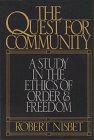
This is a peculiar book. The author summarizes its argument on two occasions. Summary number one: "It is the argument of this book that the ominous preoccupation with community revealed by modern thought and mass behaviour is a manifestation of certain profound dislocations in the primary associative area of society, dislocations that have been created to a great extent by the structure of the western political state" (p.42). Summary number two: "The argument of this book is that the single show more most decisive influence upon western social organization has been the rise and development of the centralized territorial state" (p.89).
The first summary encapsulates Part One of this book nicely, because it's hard to make any sense of it. In fact early on in this book I was so frustrated by bad arguments that I felt like abandoning the book entirely. The author writes about how "alienated" and "dislocated" modern man feels. He seems to consider this so obvious that it needs little elaboration, only repetition. But I could not understand which persons or groups have been so tragically dislocated, from what they have been dislocated, or even what "dislocation" or "alienation" is supposed to mean. At first I thought it had something to do with the fact that this book was written shortly after World War II, but the author clearly has more abstract "dislocations" in mind. Whatever they may be, the first part of the book is awful.
But the second summary I quoted above seems sensible and interesting. As it happens it actually fits Part Two, which contains well-reasoned and interesting arguments on many important questions. It's almost as if a different author had written this part of the book. I was impressed by how broadly the author manages to argue without diluting the point he is trying to make. The argument flows from political history to the history of political thought and to cogent theoretical analyses of both totalitarian and liberal state systems. The author laments the decline of small-scale communities - families, cities, workplaces etc. - under the extensive canopy of modern government. I can't say I share any of his concerns, but at least he makes an interesting case with many points worthy of serious consideration.
The third part of the book seemed a bit superfluous since it didn't add much to what had been said before. All in all I can recommend this book to readers with theoretical and historical interests in the modern state. If you skip directly to Part Two and ignore every mention of alienation or dislocation, it should be worth your while. show less
The first summary encapsulates Part One of this book nicely, because it's hard to make any sense of it. In fact early on in this book I was so frustrated by bad arguments that I felt like abandoning the book entirely. The author writes about how "alienated" and "dislocated" modern man feels. He seems to consider this so obvious that it needs little elaboration, only repetition. But I could not understand which persons or groups have been so tragically dislocated, from what they have been dislocated, or even what "dislocation" or "alienation" is supposed to mean. At first I thought it had something to do with the fact that this book was written shortly after World War II, but the author clearly has more abstract "dislocations" in mind. Whatever they may be, the first part of the book is awful.
But the second summary I quoted above seems sensible and interesting. As it happens it actually fits Part Two, which contains well-reasoned and interesting arguments on many important questions. It's almost as if a different author had written this part of the book. I was impressed by how broadly the author manages to argue without diluting the point he is trying to make. The argument flows from political history to the history of political thought and to cogent theoretical analyses of both totalitarian and liberal state systems. The author laments the decline of small-scale communities - families, cities, workplaces etc. - under the extensive canopy of modern government. I can't say I share any of his concerns, but at least he makes an interesting case with many points worthy of serious consideration.
The third part of the book seemed a bit superfluous since it didn't add much to what had been said before. All in all I can recommend this book to readers with theoretical and historical interests in the modern state. If you skip directly to Part Two and ignore every mention of alienation or dislocation, it should be worth your while. show less

An interesting survey of western political and religious thought.
THEME: political theory arising vis a vis the national state, the individual, and "intermediate" structures 42, 83, 139, 235; the centralization of social function and authority 198, 234
BASIS IN REALITY: God has made us social creatures 182, 184
PURPOSE: save a free society by strengthening local organizational jurisdictions 222-3, 235, 238, 247, 252
PROBLEM: social alienation resulting from disintegration of local authority (their organizations' jurisdictions) 45, 47-8
Freedom is found in the show more interstices of intermediary organizations 239
totalitarianism can be rooted in the yearning for community vii, 34, 38, 172
More notes in book cover show less
BASIS IN REALITY: God has made us social creatures 182, 184
PURPOSE: save a free society by strengthening local organizational jurisdictions 222-3, 235, 238, 247, 252
PROBLEM: social alienation resulting from disintegration of local authority (their organizations' jurisdictions) 45, 47-8
Freedom is found in the show more interstices of intermediary organizations 239
totalitarianism can be rooted in the yearning for community vii, 34, 38, 172
More notes in book cover show less
Lists
Awards


You May Also Like
Associated Authors
Statistics
- Works
- 14
- Also by
- 7
- Members
- 1,010
- Popularity
- #25,529
- Rating
- 4.2
- Reviews
- 8
- ISBNs
- 81
- Languages
- 2

