
Frank Wu
Author of ESPionage: Regime Change
About the Author
Disambiguation Notice:
These two people named Frank Wu are the same person. They're both me!
Image credit: Frank Wu. Photo by VentnorNJ (Wikimedia)
Series
Works by Frank Wu
Analog Science Fiction and Fact: Vol. CXLII, Nos. 1 & 2 (January/February 2022) (2021) — Contributor — 4 copies
Associated Works
Up and Coming: Stories by the 2016 Campbell-Eligible Authors (2016) — Contributor, some editions — 24 copies, 1 review
Event Horizon 2017 — Contributor — 4 copies
The Year's Top Hard Science Fiction Stories 7 — Contributor — 3 copies
Tagged
Common Knowledge
- Gender
- male
- Disambiguation notice
- These two people named Frank Wu are the same person. They're both me!
Members
Reviews

At first, I was confused whether this book was a mash-up of the Jazz Age and science fiction (which might have been interesting). However, this is not the case. Jazz is the name of the main female character. Was I slightly disappointed? A little. Anyway, Jazz works at a French restaurant in Washington, D.C. She has certain "powers," we'll say, and soon finds out others have them, too. She's very smart, but gets involved with some dangerous things. The book is well-written and easy to read. show more It kept my interest. Jazz is a fun character. Sci-fi/spy is not my favorite genre, but sometimes it works for me. This is one of those times. Sometimes I was laughing, other times yelling out, "You get 'em, Girl!" There was quite a bit more slaughter than I was expecting, but I don't shy away from reading books because of that. Overall, I thought it was a good time, and I give it four stars. Thank you to LibraryThing and the authors for the copy. All opinions are my own. show less
 This review was written for LibraryThing Early Reviewers.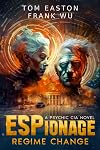
"ESPionage: Regime Change" by Tom Easton and Frank Wu was a fun read. The authors managed to combined science fiction and espionage to create a thrilling story.
The book introduced me into the world of psychic espionage, where a group of former agents and recruits from different countries have to use their with extraordinary psychic talents after being reactivated by the CIA to counter covert attacks. The story was set against the backdrop of an undeclared war, with assassinations and show more disinformation campaigns. I will say that at times the plot was a bit complex but if you like fiction, the spy genre and a touch of supernatural this book should be on your list! show less
The book introduced me into the world of psychic espionage, where a group of former agents and recruits from different countries have to use their with extraordinary psychic talents after being reactivated by the CIA to counter covert attacks. The story was set against the backdrop of an undeclared war, with assassinations and show more disinformation campaigns. I will say that at times the plot was a bit complex but if you like fiction, the spy genre and a touch of supernatural this book should be on your list! show less
This review was written for LibraryThing Early Reviewers.I’m mainly familiar with Tom Easton from his long run as book reviewer for the SF digest magazine Analog, where I appreciated his clear, relatively short, succinct summaries of what he liked about the books he chose to review. Although I don’t know the specific nature of the collaborative division of labor here between coauthors Easton and Wu, there are certainly echoes of Easton’s brisk, at times almost staccato book-review writing style—unfortunately to the detriment of the work as show more a whole. That style, coupled with nothing more than bare-bones characterizations for most of the cast (other than maybe the two leads, Gabriel and Katrinka), yields for the most part a disappointingly bland and unexciting narrative.
I never felt much tension building as the narrative progressed in fits and starts. This likely had to do with the rapid-fire pacing, the lack of explanation, the almost constant introduction of a myriad of faceless characters throughout the first third of the book, and the occasional head-scratching segues veering off to odd locales (such as the trip to a nearby casino for nothing more than an apparent round of ESP-enhanced gambling). Nor did I feel much empathy for any of the characters, probably because I was never able to form a clear picture of any of them (there’s a somewhat significant character, for example, who’s referred to throughout by gender-neutral pronouns—but beyond that, we’re never given much of a clue about this character’s story or why they prefer “they” to “she” or “he”). Many of the characters could have easily been interchangeable, and in fact the tone and cadence of much of the dialogue was indistinguishable from character to character.
As I was reading though the book, I had an ever-present feeling that I was missing important details or plot points. I often found myself skimming back over previously read pages to see if that were actually the case, and most times it turned out to be something that I’d glossed over because it hadn’t been clearly elucidated by the authors.
There were way too many convenient coincidences and outright suspension-of-disbelief killers, which ultimately conspired to take me right out of the story. The basic underpinnings of the CIA-backed ESPionage corps as presented here seems half-baked to begin with. The day-to-day workings of the motley group of psychics and their validity within the CIA hierarchy are never really explained in any way beyond the group being run by Gabriel’s old boss, Col. Gibson. Although Gabriel is ex-CIA, most of the other psychics seem to be civilians with no experience in law enforcement, spycraft, or any other adjacent skills (except Katrinka, who’s a former Russian operative and in her sixties or seventies, which should have raised an eyebrow or two among the CIA personnel but seems to have gone completely unremarked).
A bevy of questionable story choices, both ludicrous and contrived, found me shaking my head and asking a lot of questions—like: Why does the CIA agree to headquarter the psychics in Chez Bernie, a French restaurant owned by one of the psychics? Why does restaurateur Bernie allow Katrinka to set up a fortune-telling table in the restaurant? Why does he give another of the psychics and his newly formed band (centered around a guitar and theremin player!) a weekend gig at the restaurant? Why does he allow the same psychic to take in a stray cat (and apparently allow it to hang out in the restaurant at least some of the time)? And what on earth is Bernie doing feeding bread and cheese to an army of rats in the back alley (supposedly to entice them to stick around to act as a canary-in-a-coal-mine early-warning system for tainted food being delivered by the bad guys—which, by the way, seems like a pretty roundabout way of eliminating their enemies)? Not to mention, why does the vice president conveniently show up at Chez Bernie for an event with some disadvantaged children, but seemingly without his Secret Service detail in tow, allowing the in-house, Johnny-on-the-spot psychics to foil a plot on his life? And why does it seem the only reason our heroes travel to a local casino is so that they can conveniently run into the executive director of the Southeast Shellfish Growers Association (!), who’d indirectly badmouthed them in the press, where they engage in an inconsequential conversation with said exec director, who then quickly exits the scene never to be heard from again? And why oh why do most of the bad guys have the same readily evident tattoo on their hands, making for pretty damn easy identification? So many questions . . .
There seems to be a germ of an interesting idea here, but the execution was a letdown. At the very least, I’m hoping that the authors will be willing to infuse significantly more characterization, backstory, and explication into future volumes of what seems to be intended as an ongoing series of ESPionage books. This book also would have benefited from a good proofread, at the very least to help address numerous annoying capitalization and punctuation problems (underlining the semiprofessional quality of the whole enterprise) that further detracted from my enjoyment of the book. Even more benefit could have come from a more thorough initial editorial pass to address the problems and inconsistencies touched on above. show less
I never felt much tension building as the narrative progressed in fits and starts. This likely had to do with the rapid-fire pacing, the lack of explanation, the almost constant introduction of a myriad of faceless characters throughout the first third of the book, and the occasional head-scratching segues veering off to odd locales (such as the trip to a nearby casino for nothing more than an apparent round of ESP-enhanced gambling). Nor did I feel much empathy for any of the characters, probably because I was never able to form a clear picture of any of them (there’s a somewhat significant character, for example, who’s referred to throughout by gender-neutral pronouns—but beyond that, we’re never given much of a clue about this character’s story or why they prefer “they” to “she” or “he”). Many of the characters could have easily been interchangeable, and in fact the tone and cadence of much of the dialogue was indistinguishable from character to character.
As I was reading though the book, I had an ever-present feeling that I was missing important details or plot points. I often found myself skimming back over previously read pages to see if that were actually the case, and most times it turned out to be something that I’d glossed over because it hadn’t been clearly elucidated by the authors.
There were way too many convenient coincidences and outright suspension-of-disbelief killers, which ultimately conspired to take me right out of the story. The basic underpinnings of the CIA-backed ESPionage corps as presented here seems half-baked to begin with. The day-to-day workings of the motley group of psychics and their validity within the CIA hierarchy are never really explained in any way beyond the group being run by Gabriel’s old boss, Col. Gibson. Although Gabriel is ex-CIA, most of the other psychics seem to be civilians with no experience in law enforcement, spycraft, or any other adjacent skills (except Katrinka, who’s a former Russian operative and in her sixties or seventies, which should have raised an eyebrow or two among the CIA personnel but seems to have gone completely unremarked).
A bevy of questionable story choices, both ludicrous and contrived, found me shaking my head and asking a lot of questions—like: Why does the CIA agree to headquarter the psychics in Chez Bernie, a French restaurant owned by one of the psychics? Why does restaurateur Bernie allow Katrinka to set up a fortune-telling table in the restaurant? Why does he give another of the psychics and his newly formed band (centered around a guitar and theremin player!) a weekend gig at the restaurant? Why does he allow the same psychic to take in a stray cat (and apparently allow it to hang out in the restaurant at least some of the time)? And what on earth is Bernie doing feeding bread and cheese to an army of rats in the back alley (supposedly to entice them to stick around to act as a canary-in-a-coal-mine early-warning system for tainted food being delivered by the bad guys—which, by the way, seems like a pretty roundabout way of eliminating their enemies)? Not to mention, why does the vice president conveniently show up at Chez Bernie for an event with some disadvantaged children, but seemingly without his Secret Service detail in tow, allowing the in-house, Johnny-on-the-spot psychics to foil a plot on his life? And why does it seem the only reason our heroes travel to a local casino is so that they can conveniently run into the executive director of the Southeast Shellfish Growers Association (!), who’d indirectly badmouthed them in the press, where they engage in an inconsequential conversation with said exec director, who then quickly exits the scene never to be heard from again? And why oh why do most of the bad guys have the same readily evident tattoo on their hands, making for pretty damn easy identification? So many questions . . .
There seems to be a germ of an interesting idea here, but the execution was a letdown. At the very least, I’m hoping that the authors will be willing to infuse significantly more characterization, backstory, and explication into future volumes of what seems to be intended as an ongoing series of ESPionage books. This book also would have benefited from a good proofread, at the very least to help address numerous annoying capitalization and punctuation problems (underlining the semiprofessional quality of the whole enterprise) that further detracted from my enjoyment of the book. Even more benefit could have come from a more thorough initial editorial pass to address the problems and inconsistencies touched on above. show less
This review was written for LibraryThing Early Reviewers.This was a fun read for me! The writing was very descriptive, which allowed me to picture what was going on with ease. I found myself laughing many times as I read the book, which is always a good thing in my view. As a sci-fi fan, I had no problem with suspension of disbelief; in fact, welcome it, especially when comedic elements are involved. I hope to read something else by these authors, because I like their style.
I’m grateful to have received a free evaluation copy of this book, but show more these are my genuine opinions. Peace be with you. :-) show less
I’m grateful to have received a free evaluation copy of this book, but show more these are my genuine opinions. Peace be with you. :-) show less
This review was written for LibraryThing Early Reviewers.Lists
You May Also Like
Associated Authors
Statistics
- Works
- 8
- Also by
- 20
- Members
- 103
- Popularity
- #185,854
- Rating
- 3.7
- Reviews
- 74
- ISBNs
- 4

