

Robert Greenwood (1) (1897–1981)
Author of Mr Bunting at War
For other authors named Robert Greenwood, see the disambiguation page.
Works by Robert Greenwood
Mr Bunting 4 copies
A Breeze in Dinglesea 2 copies
Tagged
Common Knowledge
- Canonical name
- Greenwood, Robert
- Birthdate
- 1897-03-08
- Date of death
- 1981
- Gender
- male
- Occupations
- civil servant
novelist
short story writer - Nationality
- UK
- Birthplace
- Crosshill, Yorkshire, England, UK
- Places of residence
- Crosshill, Yorkshire, England, UK (birthplace)
- Associated Place (for map)
- Crosshill, Yorkshire, England, UK
Members
Reviews
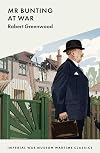
ecause my parents lived through the blitz in London, I have an interest in fiction of the period, books that were written and published under wartime conditions when the outcome of the war was uncertain. So it's interesting to see the image of Mr Bunting at War in a 1941 hardback edition, on sale (signed! for £145!!) at John Atkinson Books. Previous books I've reviewed were flimsy paperbacks because of restrictions on paper and materials i.e. I, James Blunt, (1942) by H V Morton and John show more Steinbeck’s The Moon is Down (1942). I've also read a 2020 reprint of The Silence of the Sea by Vercors, which was published clandestinely in France under the Occupation, and subsequently throughout occupied territory, Russia, Britain and America. A hardback English translation by Cyril Connolly (oddly) titled Put Out the Light was published in 1944 Macmillan & Co. So my assumptions about paperbacks and hardbacks were wrong, and it would be interesting to know more about this.
But I am not wrong about the heavy censorship that prevailed. The Ministry of Information had a Literary and Editorial Division led by Graham Green that prepared morale-boosting publications, and Mr Bunting clearly fits into this category.
Mr Bunting is an Everyman, and his story was made into what was presumably intended to be an uplifting film called Salute John Citizen in 1942 but has not weathered well at all. But the novel is more sophisticated than that. Although Mr Bunting is the stoic patriot, but also sometimes a comic buffoon, the plot shows how the progress of the war affects the family. His children are better educated than he is, and he uses a small inheritance to set his sons up in small business — a laundry and a car repair shop, both of which are almost immediately affected by rationing and staff shortages. So it's not just rationing that affects their standard of living, and the vegetables that he 'digs for victory' help the family budget. As time goes by, it's not just the irritation of blackout curtains and darkened streets, it's also the infringement on their time. With the exception of Mrs Bunting (who cooks, knits and keeps the home fires burning with courage and good cheer) all of them eventually have volunteer duties as well as their employment, even though in the (fictional) town of Kilworth in Essex, they think themselves safe from Hitler's bombs, though they turn out to be wrong about that.
The novel also shows generational differences.
To read the rest of my review please visit https://anzlitlovers.com/2025/06/12/mr-bunting-at-war-1941-by-robert-greenwood/ show less
But I am not wrong about the heavy censorship that prevailed. The Ministry of Information had a Literary and Editorial Division led by Graham Green that prepared morale-boosting publications, and Mr Bunting clearly fits into this category.
Mr Bunting is an Everyman, and his story was made into what was presumably intended to be an uplifting film called Salute John Citizen in 1942 but has not weathered well at all. But the novel is more sophisticated than that. Although Mr Bunting is the stoic patriot, but also sometimes a comic buffoon, the plot shows how the progress of the war affects the family. His children are better educated than he is, and he uses a small inheritance to set his sons up in small business — a laundry and a car repair shop, both of which are almost immediately affected by rationing and staff shortages. So it's not just rationing that affects their standard of living, and the vegetables that he 'digs for victory' help the family budget. As time goes by, it's not just the irritation of blackout curtains and darkened streets, it's also the infringement on their time. With the exception of Mrs Bunting (who cooks, knits and keeps the home fires burning with courage and good cheer) all of them eventually have volunteer duties as well as their employment, even though in the (fictional) town of Kilworth in Essex, they think themselves safe from Hitler's bombs, though they turn out to be wrong about that.
The novel also shows generational differences.
To read the rest of my review please visit https://anzlitlovers.com/2025/06/12/mr-bunting-at-war-1941-by-robert-greenwood/ show less
Statistics
- Works
- 7
- Members
- 32
- Popularity
- #430,837
- Rating
- 4.0
- Reviews
- 1
- ISBNs
- 10