
Alex Adams
Author of White Horse
Series
Works by Alex Adams
Tagged
Common Knowledge
- Birthdate
- 1973
- Gender
- female
- Birthplace
- Auckland, New Zealand
- Places of residence
- Portland, Oregon, USA
- Associated Place (for map)
- Portland, Oregon, USA
Members
Reviews
I had a certain idea of what this book was going to be like before I started reading it. I thought the blurb sounded interesting and it reminded me of daydreams I had when I was a teenager about a movie, the title of which I’ve long forgotten, of a man who was one of the very few left in the world after a catastrophe wipes out humanity. What would I do in those circumstances? Well, from the blurb, White Horse sounded like my childhood daydreams but after the first page I knew I’d never show more imagined anything like this.
Then it made me think of The Road by Cormac McCarthy, a book I was not very fond of. Fortunately I saw differences almost right away. Whereas in The Road, the idea of hope was conveyed with contempt, I sensed hope was the backbone of White Horse; every page is imbued with it even as events make it seem there’s nothing worth fighting for.
This novel is so rich in detail and imagination that every page brought new surprises. Sometimes I found myself rereading a paragraph to decipher what the author meant and then it would hit me a paragraph or page later – ah hah! But it’s so cleverly written that if there had not been an ‘aha’ moment it wouldn’t have mattered. That’s the way this book is – it infuses the culture of a new world order around the reader so well that its meaning sinks in without realization.
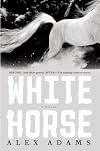
The main character is likeable so I rooted for her on every page. She’s brave, focused and honest. Even at the most cringe-worthy moments, it was difficult to put down. The only issue I would have with this book is the cover. Something about it gave me the idea that White Horse leans towards the YA genre. Wrong! Not YA at all. And of course the blurb does start off saying ‘thirty-year-old Zoe leads an ordinary life…’ which should dispel any the notion that it’s YA. But the cover threw me off.
I will go so far as to predict that this book will become a huge best-seller. It certainly deserves to be. show less
Then it made me think of The Road by Cormac McCarthy, a book I was not very fond of. Fortunately I saw differences almost right away. Whereas in The Road, the idea of hope was conveyed with contempt, I sensed hope was the backbone of White Horse; every page is imbued with it even as events make it seem there’s nothing worth fighting for.
This novel is so rich in detail and imagination that every page brought new surprises. Sometimes I found myself rereading a paragraph to decipher what the author meant and then it would hit me a paragraph or page later – ah hah! But it’s so cleverly written that if there had not been an ‘aha’ moment it wouldn’t have mattered. That’s the way this book is – it infuses the culture of a new world order around the reader so well that its meaning sinks in without realization.
The main character is likeable so I rooted for her on every page. She’s brave, focused and honest. Even at the most cringe-worthy moments, it was difficult to put down. The only issue I would have with this book is the cover. Something about it gave me the idea that White Horse leans towards the YA genre. Wrong! Not YA at all. And of course the blurb does start off saying ‘thirty-year-old Zoe leads an ordinary life…’ which should dispel any the notion that it’s YA. But the cover threw me off.
I will go so far as to predict that this book will become a huge best-seller. It certainly deserves to be. show less
Dystopian/post-apocalyptic novels are all the rage the last few years. I suspect it's related in part to the economy and the sociopolitical landscape. The current world ain't what it was. Dystopian novels allow us to write through or read through the basic tension that underlies much of our lives now. Will I lose my job? What if I get sick? What happens if terrorists blow up What if Republicans take power and put women back in the kitchen with no rights? What if Democrats win and take away show more all our guns and use tax money to do it? What if someone kidnaps/hurts/murders my child? Is school safe? Is my house safe? What if I end up homeless? The list of modern anxiety is endless and much of it, rational or not, is based in part on the reality that we are shown every minute of every day in our living rooms, on our computers, on the radio - the 24-hour news cycle stoking the voyeurism, the anxiety, the fear.
I'm hard on the post-apocalypse in fiction. I think it's Margaret Atwood's fault. I was in my early twenties when The Handmaid's Tale was published. It was the mid-eighties, Reagan ruled the roost and pro-life people were beginning to protest at abortion clinics - many of these protests became violent. The evangelical right was on the rise. It was a scary time for me and Ms. Atwood tapped into that anxiety - you could feel the potential for theocracy sliding beneath the surface of our politics. It's a brilliant book and difficult to top or even equal. In all that time only The Reapers Are the Angels by Alden Bell has truly satisfied my requirements. I'm adding White Horse to the list.
White Horse is not a young adult novel, although young adults might like it. It's a very adult novel centered around a pandemic, but more importantly the story of one woman's journey through the before, the during, and the after. It's a love story, and love is the motivating factor for Zoe's journey all across the map, but more importantly it's a novel of survival, of search for self and meaning, of the beauty of the journey, of compassion for humanity, of the possibility that lies at journey's end. Ms. Adams writes well and Zoe's voice sings through the death and the ugly and the search for beauty left untouched or begun anew. I loved this book - couldn't put it down. I hope you'll read it. You won't be sorry. show less
I'm hard on the post-apocalypse in fiction. I think it's Margaret Atwood's fault. I was in my early twenties when The Handmaid's Tale was published. It was the mid-eighties, Reagan ruled the roost and pro-life people were beginning to protest at abortion clinics - many of these protests became violent. The evangelical right was on the rise. It was a scary time for me and Ms. Atwood tapped into that anxiety - you could feel the potential for theocracy sliding beneath the surface of our politics. It's a brilliant book and difficult to top or even equal. In all that time only The Reapers Are the Angels by Alden Bell has truly satisfied my requirements. I'm adding White Horse to the list.
White Horse is not a young adult novel, although young adults might like it. It's a very adult novel centered around a pandemic, but more importantly the story of one woman's journey through the before, the during, and the after. It's a love story, and love is the motivating factor for Zoe's journey all across the map, but more importantly it's a novel of survival, of search for self and meaning, of the beauty of the journey, of compassion for humanity, of the possibility that lies at journey's end. Ms. Adams writes well and Zoe's voice sings through the death and the ugly and the search for beauty left untouched or begun anew. I loved this book - couldn't put it down. I hope you'll read it. You won't be sorry. show less
Terrified and curious.
That's how Zoe says she feels about a recurring dream that she's been having; she's both terrified by and curious about how it plays out.
That's exactly the response that a number of readers will have to White Horse.
Alex Adams' debut novel contains a lot of conflicting emotions.
Falling in love is described as "'Great and terrible. Like Oz."
And when Zoe Marshall opens a fortune cookie, she finds "Welcome change." So ironic. "I read my fortune until I laugh. I laugh until show more I cry. I cry until I sleep."
The kind of change in Zoe's life is the unsettling sort. This is not the little white horse of Elizabeth Goudge's magic tale for children.
"A few months ago I was living a normal life, doing a whole lot of not much, and a couple weeks ago I was stopping a rape in progress so that a young woman might have a chance at survival."
White Horse is an infection. Humans who are infected with it mutate in unexpected ways.
Ninety percent of the infected people die. Of the remaining ten percent, five percent live on (immune maybe) and five percent mutate in a way which allows them to continue living, or, more accurately, surviving.
Because living just isn't what it once was.
Nothing is.
The book is populated with the kind of nearly-familiar language that reflects this new reality, and the structure mimics it as well.
The narrative, too, is structured in segments which begin either "Now" or "Then". Because of course that's how you would measure time.
Then, the world ran with money. Now, money is useless; a ticket can be purchased with a pint of blood.
Then, Zoe worked for Pope Pharmaceuticals. Now, she journeys towards an end that she has imagined for herself.
It's nearly always raining. Most days include a fight-to-the-death, which she hopes won't be her own. How likely it is that her destination has anything to offer other than the new reality she faces every day of her journey?
It doesn't matter how likely; what matters is that she still hopes.
The structure is somewhat complex; those readers who seek a straightforward chronological recounting might be frustrated by the literary back-and-forth-ing. Zoe is at the heart of the novel, her characterization developed through scenes and her inner thoughts, rather than through oblique narrative statements, but this is primarily a plot-driven novel that succeeds because the characterization remains strong.
Alex Adams adds to the suspense by pulling the reader across time sharply, establishing tenuous present-day alliances against the backdrop of other relationships that have, since, crumbled. She moves from scene-to-scene abruptly, so that the tension naturally rises exponentially.
The language is straightforward, with only the occasional figurative bit. "The clouds lift their petticoats for just a short time, long enough for the sun to dazzle us."
Throughout, the emphasis is on fast-paced prose -- some very short sentences, even some fragments, designed to keep the pages turning -- with a good bit of dialogue.
Raging and retching, gnawing and snarling, bruising and beating, hysteria and, yes, hope: White Horse is a horrifying gallop of a read.
(My full response to this novel is on Buried In Print: more quotes, more thoughts on the dystopic flavour herein.) show less
That's how Zoe says she feels about a recurring dream that she's been having; she's both terrified by and curious about how it plays out.
That's exactly the response that a number of readers will have to White Horse.
Alex Adams' debut novel contains a lot of conflicting emotions.
Falling in love is described as "'Great and terrible. Like Oz."
And when Zoe Marshall opens a fortune cookie, she finds "Welcome change." So ironic. "I read my fortune until I laugh. I laugh until show more I cry. I cry until I sleep."
The kind of change in Zoe's life is the unsettling sort. This is not the little white horse of Elizabeth Goudge's magic tale for children.
"A few months ago I was living a normal life, doing a whole lot of not much, and a couple weeks ago I was stopping a rape in progress so that a young woman might have a chance at survival."
White Horse is an infection. Humans who are infected with it mutate in unexpected ways.
Ninety percent of the infected people die. Of the remaining ten percent, five percent live on (immune maybe) and five percent mutate in a way which allows them to continue living, or, more accurately, surviving.
Because living just isn't what it once was.
Nothing is.
The book is populated with the kind of nearly-familiar language that reflects this new reality, and the structure mimics it as well.
The narrative, too, is structured in segments which begin either "Now" or "Then". Because of course that's how you would measure time.
Then, the world ran with money. Now, money is useless; a ticket can be purchased with a pint of blood.
Then, Zoe worked for Pope Pharmaceuticals. Now, she journeys towards an end that she has imagined for herself.
It's nearly always raining. Most days include a fight-to-the-death, which she hopes won't be her own. How likely it is that her destination has anything to offer other than the new reality she faces every day of her journey?
It doesn't matter how likely; what matters is that she still hopes.
The structure is somewhat complex; those readers who seek a straightforward chronological recounting might be frustrated by the literary back-and-forth-ing. Zoe is at the heart of the novel, her characterization developed through scenes and her inner thoughts, rather than through oblique narrative statements, but this is primarily a plot-driven novel that succeeds because the characterization remains strong.
Alex Adams adds to the suspense by pulling the reader across time sharply, establishing tenuous present-day alliances against the backdrop of other relationships that have, since, crumbled. She moves from scene-to-scene abruptly, so that the tension naturally rises exponentially.
The language is straightforward, with only the occasional figurative bit. "The clouds lift their petticoats for just a short time, long enough for the sun to dazzle us."
Throughout, the emphasis is on fast-paced prose -- some very short sentences, even some fragments, designed to keep the pages turning -- with a good bit of dialogue.
Raging and retching, gnawing and snarling, bruising and beating, hysteria and, yes, hope: White Horse is a horrifying gallop of a read.
(My full response to this novel is on Buried In Print: more quotes, more thoughts on the dystopic flavour herein.) show less

Scary, how humans can treat each other when things fall apart. I really liked Zoe, protagonist. She keeps in mind that "We don't have to be monsters. We still can choose."
Premise: a pharmaceutical company's research project gets out of hand. The action moves between before & after, clearly marked, & give us a fully developed portrayal of Zoe's character--so much more than her menial job--to explain her behavior in the grisly present.
The information we are given at the end about Koch's show more identity doesn't have any foreshadowing, & comes across as something the author pulled out of her hat because she didn't know how to resolve the problem.
Random quote: "We are a parody of normality."
Reread 2021--I didn't remember it from prior 2011 read. Downgrading to 3 stars. The ending really strikes me as out of sync with the macabre storyline. Given how the current epidemic highlights our culture's dependence on international supply chains, her 18 month timeframe for chaos seems realistic. Since this was written beforehand, Adams' scenarios had no dependence on how things are actually going but does highlight how greed for power and scientific hubris can destroy everything. A cautionary tale.
Review based on an ARC show less
Premise: a pharmaceutical company's research project gets out of hand. The action moves between before & after, clearly marked, & give us a fully developed portrayal of Zoe's character--so much more than her menial job--to explain her behavior in the grisly present.
The information we are given at the end about Koch's show more identity doesn't have any foreshadowing, & comes across as something the author pulled out of her hat because she didn't know how to resolve the problem.
Random quote: "We are a parody of normality."
Reread 2021--I didn't remember it from prior 2011 read. Downgrading to 3 stars. The ending really strikes me as out of sync with the macabre storyline. Given how the current epidemic highlights our culture's dependence on international supply chains, her 18 month timeframe for chaos seems realistic. Since this was written beforehand, Adams' scenarios had no dependence on how things are actually going but does highlight how greed for power and scientific hubris can destroy everything. A cautionary tale.
Review based on an ARC show less
Lists
You May Also Like


Statistics
- Works
- 17
- Members
- 458
- Popularity
- #53,634
- Rating
- 3.6
- Reviews
- 33
- ISBNs
- 30
- Languages
- 3