

John Shaw (22) (1963–)
Author of This Land that I Love: Irving Berlin, Woody Guthrie, and the Story of Two American Anthems
For other authors named John Shaw, see the disambiguation page.
About the Author
Image credit: Music writer John Shaw presenting on "'The Union' vs. 'The Battle of Manassas'", Pop Conference 2013, Seattle, Washington, U.S. By Joe Mabel, CC BY-SA 3.0, https://commons.wikimedia.org/w/index.php?curid=25720661
Works by John Shaw
This Land that I Love: Irving Berlin, Woody Guthrie, and the Story of Two American Anthems (2013) 41 copies, 1 review
Tagged
Common Knowledge
- Legal name
- Shaw, John Allen
- Birthdate
- 1963
- Gender
- male
Members
Reviews
This Land that I Love: Irving Berlin, Woody Guthrie, and the Story of Two American Anthems by John Shaw
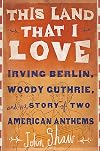
This is a study of two American "anthems," or at least songs much loved and much sung, and of how they arose in very different ways. Irving Berlin, a Jew whose family fled anti-Semitism in Europe, found success in America, and wrote "God Bless America" in no small part because he was thankful for the success he had found. Woody Guthrie, native-born, a generation younger, hard-luck all his life, a radical rather than a conservative, heard the fatuous "God Bless America" on the radio too many show more times, and responded with the radical "This Land Is Your Land."
This book is part biography of the authors, part history of the songs, including discussion of their interaction and of their evolution. (For both evolved -- "God Bless America" was a World War I piece that Berlin rewrote prior to World War II, and which Kate Smith then put in a different tempo. "This Land Is Your Land," as Woody originally wrote it down, ended not with "This land was made for you and me" but "God blessed America for me" -- a direct response to his disgust with Berlin's song. Moreover, "This Land" is usually sung in much-softened form, omitting many of Woody's radical lyrics.)
As history, the book strikes me as useful. I don't know beans about Irving Berlin, and I feel as if I learned much that was informative. I do know a lot about Woody Guthrie, and I have a few beefs about what is told here, I have no major disagreements with the broad history. What's more, I think the appendix on the textual history of "This Land Is Your Land" very useful.
I do have to put out a little caution, though: the depiction of Woody just doesn't quite feel right to me. It wasn't just lack of employment that caused Woody to ramble; there was clearly a deep itch in him. He associated with Communists, and was widely called a Communist -- but he wasn't, exactly. It's not that he wasn't left-wing enough; he just wasn't an organization-type guy. He was more like a liberal anarchist. And you probably didn't want him alone with your daughter.... I'm not giving a full or even a good picture of Woody; I just want it clear that I don't think you'll get the full feeling for Woody from this book. Probably not Berlin, either, since there isn't much that describes his deep conservatism.
But those defects can be overcome by reading the biographies (Ed Cray's of Woody, and presumably someone's work on Berlin). For the songs, and their interrelation, I doubt you will ever read better. show less
This book is part biography of the authors, part history of the songs, including discussion of their interaction and of their evolution. (For both evolved -- "God Bless America" was a World War I piece that Berlin rewrote prior to World War II, and which Kate Smith then put in a different tempo. "This Land Is Your Land," as Woody originally wrote it down, ended not with "This land was made for you and me" but "God blessed America for me" -- a direct response to his disgust with Berlin's song. Moreover, "This Land" is usually sung in much-softened form, omitting many of Woody's radical lyrics.)
As history, the book strikes me as useful. I don't know beans about Irving Berlin, and I feel as if I learned much that was informative. I do know a lot about Woody Guthrie, and I have a few beefs about what is told here, I have no major disagreements with the broad history. What's more, I think the appendix on the textual history of "This Land Is Your Land" very useful.
I do have to put out a little caution, though: the depiction of Woody just doesn't quite feel right to me. It wasn't just lack of employment that caused Woody to ramble; there was clearly a deep itch in him. He associated with Communists, and was widely called a Communist -- but he wasn't, exactly. It's not that he wasn't left-wing enough; he just wasn't an organization-type guy. He was more like a liberal anarchist. And you probably didn't want him alone with your daughter.... I'm not giving a full or even a good picture of Woody; I just want it clear that I don't think you'll get the full feeling for Woody from this book. Probably not Berlin, either, since there isn't much that describes his deep conservatism.
But those defects can be overcome by reading the biographies (Ed Cray's of Woody, and presumably someone's work on Berlin). For the songs, and their interrelation, I doubt you will ever read better. show less
Statistics
- Works
- 1
- Members
- 41
- Popularity
- #363,651
- Rating
- 3.5
- Reviews
- 1
- ISBNs
- 117
- Languages
- 5