
Martin Maiden
Author of Reference Grammar of Modern Italian
About the Author
Series
Works by Martin Maiden
Morphological autonomy : perspectives from Romance inflectional morphology (2011) — Editor — 3 copies
Associated Works
Historical linguistics 1997 : selected papers from the 13th International Conference on Historical Linguistics, Düsseldorf, 10-17 August 1997 (1998) — Contributor — 6 copies
Tagged
Common Knowledge
Members
Reviews
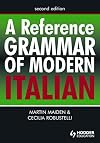
My basic “bible” for teaching myself Italian at home has been (and continues to be) “Living Italian” by Maria Valgimigli and Derek Aust. It is a book that I would strongly recommend for anyone starting out on Italian.
But if you want to take your Italian up to a higher level, then this reference grammar by Maiden and Robustelli is an extremely useful tool.
It is a book to be dipped into, rather than one to work through cover to cover. For example, I have just been learning how the show more traditional Tuscan usage of “si” as “we” has spread into wider use, especially in the spoken language. So we get: “Si viene anche noi!” for “We’re coming too!”
The large number of useful examples of usage for each grammatical point is the best feature of the book.
The last two chapters are particularly useful. They cover formal and informal discourse and forms of address, and in more detail than I have seen elsewhere. So we learn that it would NOT be acceptable to say, “Ciao signora, si accomodi.” (Because the “ciao” is informal, while the rest is formal.)
And how about this as an example (not recommended!) of informal discourse? “Stai zitto o ti spacco il muso.” (“Shut up or I’ll smash your face in.”) show less
But if you want to take your Italian up to a higher level, then this reference grammar by Maiden and Robustelli is an extremely useful tool.
It is a book to be dipped into, rather than one to work through cover to cover. For example, I have just been learning how the show more traditional Tuscan usage of “si” as “we” has spread into wider use, especially in the spoken language. So we get: “Si viene anche noi!” for “We’re coming too!”
The large number of useful examples of usage for each grammatical point is the best feature of the book.
The last two chapters are particularly useful. They cover formal and informal discourse and forms of address, and in more detail than I have seen elsewhere. So we learn that it would NOT be acceptable to say, “Ciao signora, si accomodi.” (Because the “ciao” is informal, while the rest is formal.)
And how about this as an example (not recommended!) of informal discourse? “Stai zitto o ti spacco il muso.” (“Shut up or I’ll smash your face in.”) show less
You May Also Like
Associated Authors
Statistics
- Works
- 11
- Also by
- 6
- Members
- 162
- Popularity
- #130,373
- Rating
- 4.3
- Reviews
- 1
- ISBNs
- 43
- Languages
- 1