
Peter Seibel
Author of Coders at Work: Reflections of the Craft of Programming
Works by Peter Seibel
Tagged
Common Knowledge
Members
Reviews
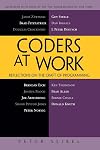
Software developers are typically bright people but possess few social contacts who approach the world like them. Such loneliness is famously parodied by stereotypes. Even the most social among us have a difficult time relating to others what programming is like. In this work, Seibel provides interviews with 15 accomplished programmers and alleviates some of that alone-ness. In so doing, he explains to the English-speaking world how computer programming has grown and is currently show more practiced.
The interviewees compose a veritable who’s who of computer science – including, at the end, Donald Knuth, who is widely regarded as the best programmer of all time. Fran Allen, a widely recognized female programmer, is included. Some were educated well at Harvard or MIT. Others were, to a large degree, self-taught before the discipline of computer science was established. All convey a unique perspective about how they write code.
For the most part, Seibel asks each person a similar set of questions: about their background, formative experiences, approach to the craft of coding, and their approach to a new trend of literate programming. It’s amazing to see how wide the range of different opinions is! They all seem to disagree, especially about very important things. Providing room for (sometimes heated) disagreements is healthy for computer programmers who are smart but have few companions. After all, we must work together to accomplish work.
This is not a technical work. Neither code nor math is presented. It’s more of a biographical work of 16 different programmers. It spans the lanes of human interest and computer science. Non-programmers might be interested in learning how IT people work, but the obvious audience here consists of software developers. By grabbing big-name interviews, Seibel hits the sweet spot for this audience and knocks a homer out of the park.
In particular, expositions such as this allow people to see the history of computing. Readers get to see innovators, spanning back to the 1950s until the date of publication in 2009. These people changed the world such that a mini-computer resides in many people’s pockets in the developed world, in the form of a smart phone. They went from coding in assembly code to writing in higher-level languages to co-writing in more everyday language. That history of science will be of interest to readers in the future when future students seek to learn about the “old days” when computers were young. And we will have the writer Peter Seibel to thank. show less
The interviewees compose a veritable who’s who of computer science – including, at the end, Donald Knuth, who is widely regarded as the best programmer of all time. Fran Allen, a widely recognized female programmer, is included. Some were educated well at Harvard or MIT. Others were, to a large degree, self-taught before the discipline of computer science was established. All convey a unique perspective about how they write code.
For the most part, Seibel asks each person a similar set of questions: about their background, formative experiences, approach to the craft of coding, and their approach to a new trend of literate programming. It’s amazing to see how wide the range of different opinions is! They all seem to disagree, especially about very important things. Providing room for (sometimes heated) disagreements is healthy for computer programmers who are smart but have few companions. After all, we must work together to accomplish work.
This is not a technical work. Neither code nor math is presented. It’s more of a biographical work of 16 different programmers. It spans the lanes of human interest and computer science. Non-programmers might be interested in learning how IT people work, but the obvious audience here consists of software developers. By grabbing big-name interviews, Seibel hits the sweet spot for this audience and knocks a homer out of the park.
In particular, expositions such as this allow people to see the history of computing. Readers get to see innovators, spanning back to the 1950s until the date of publication in 2009. These people changed the world such that a mini-computer resides in many people’s pockets in the developed world, in the form of a smart phone. They went from coding in assembly code to writing in higher-level languages to co-writing in more everyday language. That history of science will be of interest to readers in the future when future students seek to learn about the “old days” when computers were young. And we will have the writer Peter Seibel to thank. show less
I loved "Coders at work". It consists of in-depth interviews with 15 very accomplished and famous programmers. The author Peter Seibel has, in my opinion, done an outstanding job with these interviews.
First, he picked a stellar set of super star programmers to interview. Second, he asked very interesting questions, some of which only a fellow programmer would ask. Third, he asked several questions to all of his subjects, which allows the reader to compare and contrast the answers, while also show more asking questions about each programmer's special areas of interest.
To give you a sense of the questions he asked, here are some samples: "How do you design code?", "What is the worst bug you've ever had to track down?", "What's your preferred debugging techniques and tools? Print statements? Symbolic debuggers? Formal proofs?" and "As a programmer, do you consider yourself a scientist, an engineer, an artist, or a craftsman?". I think these are all excellent questions, and I learned a lot by reading all the different answers.
Each interview is on average 40 pages long (the whole book is about 600 pages), so it took me a while to read it, even though it was a pretty easy read. But this also means that there is room to ask a lot of questions. You can tell from the questions and follow-up questions that Peter Seibel is himself an experienced programmer. In addition, he seems very well read. He recognizes and comments on almost any book or research paper that is mentioned during the interviews. For example, Joshua Bloch mentioned the book Hacker's Delight, and Peter Seibel's comment is "that's the bit-twiddling book?".
Occasionally there are some pretty funny comments from Peter Seibel too. When Simon Peyton Jones talked about how he had not had a lot of experience with C , he ended by saying "... I never really spent several years writing big C programs. That's how you get some kind of deep, visceral feel and I never have". To which Peter Seibel replied "I think that feeling is usually revulsion".
While reading the book, I wondered whether I would get tired of the interviews by the end, but that did not happen. It kept being interesting till the end (and that's not just because Donald Knuth, arguably the most famous of them all, is last). For me, the most interesting interviews were the ones with Simon Peyton Jones and Peter Norvig. But even the least interesting interviews (for me that was the ones with L Peter Deutsch and Fran Allen) were still very good. In fact, even a single one of these interviews is worth the price of the book in my opinion.
There is also a historical quality to the book. The majority of the people interviewed started programming in the 50s or the early 60s. One of the standard questions was "How did you learn to program?" and I thought it was quite interesting to read about the old computers they used, the punch cards etc. It was almost like little history lessons from the computing field.
Almost as soon as I started reading this book, I grabbed a piece of paper and jotted down things of interest: concepts I hadn't heard about before, quotes, new languages to try, references to papers and blog posts, books that were recommended etc. When I got to the end, I had accumulated 6 full pages worth of notes. To me, that's an indication of the quality of the interviews, and of the value I got out of the book.
OK, one small complaint: it would have been nice with a picture of each of the interviewees, so we can see what they look like.
It is also worth mentioning that both Joe Armstrong and Simon Peyton Jones have been interviewed at Software Engineering Radio ([...]) - both those interviews were very good, definitely worth listening to. Also, Peter Seibel was interview about "Coders at work" by Jeff Atwood and Joel Spolsky on the StackOverflow podcast (episode 69). And Peter Seibel has some interesting blog posts with excerpts from the book at his site [...] - check them out.
If you are seriously interested in programming, this is definitely one of the books you should read. Highly recommended. show less
First, he picked a stellar set of super star programmers to interview. Second, he asked very interesting questions, some of which only a fellow programmer would ask. Third, he asked several questions to all of his subjects, which allows the reader to compare and contrast the answers, while also show more asking questions about each programmer's special areas of interest.
To give you a sense of the questions he asked, here are some samples: "How do you design code?", "What is the worst bug you've ever had to track down?", "What's your preferred debugging techniques and tools? Print statements? Symbolic debuggers? Formal proofs?" and "As a programmer, do you consider yourself a scientist, an engineer, an artist, or a craftsman?". I think these are all excellent questions, and I learned a lot by reading all the different answers.
Each interview is on average 40 pages long (the whole book is about 600 pages), so it took me a while to read it, even though it was a pretty easy read. But this also means that there is room to ask a lot of questions. You can tell from the questions and follow-up questions that Peter Seibel is himself an experienced programmer. In addition, he seems very well read. He recognizes and comments on almost any book or research paper that is mentioned during the interviews. For example, Joshua Bloch mentioned the book Hacker's Delight, and Peter Seibel's comment is "that's the bit-twiddling book?".
Occasionally there are some pretty funny comments from Peter Seibel too. When Simon Peyton Jones talked about how he had not had a lot of experience with C , he ended by saying "... I never really spent several years writing big C programs. That's how you get some kind of deep, visceral feel and I never have". To which Peter Seibel replied "I think that feeling is usually revulsion".
While reading the book, I wondered whether I would get tired of the interviews by the end, but that did not happen. It kept being interesting till the end (and that's not just because Donald Knuth, arguably the most famous of them all, is last). For me, the most interesting interviews were the ones with Simon Peyton Jones and Peter Norvig. But even the least interesting interviews (for me that was the ones with L Peter Deutsch and Fran Allen) were still very good. In fact, even a single one of these interviews is worth the price of the book in my opinion.
There is also a historical quality to the book. The majority of the people interviewed started programming in the 50s or the early 60s. One of the standard questions was "How did you learn to program?" and I thought it was quite interesting to read about the old computers they used, the punch cards etc. It was almost like little history lessons from the computing field.
Almost as soon as I started reading this book, I grabbed a piece of paper and jotted down things of interest: concepts I hadn't heard about before, quotes, new languages to try, references to papers and blog posts, books that were recommended etc. When I got to the end, I had accumulated 6 full pages worth of notes. To me, that's an indication of the quality of the interviews, and of the value I got out of the book.
OK, one small complaint: it would have been nice with a picture of each of the interviewees, so we can see what they look like.
It is also worth mentioning that both Joe Armstrong and Simon Peyton Jones have been interviewed at Software Engineering Radio ([...]) - both those interviews were very good, definitely worth listening to. Also, Peter Seibel was interview about "Coders at work" by Jeff Atwood and Joel Spolsky on the StackOverflow podcast (episode 69). And Peter Seibel has some interesting blog posts with excerpts from the book at his site [...] - check them out.
If you are seriously interested in programming, this is definitely one of the books you should read. Highly recommended. show less
This book is a collection of interviews with prominent (at least within the programming community) software developers. Most of them are important figures in the development of languages and operating systems; one is Donald Knuth. All are people who have significant bodies of actual code to their names.
There's a bit of a selection bias - there are no C++ gurus and most of the interviewees are dubious about C++, and maybe more Lispers than there might be in a random sample (the author is a show more Lisp developer) - but in general these are significant names with a wide range of types of background (IBM, minis, micros, a lot of PDP-11 people (largely a function of age)). Almost everyone worked in C at some point.
They clearly belong to an extended community (of which I'm a part) with a focus on coding as an interesting activity in itself rather than just a means to an end. In talking about hiring, the ones who discuss it almost all talk about looking for people with a "spark" rather than specific skills.
They almost all use Emacs. In thirty years of being a developer. I've never met anyone else who was a committed Emacs user. Most have read Knuth to one degree or another, as well. (I read through the first three volumes, and have started making my way through the newer volumes in book 4.)
Many of them started out without formal training. In many cases, this was because they started in high school. In others, it's because programming was a hobby to them while they studied other disciplines, and then became a practical benefit when they started looking for work. (There are some trained CS graduates and academics, products of or teachers of standard academic courses.) The non-formally-trained ones still think like software engineers and not simply hackers, with concerns around process, design, and structure. Most of them started work with computers before the development of the current credentialist model creating a conveyor belt between university and the workplace.
Overall, I found it one of the better books I have read at conveying what the experience of software development is like. show less
There's a bit of a selection bias - there are no C++ gurus and most of the interviewees are dubious about C++, and maybe more Lispers than there might be in a random sample (the author is a show more Lisp developer) - but in general these are significant names with a wide range of types of background (IBM, minis, micros, a lot of PDP-11 people (largely a function of age)). Almost everyone worked in C at some point.
They clearly belong to an extended community (of which I'm a part) with a focus on coding as an interesting activity in itself rather than just a means to an end. In talking about hiring, the ones who discuss it almost all talk about looking for people with a "spark" rather than specific skills.
They almost all use Emacs. In thirty years of being a developer. I've never met anyone else who was a committed Emacs user. Most have read Knuth to one degree or another, as well. (I read through the first three volumes, and have started making my way through the newer volumes in book 4.)
Many of them started out without formal training. In many cases, this was because they started in high school. In others, it's because programming was a hobby to them while they studied other disciplines, and then became a practical benefit when they started looking for work. (There are some trained CS graduates and academics, products of or teachers of standard academic courses.) The non-formally-trained ones still think like software engineers and not simply hackers, with concerns around process, design, and structure. Most of them started work with computers before the development of the current credentialist model creating a conveyor belt between university and the workplace.
Overall, I found it one of the better books I have read at conveying what the experience of software development is like. show less
I thought it was a pretty great book on Lisp, although it's hard to distinguish how much of this is from the elegance of the language itself, my understanding of computer languages in an abstract sense, or the writer's ability to put together a sticky and comprehensive tutorial.
I certainly didn't feel like this book went overlong, as many tutorials so. Every chapter felt really short, and explained everything relatively tersely. The author seemed happy to talk about theory and esoteric show more concerns in the footnotes, which I chose to read and sometimes become overwhelmed by, but this was an option I had.
While the book is organized well as a primer, it is somewhat overwhelming in that functions are just thrown at you in related groups for each chapter. Having read through this book once has taught me the basics of the language but hasn't necessarily taught me how to *think* in LISP (the way [b:Land of LISP: Learn to Program in LISP, One Game at a Time!|6905041|Land of LISP Learn to Program in LISP, One Game at a Time!|Conrad Barski|https://i.gr-assets.com/images/S/compressed.photo.goodreads.com/books/1403198191l/6905041._SX50_.jpg|7129234] seems to be approaching it. That being said, when I finally say "I should really get familiar with doing X in Lisp" I will probably know exactly where in PCL to look. I have a feeling that every primary feature of Lisp is touched upon in the book, it's just a matter of retaining it and perhaps understanding the context.
It's hard for me to gauge because I have programming languages (including functional ones like Scheme) under my belt already, but if you want to learn Common Lisp I'd definitely pick up this book as one of my first. I wouldn't sweat comprehending it too much, but it would at least give me an overall view of the terrain before I went into books like Land of Lisp or other books on functional programming before coming back and constantly referencing this book as I was getting my sea legs going. show less
I certainly didn't feel like this book went overlong, as many tutorials so. Every chapter felt really short, and explained everything relatively tersely. The author seemed happy to talk about theory and esoteric show more concerns in the footnotes, which I chose to read and sometimes become overwhelmed by, but this was an option I had.
While the book is organized well as a primer, it is somewhat overwhelming in that functions are just thrown at you in related groups for each chapter. Having read through this book once has taught me the basics of the language but hasn't necessarily taught me how to *think* in LISP (the way [b:Land of LISP: Learn to Program in LISP, One Game at a Time!|6905041|Land of LISP Learn to Program in LISP, One Game at a Time!|Conrad Barski|https://i.gr-assets.com/images/S/compressed.photo.goodreads.com/books/1403198191l/6905041._SX50_.jpg|7129234] seems to be approaching it. That being said, when I finally say "I should really get familiar with doing X in Lisp" I will probably know exactly where in PCL to look. I have a feeling that every primary feature of Lisp is touched upon in the book, it's just a matter of retaining it and perhaps understanding the context.
It's hard for me to gauge because I have programming languages (including functional ones like Scheme) under my belt already, but if you want to learn Common Lisp I'd definitely pick up this book as one of my first. I wouldn't sweat comprehending it too much, but it would at least give me an overall view of the terrain before I went into books like Land of Lisp or other books on functional programming before coming back and constantly referencing this book as I was getting my sea legs going. show less
Lists
You May Also Like


Statistics
- Works
- 3
- Members
- 1,304
- Popularity
- #19,681
- Rating
- 4.1
- Reviews
- 24
- ISBNs
- 15
- Languages
- 2
- Favorited
- 1