
Alexandra Walsham
Author of The Reformation of the Landscape: Religion, Identity, and Memory in Early Modern Britain and Ireland
About the Author
Alexandra Walsham is Professor of Modern History at the University of Cambridge, and a Fellow of Trinity College.
Works by Alexandra Walsham
Associated Works
Renaissance Quarterly : Volume LXIX, No. 2 (Summer 2016) — Contributor — 1 copy
Tagged
Common Knowledge
- Legal name
- Walsham, Alexandra Marie
- Birthdate
- 1966-01-04
- Gender
- female
- Education
- University of Melbourne (BA â MA)
Trinity College, University of Cambridge (Ph.D|1995) - Occupations
- historian
professor - Organizations
- Emannuel College, University of Cambridge
Trinity College, University of Cambridge
University of Exeter
Association of University Teachers
Church of England Record Society
Cambridge Historical Society (show all 8)
Cambridge Commonwealth Society
Ecclesiastical History Society - Awards and honors
- Royal Historical Society (Fellow, 1999)
British Academy (Fellow, 2009)
Australian Academy of the Humanities (Fellow, 2013)
Order of the British Empire (Commander, 2017)
Wolfson History Prize (2012)
Longman-History Today Award (2000) (show all 8)
Morris D. Forkosch Prize (2000)
Leo Gershoy Award (2011) - Nationality
- UK
Australia - Birthplace
- Hayle, Cornwall, England
- Associated Place (for map)
- Hayle, Cornwall, England
Members
Reviews
The Reformation of the Landscape: Religion, Identity, and Memory in Early Modern Britain and Ireland by Alexandra Walsham
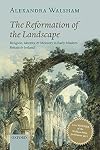
This is a thorough and fascinating coverage of the changes which took place between the 16th and the 18th Centuries regarding (initially) the religious treatment of elements of the landscape (shrines, groves, wells, etc.) and (later) the non-religious treatment of sites with a religious history (e.g. the conversion of what had been "holy wells" into spas with medicinal claims made for them, or the secular treatment of abbey ruins as attractive landscape features). This includes sites with a show more pre-Christian past (dolmens and tumuli, principally).
Walsham's coverage is thorough, and the texture of the book is accordingly dense. Her material is thoroughly documented and she has made an extensive survey of the original sources.
There are few major surprises -- such as there are tend to appear in the latter part of the book, regarding invented traditions (she draws explicitly on Hobsbawm's The Invention of Tradition) -- for example, she is unable to find any evidence for the story of St. Joseph of Arimathea and the Glastonbury thorn prior to the Reformation. (Note that the story of St. Joseph visiting Britain is earlier (it's in some of the Lancelot cycle, IIRC) but the specific link with Glastonbury, and with the Christmas-flowering thorn, is later.) However, her accumulation of details not only fills out the broadly expected narrative but provides evidence of the complexity of detail and local variation within the broadly expected outlines. show less
Walsham's coverage is thorough, and the texture of the book is accordingly dense. Her material is thoroughly documented and she has made an extensive survey of the original sources.
There are few major surprises -- such as there are tend to appear in the latter part of the book, regarding invented traditions (she draws explicitly on Hobsbawm's The Invention of Tradition) -- for example, she is unable to find any evidence for the story of St. Joseph of Arimathea and the Glastonbury thorn prior to the Reformation. (Note that the story of St. Joseph visiting Britain is earlier (it's in some of the Lancelot cycle, IIRC) but the specific link with Glastonbury, and with the Christmas-flowering thorn, is later.) However, her accumulation of details not only fills out the broadly expected narrative but provides evidence of the complexity of detail and local variation within the broadly expected outlines. show less
Awards


You May Also Like
Associated Authors
Statistics
- Works
- 11
- Also by
- 5
- Members
- 174
- Popularity
- #123,125
- Rating
- 3.8
- Reviews
- 1
- ISBNs
- 30