
Matt Baume
Author of Hi Honey, I'm Homo! Sitcoms, Specials, and the Queering of American Culture
About the Author
Works by Matt Baume
Hi Honey, I'm Homo! Sitcoms, Specials, and the Queering of American Culture (2023) 133 copies, 7 reviews
Tagged
Common Knowledge
Members
Reviews
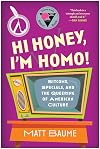
Brief but entertaining and informative look at how American television sitcoms have portrayed queer characters since the 1960s. Starting with Bewitched and ending with Modern Family, Baume illustrates how the gradual upward trend in queer characters' number and visibility mirrored history, and helped normalize and personalize the average American's experience of queerness.
I'm an Old, so I remember watching Bewitched as a young child. It never occurred to me that Samantha's need to hide her show more witch status from the neighbors could be queer coded. I also had no clue that Paul Lynde's outlandish behavior as Uncle Arthur meant anything beyond the fact that it made him a witty Hollywood Squares celebrity (look it up, kids).
Reading about the evolution of Marty Morrison on Barney Miller in the 1970s made me glad that the police sitcom was one of my favorite shows at the time (and yes, it looks different in the face of the "Abolish the Police" movement). The writers took a cliched mincing homosexual, a petty thief at that, and over the years turned him into a well-developed character with a business suit-wearing partner. As Baume notes, even though Marty was a minor recurring character, television viewers had a chance to see for themselves that gay people were not deviant predators. As public perception changed, television adjusted, which then fed into more pubic acceptance.
The book highlights the sitcom directors, producers and writers who pushed back against network suits who feared retaliation by conservative groups. And at the same time they faced criticism from the queer community for not moving far enough or fast enough (e.g., Modern Family's gay couple were not allowed to kiss each other in earlier seasons).
Baume's breezy writing style belies the seriousness of the topic. Writing this review in mid-2023, I worry that the latest backlash against LGBTQIA and trans persons will reverse the progress and send queer characters back into the shadows. They may only be sitcoms, but if we're headed back to shows with only white cis-het characters like Leave It to Beaver, we will lose an important avenue for queer visibility.
ARC received from Net Galley in exchange for objective review. Thanks to: Bookshire Cat's review for letting me know of this book's existence. show less
I'm an Old, so I remember watching Bewitched as a young child. It never occurred to me that Samantha's need to hide her show more witch status from the neighbors could be queer coded. I also had no clue that Paul Lynde's outlandish behavior as Uncle Arthur meant anything beyond the fact that it made him a witty Hollywood Squares celebrity (look it up, kids).
Reading about the evolution of Marty Morrison on Barney Miller in the 1970s made me glad that the police sitcom was one of my favorite shows at the time (and yes, it looks different in the face of the "Abolish the Police" movement). The writers took a cliched mincing homosexual, a petty thief at that, and over the years turned him into a well-developed character with a business suit-wearing partner. As Baume notes, even though Marty was a minor recurring character, television viewers had a chance to see for themselves that gay people were not deviant predators. As public perception changed, television adjusted, which then fed into more pubic acceptance.
The book highlights the sitcom directors, producers and writers who pushed back against network suits who feared retaliation by conservative groups. And at the same time they faced criticism from the queer community for not moving far enough or fast enough (e.g., Modern Family's gay couple were not allowed to kiss each other in earlier seasons).
Baume's breezy writing style belies the seriousness of the topic. Writing this review in mid-2023, I worry that the latest backlash against LGBTQIA and trans persons will reverse the progress and send queer characters back into the shadows. They may only be sitcoms, but if we're headed back to shows with only white cis-het characters like Leave It to Beaver, we will lose an important avenue for queer visibility.
ARC received from Net Galley in exchange for objective review. Thanks to: Bookshire Cat's review for letting me know of this book's existence. show less
Having grown up in the ‘70s on a steady diet of sit-coms (and being a fan of the author’s YouTube channel) I found the book entertaining and informative. Each chapter is devoted to a different comedy that, for better or worse, impacted Americans views on homosexuality, from the coded language of Bewitched to the blockbuster success of Modern Family. It’s both frustrating (once again our recurring villains are moralist hypocrites) and inspiring (those who kept pushing boundaries and show more stood by gay friends and co-workers). show less
An engaging look at LGBTQ+ representation on American sitcoms from the 1960s to the 2010s. It made for a good road trip audiobook since I have seen almost all the shows (sorry Golden Girls and Will & Grace), the oldest ones on original broadcast or in syndication and the newest on streaming.
It's sad to see how slow the progress was and how much effort had to go into each little bit of it, battling controversy and network censors every step of the way, but it's great to follow the upward show more trend and realize how far it has come.
I'd love to see a follow-up survey of television dramas.
FOR REFERENCE:
Contents: Introduction -- Bewitched -- All in the Family -- Alice -- Barney Miller -- Soap -- Cheers -- The Golden Girls -- Dinosaurs -- Friends -- Ellen -- Will & Grace -- Modern Family -- Conclusion -- Acknowledgments -- Notes -- Index show less
It's sad to see how slow the progress was and how much effort had to go into each little bit of it, battling controversy and network censors every step of the way, but it's great to follow the upward show more trend and realize how far it has come.
I'd love to see a follow-up survey of television dramas.
FOR REFERENCE:
Contents: Introduction -- Bewitched -- All in the Family -- Alice -- Barney Miller -- Soap -- Cheers -- The Golden Girls -- Dinosaurs -- Friends -- Ellen -- Will & Grace -- Modern Family -- Conclusion -- Acknowledgments -- Notes -- Index show less

Baume looks at the changing role and place of the LGBTQ community as reflected in American sitcoms. A dozen chapters, each focused on one TV show, provide snapshots of how things are changing from Bewitched in the mid-1960s, which could address the community only subtextually, to Modern Family 40 years later, which got more objections about the fact that its gay couple never kissed than it did about their presence.
Most of Baume's featured shows are obvious choices -- Soap, The Golden Girls, show more Will and Grace -- but a couple are somewhat out of left field. Alice and Dinosaurs seem to have been chosen for a single episode, and in the case of Dinosaurs, an episode that Baume describes as so muddled in its allegory that it's hard to say with any certainty that it's about gayness at all.
This would have made a top-notch New Yorker article, but at 250 pages, it's bloated far beyond any length that can be justified by its minimal new information or insight. show less
Most of Baume's featured shows are obvious choices -- Soap, The Golden Girls, show more Will and Grace -- but a couple are somewhat out of left field. Alice and Dinosaurs seem to have been chosen for a single episode, and in the case of Dinosaurs, an episode that Baume describes as so muddled in its allegory that it's hard to say with any certainty that it's about gayness at all.
This would have made a top-notch New Yorker article, but at 250 pages, it's bloated far beyond any length that can be justified by its minimal new information or insight. show less
Lists
Awards


You May Also Like
Associated Authors
Statistics
- Works
- 2
- Members
- 146
- Popularity
- #141,735
- Rating
- 4.1
- Reviews
- 7
- ISBNs
- 5