
Will Carter (1912–2001)
Author of Getting Better
Works by Will Carter
Associated Works
Tagged
Common Knowledge
- Canonical name
- Carter, Will
- Legal name
- Carter, William Nicholas
- Birthdate
- 1912-09-24
- Date of death
- 2001-03-17
- Gender
- male
- Occupations
- private press printer
font designer - Organizations
- Rampant Lions Press (founder and owner)
London Chappel of Private Presses (president)
Royal Navy (WWII) - Awards and honors
- Officer of the Most Excellent Order of the British Empire (1977)
Honorary Fellow, Magdalene College, Cambridge (1977) - Relationships
- Carter, Sebastian (son)
Carter, John (brother) - Nationality
- UK
- Birthplace
- London, England, UK
- Place of death
- Cambridge, Cambridgeshire, England, UK
- Associated Place (for map)
- England, UK
Members
Reviews
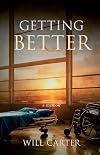
During his senior year of high school, Will is in a car accident that results in a coma and traumatic brain injury. This incident leaves him with a severely damaged short term memory and mobility issues.
This book covers his intense struggle to regain his ability to walk and recover his mental faculties sufficiently to graduate on time. The book itself is very intimate, and gives the reader a look into the fractured experience of the brain damaged.
Throughout it all, Will relies upon his show more parents and his faith to keep him encouraged and motivated to continue on at the slow pace of his healing.
I appreciated the unique perspective of this book, but the actual meat of the narrative was a bit dull and repetitive. Hearing about studying, physical therapy and the mundane events of each day was a little tedious. The characters aren't well-defined and mostly appear as two dimensional figures: the devoted parents the long-suffering girlfriend, the saintly teacher.
Even the narrator is a bit difficult to connect to. He's constantly thinking about the person he used to be, and hoping to get back to. He's obsessed with hitting a B in his physics class, he likes stand up and wants to be a playwright, but that's about all we know.
I appreciated this story shared here, but it lacked a certain necessary authenticity to truly engage the reader. The more I meditate upon this memoir, the more it troubles me. As I was reading it, I forgave a certain immaturity in the prose as I thought it had been written by a young man within a few years of his injury.
I remember being in high school and being obsessed with my academic success because it seemed the only part of my life that I could control and adults had told me that this was my ticket to a better life. But this perspective isn't really accurate and a lot of the matters which seemed so weighty at the time, were in reality not particularly important.
As a result, the achievement of a B in his physics class is centered as the climax of the memoir and considered "proof" that he is getting better and that his life has not been ruined by his disability and that God loves him and will prosper him. As an adult, I understand that this is a false and shallow construction. Furthermore, I know that him achieving this B will actually contribute nothing to his future success and happiness, but I understand that from the perspective of a high schooler, it is extremely important.
That didn't make the narrative particularly riveting, but I was willing to make allowances for the relative immaturity of the author. But in the epilogue of the book, we learn that the author is actually in his late thirties and that he spent 12 years struggling with inadequacy and depression before finding his true calling and accepting his disability as part of his larger story.
Knowing the author's age when he wrote this book frustrated me a bit as I wanted him to be in deeper conversation with his past self. I wanted to see him self-reflecting upon the unhealthy attitudes of his youth and his obsession with performing to prove his worth. He just didn't go deep enough for me.
I also really didn't like the way he tried to wrap up his decades of struggle in a happily ever after by essentially claiming that he met his wife and her love "fixed" all the problems he was having. Our culture already puts so much pressure and importance upon the marital relationship as a sources of meaning and men especially come to marriage expecting their wives to be everything from their housekeeper to their therapist.
Resting your self-worth upon another person is too heavy a burden for anyone to bear and sets you up for failure. The protagonist would have benefited much more from examining his issues in therapy rather than striving so hard to "prove" he was worth something. show less
This book covers his intense struggle to regain his ability to walk and recover his mental faculties sufficiently to graduate on time. The book itself is very intimate, and gives the reader a look into the fractured experience of the brain damaged.
Throughout it all, Will relies upon his show more parents and his faith to keep him encouraged and motivated to continue on at the slow pace of his healing.
I appreciated the unique perspective of this book, but the actual meat of the narrative was a bit dull and repetitive. Hearing about studying, physical therapy and the mundane events of each day was a little tedious. The characters aren't well-defined and mostly appear as two dimensional figures: the devoted parents the long-suffering girlfriend, the saintly teacher.
Even the narrator is a bit difficult to connect to. He's constantly thinking about the person he used to be, and hoping to get back to. He's obsessed with hitting a B in his physics class, he likes stand up and wants to be a playwright, but that's about all we know.
I appreciated this story shared here, but it lacked a certain necessary authenticity to truly engage the reader. The more I meditate upon this memoir, the more it troubles me. As I was reading it, I forgave a certain immaturity in the prose as I thought it had been written by a young man within a few years of his injury.
I remember being in high school and being obsessed with my academic success because it seemed the only part of my life that I could control and adults had told me that this was my ticket to a better life. But this perspective isn't really accurate and a lot of the matters which seemed so weighty at the time, were in reality not particularly important.
As a result, the achievement of a B in his physics class is centered as the climax of the memoir and considered "proof" that he is getting better and that his life has not been ruined by his disability and that God loves him and will prosper him. As an adult, I understand that this is a false and shallow construction. Furthermore, I know that him achieving this B will actually contribute nothing to his future success and happiness, but I understand that from the perspective of a high schooler, it is extremely important.
That didn't make the narrative particularly riveting, but I was willing to make allowances for the relative immaturity of the author. But in the epilogue of the book, we learn that the author is actually in his late thirties and that he spent 12 years struggling with inadequacy and depression before finding his true calling and accepting his disability as part of his larger story.
Knowing the author's age when he wrote this book frustrated me a bit as I wanted him to be in deeper conversation with his past self. I wanted to see him self-reflecting upon the unhealthy attitudes of his youth and his obsession with performing to prove his worth. He just didn't go deep enough for me.
I also really didn't like the way he tried to wrap up his decades of struggle in a happily ever after by essentially claiming that he met his wife and her love "fixed" all the problems he was having. Our culture already puts so much pressure and importance upon the marital relationship as a sources of meaning and men especially come to marriage expecting their wives to be everything from their housekeeper to their therapist.
Resting your self-worth upon another person is too heavy a burden for anyone to bear and sets you up for failure. The protagonist would have benefited much more from examining his issues in therapy rather than striving so hard to "prove" he was worth something. show less
 This review was written for LibraryThing Early Reviewers.
This is Will Carter's story. His senior year in high school he was involved in an accident. With all of his sever injuries he was put into a coma to give his body a chance to heal. With such a traumatic brain injury he had to learn to walk and talk all over again. He tells you right from the beginning that these are his memories of that time and he can't be one hundred percent sure how accurate they are. This is a story of perseverance and becoming a new and best you.
The majority of this show more story takes place during Will's senior year. He talks about his different therapies. He talks about the challenges of going from a straight A student to someone who has trouble remembering what was said just a few minutes before. The theme that ran throughout this book and is a part of the title is the theme of getting better, and what exactly that means. At what point do you realize and accept the definition of getting better? This is a very inspirational book and one I will proudly put on my shelves at school. show less
The majority of this show more story takes place during Will's senior year. He talks about his different therapies. He talks about the challenges of going from a straight A student to someone who has trouble remembering what was said just a few minutes before. The theme that ran throughout this book and is a part of the title is the theme of getting better, and what exactly that means. At what point do you realize and accept the definition of getting better? This is a very inspirational book and one I will proudly put on my shelves at school. show less
This review was written for LibraryThing Early Reviewers.I received this book as part of the Early Reviewers Program on LibraryThing.com - This book is very well written! It is easy to follow, and does a fantastic job of explaining the author's experience. Having worked with adults who have acquired brain injuries through traumatic accidents, I can say the author did a great job expressing their thoughts and outlining their experiences in recovery! There are some areas where it was difficult to read but I think I expected this due to my experience show more in the field. Well done! I hope you go on to write more! show less
This review was written for LibraryThing Early Reviewers.Will Carter writes about his struggles after a horrible car accident, leaving him in a coma for a period of time and with brain damage. Not only physical struggles but mental. With all the hardships he seems to have found a good life.
This review was written for LibraryThing Early Reviewers.You May Also Like
Associated Authors
Statistics
- Works
- 9
- Also by
- 4
- Members
- 27
- Popularity
- #483,026
- Rating
- 3.1
- Reviews
- 5
- ISBNs
- 3
