
Works by Bob Dorf
The Startup Owner's Manual: The Step-By-Step Guide for Building a Great Company (2012) 462 copies, 1 review
Tagged
Common Knowledge
There is no Common Knowledge data for this author yet. You can help.
Members
Reviews

Despite the title, this is not a general purpose strategy guide for startups, but a guide focused on how to validate products in the market. Of course, this is still an important topic, and most startups should follow the iterative approach in this book. The ideas of seeing a startup as search process, seeing product development as a series of experiments, and the pivot or proceed examples at the end are great. That said, the writing style sounds like an infomercial (the book regularly show more describes itself with superlatives like "revolutionary") and is *extremely* repetitive. You get 90% of the value from reading the introduction. Skim the rest.
Some good quotes:
Today, after half a century of practice, we know unequivocally that the traditional MBA curriculum for running large companies like IBM, GM and Boeing does not work in startups. In fact, it’s toxic. With the benefit of hindsight, entrepreneurs now understand the problem, namely that startups are not simply smaller versions of large companies. Companies execute business models where customers, their problems, and necessary product features are all “knowns.” In sharp contrast, startups operate in “search” mode, seeking a repeatable and profitable business model. The search for a business model requires dramatically different rules, roadmaps, skill sets, and tools in order to minimize risk and optimize chances for success.
But what exactly is a startup? A startup is not a smaller version of a large company. A startup is a temporary organization in search of a scalable, repeatable, profitable business model.
Winners also recognize their startup “vision” as a series of untested hypotheses in need of “customer proof.” They relentlessly test for insights, and they course-correct in days or weeks, not months or years, to preserve cash and eliminate time wasted on building features and products that customers don’t want.
Startups begin with a set of initial hypotheses (guesses), most of which will end up being wrong. Therefore, focusing on execution and delivering a product or service based on those initial, untested hypotheses is a going-out-of-business strategy.
A startup is a temporary organization designed to search for a repeatable and scalable business model. Within this definition, a startup can be a new venture or it can be a new division or business unit in an existing company.
Search embraces failure as a natural part of the startup process.
If you’re afraid to fail in a startup, you’re destined to do so.
The customer discovery process searches for problem/solution fit: “have we found a problem lots of people want us to solve (or a need they want us to fill)” and “does our solution (a product, a website, or an app) solve the problem in a compelling way?” show less
Some good quotes:
Today, after half a century of practice, we know unequivocally that the traditional MBA curriculum for running large companies like IBM, GM and Boeing does not work in startups. In fact, it’s toxic. With the benefit of hindsight, entrepreneurs now understand the problem, namely that startups are not simply smaller versions of large companies. Companies execute business models where customers, their problems, and necessary product features are all “knowns.” In sharp contrast, startups operate in “search” mode, seeking a repeatable and profitable business model. The search for a business model requires dramatically different rules, roadmaps, skill sets, and tools in order to minimize risk and optimize chances for success.
But what exactly is a startup? A startup is not a smaller version of a large company. A startup is a temporary organization in search of a scalable, repeatable, profitable business model.
Winners also recognize their startup “vision” as a series of untested hypotheses in need of “customer proof.” They relentlessly test for insights, and they course-correct in days or weeks, not months or years, to preserve cash and eliminate time wasted on building features and products that customers don’t want.
Startups begin with a set of initial hypotheses (guesses), most of which will end up being wrong. Therefore, focusing on execution and delivering a product or service based on those initial, untested hypotheses is a going-out-of-business strategy.
A startup is a temporary organization designed to search for a repeatable and scalable business model. Within this definition, a startup can be a new venture or it can be a new division or business unit in an existing company.
Search embraces failure as a natural part of the startup process.
If you’re afraid to fail in a startup, you’re destined to do so.
The customer discovery process searches for problem/solution fit: “have we found a problem lots of people want us to solve (or a need they want us to fill)” and “does our solution (a product, a website, or an app) solve the problem in a compelling way?” show less

The basics for getting a company further toward "treating different customers differently." Lot's of useful templates and discussion notes. Lots of great case studies, including 3 about my then current employer.
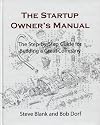
The National Science Foundation pays hundreds of startup teams each year to follow the process outlined in the book, and it's taught at Stanford, Berkeley, Columbia and more than 100 other leading universities worldwide. Why?The Startup Owner's Manual guides you, step-by-step, as you put the Customer Development process to work. This method was created by renowned Silicon Valley startup expert Steve Blank, co-creator with Eric Ries of the "Lean Startup" movement and tested and refined by him show more for more than a decade. This 608-page how-to guide includes over 100 charts, graphs, and diagrams, plus 77 valuable checklists that guide you as you drive your company toward profitability. It will help you: - Avoid the 9 deadly sins that destroy startups' chances for success- Use the Customer Development method to bring your business idea to life- Incorporate the Business Model Canvas as the organizing principle for startup hypotheses- Identify your customers and determine how to "get, keep and grow" customers profitably- Compute how you'll drive your startup to repeatable, scalable profits. show less
Apr 15, 2023Portuguese (Brazil)
You May Also Like
Associated Authors
Statistics
- Works
- 3
- Members
- 547
- Popularity
- #45,592
- Rating
- 3.8
- Reviews
- 3
- ISBNs
- 14
- Languages
- 4