
Mark Finn
Author of Blood and Thunder: The Life and Art of Robert E. Howard
About the Author
Series
Works by Mark Finn
Slings And Arrows 2 copies
A Gathering Of Storms 2 copies
Monty Haul #2 1 copy
Monty Haul #1 1 copy
The Bridge of Teeth 1 copy
Strange Sports Stories (2015) #2 — Author — 1 copy
Associated Works
Tagged
Common Knowledge
- Birthdate
- 1969-10
- Gender
- male
- Birthplace
- Abilene, Texas, USA
- Associated Place (for map)
- Texas, USA
Members
Reviews
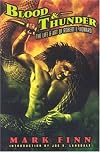
This book explores the life and times of one of the most famous writers ever to come out of the state of Texas. During his brief writing career in the 1920s and 1930s, Robert E. Howard did a lot more for imaginative literature than simply create the character of Conan the Cimmerian.
In the early 1900s, Texas was experiencing an oil boom. Practically overnight, a town would spring up around oil wells, bringing all sorts of people, from roughnecks to work the wells, to barkeepers to show more prostitutes. They would stay until the oil ran out, then move on to the next boom town. Howard grew up in one boom town after another; Isaac, his father, was a frontier doctor, so they also followed the oil. Howard got to see, up close and personal, the dark underside of civilization, and it disgusted him. Finally settling in Cross Plains, he was a voracious reader who hated the regimentation of school. He lived on pulp magazines, like Weird Tales, available at the local general store. Howard was the shy, quiet kid in town with no interest in joining the oil boom.
A major influence on Howard’s development as a writer was the Texas tradition of telling tall tales. Isaac was an expert spinner of tales, and in her own way, Hester, his mother and an Irish immigrant, was pretty good at it, too. Hester had tuberculosis for most of Robert’s life, which forced him to stay home and help take care of her, because Isaac was frequently gone for days on his "rounds." After he became a published author, Howard was one of the mainstays at Weird Tales. He sent them all sorts of stories, usually set in the distant past, showing civilizations that had already degraded into barbarism (like Texas of the early 20th Century). In those days, pulp magazines usually paid half a cent to one cent per word, payment was usually on publication, which could be several months after acceptance, and even then, payment was sporadic. Howard spent hours a day at his typewriter, writing boxing stories (a huge interest of his), poetry and westerns, along with tales of Conan, his most famous creation.
Anyone who has ever picked up a pulp magazine, or who knows REH as more than just the creator of Conan, will love this book, as I did. While Howard’s books are still in print, Howard’s life has fallen into obscurity. This book does a really good job of remedying that situation. show less
In the early 1900s, Texas was experiencing an oil boom. Practically overnight, a town would spring up around oil wells, bringing all sorts of people, from roughnecks to work the wells, to barkeepers to show more prostitutes. They would stay until the oil ran out, then move on to the next boom town. Howard grew up in one boom town after another; Isaac, his father, was a frontier doctor, so they also followed the oil. Howard got to see, up close and personal, the dark underside of civilization, and it disgusted him. Finally settling in Cross Plains, he was a voracious reader who hated the regimentation of school. He lived on pulp magazines, like Weird Tales, available at the local general store. Howard was the shy, quiet kid in town with no interest in joining the oil boom.
A major influence on Howard’s development as a writer was the Texas tradition of telling tall tales. Isaac was an expert spinner of tales, and in her own way, Hester, his mother and an Irish immigrant, was pretty good at it, too. Hester had tuberculosis for most of Robert’s life, which forced him to stay home and help take care of her, because Isaac was frequently gone for days on his "rounds." After he became a published author, Howard was one of the mainstays at Weird Tales. He sent them all sorts of stories, usually set in the distant past, showing civilizations that had already degraded into barbarism (like Texas of the early 20th Century). In those days, pulp magazines usually paid half a cent to one cent per word, payment was usually on publication, which could be several months after acceptance, and even then, payment was sporadic. Howard spent hours a day at his typewriter, writing boxing stories (a huge interest of his), poetry and westerns, along with tales of Conan, his most famous creation.
Anyone who has ever picked up a pulp magazine, or who knows REH as more than just the creator of Conan, will love this book, as I did. While Howard’s books are still in print, Howard’s life has fallen into obscurity. This book does a really good job of remedying that situation. show less
I loved Finn’s biography. It was a major correction in terms of my view of REH, which derived from a hodge-podge of (1) introductions to Ace Editions of his stories (or, “versions” of his stories–considering, of course, how you view the Ace editions), (2) the “Swords and Scrolls” section of *The Savage Sword of Conan,* and (3)–slightly embarrassed by this–the film *The Whole Wide World.* Also, of course, I was enriched by the Del Rey editions and the journal and blog *The show more Cimmerian*
Reading Finn’s biography really helped me reframe Howard as a particularly “Texan” writer. To a large extent, interest in Howard’s psychology had been the source of interest for critics (I am thinking of Edmund Wilson’s horrible review of *Skull-face and Other Stories*). And so, focusing on his context is a good corrective; nevertheless, I think there’s payoff to consider both: context and psychology. Not that Finn disregards context but he does seem to be foregrounding it and downplaying Howard “as a character.”
Reading Finn’s book I get the sense that he is defending Howard’s–not sure how to say this better–”normalcy.” There is a thread of “he wasn’t as crazy as de Camp said he was!” running through that biography.
I’m sure that de Camp spetacularized Howard’s psychology (haven’t read his biography), and yet–and yet! Howard did commit suicide… he was a prize fighter when boxing was illegal… he dressed up in various costumes and walked around his town. He wasn’t crazy–but he wasn’t just another roughneck wandering around Cross Plains.
I mean no disrespect when I say this, but–this is just me reading between the lines of the “text” that his life has become–he was mentally “unique.”
His psychological uniqueness, in connection with his context, are the source of the fiction we love.
But still–Finn’s biography WAS GREAT! I, however, am invested with the personality of artistic genius, which I always think is slightly off-kilter, at odds with society and context. It’s that dissonance–between who the artist is and *where* and *when* they are–that is the source of good fiction. show less
Reading Finn’s biography really helped me reframe Howard as a particularly “Texan” writer. To a large extent, interest in Howard’s psychology had been the source of interest for critics (I am thinking of Edmund Wilson’s horrible review of *Skull-face and Other Stories*). And so, focusing on his context is a good corrective; nevertheless, I think there’s payoff to consider both: context and psychology. Not that Finn disregards context but he does seem to be foregrounding it and downplaying Howard “as a character.”
Reading Finn’s book I get the sense that he is defending Howard’s–not sure how to say this better–”normalcy.” There is a thread of “he wasn’t as crazy as de Camp said he was!” running through that biography.
I’m sure that de Camp spetacularized Howard’s psychology (haven’t read his biography), and yet–and yet! Howard did commit suicide… he was a prize fighter when boxing was illegal… he dressed up in various costumes and walked around his town. He wasn’t crazy–but he wasn’t just another roughneck wandering around Cross Plains.
I mean no disrespect when I say this, but–this is just me reading between the lines of the “text” that his life has become–he was mentally “unique.”
His psychological uniqueness, in connection with his context, are the source of the fiction we love.
But still–Finn’s biography WAS GREAT! I, however, am invested with the personality of artistic genius, which I always think is slightly off-kilter, at odds with society and context. It’s that dissonance–between who the artist is and *where* and *when* they are–that is the source of good fiction. show less
I really enjoyed this look at the life of Robert E. Howard. It seemed far more balanced and scholarly than any other biography of Howard I have ever read. Top notch work. Now, this is how one should write a biography. Engaging to the last, it kept me going even though I have other pressing matters at hand to do.
I expected an easily accessible style. I expected solid scholarship and a passionate defense of Howard's legacy. What I didn't expect was to get so caught up in Mark Finn's picture of Howard's world that I didn't want to put the book down. Of course you should read this if you're a fan of Robert E. Howard and his work. You don't need me to tell you that. But even folks who only know Howard in passing will get caught up in this one.
Awards


You May Also Like


Associated Authors
Statistics
- Works
- 29
- Also by
- 4
- Members
- 207
- Popularity
- #106,919
- Rating
- 4.2
- Reviews
- 8
- ISBNs
- 24