

Jacques Lob (1932–1990)
Author of Snowpiercer, Volume 1: The Escape
About the Author
Series
Works by Jacques Lob
Ulysses (Volumes 1 & 2) — Author — 3 copies
O expresso do amanhã II 2 copies
Lob de la jungle 1 copy
Associated Works
Ali Baba Yaga — Author — 4 copies
Barbarella speciale — Author — 3 copies
Linus (1969) n.4 — Author — 1 copy
Tagged
Common Knowledge
- Birthdate
- 1932-08-19
- Date of death
- 1990-05-24
- Occupations
- comic book creator
- Awards and honors
- Grand Prix de la Ville d'Angoulême 1986.
- Relationships
- Bousset, Couetsch (wife)
- Nationality
- France
- Birthplace
- Paris, France
- Place of death
- Château-Thierry, France
- Associated Place (for map)
- France
Members
Reviews
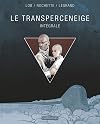
Je m’excuse, I am too lazy to write this review in French. I took the A-level ten years ago and whilst I’ve mostly retained the reading ability, my spoken and written French are very rusty. I found ‘Transperceneige’ for the most part easy to follow. The vocabulary isn’t complicated, although it is is pretty idiomatic. The sentence constructions tend to be quite simple, though, so for the most part I could guess words I didn’t know from context. Having a French dictionary around show more could be helpful, but personally I prefer to get caught up in the story and miss the odd word to constantly stopping and checking things. I’ll need a re-read to catch some plot nuances, I think.
I’ve never read a graphic novel, or indeed any novel, quite like ‘Transperceneige’. It was thanks to the trailer for the film (to be called Snowpiercer en anglais) that I discovered its existence. The whole story, broken into three parts, is set on a vast train travelling through a new ice age. As far as they know, the inhabitants of the train are the last living beings on the planet. This post-apocalyptic premise is strikingly evoked by the monochrome art, which gets darker as the book progresses. Political machinations and the struggle for survival are played out in the claustrophobic confines of the train. I was impressed by how well the tension kept up throughout the book, which is longer than most graphic novels.
In fact, the novel was a lot darker and more unsettling than I expected. Since it has been made into a big screen film, I assumed it would be more hopeful and Hollywood-ish (as I note the international trailer for the film made it seem). I’m more eager than ever now to see the film and how the novel has been adapted. I don’t want to comment too much on the plot to avoid spoilers, though. Suffice it to say, I found it involving and worthy of top quality dystopian fiction. The characters were interesting, although there weren't enough women. (It was written in the 1980s.) I liked the art a lot, as it showed the stark contrast between the interior and exterior of the train beautifully. ‘Transperceneige’ is a pessimistic and powerful piece of work, as well as an elegant metaphor for environmental destruction. Plus, it gave me an excuse to read aloud in French, which is great fun. show less
I’ve never read a graphic novel, or indeed any novel, quite like ‘Transperceneige’. It was thanks to the trailer for the film (to be called Snowpiercer en anglais) that I discovered its existence. The whole story, broken into three parts, is set on a vast train travelling through a new ice age. As far as they know, the inhabitants of the train are the last living beings on the planet. This post-apocalyptic premise is strikingly evoked by the monochrome art, which gets darker as the book progresses. Political machinations and the struggle for survival are played out in the claustrophobic confines of the train. I was impressed by how well the tension kept up throughout the book, which is longer than most graphic novels.
In fact, the novel was a lot darker and more unsettling than I expected. Since it has been made into a big screen film, I assumed it would be more hopeful and Hollywood-ish (as I note the international trailer for the film made it seem). I’m more eager than ever now to see the film and how the novel has been adapted. I don’t want to comment too much on the plot to avoid spoilers, though. Suffice it to say, I found it involving and worthy of top quality dystopian fiction. The characters were interesting, although there weren't enough women. (It was written in the 1980s.) I liked the art a lot, as it showed the stark contrast between the interior and exterior of the train beautifully. ‘Transperceneige’ is a pessimistic and powerful piece of work, as well as an elegant metaphor for environmental destruction. Plus, it gave me an excuse to read aloud in French, which is great fun. show less
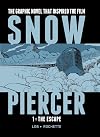
SNOWPIERCER by Jacques Lob as writer and artwork provided by Jean-Marc Rochette, is a evocative view of a dystopian future. All of humanity is relegated to live aboard one solitary train that constantly drives onward through a stark ice age. Nothing lives outside the train. Within the massive super vehicle, 1001 cars long, the population is still stratified. Military might keeps the poor in their ghetto at the rear of the train while the powerful enjoy a life of splendor at the front.
And show more then one man escapes from the tail end cars and life changes for everyone.
Superb storytelling from 1984, now in updated versions to coincide with the release of a movie version, this story is a harsh commentary on modern life and just as vital now 34 years later. show less
And show more then one man escapes from the tail end cars and life changes for everyone.
Superb storytelling from 1984, now in updated versions to coincide with the release of a movie version, this story is a harsh commentary on modern life and just as vital now 34 years later. show less
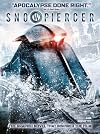
A train holds the survivors of a sudden nuclear winter, and they build an extremely classist society in the microcosm of its compartments and halls. This is a loopy premise that could turn corny in the hands of a lesser writer, but here, it's the base for a quite adult, sociologically interesting story. As with most polemic pieces, the characters are a bit thin, but no matter. The art is solid, though the panel layout won't win any awards. But the writing is the thing to focus on here, and show more that's rather above average. show less

I watched the movie Snowpiercer recently. It had an interesting concept: the Earth was frozen and its only survivors were aboard a fast-moving train. There were some high concepts introduced -- climate change, class and status during a dystopian future -- but the movie was a complete joke as its internal inconsistencies piled up too high.
The movie, though, was based on a graphic novel. So I looked that up. Le Transperceneige had a snowy background, a long train, and a few people who wanted show more to go from the back to the front. That's about all it shared with the movie. (In some ways, that was disappointing, as I wanted questions about the movie answered, but perhaps it's all for the best.)
Here, we have our hero, a passenger in the back cars of the train (and thus with a much lower status than those in the front cars) wanting to prove something by literally advancing his cause. He's joined by a woman who has some privilege, but only enough to get the story moving. There are some odd moments along the way (like a love affair in a side bathroom that ultimately goes nowhere), and a few that seem a bit more exaggerated than what might "really" happen (for example, during yet another advancement, the heroic duo are surrounded by train police, and the police start shooting -- the two in the middle essentially duck and that's the end of those officers).
I'm not sure I would have rated this higher even if I hadn't seen the movie. The ending (of the book) is a bit too fatalistic for my tastes. But it's much more internally consistent than the movie.
-----------------------
LT Haiku:
Life protects its own,
and social order system
exists to do same. show less
The movie, though, was based on a graphic novel. So I looked that up. Le Transperceneige had a snowy background, a long train, and a few people who wanted show more to go from the back to the front. That's about all it shared with the movie. (In some ways, that was disappointing, as I wanted questions about the movie answered, but perhaps it's all for the best.)
Here, we have our hero, a passenger in the back cars of the train (and thus with a much lower status than those in the front cars) wanting to prove something by literally advancing his cause. He's joined by a woman who has some privilege, but only enough to get the story moving. There are some odd moments along the way (like a love affair in a side bathroom that ultimately goes nowhere), and a few that seem a bit more exaggerated than what might "really" happen (for example, during yet another advancement, the heroic duo are surrounded by train police, and the police start shooting -- the two in the middle essentially duck and that's the end of those officers).
I'm not sure I would have rated this higher even if I hadn't seen the movie. The ending (of the book) is a bit too fatalistic for my tastes. But it's much more internally consistent than the movie.
-----------------------
LT Haiku:
Life protects its own,
and social order system
exists to do same. show less
Lists
Awards

You May Also Like


Associated Authors
Statistics
- Works
- 28
- Also by
- 3
- Members
- 650
- Popularity
- #38,840
- Rating
- 3.4
- Reviews
- 24
- ISBNs
- 58
- Languages
- 7