On This Page
Description
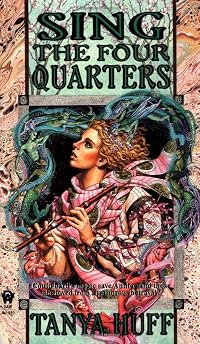
Fantasy. Fiction. HTML:The Bards of Shkoder hold the country together. They, and the elemental spirits they Sing – earth, air, fire, and water - bring the news of the sea to the mountains, news of the mountains to the plains. They give their people, from peasant to king, a song in common.Annice is a rare talent, able to Sing all four quarters, but her brother, the newly enthroned King Theron, sees her request to study at the Bardic Hall as a betrayal. To his surprise, Annice accepts his show more conditions, renouncing her royal blood and swearing to remain childless so as not to jeopardize the line of succession. She walks away from political responsibilities, royal privilege and her family.
Ten years later, Annice has become the Princess Bard and her real life is about to become the exact opposite of the overwrought ballad her fellow students at the Bardic Hall wrote about her. Now, she's on the run from the Royal Guards with the Duc of Ohrid, the father of her unborn child, both of them guilty of treason – one of them unjustly accused. To save the Duc's life, they'll have to cross the country, manage to keep from strangling each other, and defeat an enemy too damaged for even a Bard's song to reach. show less
Tags
Recommendations



Member Reviews
Thoroughly enjoyed this. Strong world-building - the bards in this world sing to the kigh. Kigh are best described as elemental spirits who will help the bards in return for the song. While many people and cultures value the kigh and what they can do, others regard them with fear and superstition. This leads to some interesting conflicts - and some logical plot points that are wonderfully obvious in retrospect when both you and the characters realise at the same point that you should have spotted it sooner. (I like writers who can do that to me)
The characters are well developed. I was particularly pleased when one character, whom I'd thought to be a bit one-dimensional and cliched, turned out to be nothing of the sort. I'd been viewing show more him through the eyes of a character who had her own prejudices. (With many writers, the protagonist would automatically be correct in their assessment, so again, I regarded this as good writing.
This book is also unusual in that there are several gay/lesbian couples and their relationship is simply part of who they are. It isn't essential to the plot. There isn't a romance (love, yes, romance no). Simply people with different sexual identities living normal lives in a culture that has no issues on this subject.
I got the first book in the series free. I'm now off to buy the second book and look forward to buying more by this author. show less
The characters are well developed. I was particularly pleased when one character, whom I'd thought to be a bit one-dimensional and cliched, turned out to be nothing of the sort. I'd been viewing show more him through the eyes of a character who had her own prejudices. (With many writers, the protagonist would automatically be correct in their assessment, so again, I regarded this as good writing.
This book is also unusual in that there are several gay/lesbian couples and their relationship is simply part of who they are. It isn't essential to the plot. There isn't a romance (love, yes, romance no). Simply people with different sexual identities living normal lives in a culture that has no issues on this subject.
I got the first book in the series free. I'm now off to buy the second book and look forward to buying more by this author. show less
Summary: When she was fourteen, Princess Annice was offered a choice: stay as a princess and marry someone her brother, the new king, found politically expedient; or to follow her heart and train to become a Bard - one capable of directing the elemental spirits - but give up all of her royal ties and privileges in the process. Annice chose the later without a moment's hesitation, and although she hasn't spoken to her brother in the intervening ten years, she loves life as a bard, and has become one of the most powerful singers in the Bardic Hall. But all of that changes when Annice finds herself committing treason twice-over. Not only is she pregnant (a condition that was specifically forbidden to her by her brother when she chose to show more become a bard), but the father of her child, the Duc of Ohrid, has been accused of plotting to allow hostile forces from a neighboring country free passage through his lands. Annice doesn't believe the Duc capable of such an act, but she can't go to her brother without revealing her own treasonous condition, so she must find another way to keep the Duc from his appointment with the headsman long enough for them to unravel what's really going on.
Review: Solid, original, thoroughly enjoyable fantasy. There were a few bumps along the way, but there were also a lot of things that I really enjoyed, and on the whole I found this book highly entertaining. It's got a subtle touch with worldbuilding and characterization, an original plot, a good wit, and a down-to-earth sensibility, and I frequently found myself wishing that I had more books like this: maybe not mind-shatteringly amazing, but solidly, reliably, readably good.
One of the things I liked best about this book was that it felt appropriately high fantasy, without having anything like a "standard" high fantasy plot. There was no quest to go on, no ultimate battle between the forces of good and evil, just a lot of sympathetic characters making understandable choices that wind up getting them stuck in impossible-to-resolve situations. Even the ostensible bad guy was acting out of believable (if not entirely sympathetic) motivations, but the beauty of the plot was that the majority of the dramatic tension originated from good people trying to do what they thought was right.
This was certainly helped by Huff's skill at characterization; even with the royalty and the magic and everything, her characters felt like real people. No one is entirely good or entirely bad; even the good guys are cursed with stubbornness or short tempers or other frustrating character tics. The dialogue (and the prose style in general) is similarly down-to-earth, with characters able to have high-minded political discussions or lofty conversations about magic but still likely to mutter imprecations at the minor trials of everyday life. I also really appreciated Huff's take on sexuality; it's still fairly rare nowadays to have stories that feature bisexual / homosexual characters without making their homosexuality A Thing, and I imagine it was even rarer in the mid-90s. Annice could easily have been written as straight, with Stasya (her primary partner) being relegated to the role of best friend, and I applaud Huff for making the more interesting and potentially more controversial character choice. But what I thought spoke even more to the issue of diversity and acceptance was that Annice's (and others') sexuality was just taken as given by all of the other characters, not as something interesting or controversial or even worth remarking on at all.
My only real problem with this book was that the writing was occasionally a little choppy. Huff switches viewpoints frequently, which I don't mind, but she frequently does so within a single scene, which I found to be somewhat distracting. I eventually got into the rhythm of the viewpoint switches, though, and really, I was enjoying the characters and the story too much for it bother me for long. 4 out of 5 stars.
Recommendation: Definitely recommended for fantasy fans who are looking for a solidly enjoyable read that's not a re-hash of something they've read a thousand times before. It may be on the backlist, but it's not showing its age at all. show less
Review: Solid, original, thoroughly enjoyable fantasy. There were a few bumps along the way, but there were also a lot of things that I really enjoyed, and on the whole I found this book highly entertaining. It's got a subtle touch with worldbuilding and characterization, an original plot, a good wit, and a down-to-earth sensibility, and I frequently found myself wishing that I had more books like this: maybe not mind-shatteringly amazing, but solidly, reliably, readably good.
One of the things I liked best about this book was that it felt appropriately high fantasy, without having anything like a "standard" high fantasy plot. There was no quest to go on, no ultimate battle between the forces of good and evil, just a lot of sympathetic characters making understandable choices that wind up getting them stuck in impossible-to-resolve situations. Even the ostensible bad guy was acting out of believable (if not entirely sympathetic) motivations, but the beauty of the plot was that the majority of the dramatic tension originated from good people trying to do what they thought was right.
This was certainly helped by Huff's skill at characterization; even with the royalty and the magic and everything, her characters felt like real people. No one is entirely good or entirely bad; even the good guys are cursed with stubbornness or short tempers or other frustrating character tics. The dialogue (and the prose style in general) is similarly down-to-earth, with characters able to have high-minded political discussions or lofty conversations about magic but still likely to mutter imprecations at the minor trials of everyday life. I also really appreciated Huff's take on sexuality; it's still fairly rare nowadays to have stories that feature bisexual / homosexual characters without making their homosexuality A Thing, and I imagine it was even rarer in the mid-90s. Annice could easily have been written as straight, with Stasya (her primary partner) being relegated to the role of best friend, and I applaud Huff for making the more interesting and potentially more controversial character choice. But what I thought spoke even more to the issue of diversity and acceptance was that Annice's (and others') sexuality was just taken as given by all of the other characters, not as something interesting or controversial or even worth remarking on at all.
My only real problem with this book was that the writing was occasionally a little choppy. Huff switches viewpoints frequently, which I don't mind, but she frequently does so within a single scene, which I found to be somewhat distracting. I eventually got into the rhythm of the viewpoint switches, though, and really, I was enjoying the characters and the story too much for it bother me for long. 4 out of 5 stars.
Recommendation: Definitely recommended for fantasy fans who are looking for a solidly enjoyable read that's not a re-hash of something they've read a thousand times before. It may be on the backlist, but it's not showing its age at all. show less
I've read enough fantasy involving music-based magic that it was neat to see it treated as magic, not music. Music theory is interesting, I suppose, but not always what I want a lecture on.
This also may be the first fantasy novel I've ever read where the main character's pregnancy is central to the plot for the entire book. And one of the very few where the bi woman and her lesbian partner don't end up splitting up so the bi chick can end up with the dude. (Or where the lesbian dies.) This is why I love Tanya Huff.
Political issues aside, this is a solid middlebrow fantasy along the lines of the Valdemar series, with less wish-fulfillment and more fundamental queer-friendliness. Right up my alley.
This also may be the first fantasy novel I've ever read where the main character's pregnancy is central to the plot for the entire book. And one of the very few where the bi woman and her lesbian partner don't end up splitting up so the bi chick can end up with the dude. (Or where the lesbian dies.) This is why I love Tanya Huff.
Political issues aside, this is a solid middlebrow fantasy along the lines of the Valdemar series, with less wish-fulfillment and more fundamental queer-friendliness. Right up my alley.
This is actually the only one of this Bard series that I've read. I have trouble with the elemental fairie sprite things that keep following the bards around. Too much like cartoons or talking animals.
But, Tadeus the gay blind bard? Completely rocks. And I told Tanya Huff so, in a moment of fangirl blither at a con once.
But, Tadeus the gay blind bard? Completely rocks. And I told Tanya Huff so, in a moment of fangirl blither at a con once.
This is actually the only one of this Bard series that I've read. I have trouble with the elemental fairie sprite things that keep following the bards around. Too much like cartoons or talking animals.
But, Tadeus the gay blind bard? Completely rocks. And I told Tanya Huff so, in a moment of fangirl blither at a con once.
But, Tadeus the gay blind bard? Completely rocks. And I told Tanya Huff so, in a moment of fangirl blither at a con once.
This is actually the only one of this Bard series that I've read. I have trouble with the elemental fairie sprite things that keep following the bards around. Too much like cartoons or talking animals.
But, Tadeus the gay blind bard? Completely rocks. And I told Tanya Huff so, in a moment of fangirl blither at a con once.
But, Tadeus the gay blind bard? Completely rocks. And I told Tanya Huff so, in a moment of fangirl blither at a con once.
Really liked this book, will definitely be reading the rest of the series. Interesting magic system, normalized queer relationships, drama, a dose of chaos.
Members
- Recently Added By
Lists

Best Fantasy Novels
821 works; 357 members

Future Green Dragon Group Read Books
80 works; 6 members

LGBTQ+ Speculative Fiction
820 works; 50 members
Author Information

96+ Works 32,146 Members
Tanya Huff was born in Halifax, Nova Scotia, Canada. After graduating high school, she served in the Canadian Naval Reserve as a cook from 1975 to 1979. She received a B.A.A. in radio and television arts from Ryerson Polytechnical Institute. After graduating college, she worked at Bakka, Canada's oldest SF and fantasy book store, from 1985 to show more 1992. She is the author of more than 20 books including Blood Price, Blood Trail, Blood Lines, Blood Pact, and Blood Debt. (Bowker Author Biography) show less
Some Editions
Series

Belongs to Publisher Series
DAW Book Collectors (970)
Work Relationships
Is contained in
Common Knowledge
- Canonical title
- Sing the Four Quarters
- Original publication date
- 1994
- People/Characters
- Annice; Stasya; King Theron; Lilyana; Captain Liene; Pjerin a'Stasiek (show all 16); Gerek a'Pjerin; Olina i'Katica; Lucas a'Tynek; Bohdan a'Samuil; Leksik i'Samuil; Tadeus; Jazep; Jurgis; Elica; Albek
- Important places
- Elbasan, Shkoder; Ohrid; Cemandia
- Dedication
- For Daniel,
whose timing couldn't have been better.
And for his mother, who shared. - First words
- "Was it something I said?" The inkeeper laughed as the young woman continued her headlong dash out of the door, ignoring him completely.
- Last words
- (Click to show. Warning: May contain spoilers.)Over her head, Stasya and Pjerin exchanged identical expressions of disbelief.
- Blurbers
- Rawn, Melanie
Classifications
Statistics
- Members
- 1,156
- Popularity
- 21,653
- Reviews
- 17
- Rating
- (3.79)
- Languages
- English
- Media
- Paper, Audiobook, Ebook
- ISBNs
- 4
- ASINs
- 3