
Iggie's House
by Judy Blume
On This Page
Description
When an African American family with three children moves into her white neighborhood, eleven-year-old Winnie learns the difference between being a good neighbor and being a good friend.Tags
Recommendations






















Member Reviews
Iggie's house just wasn't the same. Iggie was gone, moved to Tokyo. And there was Winnie, cracking her gum on Grove Street, where she'd always lived, with no more best friend and two weeks left of summer.
Then the Garber family moved into Iggie's house—two boys, Glenn and Herbie, and Tina, their little sister. The Garbers were black and Grove Street was white and always had been. Winnie, a welcoming committee of one, set out to make a good impression and be a good neighbor. That's why the trouble started.
Glenn and Herbie and Tina didn't want a "good neighbor." They wanted a friend.
Then the Garber family moved into Iggie's house—two boys, Glenn and Herbie, and Tina, their little sister. The Garbers were black and Grove Street was white and always had been. Winnie, a welcoming committee of one, set out to make a good impression and be a good neighbor. That's why the trouble started.
Glenn and Herbie and Tina didn't want a "good neighbor." They wanted a friend.
This is one of Blume's books for younger readers, but despite this (and its age), she manages to examine race relations in suburbia in a really provocative way, touching on many of the sometimes-conflicted emotions that children caught in the racial crossfires might experience. The black children in the novel, for example, have understandable problems trusting their new white friend--is she being genuine, or does she just want an exotic token of her openmindedness? That Blume had the guts to address these sort of complexities is a testament to the respect she gave young readers.
When Winnie’s best friend Iggie moves away, a new family—the Garbers—moves into her house. Winnie is excited to welcome them, but not everyone in the neighborhood is as kind. The Garbers are the first Black family on the block, and Winnie quickly learns that standing up for what's right can be uncomfortable, complicated, and necessary.
Narrated by Emily Janice Card. Winnie’s best friend Iggie has moved to Tokyo and Winnie still misses her. Then the Garber family moves into Iggie’s house with three kids. Winnie is excited to meet the kids and even more intrigued because the family is black. But some of the neighbors especially Mrs. Landon are concerned about what the Garbers’ presence means for the neighborhood. Card's presentation is likable but I found the story uncomfortably dated, even viewing it as a historical novel.
"Winnie Barringer feels lonely ever since her best friend Iggie moved away. She is thrilled when a new family moves into Iggie's house, and hopes Glenn, Herbie and Tina Garber will all want to be her friends. But the Garbers are the first black family on an all-white block. Will that stand in the way of their friendship?" - jacket notes
First published 1970. Direct conflict between families (petitions, threats to move etc.), realistic emotional reactions from the white and black families. Winnie discovers that the issues are complex, and some issues remain unresolved at the end of the book, but a cautious friendship is growing. Somewhat dated. A serious and sad tone, a drama not a comedy. Perhaps suitable for grade 4 to 6.
First published 1970. Direct conflict between families (petitions, threats to move etc.), realistic emotional reactions from the white and black families. Winnie discovers that the issues are complex, and some issues remain unresolved at the end of the book, but a cautious friendship is growing. Somewhat dated. A serious and sad tone, a drama not a comedy. Perhaps suitable for grade 4 to 6.
Rather heavy-handed YA novel on the evils of racism.
I felt this book was different from all other of Judy Blume's wonderful books. It says how segragation sometimes stays in people's lives. It gave a message that all people are different; and you should always respect that.
Members
- Recently Added By
Lists

Which house?
423 works; 16 members
Author Information

87+ Works 103,940 Members
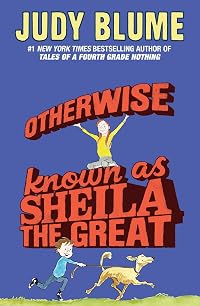
Judy Blume was born in Elizabeth, New Jersey on February 12, 1938. She received a bachelor's degree in education from New York University in 1961. Her first book, The One in the Middle Is the Green Kangaroo, was published in 1969. Her other books include Are You There, God? It's Me Margaret; Then Again, Maybe I Won't; Tales of a Fourth Grade show more Nothing; Otherwise Known as Sheila the Great; and Blubber. Her adult titles include Wifey, Smart Women, Summer Sisters, and In the Unlikely Event. In 1996, she received the American Library Association's Margaret A. Edwards Award for Lifetime Achievement and in 2004, she received the National Book Foundation's Medal for Distinguished Contribution to American Letters. (Bowker Author Biography) show less
Some Editions
Work Relationships
Common Knowledge
- Original publication date
- 1970
- People/Characters
- Winifred Bates Barringer; Glenn Garber; Herbie Garber; Tina Garber
- Dedication
- For Lee Wyndham
- First words
- Winnie shoved a second piece of gum into her mouth.
- Last words
- (Click to show. Warning: May contain spoilers.)Winnie spat the double wad of gum she was chewing into the waste basket and ran down the stairs.
- Original language
- English
Classifications
- Genres
- Kids, Children's Books, Fiction and Literature
- DDC/MDS
- 813.54 — Literature & rhetoric American literature in English American fiction in English 1900-1999 1945-1999
- LCC
- PZ7 .B6265 .I — Language and Literature Fiction and juvenile belles lettres Fiction and juvenile belles lettres Juvenile belles lettres
- BISAC
Statistics
- Members
- 1,950
- Popularity
- 10,925
- Reviews
- 11
- Rating
- (3.47)
- Languages
- Catalan, English, Spanish
- Media
- Paper, Audiobook, Ebook
- ISBNs
- 40
- ASINs
- 25