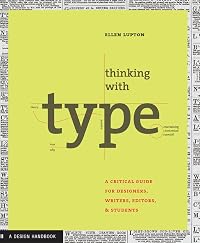
Thinking with Type
by Ellen Lupton
On This Page
Description
"Thinking with Type is to typography what Stephen Hawking's A Brief History of Time is to physics."-I Love Typography The best-selling Thinking with Type in a revised and expanded second edition: Thinking with Type is the definitive guide to using typography in visual communication. Ellen Lupton provides clear and focused guidance on how letters, words, and paragraphs should be aligned, spaced, ordered, and shaped. The book covers all typography essentials, from typefaces and type families, show more to kerning and tracking, to using a grid. Visual examples show how to be inventive within systems of typographic form, including what the rules are, and how to break them. This revised edition includes forty-eight pages of new content with the latest information on: - style sheets for print and the web - the use of ornaments and captions - lining and non-lining numerals - the use of small caps and enlarged capitals - mixing typefaces - font formats and font licensing Plus, new eye-opening demonstrations of basic typography design with letters, helpful exercises, and dozens of additional illustrations. Thinking with Type is the typography book for everyone: designers, writers, editors, students, and anyone else who works with words. If you love font and lettering books, Ellen Lupton's guide reveals the way typefaces are constructed and how to use them most effectively. Fans of Thinking with Type will love Ellen Lupton's new book Extra Bold: A Feminist, Inclusive, Anti-racist, Nonbinary Field Guide for Graphic Designers. show lessTags
Recommendations






Member Recommendations
Member Reviews
Graphic design is an important help to any venture. In the age of electronic communication, it has become only more important to capture the public’s attention. Distractions abound, but well-thought visuals stand the chance of garnering a glance. Of course, only deeper substance will sustain interest in a written work, but interest will never be piqued without visual appeal. Lupton’s work seeks to enlighten those who deal with type in some format about the graphical principles required to display those words pleasingly.
Lupton divides her book into three main sections: Letter, Text, and Grid. Letter covers typefaces and fonts; Text covers practices about forming words into sentences; and Grid covers how to lay them out on a page or show more screen. The book primarily examines the medium of print, but communication via computers frequently receives mention. Further, many of the concepts of graphical appeal can be translated to this increasingly common mew medium. (Some readers might also benefit from Lupton’s Type on Screen, but this work is the more important seminal work.) Like any graphical design book, frequent use of example images litter the book throughout. Every caption not only cites a source but also informs the reader of its worth.
As the subtitle suggests, multiple potential audiences exist for this classic. Pure graphic designers provide an obvious one, but writers, editors, students, and even web developers (like myself) can benefit from perusing Lupton’s pages. After reading this, I immediately changed a graphic or two in my software’s code. It’s hard not to get thinking creatively about how type is presented after reading this work, both through well-explicated ideas and copious inspirational examples. Reading it is time well spent. show less
Lupton divides her book into three main sections: Letter, Text, and Grid. Letter covers typefaces and fonts; Text covers practices about forming words into sentences; and Grid covers how to lay them out on a page or show more screen. The book primarily examines the medium of print, but communication via computers frequently receives mention. Further, many of the concepts of graphical appeal can be translated to this increasingly common mew medium. (Some readers might also benefit from Lupton’s Type on Screen, but this work is the more important seminal work.) Like any graphical design book, frequent use of example images litter the book throughout. Every caption not only cites a source but also informs the reader of its worth.
As the subtitle suggests, multiple potential audiences exist for this classic. Pure graphic designers provide an obvious one, but writers, editors, students, and even web developers (like myself) can benefit from perusing Lupton’s pages. After reading this, I immediately changed a graphic or two in my software’s code. It’s hard not to get thinking creatively about how type is presented after reading this work, both through well-explicated ideas and copious inspirational examples. Reading it is time well spent. show less
I've read many, many books on typography and I still learned new things from this one.
The section on individual letters is very strong, including information on the parts of a letter and on the history of typefaces, with more information on 20th century typefaces than I've seen in comparable reference works.
The section on individual letters is very strong, including information on the parts of a letter and on the history of typefaces, with more information on 20th century typefaces than I've seen in comparable reference works.
Many situations of visual communication in practice involve written language; interaction design is no exception in that regard. Typography is important in all those situations, and the book by Lupton is a really good introduction for teaching and learning. It draws upon the history of typography, presents a broad collection of typographic concepts and well-chosen examples, and shares practical advice, all in a very accessible and enjoyable way.
Not terribly in-depth, but a good introduction to the concepts of page design (whether paper or web) and typography. Most of which I knew but this is nicely condensed with some examples scattered along the way.
I would recommend it to people getting into typography or design, proabably too simple for someone with experience but a good primer.
I would recommend it to people getting into typography or design, proabably too simple for someone with experience but a good primer.
The organization of letters on a blank sheet—or screen—is the most basic challenge facing anyone who practices design. What type of font to use? How big? How should those letters, words, and paragraphs be aligned, spaced, ordered, shaped, and otherwise manipulated? In this groundbreaking new primer, leading design educator and historian Ellen Lupton provides clear and concise guidance for anyone learning or brushing up on their typographic skills. Thinking with Type is divided into three sections: letter, text, and grid. Each section begins with an easy-to-grasp essay that reviews historical, technological, and theoretical concepts, and is then followed by a set of practical exercises that bring the material covered to life. show more Sections conclude with examples of work by leading practitioners that demonstrate creative possibilities (along with some classic no-no's to avoid). show less
Really great overview. I've been struggling with the density of "Elements of typographic style". But thanks to this book, I'll go back with a better mental model.
Great examples. Sometimes references to the Web feel a bit dated.
Great examples. Sometimes references to the Web feel a bit dated.
Excellent! Everyone who works with words in some way — designers, editors, writers, and their employers and clients — should read this book. It is smartly organized and dense with insight and advice. The final section, "Grid," and the appendix are particularly noteworthy. Highly recommended.
Members
- Recently Added By
Published Reviews
ThingScore 88
Thinking with type is worthy of adding to your library; it's essential if you salivate when you look at well-designed and well-chosen type.
added by Katya0133
Thinking with Type is written with warmth and clarity. Together with its compact size and affordable price, the book is destined to become an essential part of many typographers' and designers' libraries.
added by Katya0133
Lists

design
7 works; 3 members

The Great Courses: Visual Literacy Skills
53 works; 1 member
Author Information

43+ Works 4,385 Members
Ellen Lupton is Adjunct Curator at the Cooper-Hewitt National Design Museum and Co-Chair of the Design Department of the Maryland Institute College of Art.
Series
Belongs to Publisher Series
Common Knowledge
- Canonical title
- Thinking with Type
- Original title
- Thinking with Type
- Original publication date
- 2004
- Dedication
- Dedicated to George Sadek and all my teachers
- First words
- The organization of letters on a blank page--or screen--is the designer's most basic challenge.
Classifications
Statistics
- Members
- 1,771
- Popularity
- 12,429
- Reviews
- 18
- Rating
- (3.91)
- Languages
- 9 — Catalan, Chinese, English, French, German, Greek, Italian, Spanish, Portuguese (Portugal)
- Media
- Paper, Ebook
- ISBNs
- 22
- UPCs
- 1
- ASINs
- 8