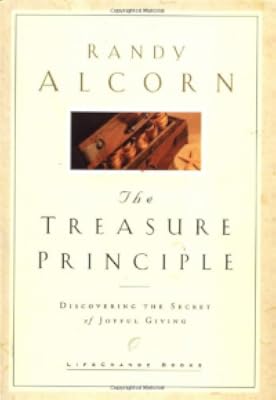
The Treasure Principle
by Randy Alcorn 
On This Page
Description
Discover a joy more precious than gold! Priceless treasure is within your reach. And with it, liberating joy. In Randy Alcorn's The Treasure Principle, you'll unearth a radical teaching of Jesus - a secret wrapped up in giving. Once you discover this secret, life will never look the same. And you won't want it to!.Tags
Recommendations

Member Reviews
Nice discussion on joy, glorification, and a godly perspective on life, that comes from Jesus' brief parable about finding the treasure in the field. Alcorn, however, exchanges Jesus' wider paradigm of love for the paradigm given to us by bankers and capitalists. Although there are many things I will revisit as I discuss stewardship in the future (e.g., section on Tyranny of Things and principle #5: Giving is the antidote to materialism), Acorn's starting point sets the whole tone of the book, and it's not a tone rooted in love.
He's right about so much: Giving can/should be joyful, Giving jump starts our relationship with God, Giving helps us store up heavenly rewards, but what is almost entirely absent is the object of the giving: the show more poor.
Acorn writes, "We need to feed, clothe, house, and transport our families. But when the basics are taken care of, why shouldn't the rest go toward treasures in heaven?" He also writes, "When we die after devoting our lives to acquiring things, we don't win--we lose." In both cases, he ends with a focus on ourselves instead of on others, that is, his motivation isn't love. The first statement should end with the phrase the poor who need it and the second with the poor lose.
Acorn believes that the biggest roadblock to giving is thinking that earth is our home. He's wrong. The biggest roadblock is our lack of empathy with the poor. For who could live the affluent life of a suburban American with all our excess and know that there are people dying because our money is tied up in HDTV subscriptions? show less
He's right about so much: Giving can/should be joyful, Giving jump starts our relationship with God, Giving helps us store up heavenly rewards, but what is almost entirely absent is the object of the giving: the show more poor.
Acorn writes, "We need to feed, clothe, house, and transport our families. But when the basics are taken care of, why shouldn't the rest go toward treasures in heaven?" He also writes, "When we die after devoting our lives to acquiring things, we don't win--we lose." In both cases, he ends with a focus on ourselves instead of on others, that is, his motivation isn't love. The first statement should end with the phrase the poor who need it and the second with the poor lose.
Acorn believes that the biggest roadblock to giving is thinking that earth is our home. He's wrong. The biggest roadblock is our lack of empathy with the poor. For who could live the affluent life of a suburban American with all our excess and know that there are people dying because our money is tied up in HDTV subscriptions? show less
A quick read on an important topic, Alcorn's general premise is not unique to many books written on Christian stewardship. What is unique is the winsome presentation of Alcorn's argument; careful to avoid guilt, self centeredness, or false promises in the Christian exhortation to be generous. Alcorn has mined Scripture throughly here; and it is a great resource.
My one tiny quibble on the book could be summed in one question. Why don't we just give everything away? And there Alcorn is less clear about the stewardship of not just giving, but of everyday life that we do have to keep for ourselves. But to ask him to write at length on that would have veered off into territory that I think would have harmed his central thought in the book show more (and given selfish American Evangelicals a "way out"). So a tiny quibble does remain, but only because the wisdom of this book is just that good and I'd like for him to write more. show less
My one tiny quibble on the book could be summed in one question. Why don't we just give everything away? And there Alcorn is less clear about the stewardship of not just giving, but of everyday life that we do have to keep for ourselves. But to ask him to write at length on that would have veered off into territory that I think would have harmed his central thought in the book show more (and given selfish American Evangelicals a "way out"). So a tiny quibble does remain, but only because the wisdom of this book is just that good and I'd like for him to write more. show less
This is a deceptively powerful book. It does what I hope all books will do for me. it's changing the way that I think about how the world works. Here are some of my favorite quotes and thoughts. I hope to add more.
Why did Jesus put such an emphasis on money and possessions? Because there's a fundamental connection between their spiritual blindness think about it handle money. We may try to divorce her faith and her finances, but God sees them as inseparable.
Suppose I offer you $1000 today to spend however you want. Not a bad deal. But suppose I give you a choice you can either have that $1000 today or you can have $10 million one year from now, and ten million more every year after that. Only a fool would take that thousand dollars show more today. Yet that's what we do whenever we grab onto something that will last for only a moment, foregoing something far more valuable we could enjoy later for much Longer.
I got the idea from this book to make my personal library more of a loaning library.
Giving isn't a luxury of the rich. It's a privilege of the pool. I've discovered that Christians find no greater joy than in giving.
There have been days when I've lost focus, and then a need arises and God leads me to give. Suddenly I'm infused with energy, purpose, and joy. I feel God's pleasure.
He recommends taking a family trip to a junkyard as a powerful object lesson. show less
Why did Jesus put such an emphasis on money and possessions? Because there's a fundamental connection between their spiritual blindness think about it handle money. We may try to divorce her faith and her finances, but God sees them as inseparable.
Suppose I offer you $1000 today to spend however you want. Not a bad deal. But suppose I give you a choice you can either have that $1000 today or you can have $10 million one year from now, and ten million more every year after that. Only a fool would take that thousand dollars show more today. Yet that's what we do whenever we grab onto something that will last for only a moment, foregoing something far more valuable we could enjoy later for much Longer.
I got the idea from this book to make my personal library more of a loaning library.
Giving isn't a luxury of the rich. It's a privilege of the pool. I've discovered that Christians find no greater joy than in giving.
There have been days when I've lost focus, and then a need arises and God leads me to give. Suddenly I'm infused with energy, purpose, and joy. I feel God's pleasure.
He recommends taking a family trip to a junkyard as a powerful object lesson. show less
I think this is a great resource to examine one's attitude toward money and things in general. With the world being so materialistic, it is a great reminder about what is really important. At the end of our lives, will we really say "I am so glad that I had the latest gadgets" or "I made a difference in the world by trying to keep up with the latest fashions"? The focus was to be more like John Wesley, whom Mr. Alcorn quotes "Money never stays with me. It would burn me if it did. I throw it out of my hands as soon as possible, lest it should find its way into my heart." It is not that money in and of itself is bad, but how it is used, and as Christians we will one day have to give an account with everything the Lord entrusted us with-- show more not only our talents and lives but also our money. Did we spend more of it on ourselves (outside of necessary living expenses) than on feeding the hungry, or trying to educate the impoverished, etc? I don't see the major theme as using money now to buy goods in heaven (although Jesus did talk about "laying up treasures in heaven" by what we do and give in our earthly life), but since Jesus himself did talk about this, Mr. Alcorn addresses it as well. I think that since Jesus addressed this, I don't find Randy Alcorn's addressing it objectionable. Even though, truly, everyone should give for purely altruistic reasons and cheerfully, I guess there are some that need a little extra encouragement and motivation. show less
I picked this book up used from Harvest Logos bookstore and I'm afraid that I'm going to donate it right back. I was looking for a resource to help me discover what the Bible says about money. While this little book has plenty of Bible references, it's essentially a glorified sermon on generosity with various proof texts attached. Mr. Alcorn's conculsion is good, but I think he oversimplifies the topic and fails to connect it with other aspects of money and stewardship.
--J.
--J.
A good start to an idea that is very close to the heart of God. Although I first received this book at a conference many years ago, I never bothered to read it until now. I find Alcorn's writing to be trite, but the principles in the book are solid. I recommend it as a good read for anyone starting to scratch the surface of God's heart toward giving.
Michael Comments:
In Alcorn's book he breaks down the sections by the title of treasure principles. One that stood out to me was treasure principle 6. It states 'God prospers me not to raise my standard of Living, but to raise my standard of Giving'. When I read this it was an affirmation to me that though God has blessed me financially beyond my expectations it is to be used for his Glory. It was also a reminder as is stated in Matthew 6:19-21 'Do not store up for yourselves treasures on earth, where moth and rust destroy, and where thieves break in and steal. 20But store up for yourselves treasures in heaven, where moth and rust do not destroy, and where thieves do not break in and steal. 21For where your treasure is, there your heart show more will be also'. Remember the material things of the world fade away but giving to Lord and his Glory is eternal. This was a great book and though it's a small book, it is jammed packed with wisdom. show less
In Alcorn's book he breaks down the sections by the title of treasure principles. One that stood out to me was treasure principle 6. It states 'God prospers me not to raise my standard of Living, but to raise my standard of Giving'. When I read this it was an affirmation to me that though God has blessed me financially beyond my expectations it is to be used for his Glory. It was also a reminder as is stated in Matthew 6:19-21 'Do not store up for yourselves treasures on earth, where moth and rust destroy, and where thieves break in and steal. 20But store up for yourselves treasures in heaven, where moth and rust do not destroy, and where thieves do not break in and steal. 21For where your treasure is, there your heart show more will be also'. Remember the material things of the world fade away but giving to Lord and his Glory is eternal. This was a great book and though it's a small book, it is jammed packed with wisdom. show less
Members
- Recently Added By
Lists

Develop Your Personal Christian Library
101 works; 15 members
Author Information

123+ Works 24,441 Members
Randy Alcorn is the founder and director of Eternal Perspectives Ministries and a New York Times bestselling author of 55 books, including Heaven and Face to Face with Jesus. His books have sold over 11 million copies and been translated into more than 70 languages. Randy resides in Oregon with his wife, Nanci.
Randy Alcorn is a LibraryThing Author, an author who lists their personal library on LibraryThing.
Some Editions
Common Knowledge
- Canonical title
- The Treasure Principle
- Original title
- The treasure principle
- Alternate titles*
- Wo dein Schatz ist …
- Original publication date
- 2001 (copyright) (copyright)
- First words
- "He is no fool who gives what he cannot keep to gain what he cannot lose. - Jim Elliot
A first-century Hebrew walks alone on a hot afternoon, staff in hand. His shoulders are stooped, sandals covered with dirt, tunic stai... (show all)ned with sweat. But he doesn't stop to rest. He has pressing business in the city. - Last words
- (Click to show. Warning: May contain spoilers.)When you give, you'll feel His pleasure.
- Original language*
- Amerikanisch
- Canonical DDC/MDS
- 241.68
*Some information comes from Common Knowledge in other languages. Click "Edit" for more information.
Classifications
- Genres
- Business, Religion & Spirituality, Nonfiction, General Nonfiction
- DDC/MDS
- 241.68 — Religion Christian practice & observance Christian ethics Christian ethics not otherwise covered
- LCC
- BR115 .W4 .A44 — Philosophy, Psychology and Religion Christianity Christianity Christianity in relation to special subjects
- BISAC
Statistics
- Members
- 3,574
- Popularity
- 4,618
- Reviews
- 19
- Rating
- (3.90)
- Languages
- Dutch, English, German, Spanish
- Media
- Paper, Audiobook, Ebook
- ISBNs
- 26
- UPCs
- 1
- ASINs
- 16