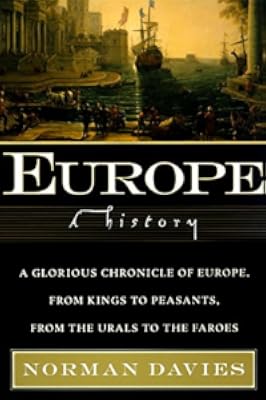
Europe: A History
by Norman Davies
On This Page
Description
Here is a masterpiece of historical narrative that stretches from the Ice Age to the Atomic Age, as it tells the story of Europe, East and West. Norman Davies captures it all-the rise and fall of Rome, the sweeping invasions of Alaric and Atilla, the Norman Conquests, the Papal struggles for power, the Renaissance and the Reformation, the French Revolution and the Napoleonic Wars, Europe's rise to become the powerhouse of the world, and its eclipse in our own century, following two show more devastating World Wars. This is the first major history of Europe to give equal weight to both East and West, and it shines light on fascinating minority communities, from heretics and lepers to Gypsies, Jews, and Muslims. It also takes an innovative approach, combining traditional narrative with unique features that help bring history alive: 299 time capsules scattered through the narrative capture telling aspects of an era, and twelve snapshots offer a panoramic look at all of Europe at a particular moment in history. All told, Davies's Europe represents one of the most important and illuminating histories to be published in recent years. show lessTags
Recommendations





Member Reviews
This is one monster of a volume. It is well done, researched and put together. But it has some serious problems with the way it is laid out. The pages of side notes are informative but all together they only slow the pace of the book down. Constantly having to go back and forth and read them. You don't want to pass them up because you do not know what you might miss. So when you attack this volume you have to make a precise battle plan on how you are going to achieve the goal of finishing it. I would give it 4 stars but 3 will have to do because of the back and forth.
At first I thought this would be very slow and detailed given the book's length but then very quickly realised this will have to fly through history at lightspeed - before reading this book I never realised how rich it is because most books only try to cover one aspect of it. I gorged myself on this book for two days and it was an amazing ride through the glorious and terrifying history of Europe.
The book assumes that you haven't been sleeping through history class at school so will not spoonfeed you basic history.
The book assumes that you haven't been sleeping through history class at school so will not spoonfeed you basic history.
Extraordinary history of Europe. Brilliant, especially for its attention to eastern Europe, although written just after the opening of the Iron Curtain. The "lemma's" that accompany the chronological story are perfect complementaries, that give depth to the narrative.
This magisterial work takes a completely continental view of European history. It sets the story of migrations and the rise and fall of empires in a geographical context, starting with the premise that Europe is distinguished by the movement of populations in prehistoric times from East to West. It therefore gives proper space to accounts of peoples, empires and movements beyond what we used to call 'the Iron Curtain'. To emphasise this point, many of the maps are drawn with North at the right-hand side, not the top. Davies constantly reminds us that he is trying very hard to avoid "Western-centricism".
The book has many 'capsules', self-contained essays on topics not central to the main thrust of the historical narrative but show more illuminating nonetheless. These can be accessed throughout the book by a sort of typographical hyperlink and they do not necessarily correspond to the chronological sequence of the text where they first appear.
The overall effect is one of comprehensiveness. This book is essential reading for anyone who thinks that there is something special about 'Britishness' (or any other sort of '-ness', for that matter). It shows that one way or another, we in the UK are all European, no matter what our origin. show less
The book has many 'capsules', self-contained essays on topics not central to the main thrust of the historical narrative but show more illuminating nonetheless. These can be accessed throughout the book by a sort of typographical hyperlink and they do not necessarily correspond to the chronological sequence of the text where they first appear.
The overall effect is one of comprehensiveness. This book is essential reading for anyone who thinks that there is something special about 'Britishness' (or any other sort of '-ness', for that matter). It shows that one way or another, we in the UK are all European, no matter what our origin. show less
This is a voluminous but interesting survey of European history covering the scope of a World History or Western Civilization course. It reminds me of the expansive Will and Ariel Durant series on civilization although here it is confined to Europe alone. He posits numerous fault lines of history, religion, and culture while initially introducing the text and simply, but intriguingly, shifts the graphic illustrations throughout the work to shift the readers perspective from the traditional North-South-East-West European continuum to one that displays maps demonstrating Europe as one huge sub-continent. In this effort, he includes Eastern European evidence that is usually not included in standard European histories. I would fault Davies show more for being too critical of religion and he suspiciously reports religious history, and he may be too sympathetic for internationalist sympathies in his presentation of what constitutes "Europeanness."
One of the other limitations of the work is his use of odd capsules which are presented in boldface throughout the text of the work. The reader is then expected to dip into the highlighted sections as they can. In some instances the capsules bear little relation to the narrative, and in other cases they are quite revealing. However, by arranging the text in this way the reader is sometimes interrupted with irrelevant material, or in other instances, you may miss critical information. You never know which. I would have preferred that Davies would have followed a more typical, standard approach and performed the work of integrating his ideas more coherently to fit the narrative. Likewise, the appendices, which are often quite revealing, are not integrated into the work and they remain abstracted from the text at the end of the text. On the other hand, the material is valuable, as are the helpful and consistent mapping of Europe as viewed from the East with Great Britain at the top of the maps. In this way, Davies is expressing a basic motif developed throughout the text that he is including generally overlooked areas and material from Eastern Europe, Scandinavia, and lesser examined regions of Europe.
None of the limitations detracts unduly from the work and Davies is to be commended for writing an interesting narrative and fresh approach for a generalist work on Europe. show less
One of the other limitations of the work is his use of odd capsules which are presented in boldface throughout the text of the work. The reader is then expected to dip into the highlighted sections as they can. In some instances the capsules bear little relation to the narrative, and in other cases they are quite revealing. However, by arranging the text in this way the reader is sometimes interrupted with irrelevant material, or in other instances, you may miss critical information. You never know which. I would have preferred that Davies would have followed a more typical, standard approach and performed the work of integrating his ideas more coherently to fit the narrative. Likewise, the appendices, which are often quite revealing, are not integrated into the work and they remain abstracted from the text at the end of the text. On the other hand, the material is valuable, as are the helpful and consistent mapping of Europe as viewed from the East with Great Britain at the top of the maps. In this way, Davies is expressing a basic motif developed throughout the text that he is including generally overlooked areas and material from Eastern Europe, Scandinavia, and lesser examined regions of Europe.
None of the limitations detracts unduly from the work and Davies is to be commended for writing an interesting narrative and fresh approach for a generalist work on Europe. show less
In a fit of ambition five months ago at the beach in Casablanca, I downloaded and started Norman Davies’ epic Europe: A History. I’m not sure I’ve ever been quite so proud to click that “I’m Finished” button on my GoodReads update page. On my Kindle, the page count reads upwards of sixteen hundred pages. However, with the opening chapter an easily digestible introduction to the physical and prehistoric beginnings of the cultures that came to be called collectively European, I felt like the book would fly by as quickly as a book with chapters over a hundred pages could. I was wrong. That first chapter is structured, with headings and concise sections of information. Very early on, Davies throws in the trivia blurbs – while show more the Kindle couldn’t handle the formatting of these sections with much ease, I greatly enjoyed not only the liveliness that these somewhat informal additions of information added, but also the context they provided. Or, rather, the contexts in which they were provided – that is, I enjoyed seeing those bracketed titles over and over again throughout different epics of the book. (For better or for worse, the one that springs to mind first is the “Condom” one – it comes up in the middle ages, later on in the seventeenth or eighteenth century, and then again in the twentieth century.) Not all of them reappear throughout the ages, but the ones that do provide a nice line of progress (or anti-progress, as the case may be) over the centuries. Apart from that first chapter and the numerous brief interruptions that keep it ever so mildly entertaining, the whole middle section turns to mush. He rushes through plenty of the more interesting parts of the Greek and Roman empires (including the civil war) only to harp on for what feels like forever about the Holy Roman Empire. Commendably, he includes much detail about the countries of Eastern Europe. Regrettably, I missed whatever initial introduction there may have been and spent most of the middle of the book confused and bored. I struggled to find the storyline. I only followed the timeline of the Eastern Europe toward the last couple chapters, and at that point, I’m fairly sure it was just excitement about having only a handful (uh, relative term) of pages left. I did enjoy the last two chapters, though – even when he glossed over major events like the tearing down of the Berlin Wall in half a sentence. By the end, I kind of felt like I needed to reread the whole middle part (not any time soon, mind you) because I had grasped the cultures and the personalities in those chapters even with a very hazy background. Davies’ Europe: A History reviewed much of the information I’d learned years ago in AP World History back in high school in almost an equally boring fashion, but the interjectory plates added a bit more interest to a painfully unstructured book. show less
Very readable overview. The Eastern European slant (especially Poland) gave a new aspect even to the bits of history I thought I knew already.
Members
- Recently Added By
Lists

Non-Fiction Worth Reading
1,015 works; 261 members

Europe
205 works; 6 members

Reading list
170 works; 1 member

1990s
309 works; 17 members

Books Read in 2005
174 works; 7 members

My List
302 works; 1 member

Works Cited in The History of White People by Nell Irvin Painter
321 works; 2 members

In Our Time books
4,934 works; 2 members
Author Information

48+ Works 8,631 Members
Norman Davies is a Supernumerary Fellow at Wolfson College, Oxford, and is a Fellow of the British Academy, Fellow of the Royal Historical Society, and Professor Emeritus of London University
Awards and Honors
Work Relationships
Common Knowledge
- Canonical title
- Europe: A History
- Original title
- Europe: A History
- Original publication date
- 1996
- Important places
- Europe; Ancient Greece; Roman Empire; Germany; Holy Roman Empire; Ancient Rome
- Important events
- Crusades; Reformation; World War I; World War II; Industrial Revolution
- Dedication
- For Christian
Our Californian - First words
- This book contains little that is original.
- Last words
- (Click to show. Warning: May contain spoilers.)Europe is not going to be fully united in the near future. But it has a chance to be less divided than for generations past. If fortune smiles, the physical and psychological barriers will be less brutal than at any other time in living memory. Europa rides on. Tremulae sinuantar flamine vestes.
- Blurbers
- Grayling, A.C.; Morris, Jan; Burleigh, Michael; Fernandez-Armesto, Felipe; Malcolm, Noel
- Original language
- English
Classifications
Statistics
- Members
- 2,793
- Popularity
- 6,533
- Reviews
- 26
- Rating
- (3.97)
- Languages
- 11 — Czech, English, Estonian, German, Hungarian, Italian, Lithuanian, Polish, Russian, Serbian, Turkish
- Media
- Paper, Audiobook, Ebook
- ISBNs
- 31
- ASINs
- 8