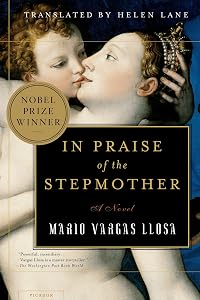
In Praise of the Stepmother | The Notebooks of Don Rigoberto
by Mario Vargas Llosa
On This Page
Description
With meticulous observation and the seductive skill of a great storyteller, Vargas Llosa lures the reader into the shadow of perversion that, little by little, darkens the extraordinary happiness and harmony of his characters. The mysterious nature of happiness and above all, the corrupting power of innocence are the themes that underlie these pages, and the author has perfectly met the demands of the erotic novel, never dimming for an instant the fine poetic polish of his writing.Tags
Recommendations
















Member Reviews
Dona Lucrecia is downstairs saying goodnight to her stepson when he becomes a little exuberant in his affections; this excites her in a confused way, and next minute, she’s making love to her husband, Don Rigoberto. And so starts In Praise of the Stepmother, a short erotic novel from Mario Vargas Llosa which essentially tells the story of what happens to this little family before the novel The Notebooks of Don Rigoberto.
As in that book, Lucrecia is more than happy with her attentive, passionate husband and their sex life, and yet finds herself becoming seduced by her stepson Fonchito. At first she thinks she is just having “dirty, scabrous thoughts” when he hugs and kisses her, but when the maid informs her he’s been spying on show more her through a skylight when she takes her baths, she realizes it’s more than that.
On one hand, the boy seems innocent even when he pursues adult desires because of how pure he is when he does so. He is honest and unashamed, and in this sense shares the characteristics of his father. On the other hand, Fonchito is diabolical, manipulating Lucrecia emotionally in order to get her into bed. Ultimately he is successful, and is then capable of “riding her like an expert horseman”.
The book is clearly not for everyone, and not just because of the incest. There are other fantasies expressed, examples of which are lesbian love, voyeurism, and exhibitionism. As Vargas Llosa wrote afterwards, “Fantasy gnaws life away, thank God”. I loved the inclusion of six paintings in color plates, with chapters telling imaginative erotic stories about the pieces. An example is Boucher’s “Diana at the Bath” from 1742 (http://www.wikipaintings.org/en/francois-boucher/diana-getting-out-of-her-bath-1742); what follows from that still image is the maid sucking the toes and kissing the feet of her lady before making love to her, while a goatherd watches on from the woods and pleasures himself. Did I mention it’s not for everyone?
Vargas Llose writes erudite, “baroque” prose, using words such as “tumid” to describe the swelling of certain body parts, and yet at the same describes some of the basest aspects of the human condition, such as trimming nose hairs and the pleasure of defecation. In a newspaper interview after the book’s publication which I was fortunate enough to have included in the beautiful, signed, first edition I found, Vargas Llosa says “I thought it necessary for the prose to be a very visible presence because I thought that was the only way an erotic novel could avoid vulgarity. That is what I hate about modern erotic literature, the vulgarity.”
And that’s how I see it. It’s beautiful, intelligent writing, with a mix of philosophy and eroticism. Vargas Llosa goes into taboos but because the prose is so sophisticated it never feels dirty, at least to me, and because he has Rigoberto accepting all aspects of Lucrecia, from the curve of her breasts to the way her stomach gurgles when he listens to it, even if a fetish they share is not the norm, it feels not only natural but very loving. For isn’t that what love is? Aside from all the fireworks, a place safe enough to completely be oneself, and accepting everything about the other person such that there is a oneness?
Of course, there are limits to everything, and while Lucrecia feels a freedom in giving into her forbidden lust, there are consequences. Maybe what Vargas Llosa is saying is that submission to desires is for the most part a beautiful thing, that pleasure is certainly nothing to be ashamed about, but that some fantasies are best left as fantasy.
Quotes:
On continual discovery, and joy in the body:
“I have studied her as scholars ponder the ancient volumes of the Temple, and though I think I know her by heart, each day – each night, rather – I discover something new about her that touches me: the gentle curve of her shoulders, the mischievous little bone in her elbow, the delicacy of her instep, the roundness of her knees, and the blue transparency of the little grove of her armpits.”
On desire, this from Cupid’s perspective, in the painting “Venus with Cupid and Music” by Titian (http://www.wikipaintings.org/en/titian/venus-and-cupid-with-an-organist-1549):
“The young music teacher and I are not here to enjoy ourselves but to work, though all work done wholeheartedly and well turns, it is true, into pleasure. Our task consists of kindling the lady’s bodily joy, poking up the ashes of each one of her five senses till they burst into flame, and peopling her fair-haired head with filthy fantasies. That is how Don Rigoberto likes to have us hand her over to him: ardent and avid, all her moral and religious scruples in abeyance and her mind and body filled to overflowing with appetites.”
On exhibitionism:
“Suddenly she rose to her feet. Not covering herself with the towel, not cowering so that those invisible little eyes would have no more than an imperfect, fleeting vision of her body. No, quite the contrary: she stood up on tiptoe, parting her legs, and before emerging from her bath she stretched, revealing herself generously, obscenely, as she removed her plastic bath cap and loosed her long hair with a toss of her head. And on stepping out of the bathtub, instead of donning her dressing gown immediately, she stood there naked, her body gleaming with tiny drops of water, tense, daring, furious. She dried herself very slowly, limb by limb, rubbing the towel over her skin again and again, leaning to one side, bending over, halting at times as though distracted by a sudden idea, in a posture of indecent abandon, or contemplating herself carefully in the mirror. And with the same lingering, maniacal care she then rubbed her body with moisturizing lotions. And as she thus displayed herself before the invisible observer, her heart pulsed with wrath. What are you doing, Lucrecia?”
On giving oneself, this on the interpretation of “Road to Mendieta 10” by Fernando de Szyszlo:
“Are we without shame? We are whole and free, rather, and as earthly as we can possibly be. They have removed our epidermises and melted our bones, bared our viscera and our cartilage, exposed to the light everything that during Mass or during amorous rites we celebrated together, grew, sweated, and excreted. They have left us without secrets, my love. That woman is what I am, slave and master, your offering. Slit open like a turtledove by love’s knife. I: cracked apart and pulsing. I: slow masturbation. I: flow of musk. I: labyrinth and sensation. I: magic ovary, semen, blood, and morning dew. That is my face for you, at the hour of the senses. I am that when, for you, I shed my everyday skin and my feast-day one. That may perhaps be my soul. Yours.”
And later:
“Altruistic sentiments, metaphysics and history, neutral reasoning, good intentions and charitable deeds, solidarity with the species, civic idealism, sympathy towards one’s fellow have also been done away with; all humans who are not you and me have been blotted out. Everything that might have distracted us or impoverished us at the hour of supreme egoism that the hour of love is has disappeared. Here, as is true as well of the monster and the god, nothing restrains or inhibits us.”
On the ‘purity’ of desire, I loved the last line in particular:
“…Dona Lucrecia sometimes seemed to divine something perverse, like those tentacle creatures that dwell in the depths of ocean paradises. Her cheeks burned. Was Fonchito really hinting at what she had intuitively sensed? Or, rather, did the youngster understand the meaning of what he was hinting at? Only halfway, doubtless, in a vague, instinctive way, beyond his power of reason. Was childhood, then, that amalgam of vice and virtue, of sanctity and sin? She tried to remember whether she, like Fonchito, had been, at some time long before, at once pure and filthy, but it was a memory beyond all recall. She rested her cheek once more against the child’s tawny back and envied him. Oh, if only a person could always act with that half-conscious animal awareness with which he caressed her and made love to her, judging neither her nor himself!”
On the, hmm, smell of desire, I laughed over this one:
“Yes, now – Don Rigoberto’s eyes were closed and it was as if all his energy had fled his body and taken refuge in his reproductive and nasal organs – his nostrils were breathing in Dona Lucrecia’s honeysuckle. And as the warm, heavy perfume, with hints of musk, incense, sauerkraut, anise, pickled herring, violets opening, moist secretions of a virgin maiden, mounted to his brain like an emanation from the vegetable kingdom or a sulfurous lava, bringing on an eruption of desire, his nose, transformed into a sensitive plant, could also catch the scent now of that beloved grove, the viscous friction of that slit of bright lips, the tickle of that moist fleece whose fine silk hairs agitated his nasal orifices, further enhancing the effect of a vaporous narcotic being offered him by the body of his beloved.” show less
As in that book, Lucrecia is more than happy with her attentive, passionate husband and their sex life, and yet finds herself becoming seduced by her stepson Fonchito. At first she thinks she is just having “dirty, scabrous thoughts” when he hugs and kisses her, but when the maid informs her he’s been spying on show more her through a skylight when she takes her baths, she realizes it’s more than that.
On one hand, the boy seems innocent even when he pursues adult desires because of how pure he is when he does so. He is honest and unashamed, and in this sense shares the characteristics of his father. On the other hand, Fonchito is diabolical, manipulating Lucrecia emotionally in order to get her into bed. Ultimately he is successful, and is then capable of “riding her like an expert horseman”.
The book is clearly not for everyone, and not just because of the incest. There are other fantasies expressed, examples of which are lesbian love, voyeurism, and exhibitionism. As Vargas Llosa wrote afterwards, “Fantasy gnaws life away, thank God”. I loved the inclusion of six paintings in color plates, with chapters telling imaginative erotic stories about the pieces. An example is Boucher’s “Diana at the Bath” from 1742 (http://www.wikipaintings.org/en/francois-boucher/diana-getting-out-of-her-bath-1742); what follows from that still image is the maid sucking the toes and kissing the feet of her lady before making love to her, while a goatherd watches on from the woods and pleasures himself. Did I mention it’s not for everyone?
Vargas Llose writes erudite, “baroque” prose, using words such as “tumid” to describe the swelling of certain body parts, and yet at the same describes some of the basest aspects of the human condition, such as trimming nose hairs and the pleasure of defecation. In a newspaper interview after the book’s publication which I was fortunate enough to have included in the beautiful, signed, first edition I found, Vargas Llosa says “I thought it necessary for the prose to be a very visible presence because I thought that was the only way an erotic novel could avoid vulgarity. That is what I hate about modern erotic literature, the vulgarity.”
And that’s how I see it. It’s beautiful, intelligent writing, with a mix of philosophy and eroticism. Vargas Llosa goes into taboos but because the prose is so sophisticated it never feels dirty, at least to me, and because he has Rigoberto accepting all aspects of Lucrecia, from the curve of her breasts to the way her stomach gurgles when he listens to it, even if a fetish they share is not the norm, it feels not only natural but very loving. For isn’t that what love is? Aside from all the fireworks, a place safe enough to completely be oneself, and accepting everything about the other person such that there is a oneness?
Of course, there are limits to everything, and while Lucrecia feels a freedom in giving into her forbidden lust, there are consequences. Maybe what Vargas Llosa is saying is that submission to desires is for the most part a beautiful thing, that pleasure is certainly nothing to be ashamed about, but that some fantasies are best left as fantasy.
Quotes:
On continual discovery, and joy in the body:
“I have studied her as scholars ponder the ancient volumes of the Temple, and though I think I know her by heart, each day – each night, rather – I discover something new about her that touches me: the gentle curve of her shoulders, the mischievous little bone in her elbow, the delicacy of her instep, the roundness of her knees, and the blue transparency of the little grove of her armpits.”
On desire, this from Cupid’s perspective, in the painting “Venus with Cupid and Music” by Titian (http://www.wikipaintings.org/en/titian/venus-and-cupid-with-an-organist-1549):
“The young music teacher and I are not here to enjoy ourselves but to work, though all work done wholeheartedly and well turns, it is true, into pleasure. Our task consists of kindling the lady’s bodily joy, poking up the ashes of each one of her five senses till they burst into flame, and peopling her fair-haired head with filthy fantasies. That is how Don Rigoberto likes to have us hand her over to him: ardent and avid, all her moral and religious scruples in abeyance and her mind and body filled to overflowing with appetites.”
On exhibitionism:
“Suddenly she rose to her feet. Not covering herself with the towel, not cowering so that those invisible little eyes would have no more than an imperfect, fleeting vision of her body. No, quite the contrary: she stood up on tiptoe, parting her legs, and before emerging from her bath she stretched, revealing herself generously, obscenely, as she removed her plastic bath cap and loosed her long hair with a toss of her head. And on stepping out of the bathtub, instead of donning her dressing gown immediately, she stood there naked, her body gleaming with tiny drops of water, tense, daring, furious. She dried herself very slowly, limb by limb, rubbing the towel over her skin again and again, leaning to one side, bending over, halting at times as though distracted by a sudden idea, in a posture of indecent abandon, or contemplating herself carefully in the mirror. And with the same lingering, maniacal care she then rubbed her body with moisturizing lotions. And as she thus displayed herself before the invisible observer, her heart pulsed with wrath. What are you doing, Lucrecia?”
On giving oneself, this on the interpretation of “Road to Mendieta 10” by Fernando de Szyszlo:
“Are we without shame? We are whole and free, rather, and as earthly as we can possibly be. They have removed our epidermises and melted our bones, bared our viscera and our cartilage, exposed to the light everything that during Mass or during amorous rites we celebrated together, grew, sweated, and excreted. They have left us without secrets, my love. That woman is what I am, slave and master, your offering. Slit open like a turtledove by love’s knife. I: cracked apart and pulsing. I: slow masturbation. I: flow of musk. I: labyrinth and sensation. I: magic ovary, semen, blood, and morning dew. That is my face for you, at the hour of the senses. I am that when, for you, I shed my everyday skin and my feast-day one. That may perhaps be my soul. Yours.”
And later:
“Altruistic sentiments, metaphysics and history, neutral reasoning, good intentions and charitable deeds, solidarity with the species, civic idealism, sympathy towards one’s fellow have also been done away with; all humans who are not you and me have been blotted out. Everything that might have distracted us or impoverished us at the hour of supreme egoism that the hour of love is has disappeared. Here, as is true as well of the monster and the god, nothing restrains or inhibits us.”
On the ‘purity’ of desire, I loved the last line in particular:
“…Dona Lucrecia sometimes seemed to divine something perverse, like those tentacle creatures that dwell in the depths of ocean paradises. Her cheeks burned. Was Fonchito really hinting at what she had intuitively sensed? Or, rather, did the youngster understand the meaning of what he was hinting at? Only halfway, doubtless, in a vague, instinctive way, beyond his power of reason. Was childhood, then, that amalgam of vice and virtue, of sanctity and sin? She tried to remember whether she, like Fonchito, had been, at some time long before, at once pure and filthy, but it was a memory beyond all recall. She rested her cheek once more against the child’s tawny back and envied him. Oh, if only a person could always act with that half-conscious animal awareness with which he caressed her and made love to her, judging neither her nor himself!”
On the, hmm, smell of desire, I laughed over this one:
“Yes, now – Don Rigoberto’s eyes were closed and it was as if all his energy had fled his body and taken refuge in his reproductive and nasal organs – his nostrils were breathing in Dona Lucrecia’s honeysuckle. And as the warm, heavy perfume, with hints of musk, incense, sauerkraut, anise, pickled herring, violets opening, moist secretions of a virgin maiden, mounted to his brain like an emanation from the vegetable kingdom or a sulfurous lava, bringing on an eruption of desire, his nose, transformed into a sensitive plant, could also catch the scent now of that beloved grove, the viscous friction of that slit of bright lips, the tickle of that moist fleece whose fine silk hairs agitated his nasal orifices, further enhancing the effect of a vaporous narcotic being offered him by the body of his beloved.” show less
"In Praise of the Stepmother" is a thought-provoking fantasia on innocence, sex, and art which never fails to force us into questioning our most precious of assumptions. Not wishing to have our own little bourgeois moralities threatened is, I suppose, one reason why many people have dismissed this novel as "disgusting" or "immoral" or something equally nonsensical.
At its core rests a simple story. After a failed marriage with his young son Alfonso's mother, Don Rigoberto marries Dona Lucrecia, a woman whom he truly adores and is certainly erotically infatuated with. On the first page of the novel, Alfonso, a boy of ten or twelve, leaves a note on his stepmother's pillow congratulating her on her fortieth birthday, and saying that he show more will do his best to become first in his class to reward her. This is the inaugurating move in a cat-and-mouse game that drives the entire novel forward in a series of events that reaches its apex in a lurid sexual encounter between Alfonso and Lucrecia which occurs while Rigoberto is on a business trip. She does not deliberately set out to do this, yet still has found herself titillated by the occasional fugitive thought of her and her stepson in coitus. At the very end of the novel, we find out that Alfonso wrote an essay for school in which he details his erotic relationship with his mother and, to make matters worse, read it to his father. Why? We don't know. In the last pages of the book, the housekeeper asks Alfonso why he would do such an insidious thing to the stepmother he loved so much, to which he replies, "I did it for you," seemingly setting the entire wheel rolling toward tragedy and destruction once more.
Vargas Llosa artfully interlards the worlds of the erotic and sensual (the lovemaking of Lucrecia and Rigoberto) with Rigoberto's mundane daily ablutions - the trimming of his nose hairs, the application of cologne to his body, the special care that he gives his feet and hands. This spiritual aubade to the body, which apparently bored so many readers, is what drew me in and made turned the reading into an almost ecstatic experience. This was only heightened by the six exquisite colored plates that are placed in the novel to accentuate themes in the story.
Alfonso's duplicity (or was it duplicity after all?) asks, as Slavoj Zizek has done by other means, "Isn't love the ultimate act of violence?" After this novel, it is impossible not to see the ulterior and tenebrous underbelly of the most innocent of gestures. Whose desire is outlawed, Lucrecia's or the boy's? Can Don Rigoberto somehow turn outside that scrutiny to which he so easily applies to himself in his daily bath in order to answer what has happened under his roof? Some of these questions are never answered, but the way Vargas Llosa asks them makes reconciling one's self to the novel and its moral imperatives deliciously fun. show less
At its core rests a simple story. After a failed marriage with his young son Alfonso's mother, Don Rigoberto marries Dona Lucrecia, a woman whom he truly adores and is certainly erotically infatuated with. On the first page of the novel, Alfonso, a boy of ten or twelve, leaves a note on his stepmother's pillow congratulating her on her fortieth birthday, and saying that he show more will do his best to become first in his class to reward her. This is the inaugurating move in a cat-and-mouse game that drives the entire novel forward in a series of events that reaches its apex in a lurid sexual encounter between Alfonso and Lucrecia which occurs while Rigoberto is on a business trip. She does not deliberately set out to do this, yet still has found herself titillated by the occasional fugitive thought of her and her stepson in coitus. At the very end of the novel, we find out that Alfonso wrote an essay for school in which he details his erotic relationship with his mother and, to make matters worse, read it to his father. Why? We don't know. In the last pages of the book, the housekeeper asks Alfonso why he would do such an insidious thing to the stepmother he loved so much, to which he replies, "I did it for you," seemingly setting the entire wheel rolling toward tragedy and destruction once more.
Vargas Llosa artfully interlards the worlds of the erotic and sensual (the lovemaking of Lucrecia and Rigoberto) with Rigoberto's mundane daily ablutions - the trimming of his nose hairs, the application of cologne to his body, the special care that he gives his feet and hands. This spiritual aubade to the body, which apparently bored so many readers, is what drew me in and made turned the reading into an almost ecstatic experience. This was only heightened by the six exquisite colored plates that are placed in the novel to accentuate themes in the story.
Alfonso's duplicity (or was it duplicity after all?) asks, as Slavoj Zizek has done by other means, "Isn't love the ultimate act of violence?" After this novel, it is impossible not to see the ulterior and tenebrous underbelly of the most innocent of gestures. Whose desire is outlawed, Lucrecia's or the boy's? Can Don Rigoberto somehow turn outside that scrutiny to which he so easily applies to himself in his daily bath in order to answer what has happened under his roof? Some of these questions are never answered, but the way Vargas Llosa asks them makes reconciling one's self to the novel and its moral imperatives deliciously fun. show less
Well, this $2 clearance book is certainly different from my normal repertoire. The story is simple, but the writing/prose is complex. Six pieces of artwork with its own story are interwoven between the chapters; each artwork tale is lightly or directly aligned to the main story. Together they form the most unlikely tale of eroticism that breaches decency. After all, how can the subject of incest and a painting of the annunciation arouse one’s imagination? Perhaps that’s what make this erotica a worthy read despite the subject.
The 40-year-old Dona Lucrecia had married the widower, Don Rigoberto, who has a son, Fonchito, whose face is as angelic as a cherub. Fonchito is physically affectionate towards his new stepmother to a magnitude show more that stirs her insides. Meanwhile, her lovemaking with her husband is a nightly ritual and legend not to be missed. Though Fonchito’s exact boyhood age was never mentioned, his seductions (with a threat of suicide) are eventually successful resulting in a love triangle, which of course, doesn’t end well. It’s not difficult to guess who is the true “evil-doer” behind this mess.
The curiosity of this book lays with the artistry of the prose. The basics of a human being is amplified – from the love-making, and more importantly, the arousals leading to the love making, to Don Rigoberto’s nightly primping making himself presentable to his lovely Lucrecia. A full chapter is devoted to his defecation, feet and armpit cleaning, that ends with him admiring his own "unicorn". He is a different kind of metro-sexual, entirely devoted to Lucrecia. Each art is enveloped in an imaginative story. The best of which is Llosa’s interpretation of “Diana at the Bath” by Boucher. Diana had hunted, bathed, and being tended to by her favorite, Justinianna, who will pleasure her, make love to her, suck her toes, all while an unseen goatherd lusts for them.
At times, the naughty theme made my cheeks turned toasty. “…you were blind and on your knees between my thighs, kindling my fires like a groveling, diligent servant.” At other times, it made me smile: “Making an intense intellectual effort – to recite aloud the Pythagorean theorem – Don Rigoberto halted halfway in its course the erection that was beginning to bare it amorous little head, and splashing it with handfuls of cold water, he calmed it down and returned it, shy and shrunken, to its discreet foreskin cocoon.” And the incest was cringe worthy, “Only a moment before, he had been a youth without scruples, of unerring instinct, riding her like an expert horseman.”
Though the book is likely not for everyone, this quote makes the book complete for me. We all need happiness.
“The bliss he had found in his solitary hygienic practices and, above all, in the love of his wife appeared to him to be sufficient compensation for his normalcy. Having this, what need was there to be rich, famous, eccentric, a genius? The modest obscurity that his life represented in the eyes of others, that routine existence as the general manager of an insurance company, concealed something which, he was sure, few of his fellows enjoyed or even suspect existed: possible happiness.” show less
The 40-year-old Dona Lucrecia had married the widower, Don Rigoberto, who has a son, Fonchito, whose face is as angelic as a cherub. Fonchito is physically affectionate towards his new stepmother to a magnitude show more that stirs her insides. Meanwhile, her lovemaking with her husband is a nightly ritual and legend not to be missed. Though Fonchito’s exact boyhood age was never mentioned, his seductions (with a threat of suicide) are eventually successful resulting in a love triangle, which of course, doesn’t end well. It’s not difficult to guess who is the true “evil-doer” behind this mess.
The curiosity of this book lays with the artistry of the prose. The basics of a human being is amplified – from the love-making, and more importantly, the arousals leading to the love making, to Don Rigoberto’s nightly primping making himself presentable to his lovely Lucrecia. A full chapter is devoted to his defecation, feet and armpit cleaning, that ends with him admiring his own "unicorn". He is a different kind of metro-sexual, entirely devoted to Lucrecia. Each art is enveloped in an imaginative story. The best of which is Llosa’s interpretation of “Diana at the Bath” by Boucher. Diana had hunted, bathed, and being tended to by her favorite, Justinianna, who will pleasure her, make love to her, suck her toes, all while an unseen goatherd lusts for them.
At times, the naughty theme made my cheeks turned toasty. “…you were blind and on your knees between my thighs, kindling my fires like a groveling, diligent servant.” At other times, it made me smile: “Making an intense intellectual effort – to recite aloud the Pythagorean theorem – Don Rigoberto halted halfway in its course the erection that was beginning to bare it amorous little head, and splashing it with handfuls of cold water, he calmed it down and returned it, shy and shrunken, to its discreet foreskin cocoon.” And the incest was cringe worthy, “Only a moment before, he had been a youth without scruples, of unerring instinct, riding her like an expert horseman.”
Though the book is likely not for everyone, this quote makes the book complete for me. We all need happiness.
“The bliss he had found in his solitary hygienic practices and, above all, in the love of his wife appeared to him to be sufficient compensation for his normalcy. Having this, what need was there to be rich, famous, eccentric, a genius? The modest obscurity that his life represented in the eyes of others, that routine existence as the general manager of an insurance company, concealed something which, he was sure, few of his fellows enjoyed or even suspect existed: possible happiness.” show less
So there I was, rushing down the center aisle of my employment [WARNING: name drop alert!] when Candace Bergen steps out in front of me and smiles, "So there you are; I have been looking everywhere for you." That was OK, I guess, as she was quite the beauty, but our doings were always colored by my sense of wonder that she was married to a giant of world cinema, one Louis Malle! And, some years before, he enchanted me and the world with his Murmur of the Heart, a film that had audiences cheering on its hapless teen-aged hero to seduce his step-mother. Now that is what I call 'charm!' But Nobel Laureate, Peru's Mario Vargas Llosa goes Malle one better, because his lead protagonist is even younger, an impish, angelic prepubescent child show more named Alfonso. And Little A has a carnal fascination so deep-seated toward his lovely step-mom Lucretia that none of us, character or reader alike, know what to make of any of it, especially when the narrative is clouded by befuddled Lima businessman and husband Rigoberto. There is, however, no charm in this misadventure! Proponents of this novel would call it Erotic Fiction, but, for me, we are in the heights of Literary Fiction, in Lolita country so to speak. Nabokov would be proud! And, allow me to add, this is one beautifully written novel, translation or not! show less
I read this in one sitting. Llosa offers the reader an erotic, provocative, shocking view of the human spirit. The narration moves from the tale of a man, his second wife and his son to interpretive narration focused on classic works of art. His theme takes the reader deep into the instinctive and sensual part of their being and boldly suggests that it is a fine line between what is a human being's dark side and evil. Where does sensuality become depravity? The references to and interpretations of the classic paintings speak to the timeless nature of our darker yearnings and the dilemmas they create. Do not venture into this one unless or until you prepare for an unsettling read.
This is one of those books that makes you nervous and queesy at the thought of the actual premise -- a woman having sexual relations with her young stepson. But the way in which Vargas Llosa narrates the story grips you from the beginning and wont let you put this book down.
One can start reading Mario Vargas Llosa from any of his work so I started to pick In Praise of Stepmother. At first glance all reader must had felt that it was like some other erotic story, but the book is beyond that...
Here we began with the story of a beautiful family with Don Rigoberto as the patriarch. He married the love of his life, Dona Lucrecia, after his previous marriage failed. He has a beautiful son, Alfonso.
Soon after, moral depravity was unavoidable when Lucrecia began the affair with Alfonso after she followed his mood for being taken care of. Lust and incestuous relationship lurks to attack Rigoberto's family.
Lucrecia initially thought that it would be fine to have Alfonso as the way he did it with her. She even show more thought that Alfonso was no other than her little cupid.
"And that's all there is between us; nothing more. He's not my lover. How could he be, at his age? What was he, then? Her little cupid, she told herself. Her sprintia. The child whom Renaissance painters added to boudoir scenes so that, by contrast to their aura of purity, the love bout depicted would be more ardent. Thanks to you, Rigoberto and I love and delight each other all the more, she thought, kissing him ever so lightly on the neck."
Sadly, Alfonso was more than a child in a Renaissance painting. He was a living creature with his own manipulative mind, messing up Lucrecia's mind which was already deluded in delusion after living in a fantastical sexual life with Rigoberto.
No, Alfonso was not one time thing which his presence was for bonding Lucrecia and Rigoberto's love. He was a wicked child, with a smile as beautiful as Lucifer's, succeed in destroying their marriage.
And his motive? No one could tell. When he was being confronted by their servant, Justiniana, Alfonso only told he did it for Justiniana, ringing another alarm that the new danger was already happening.
You would hate this book at first, with its erotic sense and phrase, also because this book mainly talked about Rigoberto's bathroom ritual. But you would like it for how smart Llosa talked about the true danger of false innocent in child's world. He also used his chance to criticize the wicked life of upper class society of Lima, Peru, just like Rigoberto and Lucrecia.
What I like most is how Llosa used several paintings as his references for describing the fantastical lusting life of Lucrecia and Rigoberto. He truly is a marvellous writer.
"Take a good look at me, my love. Recognize me, and recognize yourself." (Llosa's interpretation of Head I by Francis Bacon. He consider the painting as Profile of a Human Being). show less
Here we began with the story of a beautiful family with Don Rigoberto as the patriarch. He married the love of his life, Dona Lucrecia, after his previous marriage failed. He has a beautiful son, Alfonso.
Soon after, moral depravity was unavoidable when Lucrecia began the affair with Alfonso after she followed his mood for being taken care of. Lust and incestuous relationship lurks to attack Rigoberto's family.
Lucrecia initially thought that it would be fine to have Alfonso as the way he did it with her. She even show more thought that Alfonso was no other than her little cupid.
"And that's all there is between us; nothing more. He's not my lover. How could he be, at his age? What was he, then? Her little cupid, she told herself. Her sprintia. The child whom Renaissance painters added to boudoir scenes so that, by contrast to their aura of purity, the love bout depicted would be more ardent. Thanks to you, Rigoberto and I love and delight each other all the more, she thought, kissing him ever so lightly on the neck."
Sadly, Alfonso was more than a child in a Renaissance painting. He was a living creature with his own manipulative mind, messing up Lucrecia's mind which was already deluded in delusion after living in a fantastical sexual life with Rigoberto.
No, Alfonso was not one time thing which his presence was for bonding Lucrecia and Rigoberto's love. He was a wicked child, with a smile as beautiful as Lucifer's, succeed in destroying their marriage.
And his motive? No one could tell. When he was being confronted by their servant, Justiniana, Alfonso only told he did it for Justiniana, ringing another alarm that the new danger was already happening.
You would hate this book at first, with its erotic sense and phrase, also because this book mainly talked about Rigoberto's bathroom ritual. But you would like it for how smart Llosa talked about the true danger of false innocent in child's world. He also used his chance to criticize the wicked life of upper class society of Lima, Peru, just like Rigoberto and Lucrecia.
What I like most is how Llosa used several paintings as his references for describing the fantastical lusting life of Lucrecia and Rigoberto. He truly is a marvellous writer.
"Take a good look at me, my love. Recognize me, and recognize yourself." (Llosa's interpretation of Head I by Francis Bacon. He consider the painting as Profile of a Human Being). show less
Members
- Recently Added By
Lists

Books Read in 2023
5,638 works; 147 members

A Novel Cure
742 works; 23 members
Talk Discussions
Past Discussions
MVL: In Praise of the Stepmother/Notebooks of Don Rigoberto in Author Theme Reads (July 2011)
Author Information

393+ Works 34,591 Members
Mario Vargas Llosa was born in Arequipa, Peru on March 28, 1936. He studied literature and law at the National University of San Marcos and received a Ph.D from the University of Madrid in 1959. He is a writer, politician, and journalist. His works vary in genre from literary criticism and journalism to comedies, murder mysteries, historical show more novels, and political thrillers. His books include The Time of the Hero, The Green House, Conversation in the Cathedral, Aunt Julia and the Scriptwriter, The Feast of the Goat, and The War of the End of the World. He has received numerous awards including the Rómulo Gallegos International Novel Prize, the Premio Leopoldo Alas in 1959, the Premio Biblioteca Breve in 1962, the Premio Planeta in 1993, the Miguel de Cervantes Prize in 1994, the Jerusalem Prize in 1995, and the Nobel Prize in Literature in 2010. (Bowker Author Biography) show less
Some Editions
Awards and Honors
Distinctions
Notable Lists
Series
Belongs to Publisher Series
Diana Taschenbuch (62/0105)
Work Relationships
Is contained in
Contains
Common Knowledge
- Canonical title
- In Praise of the Stepmother; In Praise of the Stepmother | The Notebooks of Don Rigoberto
- Original title
- Elogio de la madrastra; Elogio de la madrastra | Los cuadernos de don Rigoberto
- Alternate titles*
- Lof van de stiefmoeder : roman
- Original publication date
- 1988 (original Spanish) (original Spanish); 1990 (English: Lane) (English: Lane)
- Dedication*
- A Luis G. Berlanga, con cariño y admiración.
- First words*
- El día que cumplió cuarenta años, doña Lucrecia encontró sobre su almohada una misiva de trazo infantil, caligrafiada con mucho cariño.
- Last words*
- (Click to show. Warning: May contain spoilers.)Fresca, rotunda, sana, infantil, su risa borraba el sonido del agua del lavador, parecía llenar toda la noche y subir hasta esas estrellas que, por una vez, habían asomado en el cielo barroso de lima.
- Original language*
- Spaans
*Some information comes from Common Knowledge in other languages. Click "Edit" for more information.
Classifications
Statistics
- Members
- 1,224
- Popularity
- 20,201
- Reviews
- 33
- Rating
- (3.42)
- Languages
- 28 — Arabic, Bulgarian, Czech, Danish, Dutch, English, Finnish, French, German, Greek, Hebrew, Hungarian, Italian, Japanese, Korean, Norwegian (Bokmål), Norwegian, Farsi/Persian, Polish, Romanian, Russian, Serbian, Croatian, Spanish, Swedish, Turkish, Portuguese (Portugal), Portuguese (Brazil)
- Media
- Paper, Ebook
- ISBNs
- 66
- ASINs
- 18