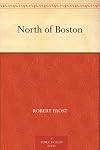
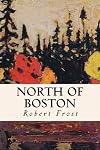
North of Boston
by Robert Frost
On This Page
Description
A collection of seventeen poems originally published in a single volume, plus thirteen other poems drawn from later books.Tags
Recommendations






















Member Reviews
This is Frost's second book of poetry. It contains much longer poems, on average, than [A Boy's Will], but honestly I'm not as happy with it. First, though, let me pick out a selection from a poem that I enjoyed.
"The Death of the Hired Man" is probably my single favorite poem in the book, less because of pretty words and more because of how effectively the story is told. In short, Silas, a man in past times hired by Warren to help on his farm, has returned, in the Winter, in a bad way. Warren is upset, because Silas had left when he was needed, seeking better wages. Warren's wife, Mary, scolds him for being cold:
In the end (it's no surprise, given the title) Silas does die, and that's it. Though Silas doesn't speak, in the poem, Mary speaks for him, relaying his words and interpreting his thoughts. The poem reflects on a number of things: the relationship between Silas and his employers; what obligations they have toward one another; particularly, the 'obligation' of one's home to take one in; and, the sort of concerns a man has, as he comes to his death.
As I said, I wasn't as happy with this book as I was with A Boy's Will. I can't say for sure that the average poem North of Boston is any worse than the average poem in that book, but I think that North of Boston manages somehow to be less than the sum of its parts. The poems share some common themes among them, but they don't build upon the themes, or explore them in a way to give you a fuller picture, so revisiting the themes feels more like repeating a thought than expanding upon it.
Too, some of the poems go on too long--not because of any general preference on my part for short poetry, but because they exhaust the points they're trying to make well before they run out of words with which to make them.
Finally, the poems in this book, like "The Death of the Hired Man", are mostly dialogues. The speakers in several of the poems have voices very similar to my ear, which is especially damaging, as it makes the feeling of a poem gone on too long carry over from one to another in a most unfortunate fashion. It's perhaps unfair of me--had I read the poems spaced far apart I might have considered them each individually better--but I cannot help what I feel. show less
"The Death of the Hired Man" is probably my single favorite poem in the book, less because of pretty words and more because of how effectively the story is told. In short, Silas, a man in past times hired by Warren to help on his farm, has returned, in the Winter, in a bad way. Warren is upset, because Silas had left when he was needed, seeking better wages. Warren's wife, Mary, scolds him for being cold:
"Warren," she said, "he has come home to die:show more
You needn't be afraid he'll leave you this time."
"Home," he mocked gently.
"Yes,
what else but home?
It all depends on what you mean by home.
Of course he's nothing to us, any more
Than was the hound that came a stranger to us
Out of the woods, worn out upon the trail."
"Home is the place where, when you have to go there,
They have to take you in."
"I should have called it
Something you somehow haven't to deserve."
In the end (it's no surprise, given the title) Silas does die, and that's it. Though Silas doesn't speak, in the poem, Mary speaks for him, relaying his words and interpreting his thoughts. The poem reflects on a number of things: the relationship between Silas and his employers; what obligations they have toward one another; particularly, the 'obligation' of one's home to take one in; and, the sort of concerns a man has, as he comes to his death.
As I said, I wasn't as happy with this book as I was with A Boy's Will. I can't say for sure that the average poem North of Boston is any worse than the average poem in that book, but I think that North of Boston manages somehow to be less than the sum of its parts. The poems share some common themes among them, but they don't build upon the themes, or explore them in a way to give you a fuller picture, so revisiting the themes feels more like repeating a thought than expanding upon it.
Too, some of the poems go on too long--not because of any general preference on my part for short poetry, but because they exhaust the points they're trying to make well before they run out of words with which to make them.
Finally, the poems in this book, like "The Death of the Hired Man", are mostly dialogues. The speakers in several of the poems have voices very similar to my ear, which is especially damaging, as it makes the feeling of a poem gone on too long carry over from one to another in a most unfortunate fashion. It's perhaps unfair of me--had I read the poems spaced far apart I might have considered them each individually better--but I cannot help what I feel. show less
I went into re-reading this book thinking I love the short poems, like “Mending Wall,” “After Apple Picking,” “The Wood-Pile,” and “Good Hours” but not the long ones that have a lot of dialogue. But actually I do like some of them too: “The Death of the Hired Man,” “A Hundred Collars,” and “Blueberries.” My new favorite was “Home Burial” which I must have read before but I have no memory of it; how do you like this part?
... The nearest friends can go
With anyone to death, comes so far short
They might as well no try to go at all.
No, from the time when one is sick to death,
One is alone, and he dies more alone.
Friends make pretense of following to the grave,
But before one is in it, their minds are turned
And show more making the best of their way back to life
And living people, and things they understand.
So pretty much a ringing endorsement for Robert Frost from me. show less
... The nearest friends can go
With anyone to death, comes so far short
They might as well no try to go at all.
No, from the time when one is sick to death,
One is alone, and he dies more alone.
Friends make pretense of following to the grave,
But before one is in it, their minds are turned
And show more making the best of their way back to life
And living people, and things they understand.
So pretty much a ringing endorsement for Robert Frost from me. show less
There's quite a change from Frost's first collection, A Boy's Will, with its sonnets and lyrical pieces and abundance of rhyme to this collection of mostly longish blank verse work. These poems are what I think of when I think of Frost rather than his shorter, rhymed poems: the sparse narration, long paragraphs of dialogue, and the way a scene, an instance, an occurrence is sketched out without the assistance of bare exposition, rather like a sort of puzzle to be worked out, very realistic in the way conversations are rendered but without a slavish adherence to realism as a creed. It's a pity American poetry didn't follow the school of Frost rather than that of Pound and Williams.
I am not a big fan of Frost's longer poems, which feel to me like poetic short stories, and they are the majority of this collection. It does include "Mending Wall", which I like a lot, and I also liked "The Good Hour" which was new to me.
Loved Frost most of my life, and getting in some re-reading as some of his stuff has gone public domain for 1923. This, of course, is from 1914, but that's cool tool. Some of my very favorite writing here.
Yeah, Home Burial still messes with me.
Yeah, Home Burial still messes with me.
Ratings
Members
- Recently Added By
Lists

Favourite Books
1,817 works; 316 members
Author Information

292+ Works 26,571 Members
Robert Frost, the quintessential poet of New England, was born in San Francisco in 1874. He was educated at Dartmouth College and Harvard University. Although he managed to support himself working solely as a poet for most of his life and holding various posts with a number of universities, as a young man he was employed as a bobbin boy in a mill, show more a cobbler, a schoolteacher, and a farmer. Frost, whose poetry focuses on natural images of New England, received the Pulitzer Prize for Poetry four times for: New Hampshire, Collected Poems, A Further Range, and A Witness Tree. His works are noted for combining characteristics of both romanticism and modernism. He also wrote A Boy's Will, North of Boston, Mountain Interval, and The Gift Outright, among others. Frost married Elinor Miriam White in 1895, and they had six children--Elliott, Lesley, Carol, Irma, Marjorie, and Elinor Bettina. He died in Boston in 1963. (Bowker Author Biography) show less
Awards and Honors
Series
Belongs to Publisher Series
Work Relationships
Is contained in
Contains
Common Knowledge
- Original publication date
- 1914
- Dedication
- TO
E. M. F.
THIS BOOK OF PEOPLE - Original language*
- Anglès
*Some information comes from Common Knowledge in other languages. Click "Edit" for more information.
Classifications
Statistics
- Members
- 207
- Popularity
- 157,350
- Reviews
- 5
- Rating
- (4.06)
- Languages
- 5 — Catalan, Czech, English, Spanish, Swedish
- Media
- Paper, Audiobook, Ebook
- ISBNs
- 35
- ASINs
- 14