On This Page
Description
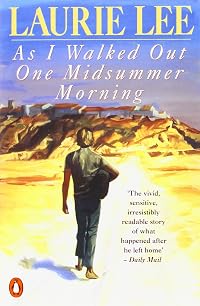
The second volume in Laurie Lee's acclaimed autobiographical trilogy, an unforgettable glimpse of Spain on the eve of its civil war On a bright Sunday morning in June 1934, Laurie Lee left the village home so lovingly portrayed in his bestselling memoir, Cider with Rosie. His plan was to walk the hundred miles from Slad to London, with a detour of an extra hundred miles to see the sea for the first time. He was nineteen years old and brought with him only what he could carry on his back: a show more tent, a change of clothes, his violin, a tin of biscuits, and some cheese. He spent the first night in a ditch, wide awake and soaking wet. From those unlikely beginnings, Laurie Lee fashioned not just the adventure of a lifetime, but one of the finest travel narratives of the twentieth century. As I Walked Out One Midsummer Morning, written more than thirty years after the events it describes, is an elegant and irresistibly charming portrait of life on the road-first in England, where the familiar landscapes and people somehow made Lee feel far from home, and then in Spain, whose utter foreignness afforded a new kind of comfort. In that brief period of peace, a young man was free to go wherever he wanted to in Europe. Lee picked Spain because he knew enough Spanish to ask for a glass of water. What he did not know, and what would become clear only after a year spent tramping across the beautiful and rugged countryside-from the Galician port city of Vigo, over the Sierra de Guadarrama and into Madrid, and along the Costa del Sol-was that the Spanish Republic would soon need idealistic young men like Lee as badly as he needed it. show lessTags
Recommendations
























Member Recommendations
Member Reviews
Laurie Lee left home in England to find, at the very least, fame and fortune as a musician. With mixed emotions he found he could make a dime on street corners but had to supplement his income with other vocations like construction work before moving on to his next adventure. At the heart of his journey was discovery; as he put it, "I felt it was for this I had come: to wake at dawn on a hillside and look out on a world for which I had no words, to start at the beginning, speechless and without a plan, in a place that still had no memories for me" (p 54). Most of his discovery takes place in Spain. As an aside, I loved his description of Madrid as an old lion with broken teeth and bad breath. As I Walked Out... ends with Lee being show more escorted out of Spain by a British destroyer and yet by summer he was fixated on getting back to Spain to join the war. show less
“I felt it was for this I had come: to wake at dawn on a hillside and look out on a world for which I had no words, to start at the beginning, speechless and without plan, in a place that still had no memories for me.”
Not as well known as 'Cider With Rosie' this book is the second in Laurie Lee's autobiographical trilogy. Its 1934 and without of a job 19-year-old Lee leaves his Gloucestershire hometown to tramp to London. In the capital he works for a year as a labourer on a building site but when that job nears completion he sets his sights on Europe: “a place of casual frontiers, few questions and almost no travellers”. He chose Spain because he knew a single Spanish phrase “‘will you please give me a glass of water?’” show more and so begins probably the best travelogue I've ever read.
Initially Lee lands on Spanish soil in Vigo from where he walks and busks east to Valladolid, south to Cadiz via Madrid and Seville, before turning left along the Andalusian coast to eventually arrive at Castillo. Along the way the reader are shown aspects of Spain that they would rather not see on a package holiday: bedbugs, blisters, wolves and fearful heat — “the brass-taloned lion which licks the afternoon ground ready to consume anyone not wise enough to take cover”, alongside things that you would want to experience: bright-whitewashed towns and the pine-cool foothills of the Sierras where he “slipped off the heat like a sweat-soaked shirt”. Along the way he meets bootblacks, peasants, innkeepers, drovers, priests, soldiers, fellow buskers, limbless beggars and of course a variety of women. Lee arrives as a callow and naïve 20-year-old but gradually comes to realise that the country is on the brink of Civil War and on account the writing slowly grows darker as the story progresses.
What raises this above the level of an ordinary travelogue is Lee's unique and deceptively simple yet poetic language, virtually every other page seemed to contain a beautiful turn of phrase: “Stepping in from the torrid street, you met a band of cool air like fruit-peel pressed to your brow.” But it would also only fair to remember that this book wasn’t published until 1969 so some 30+ years after the actual events took place. No doubt some of the conversations and events are re-imagined recollections and there is also an element of rose-tinted glasses about it. All the same its a beautiful piece of writing that although dated shouts out to be read. show less
Not as well known as 'Cider With Rosie' this book is the second in Laurie Lee's autobiographical trilogy. Its 1934 and without of a job 19-year-old Lee leaves his Gloucestershire hometown to tramp to London. In the capital he works for a year as a labourer on a building site but when that job nears completion he sets his sights on Europe: “a place of casual frontiers, few questions and almost no travellers”. He chose Spain because he knew a single Spanish phrase “‘will you please give me a glass of water?’” show more and so begins probably the best travelogue I've ever read.
Initially Lee lands on Spanish soil in Vigo from where he walks and busks east to Valladolid, south to Cadiz via Madrid and Seville, before turning left along the Andalusian coast to eventually arrive at Castillo. Along the way the reader are shown aspects of Spain that they would rather not see on a package holiday: bedbugs, blisters, wolves and fearful heat — “the brass-taloned lion which licks the afternoon ground ready to consume anyone not wise enough to take cover”, alongside things that you would want to experience: bright-whitewashed towns and the pine-cool foothills of the Sierras where he “slipped off the heat like a sweat-soaked shirt”. Along the way he meets bootblacks, peasants, innkeepers, drovers, priests, soldiers, fellow buskers, limbless beggars and of course a variety of women. Lee arrives as a callow and naïve 20-year-old but gradually comes to realise that the country is on the brink of Civil War and on account the writing slowly grows darker as the story progresses.
What raises this above the level of an ordinary travelogue is Lee's unique and deceptively simple yet poetic language, virtually every other page seemed to contain a beautiful turn of phrase: “Stepping in from the torrid street, you met a band of cool air like fruit-peel pressed to your brow.” But it would also only fair to remember that this book wasn’t published until 1969 so some 30+ years after the actual events took place. No doubt some of the conversations and events are re-imagined recollections and there is also an element of rose-tinted glasses about it. All the same its a beautiful piece of writing that although dated shouts out to be read. show less
As I Walked Out . . . is the memoir of a young Englishman who spent a year walking through Spain on the eve of the Spanish Civil War, written almost 30 years later, in 1969. We get not only a fascinating look at the almost medieval world that was Spain in those days, but also a compelling coming of age story, as Lee left his rural English village almost entirely ignorant of the world (save what he could glean from books) and comes to learn quite a bit about human nature and his own powers of observation and survival. There are astonishing revelations about the poverty and feudal nature of 1930s Spain, as Lee points out that large tracts of arable land, owned by absentee landowners, had at that point gone untilled since roughly the days show more of the Roman Empire. (I have read other contemporary reports that confirm that Spain in the 1930s had the closest thing to the original feudal system still existing in Europe.)
Lee benefits from the ancient Spanish custom of kindness and generosity to strangers, and makes his living as he travels playing his violin for small change and meals in the villages, towns and cities he passes through. He meets kindness, and squalor, almost everywhere, but comes away awed by the tough yet loving endurace of the Spanish people. The book concludes with the very opening battles of the Civil War.
In addition to the story Lee tells, the real treasure in the book is Lee's wonderful, poetic writing style. Through that style, he's able to bring people and landscapes fully to life. Here's just one example:
"In this bar, the wine was poured from a great stone jar, and served by an old man who'd lost a leg in the bullring. He carried his grumbles and miseries like a guttering candle from one group of drinkers to another."
I read this book on loan from a friend who insisted I read it before my impending trip to Spain, and I'm very, very happy I took his advice. show less
Lee benefits from the ancient Spanish custom of kindness and generosity to strangers, and makes his living as he travels playing his violin for small change and meals in the villages, towns and cities he passes through. He meets kindness, and squalor, almost everywhere, but comes away awed by the tough yet loving endurace of the Spanish people. The book concludes with the very opening battles of the Civil War.
In addition to the story Lee tells, the real treasure in the book is Lee's wonderful, poetic writing style. Through that style, he's able to bring people and landscapes fully to life. Here's just one example:
"In this bar, the wine was poured from a great stone jar, and served by an old man who'd lost a leg in the bullring. He carried his grumbles and miseries like a guttering candle from one group of drinkers to another."
I read this book on loan from a friend who insisted I read it before my impending trip to Spain, and I'm very, very happy I took his advice. show less
Written some thirty plus years after the event, English poet and memoirist Laurie Lee recalls the period in his life when aged 20 he walked from his childhood home in pastoral Gloucestershire to London - where he worked for a year on a building site - and then arrived by sea to Vigo in northwestern Spain in summer 1935; before walking down through the country's dusty interior with his fiddle in his pack, to the Andalusian south.
Lee shows us a young man's glimpse of a world largely unaffected by modern industrialisation, and still saturated with the old world order of things. Poverty abounds, though by and large 'Lorenzo' is able to make his way by playing for his supper. Does the older author writing much later in life (at the time of show more the hippies) romanticise his travels? Perhaps, I don't know (wouldn't we all?), but it cannot be said that he fails to show the squalor, or violence, or sheer destitution of the many Spaniards he becomes acquainted with on the road.
Somewhere near Valladolid, he suffers from sunstroke. Rarely has it been described quite so effectively:
"The violence of the heat seemed to bruise the whole earth and turn its crust into one huge scar. One's blood dried up and all juices vanished; the sun struck upwards, sideways, and down, while the wheat went buckling across the fields like a solid sheet of copper. I kept on walking because there was no shade to hide in, and because it seemed to be the only way to agitate the air around me."
This was a wonderfully written daydream of a book, evoking a time and place with some lovingly crafted passages of prose. The place is that of a by-then peripheral European country, the time finds it on the eve of a terrible civil war that proved the testing ground for the century's greatest conflict of ideologies and mechanised brutality. The poetry in Lee's phrasing is ever present, but never becomes trying, only a thing to savour. If ever a book could conjure up the notion of literary time travel - this is an excellent example of that particular pleasure.
As Lee moves ever south, he declares that "...it was in Seville, on the bridge, watching the river at midnight..." that he "...got the first hint of coming trouble", as a passing sailor suggests there would be "plenty of blood on the way if he stuck around." Then one morning after a night slept in a hill-top cemetery, taking breakfast in a village wineshop, he hears the first talk of war:
"The faces of the fishermen were dull and grey as they rolled the harsh dry word between them. They spoke of war in Abyssinia; meaningless to me, who hadn't seen a newspaper for almost three months."
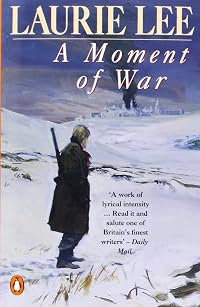
Progressively, as a carefree summer of '35 becomes a tense and gloom-filled winter of '36, we witness Lee's roaming life grind to a halt in a dead-end fishing village east of Malaga. The book's end comes suddenly and leaves me wanting to know what happened next. Lee continues the story in 'A Moment of War'.
There are countless passages that I could have selected to quote from. His ability to describe landscape and people so vividly is truly lyrical, that I am encouraged to seek out all his other works in due course. When I started reading this book, I was unaware of 2014 being Laurie Lee's centenary. Now I am most glad to have at last read this small classic of travel writing. show less
Lee shows us a young man's glimpse of a world largely unaffected by modern industrialisation, and still saturated with the old world order of things. Poverty abounds, though by and large 'Lorenzo' is able to make his way by playing for his supper. Does the older author writing much later in life (at the time of show more the hippies) romanticise his travels? Perhaps, I don't know (wouldn't we all?), but it cannot be said that he fails to show the squalor, or violence, or sheer destitution of the many Spaniards he becomes acquainted with on the road.
Somewhere near Valladolid, he suffers from sunstroke. Rarely has it been described quite so effectively:
"The violence of the heat seemed to bruise the whole earth and turn its crust into one huge scar. One's blood dried up and all juices vanished; the sun struck upwards, sideways, and down, while the wheat went buckling across the fields like a solid sheet of copper. I kept on walking because there was no shade to hide in, and because it seemed to be the only way to agitate the air around me."
This was a wonderfully written daydream of a book, evoking a time and place with some lovingly crafted passages of prose. The place is that of a by-then peripheral European country, the time finds it on the eve of a terrible civil war that proved the testing ground for the century's greatest conflict of ideologies and mechanised brutality. The poetry in Lee's phrasing is ever present, but never becomes trying, only a thing to savour. If ever a book could conjure up the notion of literary time travel - this is an excellent example of that particular pleasure.
As Lee moves ever south, he declares that "...it was in Seville, on the bridge, watching the river at midnight..." that he "...got the first hint of coming trouble", as a passing sailor suggests there would be "plenty of blood on the way if he stuck around." Then one morning after a night slept in a hill-top cemetery, taking breakfast in a village wineshop, he hears the first talk of war:
"The faces of the fishermen were dull and grey as they rolled the harsh dry word between them. They spoke of war in Abyssinia; meaningless to me, who hadn't seen a newspaper for almost three months."
Progressively, as a carefree summer of '35 becomes a tense and gloom-filled winter of '36, we witness Lee's roaming life grind to a halt in a dead-end fishing village east of Malaga. The book's end comes suddenly and leaves me wanting to know what happened next. Lee continues the story in 'A Moment of War'.
There are countless passages that I could have selected to quote from. His ability to describe landscape and people so vividly is truly lyrical, that I am encouraged to seek out all his other works in due course. When I started reading this book, I was unaware of 2014 being Laurie Lee's centenary. Now I am most glad to have at last read this small classic of travel writing. show less
This is a book about being in a place you don't know, not knowing what to do or what's happening around you. It's also about poverty and social unrest, and also about kindness and community. Laurie Lee is great at reconstructing particular times and places. I believe I have a more vivid image of Spain from reading this book than by actually being there. The different towns and villages he visits all feel unique, not because anything amazing happened as he was passing through but because he gives each of them a particular character.
Still, some things bugged me a lot while reading this. Laurie Lee is writing in the 60s about his experiences in the 30s. It's clear that he's writing about them as if they had just happened to him -- he's show more not reflecting on past memories, but going back in time and reliving them. That's not something he's completely able to do, though: several details are missing, probably because he couldn't remember all of it and his diaries were reportedly lost. The effect of this was weird: I often wondered why he skipped big sections of the story -- for example, didn't he have any inner thoughts during his long walks from town to town? -- and had to remind myself that because he was writing about it much later, the best he could do was give us some highlights.
Here's a rare point where it's made clear that he's talking about the past:
And it can't be a coincidence that this is the chapter about the civil war, the one chapter where we can easily relate past and present, since from our vantage point we know what was about to happen in Spain. As for the other places he visited, I was left wondering if they'd changed at all in the intervening time. (Another small exception: I laughed when he described the Bar Chicote in Madrid as having become a "prophylactic night-spot for tourists" since he first visited it.)
The omissions also make the story a bit hard to believe. Maybe I'm being cynical, but he seems too naive to do this well. He arrives in Spain barely speaking a word of Spanish, and suddenly he's talking to everyone and is welcome everywhere. At one point his violin breaks, but luckily someone he knows has a violin to give away. Then later a ship comes to save him as war is about to break loose, and then later, while climbing the Pyrenees, he finds a shelter that saves him from frostbite. I don't doubt that these things happened, but the way he writes makes them difficult to believe. He was probably not as naive as he's portraying himself. show less
Still, some things bugged me a lot while reading this. Laurie Lee is writing in the 60s about his experiences in the 30s. It's clear that he's writing about them as if they had just happened to him -- he's show more not reflecting on past memories, but going back in time and reliving them. That's not something he's completely able to do, though: several details are missing, probably because he couldn't remember all of it and his diaries were reportedly lost. The effect of this was weird: I often wondered why he skipped big sections of the story -- for example, didn't he have any inner thoughts during his long walks from town to town? -- and had to remind myself that because he was writing about it much later, the best he could do was give us some highlights.
Here's a rare point where it's made clear that he's talking about the past:
In fact, I don't remember meeting an official Communist in Almuñécar -- though 'communism' was a word in the bars.
And it can't be a coincidence that this is the chapter about the civil war, the one chapter where we can easily relate past and present, since from our vantage point we know what was about to happen in Spain. As for the other places he visited, I was left wondering if they'd changed at all in the intervening time. (Another small exception: I laughed when he described the Bar Chicote in Madrid as having become a "prophylactic night-spot for tourists" since he first visited it.)
The omissions also make the story a bit hard to believe. Maybe I'm being cynical, but he seems too naive to do this well. He arrives in Spain barely speaking a word of Spanish, and suddenly he's talking to everyone and is welcome everywhere. At one point his violin breaks, but luckily someone he knows has a violin to give away. Then later a ship comes to save him as war is about to break loose, and then later, while climbing the Pyrenees, he finds a shelter that saves him from frostbite. I don't doubt that these things happened, but the way he writes makes them difficult to believe. He was probably not as naive as he's portraying himself. show less
I borrowed this from family after seeing it lying around, flicking through, and reading a handful of sentences about Lee arriving in Spain and fending off wild dogs. The sentences were beautiful.
Lee takes you through a year-long walk right through Spain in the 30s, setting landscapes and communities vividly against a flow of words that it's difficult to halt. There's a casualness of exploration I love that reminds me of Lindqvist's Myth of Wu Tao-Tzu, and a show of character as good as any 'lone hero' Hollywood thriller. London is a starting point and a warm up at the outset, but after that, the end could be wherever and whenever.
Tempted to pick up his other two autobios in the series now.
Lee takes you through a year-long walk right through Spain in the 30s, setting landscapes and communities vividly against a flow of words that it's difficult to halt. There's a casualness of exploration I love that reminds me of Lindqvist's Myth of Wu Tao-Tzu, and a show of character as good as any 'lone hero' Hollywood thriller. London is a starting point and a warm up at the outset, but after that, the end could be wherever and whenever.
Tempted to pick up his other two autobios in the series now.
A young man, Laurie Lee leaves his home in Stroud, spends some time working on a building site in London (lured there by love), then decides to go to Spain, with no money but a violin. Totally unprepared, hatless in the blazing sun, he walks from Vigo across the country to the south coast, finally reaching Almunecar at the onset of the Civil War. His Spain, almost primitive, rowdy, lusty, cackling, raw, desolate, dazzling, romantic, crumbling, has now faded away; we can only regret and recapture it through his poetic ramblings.
I first read this in a Penguin paperback where the names of some of the places were altered. The FS edition is a pleasure to hold and has some (not enough) beautiful illustrations. What is missing is a map.
I first read this in a Penguin paperback where the names of some of the places were altered. The FS edition is a pleasure to hold and has some (not enough) beautiful illustrations. What is missing is a map.
Members
- Recently Added By
Lists

Folio Society
831 works; 53 members

Best Literary Walks
35 works; 7 members

Books about the Spanish Civil War
57 works; 3 members
Author Information

37+ Works 5,899 Members
Some Editions
Series

Belongs to Publisher Series
Work Relationships
Common Knowledge
- Canonical title
- As I Walked Out One Midsummer Morning
- Original publication date
- 1969
- People/Characters
- Laurie Lee; Roy Campbell; Mary Garman
- Important places
- Slad, Gloucestershire, England, UK; London, England, UK; Spain; Almuñécar, Spain
- Dedication
- To T. S. Matthews
- First words
- The stooping figure of my mother, waist-deep in the grass and caught there like a piece of sheep's wool, was the last I saw of my country home as I left it to discover the world.
- Last words
- (Click to show. Warning: May contain spoilers.)I was back in Spain, with a winter of war before me.
Classifications
Statistics
- Members
- 1,377
- Popularity
- 17,287
- Reviews
- 36
- Rating
- (3.99)
- Languages
- 10 — Dutch, English, Finnish, French, German, Italian, Norwegian, Portuguese, Spanish, Swedish
- Media
- Paper, Audiobook, Ebook
- ISBNs
- 34
- ASINs
- 27