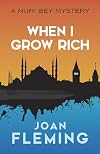
When I Grow Rich
by Joan Fleming
On This Page
Description
"My one single favorite book of the year." - Anthony Boucher, Edgar Award-winning critic for The New York Times Book Review Turkish philosopher and scholar Nuri Bey lives for his books and longs to study at Oxford. His dream is unattainable without the help of his rich patron, Madame Miasma, so when she asks Bey to deliver a parcel to a friend of hers, he readily agrees. The simple-sounding favour leads to Bey's unwitting participation in a fateful string of events, from an airport shootout show more with members of an international drug smuggling ring to his sudden and unexpected involvement with a rootless British teenager. This atmospheric tale of murder and suspense unfolds in Istanbul, which provides a vivid backdrop of minarets, mosques, and the Bosphorus, the dark and winding waterway that bisects the city. Winner of the 1962 Gold Dagger award from the British Crime Writers' Association, it colorfully portrays the differences between British and Turkish sensibilities in the 1960s. The story reflects a society at the crossroads of Europe and Asia that's caught between a proud sultanic past and a compelling modern future. AUTHOR: Joan Fleming (1908-80) twice received the Gold Dagger Award for Best Novel, awarded by the British Crime Writers' Association, for When I Grow Rich in 1962 and for Young Man, I Think You're Dying in 1970. Fleming published five children's books before her first adult crime novel, 1949's Two Lovers Too Many, after which she wrote more than 30 other books in the genre. Her novel The Deeds of Dr. Deadcert was the basis for the 1958 film Rx for Murder. show lessTags
Recommendations






















Member Reviews
You might fear that a 1960s middle-class English writer setting a novel in Istanbul would be prone to the worst kind of exoticising description of the city, the people, the religion, even the stray cats. In this case, you'd be absolutely right.
It's an interesting question whether Joan Fleming ever visited Istanbul (actually, it's not, but let's pretend). The case against: everything said about the city (etc) is said in a plodding, didactic manner that suggests diligent book-learning being recited. The case for: everything said about everything is said in a plodding didactic manner. We can't get through a description of a character building a rockery without a little digression on the formation of basalt. The dialogue is similarly show more appalling. You'd think it was an insulting characterisation of Turkish people to make them all so windy and stiff, were it not for the fact that the English characters are also so windy and stiff.
So that's the setting, the style, the writing. Is there something in the characters? Well, the principal villain is a one-time member of the Sultan's harem (I kid you not) sunk into old-age avarice, bitterness, and vanity. She gets angry a lot. She cackles. She is called Madame Miasma (again, I kid you not). She is attended in her schemes by a eunuch, also from the harem, who is secretly in love with her (once more, or perhaps twice more I kid you not). I will not describe the other characters.
Oh, the plot? It's barely there, and the few elements it has are laid out in front of us over and again: foreshadowed, occurrent, recalled. It's hard to tell what the central mystery, suspense, or drama is even meant to be.
All in all: a stinker. Hard to see what the 1962 prize-givers saw in it; remarkable to see that an Ambler novel came second to it; dismaying to see that there's more Fleming coming up in 1970. Perhaps she spent the decade learning how to write. But let's not worry about the far future now, because it's 1963 next, and this one is a stone-cold classic. show less
It's an interesting question whether Joan Fleming ever visited Istanbul (actually, it's not, but let's pretend). The case against: everything said about the city (etc) is said in a plodding, didactic manner that suggests diligent book-learning being recited. The case for: everything said about everything is said in a plodding didactic manner. We can't get through a description of a character building a rockery without a little digression on the formation of basalt. The dialogue is similarly show more appalling. You'd think it was an insulting characterisation of Turkish people to make them all so windy and stiff, were it not for the fact that the English characters are also so windy and stiff.
So that's the setting, the style, the writing. Is there something in the characters? Well, the principal villain is a one-time member of the Sultan's harem (I kid you not) sunk into old-age avarice, bitterness, and vanity. She gets angry a lot. She cackles. She is called Madame Miasma (again, I kid you not). She is attended in her schemes by a eunuch, also from the harem, who is secretly in love with her (once more, or perhaps twice more I kid you not). I will not describe the other characters.
Oh, the plot? It's barely there, and the few elements it has are laid out in front of us over and again: foreshadowed, occurrent, recalled. It's hard to tell what the central mystery, suspense, or drama is even meant to be.
All in all: a stinker. Hard to see what the 1962 prize-givers saw in it; remarkable to see that an Ambler novel came second to it; dismaying to see that there's more Fleming coming up in 1970. Perhaps she spent the decade learning how to write. But let's not worry about the far future now, because it's 1963 next, and this one is a stone-cold classic. show less
Ratings
Members
- Recently Added By
Published Reviews
"Whacky English girl is saved from murky fate by an unworldly philosopher--a beautifully drawn and most endearing character resembling an Oriental Father Brown. A charming, absorbing, unusual story."
added by bmlg
Lists

Anthony Boucher's Best Crime Fiction of the Year
115 works; 5 members

#JustTheFacts2019Silver
60 works; 1 member
Author Information
37+ Works 334 Members
Some Editions
Awards and Honors
Awards
Distinctions
Series
Belongs to Publisher Series
Common Knowledge
- Original publication date
- 1962
- People/Characters
- Nuri bey; Jenny Bolton; Madame Miasma; Hadji; Madame Bassompierre; Tony Grand
- Important places
- Istanbul, Turkey
- Dedication
- To Penelope who helped
- First words
- Between the two concrete blocks of new flats, separated by a small stretch of hard-trodden earth and half a dozen fine plane trees, stood a decrepit old wooden house.
- Last words
- (Click to show. Warning: May contain spoilers.)"Or perhaps," he said aloud, "like Potemkin, I only wanted to long for something."
Classifications
Statistics
- Members
- 38
- Popularity
- 761,178
- Reviews
- 1
- Rating
- (3.10)
- Languages
- Danish, English, Swedish
- Media
- Paper, Ebook
- ISBNs
- 9
- UPCs
- 1
- ASINs
- 6