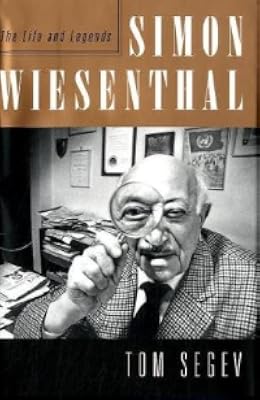
Simon Wiesenthal: The Life and Legends
by Tom Segev
On This Page
Description
A fully documented profile of the "Nazi hunter" famous for his unrelenting pursuit of Nazi criminals draws on extensive international records to discuss such topics as his role in capturing Adolf Eichmann, rivalry with Elie Wiesel, and infamy later in life.Tags
Recommendations




















Member Reviews
Overall, I liked it, but I think I would only recommend it for those already interested to some degree in either Holocaust/Jewish studies, Simon Weisenthal, WWII, etc.
For those (like me) who may not recall off the top of their head, Simon Weisenthal survived the Holocaust and tracked down many Nazis - including Adolf Eichmann, the "architect of the Holocaust" - to bring them to trial for war crimes in the decades following 1945.
Though there are explanations and context throughout, I think some familiarity with Simon Weisenthal is helpful to have before diving into this book. He's a complex man who many have argued had a liberal relationship with the truth. This biography points out instances, potential motivations, and - when the truth show more is not acertainable - multiple versions presented by Weisenthal himself. These elements coupled with the sometimes shadowy world Weisenthal exposed and make the book rich and deep and interesting.
In some ways, for those (like me) unfamiliar with the history, part of the suspense of this book is following each campaign/effort to track down Nazis and to see whether the attempt was successful in a) finding the war criminal or b) bringing them to trial/justice. The shadowy nature of the efforts and the necessity of weighing the stories, documents, arguments/lawsuites and evidence to ascertain truth (or extent thereof) is also a dramatic aspect of looking at Weisenthal's life in retrospect.
As documentation bringing to light apparently new and and more comprehensive information on Weisenthal, I think this biography succeeds. There are ~45 pages of notes and the author had access to records only recently unclassified and exclusive interviews as well as to the archives of Weisenthal's documentation center in Vienna. It does attempt to answer questions about his motivations for hunting down Nazi's, his writing (including The Sunflower), and some of his major confrontations (including with the first Jewish chancellor of Austria, Bruno Kreisky). I felt the balance largely focused on his career later in life and there was little about his personal life - his relationship with his wife or daughter Paulinka. Aside from stamp collecting, there's little mention of anything Weisenthal did aside from track down Nazis. So to some extent, it's still missing a bit of the humanistic perspective of Weisenthal even though it does get at why he made hunting Nazi's his life's work. show less
For those (like me) who may not recall off the top of their head, Simon Weisenthal survived the Holocaust and tracked down many Nazis - including Adolf Eichmann, the "architect of the Holocaust" - to bring them to trial for war crimes in the decades following 1945.
Though there are explanations and context throughout, I think some familiarity with Simon Weisenthal is helpful to have before diving into this book. He's a complex man who many have argued had a liberal relationship with the truth. This biography points out instances, potential motivations, and - when the truth show more is not acertainable - multiple versions presented by Weisenthal himself. These elements coupled with the sometimes shadowy world Weisenthal exposed and make the book rich and deep and interesting.
In some ways, for those (like me) unfamiliar with the history, part of the suspense of this book is following each campaign/effort to track down Nazis and to see whether the attempt was successful in a) finding the war criminal or b) bringing them to trial/justice. The shadowy nature of the efforts and the necessity of weighing the stories, documents, arguments/lawsuites and evidence to ascertain truth (or extent thereof) is also a dramatic aspect of looking at Weisenthal's life in retrospect.
As documentation bringing to light apparently new and and more comprehensive information on Weisenthal, I think this biography succeeds. There are ~45 pages of notes and the author had access to records only recently unclassified and exclusive interviews as well as to the archives of Weisenthal's documentation center in Vienna. It does attempt to answer questions about his motivations for hunting down Nazi's, his writing (including The Sunflower), and some of his major confrontations (including with the first Jewish chancellor of Austria, Bruno Kreisky). I felt the balance largely focused on his career later in life and there was little about his personal life - his relationship with his wife or daughter Paulinka. Aside from stamp collecting, there's little mention of anything Weisenthal did aside from track down Nazis. So to some extent, it's still missing a bit of the humanistic perspective of Weisenthal even though it does get at why he made hunting Nazi's his life's work. show less
A nice account of the life of the world's most famous Nazi hunter. It is sad to note that he was later embroiled in controversies he could have avoided, one of which at least cost him the Nobel Peace Prize.
A nice account of the life of the world's most famous Nazi hunter. It is sad to note that he was later embroiled in controversies he could have avoided, one of which at least cost him the Nobel Peace Prize.
Interessante Biographie eines Jahrhundertmenschen, dessen Leben allerdings auch von Widersprüchen geprägt war.
Apr 13, 2022German
Ratings
Members
- Recently Added By
Published Reviews
ThingScore 63
Segev makes his position clear from the beginning of this substantial and thoroughly researched volume. With uncharacteristic enthusiasm, he describes Wiesenthal as a man of "broad humanity," a "tireless warrior against evil and a central figure in the struggle for human rights...."
Nevertheless, despite his high regard for Wiesenthal, Segev gives due attention to the other side of the story. show more Indeed, he confirms many of the charges made by his critics....
Somewhat surprisingly, Tom Segev, a journalist who is usually zealous in his search for truth and contemptuous of those who distort it, is not unduly bothered by Wiesenthal's mendacity. show less
Nevertheless, despite his high regard for Wiesenthal, Segev gives due attention to the other side of the story. show more Indeed, he confirms many of the charges made by his critics....
Somewhat surprisingly, Tom Segev, a journalist who is usually zealous in his search for truth and contemptuous of those who distort it, is not unduly bothered by Wiesenthal's mendacity. show less
added by atbradley
It cannot have been simple work for Mr. Segev to sort out all of Wiesenthal’s stories, but sort he does. It’s one of his biography’s achievements that you see its subject absolutely plain. Mr. Segev admires Wiesenthal but does not turn away from the sketchier aspects of his personality.
added by Shortride
Author Information

20+ Works 2,020 Members
Tom Segev is a columnist for "Ha'aretz," Israel's leading newspaper, & the author of "One Palestine, Complete" & "1949: The First Israelis." His book, "The Seventh Million," has also been made into a documentary film. He lives in Jerusalem. (Bowker Author Biography)
Awards and Honors
Awards
Distinctions
Common Knowledge
- People/Characters
- Simon Wiesenthal
- Important places
- Germany
- Important events
- Holocaust; World War II; Nazi Germany; World War II
Classifications
- Genres
- Biography & Memoir, Nonfiction, History, Hunting and Fishing, Sports and Leisure
- DDC/MDS
- 940.53 — History & geography History of Europe History of Europe 1918- World War II, 1939-1945
- LCC
- DS135 .A93 .W537 — History of Europe, Asia, Africa and Oceania Asia History of Asia Israel (Palestine). The Jews Jews outside of Palestine
- BISAC
Statistics
- Members
- 154
- Popularity
- 213,544
- Reviews
- 4
- Rating
- (4.00)
- Languages
- 8 — Czech, Dutch, English, French, German, Hebrew, Polish, Portuguese
- Media
- Paper, Audiobook, Ebook
- ISBNs
- 15
- ASINs
- 1