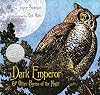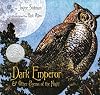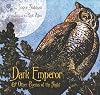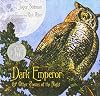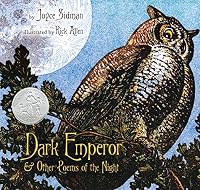
Dark Emperor & Other Poems of the Night
by Joyce Sidman
On This Page
Description
A collection of poems that celebrates the wonder, mystery, and danger of the night and describes the many things that hide in the dark.Tags
Recommendations



Member Reviews
Children's poet and author Joyce Sidman teams up with engraver and small press operator Rick Allen in this lovely picture book collection of poems about the flora and fauna of the night. Nimbly-worded and immensely expressive, these twelve poems describe snails on the move and on the make (making their shells that is), a great horned owl presiding over the night like a majestic emperor, an oak tree repairing and rejuvenating itself, a baby porcupette nursing and eating, and so much more. The collection opens with Welcome to the Night, greeting all of the creatures who come out in the dark, and closes with Moon's Lament, an ubi sunt (a form of medieval poetry mourning the loss of wonderful things). Each poem is accompanied by an show more informational blurb about the animal or plant under discussion, and the book closes with a glossary...
The second poetic picture book I had read from this author/artist pair, following upon their Winter Bees & Other Poems of the Cold (published subsequently), Dark Emperor & Other Poems of the Night was chosen as a Newbery Honor Book in 2011. Although not unheard of, this is an unusual distinction for a picture book, given that the Newbery honors writing rather than illustration, but it is certainly merited here. Sidman's poems are appealing—expressive, thoughtful, and a pleasure to read. I particularly liked the opening Welcome to the Night, which closes with the following verse:
"The night's a sea of dappled dark,
the night's a feast of sounds and spark,
the night's a wild, enchanted park,
Welcome to the night!"
I also greatly enjoyed Oak After Dark, which closes:
"I do not rest, I do not sleep,
All my promises I keep:
to stand while all the seasons fly,
to anchor earth,
to touch the sky."
As enjoyable as the poems here were, my reading pleasure was enhanced by Allen's wonderful illustrations, created using a process of relief printing. I love block print artwork of all kinds, and Allen's is very appealing. Although he has (alas!) only illustrated two books, more of his work can be found on his website, Kenspeckle Letterpress. In any case, this is one I would recommend, both to young poetry and animals lovers, and to those who are fellow admirers of this style of illustration. show less
The second poetic picture book I had read from this author/artist pair, following upon their Winter Bees & Other Poems of the Cold (published subsequently), Dark Emperor & Other Poems of the Night was chosen as a Newbery Honor Book in 2011. Although not unheard of, this is an unusual distinction for a picture book, given that the Newbery honors writing rather than illustration, but it is certainly merited here. Sidman's poems are appealing—expressive, thoughtful, and a pleasure to read. I particularly liked the opening Welcome to the Night, which closes with the following verse:
"The night's a sea of dappled dark,
the night's a feast of sounds and spark,
the night's a wild, enchanted park,
Welcome to the night!"
I also greatly enjoyed Oak After Dark, which closes:
"I do not rest, I do not sleep,
All my promises I keep:
to stand while all the seasons fly,
to anchor earth,
to touch the sky."
As enjoyable as the poems here were, my reading pleasure was enhanced by Allen's wonderful illustrations, created using a process of relief printing. I love block print artwork of all kinds, and Allen's is very appealing. Although he has (alas!) only illustrated two books, more of his work can be found on his website, Kenspeckle Letterpress. In any case, this is one I would recommend, both to young poetry and animals lovers, and to those who are fellow admirers of this style of illustration. show less
The look of this Newbery-Honor winning book is deceptively simple. It is the size of a picture book. Instead of a linear story, however, the text is made up of poems tracing the course of night from dusk to dawn by focusing on varying aspects such as nocturnal animals, trees, and the moon. Each poem is on the left-hand side of the page, with a small illustration; a larger illustration fills most of the opposite page. On the far right of the illustration, in smaller font that could easily be ignored when reading to a younger or restless audience, is a short paragraph filled with fascinating tidbits about the subject of the poem.
I confess I was so focused on the text - poetry and nonfiction - that I glossed over the illustrations at show more first. Then, I read about the process on the title page, which made me take a second look. The method used is relief printing, a process in which a drawing is transferred to wood. The wood is then carved, covered in ink, and printed onto paper. In order to create colorful prints as are in this book, this process of carving, inking, and printing must be done multiple times in multiple colors - and aligned perfectly. Think that sounds like a lot of work? Read on: "The prints for Dark Emperor were each printed from at least three blocks (and in some instances as many as six) and then hand-colored with strongly pigmented watercolor called gouache." Wow. And I had thought of them as fairly simple! I had to page through again, this time in awe of the amount of work it took to create each illustration. This is a truly lovingly crafted book of poetry, nonfiction, and illustration. show less
I confess I was so focused on the text - poetry and nonfiction - that I glossed over the illustrations at show more first. Then, I read about the process on the title page, which made me take a second look. The method used is relief printing, a process in which a drawing is transferred to wood. The wood is then carved, covered in ink, and printed onto paper. In order to create colorful prints as are in this book, this process of carving, inking, and printing must be done multiple times in multiple colors - and aligned perfectly. Think that sounds like a lot of work? Read on: "The prints for Dark Emperor were each printed from at least three blocks (and in some instances as many as six) and then hand-colored with strongly pigmented watercolor called gouache." Wow. And I had thought of them as fairly simple! I had to page through again, this time in awe of the amount of work it took to create each illustration. This is a truly lovingly crafted book of poetry, nonfiction, and illustration. show less
Dark Emperor and Other Poems of the Night is the perfect collection of nocturnal creatures and plants. The imaginative poetry reveals intriguing information of nature. The author graciously welcomes her readers to the nightlife, introducing what occurs while the audience is fast asleep. I truly appreciated the beauty this book reaches to present. The mysteric form, kept me wanting to read on. The collaboration between illustrations and text brought vibrancy to this work. Along with the informing theme, I received the impression the author is attempting to prove to her younger audience the night should not be feared, but appreciated. The last poem in this series signifies this theme. This book is a must have when it comes to expanding show more one’s collection! Despite being a critic of poetry, I adored the beauty shared. show less
I bought this book sight unseen for two reasons: I found the beautiful linocut on the cover to be irresistible (the promise of more inside), and I was curious whether the poetry itself was good enough to warrant the Newbery Honor. It's the size of a picture book, with nature poems of night creatures (including an oak tree and mushrooms). After reading the book several times, both to myself and out loud to my children, I am pleased. The artwork is wonderful. The perspective is fresh and creative, the linocuts well done. I would buy it again even if the poetry was mediocre, the art is that beautifully done. The poems are in a variety of styles and forms. My children appreciated the shape poem on the owl. They loved the rhythm of the eft show more poem. I found the imagery in the poems to be particularly appealing: snails climbing "up the horizon of log, owls hearing "symphonies of squeaks and skitters, darts and rustles"; "beetles whisper" in the oak's bark. I did find that I enjoyed the poems more when I read them aloud, because I was more aware of the juxtaposition of sounds and image. They are of excellent quality, but not necessarily of enduring value. show less
The book of poems begins with a beautiful depiction of sunset in the woods. All the poems are about animals of the night and what happens after sunset. Each poem is a two page spread with a beautiful picture and facts about the animal the poem was about. Sidman uses a variety of rhyming schemes. She uses many different styles of writing my favorite one was about the owl, it was a concrete poem with the words in the shape of an owl. The book ends with a two page spread of sunrise.This book is just brilliant. Good use to introduce children to poetry. I would recommend for grades 1-4.
One of the best things about Joyce Sidman’s Dark Emperor and Other Poems of the Night is the high caliber of poetry she offers the young reader. The book contains twelve poems about nocturnal wildlife—these include bats, porcupines, insects, fungi—and the moon itself. In her opening poem, “Welcome to the Night,” she greets creatures with rhyme and simplicity: “To all of you who crawl and creep, who buzz and chirp and hoot and peep, who wake at dusk and throw off sleep: Welcome to the night.”
Not all of the poems rhyme, as with “Dark Emperor,” Sidman’s ode to the great horned owl: “What symphonies of squeaks and skitters, darts and rustles, swell the vast, breathing darkness of your realm?” The text layout of show more “Dark Emperor” forms the shape of an owl, and ends with “…turn that awful beak away from me; disregard the tiny hiccup of my heart as I flee” with the phrase “disregard the tiny hiccup of my heart as I flee” written several fonts smaller and off to the side to form a tail. This placement of text enhances a sense of the owl’s power that is created in the imagery, beginning with the opening “Perched missile, almost invisible.”
Teaching poetry to young students is made easier with these magnificent examples, which are filled with factual information, then expanded upon in the margins with very well written prose following each poem. Not surprisingly, this is a Newbery Honor book of 2011. Students can learn about poetry and nocturnal animal behavior in one fell swoop. As with all of Sidman’s books of poetry, this one is richly complimented with illustrations, in this case Rick Allen’s colorful prints, reminiscent of 1930s woodcuts.
Sidman, J., & Allen, R. (2010). Dark emperor & other poems of the night. Boston [Mass.: Houghton Mifflin Books for Children. show less
Not all of the poems rhyme, as with “Dark Emperor,” Sidman’s ode to the great horned owl: “What symphonies of squeaks and skitters, darts and rustles, swell the vast, breathing darkness of your realm?” The text layout of show more “Dark Emperor” forms the shape of an owl, and ends with “…turn that awful beak away from me; disregard the tiny hiccup of my heart as I flee” with the phrase “disregard the tiny hiccup of my heart as I flee” written several fonts smaller and off to the side to form a tail. This placement of text enhances a sense of the owl’s power that is created in the imagery, beginning with the opening “Perched missile, almost invisible.”
Teaching poetry to young students is made easier with these magnificent examples, which are filled with factual information, then expanded upon in the margins with very well written prose following each poem. Not surprisingly, this is a Newbery Honor book of 2011. Students can learn about poetry and nocturnal animal behavior in one fell swoop. As with all of Sidman’s books of poetry, this one is richly complimented with illustrations, in this case Rick Allen’s colorful prints, reminiscent of 1930s woodcuts.
Sidman, J., & Allen, R. (2010). Dark emperor & other poems of the night. Boston [Mass.: Houghton Mifflin Books for Children. show less
Sidman has written wonderful poems accompanied by wonderful pictures. But to add more to this delightful Caldecott Honor book is that each poem is accompanied by a few paragraphs about the nocturnal creature highlighted by the poem and art on each page. I learned a lot reading the paragraphs and got a sense of each creature by ingesting each poem. Highly recommended since I don't usually enjoy poetry. And you know I thought it was something really special because I almost never write reviews unless I feel there is something that really needs to be said about the book.
Members
- Recently Added By
Lists

Best Newbery Honor Books
241 works; 31 members

Newbery Honor Books By year - II - 1981-2035
143 works; 4 members

Books Read in 2024
4,623 works; 126 members
Author Information

23+ Works 5,598 Members
Poet and author Joyce Sidman was born in Hartford, Connecticut on June 4, 1956. She received a B.A. in German from Wesleyan University and earned her teacher's certificate in 1983. Sidman teaches poetry and is a columnist for the St. Paul Pioneer Press. She has published several children's books, including Red Sings from Treetops, and she won the show more New Women's Voices award for Like the Air. (Bowker Author Biography) show less
All Editions
Awards and Honors
Awards
Distinctions
Common Knowledge
- Canonical title
- Dark Emperor & Other Poems of the Night
- Original publication date
- 2010
- Dedication
- To Gabe, my brave woodsman, who knows the night. —J.S.
For Herself, and those other few too dear to name. —R.N.A.
The artist wishes to acknowledge our Kenspeckle assistant and colleague Janelle Miller, without whose invaluable help he might still be staring at a pile of blank blocks in irresolute despair. - First words
- Welcome to the Night
To all of you who crawl and creep,
who buzz and chirp and hoot and peep,
who wake at dusk and throw off sleep:
Welcome to the night. - Quotations
- To you who make the forest sing,
who dip and dodge on silent wing,
who flutter, hover, clasp, and cling:
Welcome to the night!
Come feel the cool and shadowed breeze,
come smell your way among the tre... (show all)es,
come touch rough bark and leathered leaves:
Welcome to the night.
The night’s a sea of dappled dark,
the night’s a feast of sound and spark,
the night’s a wild, enchanted park,
Welcome to the night!
Moon’s Lament
Where are the bright dips of fireflies?
Where are the zigzags of moths?
Where are the diving sweeps of the nighthawk
and where its haunting cry?
Where is the thrum of crickets, <... (show all)br>the throbbing of frogs?
Where are the great flocks of travelers
whose soft wings whispered to me,
wave upon wave,
beating toward some distant wood?
Where are the stars?
Where are the pale scarves of clouds?
Where are my ghostly shadows,
my pools of molten silver,
poured with such extravagance?
Where has it all gone—
my glory,
my radiance,
now that day has come? - Last words
- (Click to show. Warning: May contain spoilers.)Alas. Another eternity of sunbeams to wait.
- Original language
- English
Classifications
Statistics
- Members
- 610
- Popularity
- 47,621
- Reviews
- 92
- Rating
- (4.16)
- Languages
- English, French
- Media
- Paper, Audiobook, Ebook
- ISBNs
- 15
- ASINs
- 7