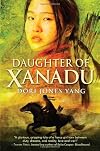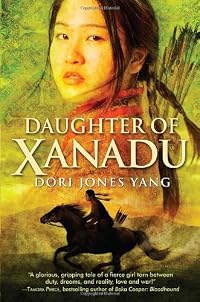
Daughter of Xanadu
by Dori Jones Yang 
On This Page
Description
Emmajin, the sixteen-year-old eldest granddaughter of Khublai Khan, becomes a warrior and falls in love with explorer Marco Polo in thirteenth-century China.Tags
Recommendations


























Member Reviews
Emmajin is the granddaughter of Kubilai Khan, the fearsome and accomplished leader of the widespread Mongolian Empire. All she has ever dreamed of is to be able to join the Mongolian army, but her destiny as a princess is to be trapped in a political marriage. Emmajin is determined to do all she can to convince the Khan that she will serve him well in battle.
With the arrival of foreign merchants to their lands, however, Emmajin is told to gather information from one Marco Polo. This is the last thing Emmajin wants to do, but as she gets to know Marco, so unlike the Mongolian men she knows, she finds that there is something special about his talented storytelling, his peace-loving beliefs. But how can she juggle her growing feelings show more towards this foreigner and her determination to become a legend in the Mongolian army?
If you’ve never read anything about the Mongolian empire, then pick DAUGHTER OF XANADU up. Writing in a style easily accessible to modern readers, Dori Jones Yang tells the surprisingly deep story of a girl caught between warring desires, who learns that dreams may change and that things are hardly ever what they seem.
Emmajin undergoes an incredible journey of self-growth, from a girl with a single-minded determination to be a soldier to a young woman with far more complicated feelings and desires. To tell the story of Emmajin’s self-discovery, Dori Jones Yang gives us a world full of marvelously fascinating details, first among the artificial glamour of court life, and then among the gruesome reality of mortality on the battlefield. This transition of her soldier aspirations from dream to reality truly affects Emmajin in ways that we who live many centuries after her time can still empathize with. I was in tears for the last few chapters of the book, so wrapped up in Emmajin’s development I was.
DAUGHTER OF XANADU is a great book if you’re looking for a story featuring a strong female character set in a fascinating “other world.” Expand the range of POC books you read with this one, and be swept away. show less
With the arrival of foreign merchants to their lands, however, Emmajin is told to gather information from one Marco Polo. This is the last thing Emmajin wants to do, but as she gets to know Marco, so unlike the Mongolian men she knows, she finds that there is something special about his talented storytelling, his peace-loving beliefs. But how can she juggle her growing feelings show more towards this foreigner and her determination to become a legend in the Mongolian army?
If you’ve never read anything about the Mongolian empire, then pick DAUGHTER OF XANADU up. Writing in a style easily accessible to modern readers, Dori Jones Yang tells the surprisingly deep story of a girl caught between warring desires, who learns that dreams may change and that things are hardly ever what they seem.
Emmajin undergoes an incredible journey of self-growth, from a girl with a single-minded determination to be a soldier to a young woman with far more complicated feelings and desires. To tell the story of Emmajin’s self-discovery, Dori Jones Yang gives us a world full of marvelously fascinating details, first among the artificial glamour of court life, and then among the gruesome reality of mortality on the battlefield. This transition of her soldier aspirations from dream to reality truly affects Emmajin in ways that we who live many centuries after her time can still empathize with. I was in tears for the last few chapters of the book, so wrapped up in Emmajin’s development I was.
DAUGHTER OF XANADU is a great book if you’re looking for a story featuring a strong female character set in a fascinating “other world.” Expand the range of POC books you read with this one, and be swept away. show less
Did you see Disney's Mulan? Did you like it? If you answered "yes" to both of those questions then you need to make sure to read this book when it's released early next year.
This story of a Mongolian princess, Emmajin Beki, is a story that proves that love triangles do not need to exist in YA level books for them to be full of romance, adventure and feature a strong, willful female as the hero. Does that mean there isn't romance? No - there's a little but it's where it belongs, adding beautiful color to the background of this story instead of elbowing its way to the forefront and demanding all of the attention.
Emmajin has always wanted to be a soldier and, as the granddaughter of the Great Khan Khubilai, she can expect nothing of the show more sort. What can she expect? Marriage to one of those soldiers - someone high ranking and to spend a lifetime in the shadows, living the quiet life of a woman in a time where women were ignored and put aside while battles waged on around them.
However, Emmajin has a different plan for her life. This is a story of Emmajin's bravery, her struggle to prove herself, her sorrow as she learns the consequences for her actions and her message of hope and ultimate peace. It's filled with historical information about the time period, beautiful descriptions of the places and a glimpse of the man, Marco Polo - someone that, up until this point, I'd only been familiar with as a game.
I'll be looking for more by this author - I loved the way she wrote, I loved Emmajin's voice and the story had me flipping pages with excitement, anxious to learn more of the story. show less
This story of a Mongolian princess, Emmajin Beki, is a story that proves that love triangles do not need to exist in YA level books for them to be full of romance, adventure and feature a strong, willful female as the hero. Does that mean there isn't romance? No - there's a little but it's where it belongs, adding beautiful color to the background of this story instead of elbowing its way to the forefront and demanding all of the attention.
Emmajin has always wanted to be a soldier and, as the granddaughter of the Great Khan Khubilai, she can expect nothing of the show more sort. What can she expect? Marriage to one of those soldiers - someone high ranking and to spend a lifetime in the shadows, living the quiet life of a woman in a time where women were ignored and put aside while battles waged on around them.
However, Emmajin has a different plan for her life. This is a story of Emmajin's bravery, her struggle to prove herself, her sorrow as she learns the consequences for her actions and her message of hope and ultimate peace. It's filled with historical information about the time period, beautiful descriptions of the places and a glimpse of the man, Marco Polo - someone that, up until this point, I'd only been familiar with as a game.
I'll be looking for more by this author - I loved the way she wrote, I loved Emmajin's voice and the story had me flipping pages with excitement, anxious to learn more of the story. show less
I really wanted to like this book more, especially given the reviews I've seen, which were very positive. There were parts of this book I really enjoyed, which elevated it to four stars rather than three.
About the parts I enjoyed, the writing is very good, the historical and cultural information was intriguing. In particular, the descriptions of war were really gripping. I read a lot of historical fiction and this book really made me feel like I was truly there, experiencing those gruesome, morbidly fascinating things. All of these parts of the book? Excellent.
Unfortunately, a lot of that is overshadowed by the two things about this book that really bothered me:
1) The contrived "romance" between Emmajin and Marco. I understand it was show more used as a vessel for us to learn cultural information, but I felt like Emmajin and Marco could have learned these things from each other (and so could we) without it. In fact, I would have vastly preferred it that way. It just... didn't feel natural to me. Their "feelings" for each other felt forced and unrealistic. It wasn't essential to the plot, and I feel like it would have been more realistic if they had admired each other in a more platonic, less bizarrely codependent way, a way that was actually closer to the courtly love that Marco was always spouting on about. (Honestly, I felt like Marco telling Emmajin about that became a little creepy. At first, I thought it was sweet, but later, as Emmajin clung to this idea and the farther from true courtly love their interactions went, I felt more like Marco was an older man in his early 20s telling this naive, unworldly girl who is barely 16 about this to justify his lusty feelings for her, particularly when he started talking about "courtly love" on, like, on the SECOND DAY. Really?? I just. Ugh.) And Marco kept comparing them to Tristan and Isolde and I'm like, "NO. NO NO NONO." Their "love" isn't timeless, Marco is in no way, shape, or form knight-like (or really even attractive or desirable, as far as I'm concerned), and Emmajin is not a princess--or even a woman--that I admire. I wasn't rooting them for as a couple, and every time one of them talked about the other in that pathetically lovesick, flowery way, I just wanted to throw the book across the room.
2) The endless, ENDLESS waffling and inconsistencies. In one sentence, Emmajin says one thing. Then, in the next breath, Marco comes into the room and she changes her mind. Then he leaves and she changes her mind again. This happened over and over and over and over and over... I wanted to scream at Emmajin, "MY GOD JUST MAKE A DECISION AND STICK WITH IT FOR CRIPE'S SAKE!" Keep in mind, sometimes these are decisions about her entire identity that she's changing willy nilly. "I LOVE MY MONGOL HERITAGE WE ARE THE WISEST AND BEST AT EVERYTHING!" *three sentences later* "HOW COULD I HAVE EVER THOUGHT MONGOLS ARE AWESOME LOOK AT HOW TERRIBLE WE ARE I AM ASHAMED!" I realize she's trying to find herself, but the author made it seem like the only way to do that is to be completely unable to make any decision ever and, if you make a decision, to change your mind about it immediately, and, if you don't change your mind immediately, to then instantly regret it after you realize that *gasp* decisions have consequences and it doesn't always mean you made a bad decision it just means that ALL decisions have consequences, good or bad. The author also made it feel like any decisions Emmajin made depended on Marco. Hardly a way to create a strong female character. There are ways to have her try to decide her future, and whether it includes Marco, without morphing the female into a tiresome, personality-less, direction-less, indecisive bore.
While writing this, I almost brought this book back down to three stars, but I'll stick with my four because, like I said, the parts that didn't involve romance or decision-making were very good.
I am moving on to the sequel because I want to know what happens, but I don't imagine it will get any better. show less
About the parts I enjoyed, the writing is very good, the historical and cultural information was intriguing. In particular, the descriptions of war were really gripping. I read a lot of historical fiction and this book really made me feel like I was truly there, experiencing those gruesome, morbidly fascinating things. All of these parts of the book? Excellent.
Unfortunately, a lot of that is overshadowed by the two things about this book that really bothered me:
1) The contrived "romance" between Emmajin and Marco. I understand it was show more used as a vessel for us to learn cultural information, but I felt like Emmajin and Marco could have learned these things from each other (and so could we) without it. In fact, I would have vastly preferred it that way. It just... didn't feel natural to me. Their "feelings" for each other felt forced and unrealistic. It wasn't essential to the plot, and I feel like it would have been more realistic if they had admired each other in a more platonic, less bizarrely codependent way, a way that was actually closer to the courtly love that Marco was always spouting on about. (Honestly, I felt like Marco telling Emmajin about that became a little creepy. At first, I thought it was sweet, but later, as Emmajin clung to this idea and the farther from true courtly love their interactions went, I felt more like Marco was an older man in his early 20s telling this naive, unworldly girl who is barely 16 about this to justify his lusty feelings for her, particularly when he started talking about "courtly love" on, like, on the SECOND DAY. Really?? I just. Ugh.) And Marco kept comparing them to Tristan and Isolde and I'm like, "NO. NO NO NONO." Their "love" isn't timeless, Marco is in no way, shape, or form knight-like (or really even attractive or desirable, as far as I'm concerned), and Emmajin is not a princess--or even a woman--that I admire. I wasn't rooting them for as a couple, and every time one of them talked about the other in that pathetically lovesick, flowery way, I just wanted to throw the book across the room.
2) The endless, ENDLESS waffling and inconsistencies. In one sentence, Emmajin says one thing. Then, in the next breath, Marco comes into the room and she changes her mind. Then he leaves and she changes her mind again. This happened over and over and over and over and over... I wanted to scream at Emmajin, "MY GOD JUST MAKE A DECISION AND STICK WITH IT FOR CRIPE'S SAKE!" Keep in mind, sometimes these are decisions about her entire identity that she's changing willy nilly. "I LOVE MY MONGOL HERITAGE WE ARE THE WISEST AND BEST AT EVERYTHING!" *three sentences later* "HOW COULD I HAVE EVER THOUGHT MONGOLS ARE AWESOME LOOK AT HOW TERRIBLE WE ARE I AM ASHAMED!" I realize she's trying to find herself, but the author made it seem like the only way to do that is to be completely unable to make any decision ever and, if you make a decision, to change your mind about it immediately, and, if you don't change your mind immediately, to then instantly regret it after you realize that *gasp* decisions have consequences and it doesn't always mean you made a bad decision it just means that ALL decisions have consequences, good or bad. The author also made it feel like any decisions Emmajin made depended on Marco. Hardly a way to create a strong female character. There are ways to have her try to decide her future, and whether it includes Marco, without morphing the female into a tiresome, personality-less, direction-less, indecisive bore.
While writing this, I almost brought this book back down to three stars, but I'll stick with my four because, like I said, the parts that didn't involve romance or decision-making were very good.
I am moving on to the sequel because I want to know what happens, but I don't imagine it will get any better. show less
I have to say, perhaps somewhat shamedly, that before this book I gave very little thought to the Mongolian empire in the times of the Great Khan Khubilai (Kublai Khan).
Beyond seeing them as the frightening, cruel people on Disney's Mulan... I really had very little to go on. My education was sorely lacking, having never discussed them in school, other than the passing comments that Kublai Khan was a powerful leader.
This book not only piqued my interest in Mongolian history, but it also, very skillfully, presented a culture who did, in fact, have some frightening war tactics... from the point of view of someone who saw those tactics as honorable and courageous... to the point where you too, as the reader, could understand that viewpoint show more and how one could be raised to see certain actions in such a glorious light.
This was the case of the main character, Emmajin Beki (or, Princess Emmajin), granddaughter of the Great Khan Khubilai. She wished to be a warrior and reveled in the stories told around the fire of great military wins for her people.
Then everything is thrown into new, confusing light with the arrival of a young Latin, Marco Polo. He looks on Mongolian practices at war as distasteful for the most part, and Emmajin is suddenly confronted with having to look at the military conquests of her people in a different light.
This book was fantastic. Emmajin was a wonderful, strong female character, worthy of any young girl's admiration. She dealt with the issues of obedience, love, loss, adventure, questioning her own beliefs and standing up for what she believed in, with grace and tact.
Not only that, but it provided historical terms and descriptions of traditions, buildings, outfits and other aspects of daily Mongolian life from the 1200s that I had never heard of before.
This story was both entertaining and informational, something that would keep teen readers deeply interested while introducing them to a world that, perhaps like myself, they never knew.
If there is ever a sequel, I would love to read it!
Book Cover: 5/5
Book Title: 4/5
Plot: 5/5
Characters: 4/5
Ending: 5/5 show less
Beyond seeing them as the frightening, cruel people on Disney's Mulan... I really had very little to go on. My education was sorely lacking, having never discussed them in school, other than the passing comments that Kublai Khan was a powerful leader.
This book not only piqued my interest in Mongolian history, but it also, very skillfully, presented a culture who did, in fact, have some frightening war tactics... from the point of view of someone who saw those tactics as honorable and courageous... to the point where you too, as the reader, could understand that viewpoint show more and how one could be raised to see certain actions in such a glorious light.
This was the case of the main character, Emmajin Beki (or, Princess Emmajin), granddaughter of the Great Khan Khubilai. She wished to be a warrior and reveled in the stories told around the fire of great military wins for her people.
Then everything is thrown into new, confusing light with the arrival of a young Latin, Marco Polo. He looks on Mongolian practices at war as distasteful for the most part, and Emmajin is suddenly confronted with having to look at the military conquests of her people in a different light.
This book was fantastic. Emmajin was a wonderful, strong female character, worthy of any young girl's admiration. She dealt with the issues of obedience, love, loss, adventure, questioning her own beliefs and standing up for what she believed in, with grace and tact.
Not only that, but it provided historical terms and descriptions of traditions, buildings, outfits and other aspects of daily Mongolian life from the 1200s that I had never heard of before.
This story was both entertaining and informational, something that would keep teen readers deeply interested while introducing them to a world that, perhaps like myself, they never knew.
If there is ever a sequel, I would love to read it!
Book Cover: 5/5
Book Title: 4/5
Plot: 5/5
Characters: 4/5
Ending: 5/5 show less
Set in 13th-century China, newcomer Dori Jones Yang paints a fascinating, vivid portrait of the period. Though, of course, for the purposes of the novel's intended age group, she does have to glaze over a few period-specific things. However, Yang does an exquisite job of transporting the reader back to unique setting when the world was completely different, and the role of women was completely different in society
Princess Emmajin is the granddaughter of the great Khan of Khans, emperor of the Mongols. A strong-willed, ambitious young woman, Emmajin dreams of joining the army and achieving glory in battle on behalf of Mongol nation. Such an ambition is not granted to Mongolan women, especially ones of royal birth. Just when Emmajin show more starts to make some headway, she meets the Westerner Marco Polo, who has come to trade with the East. Emmajin befriends Marco to spy on him on behalf of the Khan, but she finds herself falling in love with him.
An exciting adventure, Daughter of Xanadu is a fast-paced, page-turning action-packed novel complete with dashes of fantasy and romance. A quick read, Yang has a well-practiced, deliberate writing style that hits all the right notes between plot, characterization, action and history. But most importantly, Emmajin is a great, cheer-worthy character that readers can easily relate to and love. Though I knew what was going to happen to her virtually the entire novel, I still wanted to see what wild adventures she had in the meantime.
A perfect read for younger teens, Daughter of Xanadu is recommended for fans of Tamora Pierce. show less
Princess Emmajin is the granddaughter of the great Khan of Khans, emperor of the Mongols. A strong-willed, ambitious young woman, Emmajin dreams of joining the army and achieving glory in battle on behalf of Mongol nation. Such an ambition is not granted to Mongolan women, especially ones of royal birth. Just when Emmajin show more starts to make some headway, she meets the Westerner Marco Polo, who has come to trade with the East. Emmajin befriends Marco to spy on him on behalf of the Khan, but she finds herself falling in love with him.
An exciting adventure, Daughter of Xanadu is a fast-paced, page-turning action-packed novel complete with dashes of fantasy and romance. A quick read, Yang has a well-practiced, deliberate writing style that hits all the right notes between plot, characterization, action and history. But most importantly, Emmajin is a great, cheer-worthy character that readers can easily relate to and love. Though I knew what was going to happen to her virtually the entire novel, I still wanted to see what wild adventures she had in the meantime.
A perfect read for younger teens, Daughter of Xanadu is recommended for fans of Tamora Pierce. show less
Daughter of Xanadu by Dori Jones Yang is the fictional story of Emmajin, a granddaughter of Khubilai Khan. She was raised with her male cousins and allowed to partake in activities such as archery, horse-back riding, racing and wrestling. She had decided that she did not wish to marry and would rather be trained to serve the Khan in his army. All she had to do was convince her grandfather of this.
At first her grandfather was not receptive to her wishes, but did decide to use her as a spy, assigning her the youngest of the Polo’s, a family of merchants from the far city of Venice. Marco Polo was a young man of nineteen and when the two young people starting spending time together at the Khan’s summer palace of Xanadu, they formed show more both a friendship and a bond. But Emmajin did not forget her mission and her information was so well received that she was allowed to join a military expedition to the far south as a soldier. She was there when the King of Burma invaded and took part in the bloody battle to overcome the invaders. This battle showed her that she really didn’t have the stomach to be a soldier but she also did not want to settle into a woman’s traditional role so she had to once again convince her grandfather to allow her to become an emissary and travel to far lands for him.
This is a YA historical novel that was interesting, fully researched and well written. There is a sequel about Emmajin’s travels to Christendom with Marco Polo and I am looking forward to continuing on with this story. show less
At first her grandfather was not receptive to her wishes, but did decide to use her as a spy, assigning her the youngest of the Polo’s, a family of merchants from the far city of Venice. Marco Polo was a young man of nineteen and when the two young people starting spending time together at the Khan’s summer palace of Xanadu, they formed show more both a friendship and a bond. But Emmajin did not forget her mission and her information was so well received that she was allowed to join a military expedition to the far south as a soldier. She was there when the King of Burma invaded and took part in the bloody battle to overcome the invaders. This battle showed her that she really didn’t have the stomach to be a soldier but she also did not want to settle into a woman’s traditional role so she had to once again convince her grandfather to allow her to become an emissary and travel to far lands for him.
This is a YA historical novel that was interesting, fully researched and well written. There is a sequel about Emmajin’s travels to Christendom with Marco Polo and I am looking forward to continuing on with this story. show less
Daughter of Xanadu by Dori Jones Yang is a historical fiction young adult book that has been well researched. Even though the main character, Emmajin is fictional the place, Xanadu did exist.
Emmajin was inspired by the Chinese legendary female warrior Mulan. The author made her a granddaughter of the Kublai Khan. She was allowed to learn archery, horse riding and loved to be outdoors. She aspired to be a great warrior and bring honor on her family.
By the time that Marco Polo arrived, there had already been many changes to the traditional life of the Mongols. Changes in their housing, food and some of their traditions had already taken place.
The author's characterization of Marco Polo makes me want to learn more about him. He seems to show more be a learner and a peacemaker. The culture and history of Venice where he came from was vastly different.
The author cleverly teaches about the contrasting cultures by a semi romance between Emmajin and Marco Polo. Emmajin is perplexed by her feelings for Marco Polo, on one hand she was attracted by him physically and by his strangeness but on the other hand so knew it would never work.
I would recommend this book highly for young adults interested in Chinese history. There is another book by the author solely about Marco Polo. show less
Emmajin was inspired by the Chinese legendary female warrior Mulan. The author made her a granddaughter of the Kublai Khan. She was allowed to learn archery, horse riding and loved to be outdoors. She aspired to be a great warrior and bring honor on her family.
By the time that Marco Polo arrived, there had already been many changes to the traditional life of the Mongols. Changes in their housing, food and some of their traditions had already taken place.
The author's characterization of Marco Polo makes me want to learn more about him. He seems to show more be a learner and a peacemaker. The culture and history of Venice where he came from was vastly different.
The author cleverly teaches about the contrasting cultures by a semi romance between Emmajin and Marco Polo. Emmajin is perplexed by her feelings for Marco Polo, on one hand she was attracted by him physically and by his strangeness but on the other hand so knew it would never work.
I would recommend this book highly for young adults interested in Chinese history. There is another book by the author solely about Marco Polo. show less
Members
- Recently Added By
Author Information
10 Works 1,154 Members
Dori Jones Yang is a LibraryThing Author, an author who lists their personal library on LibraryThing.
Awards and Honors
Common Knowledge
- Canonical title
- Daughter of Xanadu
- Original publication date
- 2011
- People/Characters
- Princess Emmajin Beki; Marco Polo
- Important places
- China
- First words
- The fierce Mongol army was riding straight at us.
Classifications
Statistics
- Members
- 167
- Popularity
- 195,356
- Reviews
- 9
- Rating
- (3.56)
- Languages
- English
- Media
- Paper, Ebook
- ISBNs
- 5
- ASINs
- 1