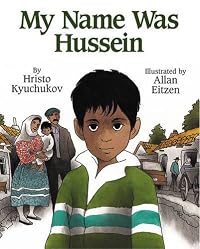
My Name Was Hussein
by Hristo Kyuchukov
On This Page
Description
Although they have kept their Islamic traditions living in their Bulgarian village for many generations, when an army takes over their village, a Muslim boy and his family are forced to take Christian names.Tags
Recommendations







Member Reviews
I enjoyed this book greatly, and think that it would be a wonderful exposure for students into the real world stories of children growing up in warring areas. The main character is framed as a very relatable little boy, growing up in a culture that is different from that of Americans, but not disconnected in any way, discussing holiday celebrations and love for family members. Then, life changes drastically for the little boy when soldiers invade his town and begin implementing procedures to wipe away his culture. The reader experiences this sharp twist along with the character, with the sentences “Then one day everything changed. The army came with tanks, cannons, guns, and dogs” and a sudden darkening of the illustrations on the show more page. This contrast was a choice that created a very effective reaction while reading.
The author, Hristo Kyuchukov, chose to focus on how the infiltration of soldiers affected the little boy as an individual, which I believe will allow young readers to more fully connect with the message. Kyuchukov created a message for his readers: this is a story that happens to real people, not just characters. A tool he used to do this was the use of a direct question on the last page of the book, “What would you call me? My name was Hussain”. This powerful challenge to the reader makes them consider what they would do, and serves as a tool to place the reader in both the shoes of the main character and of the other characters of the story. show less
The author, Hristo Kyuchukov, chose to focus on how the infiltration of soldiers affected the little boy as an individual, which I believe will allow young readers to more fully connect with the message. Kyuchukov created a message for his readers: this is a story that happens to real people, not just characters. A tool he used to do this was the use of a direct question on the last page of the book, “What would you call me? My name was Hussain”. This powerful challenge to the reader makes them consider what they would do, and serves as a tool to place the reader in both the shoes of the main character and of the other characters of the story. show less
This story made me feel every emotion - both heartwarming and heartbreaking. We meet Hussein, a little boy who is of the Muslim faith and very proud of his religion and culture. He shares many traditions with his family and explains the celebration of Ramadan through his eyes as a child. However, after WW2 when communist ruling took over and made life extremely difficult for minorities in other countries, he also showed all the ways he suffered because of his faith. He and his father were no longer allowed to pray at the mosque, to visit their grandparents for Ramadan, and he felt the fear through his parents. He and his family were forced to change their names to Christian names. Hussein became Harry, but did feel like Harry and did show more not know him. At home, his parents still called him by his childhood nickname. This story stuck with me, I wish it had been longer so that there could have been a happier ending. However, I do not believe that was the purpose it was written for. show less
I loved this book for a few reasons. First, I liked how the author chose to have the syntax and narration of the book mimic what a child would sound like. It was from Hussein’s perspective, and it used some of the language a child of his age would use. This included short and simple sentences with little to no adjectives or figurative language. For example, Hussein says, “I love my grandparents. They are happy when they see me”. This captured my attention and it made more of an impact as I truly imagined a child going through this hardship.
I also enjoyed how the author highlighted the stark contrast of Hussein’s life before and after the police came to his village. In the beginning a positive connotation was evident, “They show more hug me and hold me on their laps…they give me candies that smell nice, like roses”. The illustrations also seemed to be brighter in this portion of the story as well. Towards the end, Hussein takes on a darker tone, “My little brother was crying, he wanted a new shirt”. This was after the communist police came in and began restricting the people’s freedoms. I appreciated this contrast as it was sudden and it further highlighted the oppression of the people.
The moral of this story is that there is a lot of power behind one’s name. Someone can take your freedom away, but they can never truly take your name and identity away with it. Once the communists took over the village, Hussein was forced to change his name to a more “Christian” name. However, he stood against this oppression and claimed that his name is still what it always has been, Hussein. show less
I also enjoyed how the author highlighted the stark contrast of Hussein’s life before and after the police came to his village. In the beginning a positive connotation was evident, “They show more hug me and hold me on their laps…they give me candies that smell nice, like roses”. The illustrations also seemed to be brighter in this portion of the story as well. Towards the end, Hussein takes on a darker tone, “My little brother was crying, he wanted a new shirt”. This was after the communist police came in and began restricting the people’s freedoms. I appreciated this contrast as it was sudden and it further highlighted the oppression of the people.
The moral of this story is that there is a lot of power behind one’s name. Someone can take your freedom away, but they can never truly take your name and identity away with it. Once the communists took over the village, Hussein was forced to change his name to a more “Christian” name. However, he stood against this oppression and claimed that his name is still what it always has been, Hussein. show less
I gave this book 5 stars because of the reaction it gave my children. They just couldn’t believe a 9 year old boy would be forced to change his name. I asked them how that would make them feel, if they had to change their names. They replied with “Weird” and “Confused.” My son noticed that one illustration showed soldiers refusing Muslims into their mosques, which lead us into a discussion of what a mosque, a temple, a synagogue, and a church is. It was a relatable story allowing my children to feel empathy for the main character as he and his family are discriminated against.
I had mixed feelings about this book after reading it. I liked how the story was written in first person, using "I" as Hussein tells his perspective of his life and the experiences he has faced. I liked the writing in the story in that it is engaging to the readers emotions. It started off on a cheerful note having Hussein describe his everyday life. Here the readers are able to relate to and see how Hussein is just like them, a regular kid with a family who likes to play, goes to school, and help his family. Then the story takes a dark twist, showing the troubles Hussein and his family are facing, showing readers how Hussein is seen as "different". Hussein then writes the various experiences he has to go through due to the war violence show more in his country such as changing his name to fit in,the restrictions placed on his family and the citizens of the village, as well as confiding to a set religion and way of life, this creates a sympathetic effect on the audience. The language is simple yet informative. It includes a lot of information of Husseins culture, his heritage, family, food, and holidays. The illustrations are well done in this book too. The words are written small and placed in the corners of the page with a white background, where as the pictures are double spread and detailed, focusing the readers eye on the illustration first. I believe the author intended the illustrations to draw the readers attention and show the importance of the story. The illustrations also accurately display the characters emotions well, as they are displayed in black and white, corresponding with the feelings of the story. However, I did not like the organization of this book, as it felt like two distinct stories in one. The beginning half, Hussein talked about his culture, then the second half of the book quickly switched to the downhill of Husseins life and the affect of the war on his life. It seemed very abrupt to me. Although the book seemed a little disjointed when I first read it, it was very culturally authentic. It provides great information for students about Ramadan, as well shows the importance of cultural identity when Hussein ends the book with the thought provoking question "What would you call me?". It also shows how differently our country is from others. We sometimes take the little things for granted such as being able to choose our religion, the name we give our children, as well as keeping our name. Whereas Husseins family had no choice but to change their names and confide to a set religion demanded by their government and enforced by the army. This picture book pushes readers to consider different cultural perspectives and differences, allowing children to be accepting and culturally sensitive of others. It also brings up the fact that nobody should tell you who you are, that you're someone you're not. You decide who you are. show less
“My Name Was Hussein” is about a young Muslim boy named Hussein. In the beginning of the story, Hussein, or as his family calls him “Hughsy”, discusses a holiday that his family celebrates, Ramadan. He talks about traditions attached to this holiday, such as the food his mother cooks, praying, and most of all spending time with his entire family. The story then takes a turn when an army invades his village during the time of Ramadan. Hussein and his family were not able to leave the village, go outside at night, or even speak in their Romani language! He wants to eat his favorite foods and visit his grandparents, as he usually would do during the holiday, but it is too dangerous to leave the house. Hussein and his family are show more then told they need to change their names to Christian names and will receive new identification cards. Of course, he and his family did not want to change their names, but they had no choice. Hussein then changes his name to Harry. At school and in public, he is Harry. But at home, his family will always call him by his nickname, Hughsy.
In the beginning of the story, the illustrations are bright to represent the happiness this holiday brings to Hussein and his family. But when the soldiers invade his village, the illustrations then become dark and dull to represent depression. Being that I am Muslim, I felt the writer and illustrator have done a wonderful job explaining and showing the special holiday to those who do not know much about it. In the author's note, Hristo Kyuchukov tells how this story was based on events in his own life. After reading that, this book became an even more of a touching story. I feel this is a great story to read to students when teaching about different cultures and traditions. Also, this story shows that although most live in countries that are free, there are countries who have their individual rights taken away. I cannot imagine the feeling of someone invading my home and telling me who I need to be! Overall, this was a great story and I would definitely recommend it! show less
In the beginning of the story, the illustrations are bright to represent the happiness this holiday brings to Hussein and his family. But when the soldiers invade his village, the illustrations then become dark and dull to represent depression. Being that I am Muslim, I felt the writer and illustrator have done a wonderful job explaining and showing the special holiday to those who do not know much about it. In the author's note, Hristo Kyuchukov tells how this story was based on events in his own life. After reading that, this book became an even more of a touching story. I feel this is a great story to read to students when teaching about different cultures and traditions. Also, this story shows that although most live in countries that are free, there are countries who have their individual rights taken away. I cannot imagine the feeling of someone invading my home and telling me who I need to be! Overall, this was a great story and I would definitely recommend it! show less
Reading Log Three: My name was Hussein
In my opinion this book was very strong in developing character and allowing the reader to build connections with them as well as in language usage. In My name was Hussein, the reader is immediately drawn in by the use of “was” in the title. Since names are traditionally given at birth and used throughout one’s life, it draws the questions of why Hussein’s name has changed. The author does a good job of using descriptive language to build an image and impression of Hussein in the reader’s head. They explain how special Hussein’s name is to him because of its roots in their culture and religion as well as the special way it has been passed down from generation to generation. The reader show more can tell how much Hussein likes and is proud of carrying the family name and how his identity is strengthened from it. The author also does a good job of describing Hussein’s culture, lifestyle, and the different elements of his family’s life. They include details of the food they eat native to the middle east like dates, as well as the language they speak: Romani, they time they spend with their grandparents, and their place of worship: a mosque. The author uses simple language to develop an impression of the village Hussein and his family lives in. The language is clear and concise making it easy for all readers to imagine the simple life Hussein lives and allowing them to make personal connections with the kind of food they eat and how similar their family is to his. Once Hussein begins to explain the way the soldiers come in and change his village the author repeats each one of these elements and demonstrates how complete the soldiers take over was. The author addresses that Hussein and his family could no longer speak their language, spend time with family, or visit the mosque. When the law comes about changing their names the author includes a repeated line for each character saying that they “did not want another name”. This books was engaging and allowed readers to make connections with another culture and religion and is an example of multicultural literature. The big message of this story was how important it is to respect and appreciate the different elements of someone’s identity whether it is their name, culture, religion, or family. The soldiers represent someone who is not being respectful of others and the harm that can occur when someone is forced to abandon parts of their own identity. Hussein provides a perspective to the audience in how they would treat him once his name was legally changed by posing the question at the end of the story “what would you call me? My name was Hussein.” show less
In my opinion this book was very strong in developing character and allowing the reader to build connections with them as well as in language usage. In My name was Hussein, the reader is immediately drawn in by the use of “was” in the title. Since names are traditionally given at birth and used throughout one’s life, it draws the questions of why Hussein’s name has changed. The author does a good job of using descriptive language to build an image and impression of Hussein in the reader’s head. They explain how special Hussein’s name is to him because of its roots in their culture and religion as well as the special way it has been passed down from generation to generation. The reader show more can tell how much Hussein likes and is proud of carrying the family name and how his identity is strengthened from it. The author also does a good job of describing Hussein’s culture, lifestyle, and the different elements of his family’s life. They include details of the food they eat native to the middle east like dates, as well as the language they speak: Romani, they time they spend with their grandparents, and their place of worship: a mosque. The author uses simple language to develop an impression of the village Hussein and his family lives in. The language is clear and concise making it easy for all readers to imagine the simple life Hussein lives and allowing them to make personal connections with the kind of food they eat and how similar their family is to his. Once Hussein begins to explain the way the soldiers come in and change his village the author repeats each one of these elements and demonstrates how complete the soldiers take over was. The author addresses that Hussein and his family could no longer speak their language, spend time with family, or visit the mosque. When the law comes about changing their names the author includes a repeated line for each character saying that they “did not want another name”. This books was engaging and allowed readers to make connections with another culture and religion and is an example of multicultural literature. The big message of this story was how important it is to respect and appreciate the different elements of someone’s identity whether it is their name, culture, religion, or family. The soldiers represent someone who is not being respectful of others and the harm that can occur when someone is forced to abandon parts of their own identity. Hussein provides a perspective to the audience in how they would treat him once his name was legally changed by posing the question at the end of the story “what would you call me? My name was Hussein.” show less
Members
- Recently Added By
Author Information

4 Works 131 Members
Awards and Honors
Common Knowledge
- Important places
- Bulgaria
Classifications
Statistics
- Members
- 102
- Popularity
- 315,807
- Reviews
- 32
- Rating
- (4.28)
- Languages
- English
- Media
- Paper
- ISBNs
- 2