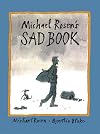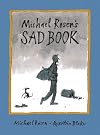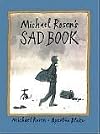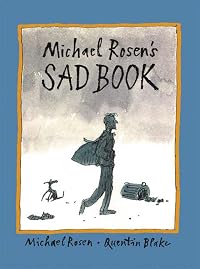
Michael Rosen's Sad Book
by Michael Rosen
On This Page
Description
A man tells about all the emotions that accompany his sadness over the death of his son, and how he tries to cope.Tags
Recommendations

















Member Reviews
The Nature of the Beast
Grief waxes and wanes.
It is a beast of many faces, many forms.
It cowers in the shadows, then tiptoes gently, bearing warm, sad, poignant memories.
Occasionally, it wanders off for two or three days.
Then it pounces, baring its teeth, and drawing blood and tears.
Some days I feel almost “normal”, and others, even three months later, I’m tearful all day. Most of the time, it’s somewhere in between, with a mask to cover the cracks, and spare others from dealing with my pain.
Losing my father, who was only 77 and in good health, with no warning at all, is my first encounter with raw grief of someone very close.
I’m not a spiritual person and have not sought solace in religion.
My pain is uniquely my own, and show more has reopened wider family complexities that go beyond what would be suitable for a bereavement group.
For weeks, I could barely read.
I talk: to myself, my family, my friends, and recently, a therapist, but mostly to myself.
But books call, speak, and soothe. Somehow I found my way to this short picture book.
Image: ”He doesn’t say anything, because he’s not there any more.” The empty cell says it all.
Why This Book?
This is only the second book explicitly tied to bereavement I’ve picked up. (The first, was Mary Oliver’s poetry collection, Thirst, which I reviewed HERE). I don’t normally read, let alone seek out children’s books (unless there’s a child around), but I’m glad I did.
Who’s This For?
I never had to face close bereavement in childhood: I lost my grandparents in my twenties and beyond: all reached a good age, ending with a period of decline. Nor did I have to help my own child through bereavement when small.
I’m not sure this book would be suitable for a sensitive child who had not lost a loved one, especially as Rosen is writing about the sudden death of his son, but for anyone in the early throes of grief, including young children, it’s beautiful, cathartic, and true.
As one who writes far too many words, I appreciate the power of Rosen’s brevity, enhanced by Blake’s sensitive artistry. (I’ve long loved both, and they’ve collaborated many times.)
This book is not about death itself. It simply and sensitively portrays and validates the fluctuating feelings experienced by those left behind after a death, admits to failings (taking it out on the cat, for example), and gently suggests coping mechanisms.
“Every day I try to do one thing I can be proud of. Then, when I go to bed, I think very, very hard about this one thing.”
“Every day I try to do one thing that means I have a good time. It can be anything so long as it doesn’t make anyone else unhappy.”
You think it’s ending on a happy, positive note (he loves birthdays, and “There must be candles”), and then you turn the final page: not a word, just this:
Six years and a couple of days after my father ended his life
November 2024. Mostly, I've learned to continue my life around the shock and unanswerable questions. I don't mark the anniversary, at least, not consciously. But today, a well-intentioned comment, offered in levity, triggered an instant and powerful tsunami of those feelings. I'm grateful for friends, memories, therapy, medication - and books like this (and others mentioned in this review). show less
Grief waxes and wanes.
It is a beast of many faces, many forms.
It cowers in the shadows, then tiptoes gently, bearing warm, sad, poignant memories.
Occasionally, it wanders off for two or three days.
Then it pounces, baring its teeth, and drawing blood and tears.
Some days I feel almost “normal”, and others, even three months later, I’m tearful all day. Most of the time, it’s somewhere in between, with a mask to cover the cracks, and spare others from dealing with my pain.
Losing my father, who was only 77 and in good health, with no warning at all, is my first encounter with raw grief of someone very close.
I’m not a spiritual person and have not sought solace in religion.
My pain is uniquely my own, and show more has reopened wider family complexities that go beyond what would be suitable for a bereavement group.
For weeks, I could barely read.
I talk: to myself, my family, my friends, and recently, a therapist, but mostly to myself.
But books call, speak, and soothe. Somehow I found my way to this short picture book.
Image: ”He doesn’t say anything, because he’s not there any more.” The empty cell says it all.
Why This Book?
This is only the second book explicitly tied to bereavement I’ve picked up. (The first, was Mary Oliver’s poetry collection, Thirst, which I reviewed HERE). I don’t normally read, let alone seek out children’s books (unless there’s a child around), but I’m glad I did.
“Sad is a place
that is deep and dark
like the space
under the bed
sad is a place
that is high and light
like the sky
above my head
When it’s deep and dark
I don’t dare go there
When it’s high and light
I want to be thin air.”
Who’s This For?
I never had to face close bereavement in childhood: I lost my grandparents in my twenties and beyond: all reached a good age, ending with a period of decline. Nor did I have to help my own child through bereavement when small.
I’m not sure this book would be suitable for a sensitive child who had not lost a loved one, especially as Rosen is writing about the sudden death of his son, but for anyone in the early throes of grief, including young children, it’s beautiful, cathartic, and true.
As one who writes far too many words, I appreciate the power of Rosen’s brevity, enhanced by Blake’s sensitive artistry. (I’ve long loved both, and they’ve collaborated many times.)
This book is not about death itself. It simply and sensitively portrays and validates the fluctuating feelings experienced by those left behind after a death, admits to failings (taking it out on the cat, for example), and gently suggests coping mechanisms.
“Every day I try to do one thing I can be proud of. Then, when I go to bed, I think very, very hard about this one thing.”
“Every day I try to do one thing that means I have a good time. It can be anything so long as it doesn’t make anyone else unhappy.”
You think it’s ending on a happy, positive note (he loves birthdays, and “There must be candles”), and then you turn the final page: not a word, just this:
Six years and a couple of days after my father ended his life
November 2024. Mostly, I've learned to continue my life around the shock and unanswerable questions. I don't mark the anniversary, at least, not consciously. But today, a well-intentioned comment, offered in levity, triggered an instant and powerful tsunami of those feelings. I'm grateful for friends, memories, therapy, medication - and books like this (and others mentioned in this review). show less
This is a tough book to review. It’s an honest and poignant look at grief, and it’s told in simple language, bit by bit, for children to read and understand. Inspired by the author’s grief at the death of his son, this story tells of a man struggling to pick up the pieces of his life. There is no overarching plot, but the book touches on different aspects of the man’s life in the time of sadness. Little things that were once simple are now impossible, and even the most mundane parts of life are changed and painful. Disturbing, raw, powerful, and vivid, this is the kind of book that stays with you long after you’ve read the last page.
Michael Rosen's Sad Book tells of his own personal grief and depression after he lost his son. Although he explains his feelings and actions in a kid friendly way, I would not recommend this book to a young child or anyone who is rather sensitive to other people's grief, though I would make an exception if the person were really struggling with a similar situation and needed to hear from someone who had gone through a similar experience. As anyone who has experienced grief and/or depression knows, it is disabling and highly impacts your ability to just get up in the morning and face a new day, but you have to do it anyway. It might be hard for a child to understand, but this book will help.
Can't praise this enough. Whether you're grieving, or depressed, you'll feel at least a little bit better to know that somebody else gets it. No matter if you're 7, 17, or 77. Even if you're doing just fine, I bet you know somebody struggling... and this might help you to better understand them.
I've read it twice now. I really should own a copy.
Maybe shelve it with [b:Hyperbole and a Half: Unfortunate Situations, Flawed Coping Mechanisms, Mayhem, and Other Things That Happened|17571564|Hyperbole and a Half Unfortunate Situations, Flawed Coping Mechanisms, Mayhem, and Other Things That Happened|Allie Brosh|https://images.gr-assets.com/books/1409522492s/17571564.jpg|24510592].
I've read it twice now. I really should own a copy.
Maybe shelve it with [b:Hyperbole and a Half: Unfortunate Situations, Flawed Coping Mechanisms, Mayhem, and Other Things That Happened|17571564|Hyperbole and a Half Unfortunate Situations, Flawed Coping Mechanisms, Mayhem, and Other Things That Happened|Allie Brosh|https://images.gr-assets.com/books/1409522492s/17571564.jpg|24510592].
This beautiful book written by the author who lost his son. It is hauntingly beautiful, with wonderful illustrations of Quentin Blake. And when Michael Rosen is sad thinking about his son, he remembers things that remain, including Eddie waking along the street simply laughing, laughing and laughing.
While it is difficult to capture grief, the combination of Rosen and Blake do a very credible job of depicting sadness, and ways used to cope with overbearing sadness.
Highly recommended.
While it is difficult to capture grief, the combination of Rosen and Blake do a very credible job of depicting sadness, and ways used to cope with overbearing sadness.
Highly recommended.
Michael Rosen’s smiling face greets us on page one. We expect smiles in picture books. His smile, however, does not seem to fit the text that describes a very big kind of sad. Closer inspection of the illustration, however, reveals a forced smile. We see that this smile is superficial and the text makes it clear that Rosen smiles because we expect the people we like to behave in this way.
Rosen’s son Eddie is dead and Michael Rosen’s Sad Book is gut wrenching honest with a perfect title. In one sequence we see Eddie as a baby, then as a young boy, next comes Eddie as a teen, and the final frame is blank because Eddie is dead. Rosen exhibits his anger and hints at a dark rage, “Sometimes because I'm sad I do bad things. I can't show more tell you what they are. They're too bad. And it's not fair to the cat.”
Little things like doing one thing to be proud of each day or realizing the difference between “sad” and “bad” begin to make a difference for Rosen. He remembers rainy days with his mum, Eddie laughing, and birthday parties with cakes and candles. The last pages of the book show Rosen in front of a single candle with its mixture of secular and spiritual light. The gray is greatly reduced and we see hints that tomorrow will be much brighter.
Quentin Blake has done a superb job illustrating the text. The words are perfect. Together we have a book that far surpasses the strengths of both. Highly recommended for Middle School and High School and a must buy for social workers and counselors. show less
Rosen’s son Eddie is dead and Michael Rosen’s Sad Book is gut wrenching honest with a perfect title. In one sequence we see Eddie as a baby, then as a young boy, next comes Eddie as a teen, and the final frame is blank because Eddie is dead. Rosen exhibits his anger and hints at a dark rage, “Sometimes because I'm sad I do bad things. I can't show more tell you what they are. They're too bad. And it's not fair to the cat.”
Little things like doing one thing to be proud of each day or realizing the difference between “sad” and “bad” begin to make a difference for Rosen. He remembers rainy days with his mum, Eddie laughing, and birthday parties with cakes and candles. The last pages of the book show Rosen in front of a single candle with its mixture of secular and spiritual light. The gray is greatly reduced and we see hints that tomorrow will be much brighter.
Quentin Blake has done a superb job illustrating the text. The words are perfect. Together we have a book that far surpasses the strengths of both. Highly recommended for Middle School and High School and a must buy for social workers and counselors. show less
I stumbled on this book in the "aging" section at Borders. It really has nothing at all to do with aging. It has everything to do with death and sadness. It is never sentimental. It is a brutal, honest and beautiful look at grief and sadness. Perhaps too intense for young child, though fine for middle school and older. And perfect for the adult who would sooner swallow knives than pick up any of the sappy grief books that sell so well in the chain bookstore... the "chicken soup for the grieving soul" sort of books that have a silver lining behind every sadness.
Members
- Recently Added By
Lists

Youth: Abuse, Grief, & Loss
51 works; 1 member

Books Read in 2018
4,360 works; 110 members

Sex Positive Sex-Ed books
35 works; 1 member

Jewish Books
367 works; 24 members
Author Information

212+ Works 18,353 Members
Michael Rosen started writing as a teenager, when his mother needed some poems for Radio programs she was making. While at college, he wrote a play which was staged at the Royal Court theatre in London. Rosen's first book was published in 1974, and he is one of Britain's leading children's poets. Michael Rosen launched the National Year of show more Literacy project, which encouraged children to help produce an Anthology to be used during the Literacy Hour in primary schools. Children ages 4-11 were invited to submit poems and illustrations featuring their favorite tree. Rosen also led the final judging sessions to decide which submissions would be included. (Bowker Author Biography) show less
All Editions
Awards and Honors
Awards
Distinctions
Common Knowledge
- Canonical title
- Michael Rosen's Sad Book
- Original publication date
- 2004
- Original language
- English
Classifications
- Genres
- Children's Books, Picture Books
- DDC/MDS
- 155.937 — Philosophy & psychology Psychology Differential and developmental psychology Environmental psychology Influences of Traumatic Experiences and Bereavement Death and Dying
- LCC
- PZ7 .R71867 .M — Language and Literature Fiction and juvenile belles lettres Fiction and juvenile belles lettres Juvenile belles lettres
- BISAC
Statistics
- Members
- 603
- Popularity
- 48,694
- Reviews
- 41
- Rating
- (4.46)
- Languages
- Dutch, English, French, Spanish
- Media
- Paper
- ISBNs
- 12
- ASINs
- 3