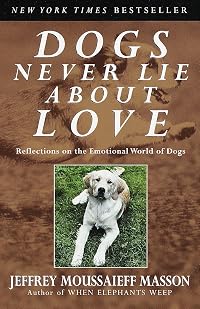
Dogs Never Lie About Love : Reflections on the Emotional World of Dogs
by Jeffrey Moussaieff Masson 
On This Page
Description
Examines the emotional lives of dogs, drawing from myth, literature, scientific studies, and from the stories and observations of dog trainers and dog lovers around the world.Tags
Recommendations










































Member Reviews
Someone I talked to recently mentioned that they don't read too many dog books as they all start sounding the same. I agree that books often cover the same themes relating to the great qualities about dogs, but I never get tired of another love song of words in relation to dogs. This book covers the theme of love from dogs so well, I have added it to my shelf for 'best' dog books.
I did like the first half of the book more than the topics in the second half, but it is all good information. I also didn't mind the author plucking choice information from other books and studies to put into this book. There are other what I refer to as 'dog psychology' books I have read that seemed to get bogged down with too much description, but I didn't show more find that with this book.
As common in my reviews, I would like to share some of my favorite excerpts I found in the book:
'According to Hediger, no other animal stands in such intimate psychological union with us; only the dog seems capable of reading our thoughts and “reacting to our faintest changes of expression or mood.” German dog trainers use the term Gefühlsinn (a feeling for feelings) to talk about the fact that a dog can sense our moods.'
'Humans have a tendency to immerse themselves in their own narcissistic concerns, losing awareness of the world around them. Not only pity for the self, but self-concerns of many varieties, preoccupy us. Perhaps one central reason for loving dogs is that they take us away from this obsession with ourselves. When our thoughts start to go in circles, and we seem unable to break away, wondering what horrible event the future holds for us, the dog opens a window into the delight of the moment. To walk with a dog is to enter the world of the immediate. Our dog stares up into a tree, watching a squirrel—she is there and nowhere else.'
'I have watched the faces of my three dogs freeze with intense interest; whatever the task at hand is, they bring such focused intensity to it. They turn to watch which way I will go at a fork in the road, They are so interested. It is extraordinary how much interest they can invest in the most ordinary thing. I find it entirely humbling. That concentrated, full, complete, undisturbed interest is what everybody wants from their own human companion.'
'They are never paralyzed by the need to judge and to compare. They are never gloomy at the thought that this walk was not as nice as yesterday’s walk, this forest not nearly as interesting as last week’s forest. Each walk is new, unique, and uniquely interesting, with its own set of smells and delights. I keep looking for my dogs’ favorite walks, but the truth is, they have no favorite walks; only I do. They love all walks. They love walking. They love being wherever they are. The reason, and it is a great lesson, is no doubt that they are perfectly content to be who they are, without torturing themselves with alternatives: They love being dogs.'
'Marjorie Garber speculates that dogs allow us to fantasize about spontaneity, emotional generosity, and togetherness. This is right, partly I think because dogs “are strangers to cynicism.”!” Dogs are not worried about how they will be perceived by other dogs. They do not have to hide their joie de vivre for fear of appearing naïve, and they do not need to feign boredom when they are in fact interested for fear of appearing unsophisticated. Dogs never stand around at parties wondering what to say, or why they came, or how pitiful they might seem to more elegant or more amusing or more important guests. They do not struggle to be witty, getting right to the point, going straight for the source. Yet they manage to come away with a greater and more accurate fund of information than humans do at their parties.'
'Dogs register no need to theorize about love (or about anything else for that matter), they just show it, And show it and show it and show it. | am continually amazed at the dog’s ability to love so unconditionally and without ambivalence. Indeed, many people will have heard at one time or another of a cruel or neglectful owner whom the dog loves regardless of how he or she is treated. The capacity for love in the dog is so pronounced, so developed that it is almost like another sense of another organ. It might well be termed hyperlove, and it is bestowed upon all humans who live closely with a dog.'
'Newfies often tow boats that have got into trouble to shore. They are capable of pulling upward of three thousand pounds. Their caretakers report that they always look so proud afterward, as if they know precisely what they have accomplished. Is the pride connected to knowledge that a life has been saved or is it merely pride in a game well played? Nobody can know for certain, but inasmuch as dogs are heroic in such varied situations which require what in humans we call “insight,” we can be certain that far more than “training” is involved.'
'Dogs love to be forgiven. They bear no grudge and are happy when they see that you don't harbor any ill will either.'
'If we are the “parents” of a dog, what are our teaching responsibilities? How much should we attempt to make a dog fit into the human world, and how much can we allow a dog to be a dog? For some people who own dogs (own is the operative word here), training is the raison d'étre for having a dog. There are others (those who would shudder at the implications of “own”) who feel just as strongly on the other side: It is a distortion of the nature of a dog to train a dog. I can see, and have felt the justice of, both of these positions. Neither, though, strikes me as completely correct.'
From the chapter on Dogs and Wolves:
'There are many things a wolf does that a dog does not do. Asked what they were, Peter told me that wolves are more serious than dogs. They give you the feeling that they have a sense of purpose, They walk unwavering down a path, where a dog will flit off to the side oy become easily distracted. A wolf, to survive, needs to know many things, Dogs just need to know us. The wolf has a relationship to the landscape that is far more profound than anything seen in a dog. For a dog, we are their landscape. What they need, they get from us. The wolf must be studious and stay focused. Where the dog learns, obeys, and copies, a wolf has insight. A wolf is attuned to all kinds of signals—to the song of birds and the subtle scents of plant and animal drifting on the wind—and these signals tell the wolf where to look for prey or competing predators.'
'The love of a dog is so often freely given that some people refuse to accept it; others have trouble even believing it. So they say they are “cat” people, because they think the cat is more discriminating, or they call the love something else, like slavish dependency.'
There is a lot of good stuff in this book. show less
I did like the first half of the book more than the topics in the second half, but it is all good information. I also didn't mind the author plucking choice information from other books and studies to put into this book. There are other what I refer to as 'dog psychology' books I have read that seemed to get bogged down with too much description, but I didn't show more find that with this book.
As common in my reviews, I would like to share some of my favorite excerpts I found in the book:
'According to Hediger, no other animal stands in such intimate psychological union with us; only the dog seems capable of reading our thoughts and “reacting to our faintest changes of expression or mood.” German dog trainers use the term Gefühlsinn (a feeling for feelings) to talk about the fact that a dog can sense our moods.'
'Humans have a tendency to immerse themselves in their own narcissistic concerns, losing awareness of the world around them. Not only pity for the self, but self-concerns of many varieties, preoccupy us. Perhaps one central reason for loving dogs is that they take us away from this obsession with ourselves. When our thoughts start to go in circles, and we seem unable to break away, wondering what horrible event the future holds for us, the dog opens a window into the delight of the moment. To walk with a dog is to enter the world of the immediate. Our dog stares up into a tree, watching a squirrel—she is there and nowhere else.'
'I have watched the faces of my three dogs freeze with intense interest; whatever the task at hand is, they bring such focused intensity to it. They turn to watch which way I will go at a fork in the road, They are so interested. It is extraordinary how much interest they can invest in the most ordinary thing. I find it entirely humbling. That concentrated, full, complete, undisturbed interest is what everybody wants from their own human companion.'
'They are never paralyzed by the need to judge and to compare. They are never gloomy at the thought that this walk was not as nice as yesterday’s walk, this forest not nearly as interesting as last week’s forest. Each walk is new, unique, and uniquely interesting, with its own set of smells and delights. I keep looking for my dogs’ favorite walks, but the truth is, they have no favorite walks; only I do. They love all walks. They love walking. They love being wherever they are. The reason, and it is a great lesson, is no doubt that they are perfectly content to be who they are, without torturing themselves with alternatives: They love being dogs.'
'Marjorie Garber speculates that dogs allow us to fantasize about spontaneity, emotional generosity, and togetherness. This is right, partly I think because dogs “are strangers to cynicism.”!” Dogs are not worried about how they will be perceived by other dogs. They do not have to hide their joie de vivre for fear of appearing naïve, and they do not need to feign boredom when they are in fact interested for fear of appearing unsophisticated. Dogs never stand around at parties wondering what to say, or why they came, or how pitiful they might seem to more elegant or more amusing or more important guests. They do not struggle to be witty, getting right to the point, going straight for the source. Yet they manage to come away with a greater and more accurate fund of information than humans do at their parties.'
'Dogs register no need to theorize about love (or about anything else for that matter), they just show it, And show it and show it and show it. | am continually amazed at the dog’s ability to love so unconditionally and without ambivalence. Indeed, many people will have heard at one time or another of a cruel or neglectful owner whom the dog loves regardless of how he or she is treated. The capacity for love in the dog is so pronounced, so developed that it is almost like another sense of another organ. It might well be termed hyperlove, and it is bestowed upon all humans who live closely with a dog.'
'Newfies often tow boats that have got into trouble to shore. They are capable of pulling upward of three thousand pounds. Their caretakers report that they always look so proud afterward, as if they know precisely what they have accomplished. Is the pride connected to knowledge that a life has been saved or is it merely pride in a game well played? Nobody can know for certain, but inasmuch as dogs are heroic in such varied situations which require what in humans we call “insight,” we can be certain that far more than “training” is involved.'
'Dogs love to be forgiven. They bear no grudge and are happy when they see that you don't harbor any ill will either.'
'If we are the “parents” of a dog, what are our teaching responsibilities? How much should we attempt to make a dog fit into the human world, and how much can we allow a dog to be a dog? For some people who own dogs (own is the operative word here), training is the raison d'étre for having a dog. There are others (those who would shudder at the implications of “own”) who feel just as strongly on the other side: It is a distortion of the nature of a dog to train a dog. I can see, and have felt the justice of, both of these positions. Neither, though, strikes me as completely correct.'
From the chapter on Dogs and Wolves:
'There are many things a wolf does that a dog does not do. Asked what they were, Peter told me that wolves are more serious than dogs. They give you the feeling that they have a sense of purpose, They walk unwavering down a path, where a dog will flit off to the side oy become easily distracted. A wolf, to survive, needs to know many things, Dogs just need to know us. The wolf has a relationship to the landscape that is far more profound than anything seen in a dog. For a dog, we are their landscape. What they need, they get from us. The wolf must be studious and stay focused. Where the dog learns, obeys, and copies, a wolf has insight. A wolf is attuned to all kinds of signals—to the song of birds and the subtle scents of plant and animal drifting on the wind—and these signals tell the wolf where to look for prey or competing predators.'
'The love of a dog is so often freely given that some people refuse to accept it; others have trouble even believing it. So they say they are “cat” people, because they think the cat is more discriminating, or they call the love something else, like slavish dependency.'
There is a lot of good stuff in this book. show less
Someone I talked to recently mentioned that they don't read too many dog books as they all start sounding the same. I agree that books often cover the same themes relating to the great qualities about dogs, but I never get tired of another love song of words in relation to dogs. This book covers the theme of love from dogs so well, I have added it to my shelf for 'best' dog books.
I did like the first half of the book more than the topics in the second half, but it is all good information. I also didn't mind the author plucking choice information from other books and studies to put into this book. There are other what I refer to as 'dog psychology' books I have read that seemed to get bogged down with too much description, but I didn't show more find that with this book.
As common in my reviews, I would like to share some of my favorite excerpts I found in the book:
'According to Hediger, no other animal stands in such intimate psychological union with us; only the dog seems capable of reading our thoughts and “reacting to our faintest changes of expression or mood.” German dog trainers use the term Gefühlsinn (a feeling for feelings) to talk about the fact that a dog can sense our moods.'
'Humans have a tendency to immerse themselves in their own narcissistic concerns, losing awareness of the world around them. Not only pity for the self, but self-concerns of many varieties, preoccupy us. Perhaps one central reason for loving dogs is that they take us away from this obsession with ourselves. When our thoughts start to go in circles, and we seem unable to break away, wondering what horrible event the future holds for us, the dog opens a window into the delight of the moment. To walk with a dog is to enter the world of the immediate. Our dog stares up into a tree, watching a squirrel—she is there and nowhere else.'
'I have watched the faces of my three dogs freeze with intense interest; whatever the task at hand is, they bring such focused intensity to it. They turn to watch which way I will go at a fork in the road, They are so interested. It is extraordinary how much interest they can invest in the most ordinary thing. I find it entirely humbling. That concentrated, full, complete, undisturbed interest is what everybody wants from their own human companion.'
'They are never paralyzed by the need to judge and to compare. They are never gloomy at the thought that this walk was not as nice as yesterday’s walk, this forest not nearly as interesting as last week’s forest. Each walk is new, unique, and uniquely interesting, with its own set of smells and delights. I keep looking for my dogs’ favorite walks, but the truth is, they have no favorite walks; only I do. They love all walks. They love walking. They love being wherever they are. The reason, and it is a great lesson, is no doubt that they are perfectly content to be who they are, without torturing themselves with alternatives: They love being dogs.'
'Marjorie Garber speculates that dogs allow us to fantasize about spontaneity, emotional generosity, and togetherness. This is right, partly I think because dogs “are strangers to cynicism.”!” Dogs are not worried about how they will be perceived by other dogs. They do not have to hide their joie de vivre for fear of appearing naïve, and they do not need to feign boredom when they are in fact interested for fear of appearing unsophisticated. Dogs never stand around at parties wondering what to say, or why they came, or how pitiful they might seem to more elegant or more amusing or more important guests. They do not struggle to be witty, getting right to the point, going straight for the source. Yet they manage to come away with a greater and more accurate fund of information than humans do at their parties.'
'Dogs register no need to theorize about love (or about anything else for that matter), they just show it, And show it and show it and show it. | am continually amazed at the dog’s ability to love so unconditionally and without ambivalence. Indeed, many people will have heard at one time or another of a cruel or neglectful owner whom the dog loves regardless of how he or she is treated. The capacity for love in the dog is so pronounced, so developed that it is almost like another sense of another organ. It might well be termed hyperlove, and it is bestowed upon all humans who live closely with a dog.'
'Newfies often tow boats that have got into trouble to shore. They are capable of pulling upward of three thousand pounds. Their caretakers report that they always look so proud afterward, as if they know precisely what they have accomplished. Is the pride connected to knowledge that a life has been saved or is it merely pride in a game well played? Nobody can know for certain, but inasmuch as dogs are heroic in such varied situations which require what in humans we call “insight,” we can be certain that far more than “training” is involved.'
'Dogs love to be forgiven. They bear no grudge and are happy when they see that you don't harbor any ill will either.'
'If we are the “parents” of a dog, what are our teaching responsibilities? How much should we attempt to make a dog fit into the human world, and how much can we allow a dog to be a dog? For some people who own dogs (own is the operative word here), training is the raison d'étre for having a dog. There are others (those who would shudder at the implications of “own”) who feel just as strongly on the other side: It is a distortion of the nature of a dog to train a dog. I can see, and have felt the justice of, both of these positions. Neither, though, strikes me as completely correct.'
From the chapter on Dogs and Wolves:
'There are many things a wolf does that a dog does not do. Asked what they were, Peter told me that wolves are more serious than dogs. They give you the feeling that they have a sense of purpose, They walk unwavering down a path, where a dog will flit off to the side oy become easily distracted. A wolf, to survive, needs to know many things, Dogs just need to know us. The wolf has a relationship to the landscape that is far more profound than anything seen in a dog. For a dog, we are their landscape. What they need, they get from us. The wolf must be studious and stay focused. Where the dog learns, obeys, and copies, a wolf has insight. A wolf is attuned to all kinds of signals—to the song of birds and the subtle scents of plant and animal drifting on the wind—and these signals tell the wolf where to look for prey or competing predators.'
'The love of a dog is so often freely given that some people refuse to accept it; others have trouble even believing it. So they say they are “cat” people, because they think the cat is more discriminating, or they call the love something else, like slavish dependency.'
There is a lot of good stuff in this book. show less
I did like the first half of the book more than the topics in the second half, but it is all good information. I also didn't mind the author plucking choice information from other books and studies to put into this book. There are other what I refer to as 'dog psychology' books I have read that seemed to get bogged down with too much description, but I didn't show more find that with this book.
As common in my reviews, I would like to share some of my favorite excerpts I found in the book:
'According to Hediger, no other animal stands in such intimate psychological union with us; only the dog seems capable of reading our thoughts and “reacting to our faintest changes of expression or mood.” German dog trainers use the term Gefühlsinn (a feeling for feelings) to talk about the fact that a dog can sense our moods.'
'Humans have a tendency to immerse themselves in their own narcissistic concerns, losing awareness of the world around them. Not only pity for the self, but self-concerns of many varieties, preoccupy us. Perhaps one central reason for loving dogs is that they take us away from this obsession with ourselves. When our thoughts start to go in circles, and we seem unable to break away, wondering what horrible event the future holds for us, the dog opens a window into the delight of the moment. To walk with a dog is to enter the world of the immediate. Our dog stares up into a tree, watching a squirrel—she is there and nowhere else.'
'I have watched the faces of my three dogs freeze with intense interest; whatever the task at hand is, they bring such focused intensity to it. They turn to watch which way I will go at a fork in the road, They are so interested. It is extraordinary how much interest they can invest in the most ordinary thing. I find it entirely humbling. That concentrated, full, complete, undisturbed interest is what everybody wants from their own human companion.'
'They are never paralyzed by the need to judge and to compare. They are never gloomy at the thought that this walk was not as nice as yesterday’s walk, this forest not nearly as interesting as last week’s forest. Each walk is new, unique, and uniquely interesting, with its own set of smells and delights. I keep looking for my dogs’ favorite walks, but the truth is, they have no favorite walks; only I do. They love all walks. They love walking. They love being wherever they are. The reason, and it is a great lesson, is no doubt that they are perfectly content to be who they are, without torturing themselves with alternatives: They love being dogs.'
'Marjorie Garber speculates that dogs allow us to fantasize about spontaneity, emotional generosity, and togetherness. This is right, partly I think because dogs “are strangers to cynicism.”!” Dogs are not worried about how they will be perceived by other dogs. They do not have to hide their joie de vivre for fear of appearing naïve, and they do not need to feign boredom when they are in fact interested for fear of appearing unsophisticated. Dogs never stand around at parties wondering what to say, or why they came, or how pitiful they might seem to more elegant or more amusing or more important guests. They do not struggle to be witty, getting right to the point, going straight for the source. Yet they manage to come away with a greater and more accurate fund of information than humans do at their parties.'
'Dogs register no need to theorize about love (or about anything else for that matter), they just show it, And show it and show it and show it. | am continually amazed at the dog’s ability to love so unconditionally and without ambivalence. Indeed, many people will have heard at one time or another of a cruel or neglectful owner whom the dog loves regardless of how he or she is treated. The capacity for love in the dog is so pronounced, so developed that it is almost like another sense of another organ. It might well be termed hyperlove, and it is bestowed upon all humans who live closely with a dog.'
'Newfies often tow boats that have got into trouble to shore. They are capable of pulling upward of three thousand pounds. Their caretakers report that they always look so proud afterward, as if they know precisely what they have accomplished. Is the pride connected to knowledge that a life has been saved or is it merely pride in a game well played? Nobody can know for certain, but inasmuch as dogs are heroic in such varied situations which require what in humans we call “insight,” we can be certain that far more than “training” is involved.'
'Dogs love to be forgiven. They bear no grudge and are happy when they see that you don't harbor any ill will either.'
'If we are the “parents” of a dog, what are our teaching responsibilities? How much should we attempt to make a dog fit into the human world, and how much can we allow a dog to be a dog? For some people who own dogs (own is the operative word here), training is the raison d'étre for having a dog. There are others (those who would shudder at the implications of “own”) who feel just as strongly on the other side: It is a distortion of the nature of a dog to train a dog. I can see, and have felt the justice of, both of these positions. Neither, though, strikes me as completely correct.'
From the chapter on Dogs and Wolves:
'There are many things a wolf does that a dog does not do. Asked what they were, Peter told me that wolves are more serious than dogs. They give you the feeling that they have a sense of purpose, They walk unwavering down a path, where a dog will flit off to the side oy become easily distracted. A wolf, to survive, needs to know many things, Dogs just need to know us. The wolf has a relationship to the landscape that is far more profound than anything seen in a dog. For a dog, we are their landscape. What they need, they get from us. The wolf must be studious and stay focused. Where the dog learns, obeys, and copies, a wolf has insight. A wolf is attuned to all kinds of signals—to the song of birds and the subtle scents of plant and animal drifting on the wind—and these signals tell the wolf where to look for prey or competing predators.'
'The love of a dog is so often freely given that some people refuse to accept it; others have trouble even believing it. So they say they are “cat” people, because they think the cat is more discriminating, or they call the love something else, like slavish dependency.'
There is a lot of good stuff in this book. show less
Same as the reader directly below, I did not have positive views on owning a dog. My family's last dog was a pain to me. I tolerated it (barely). After our first dog "passed on to the ages", my feeling was that "we'll never have another dog in this house again. However, I often found myself amused at the apparent personality and humor that I saw in dogs owned by friends and acquaintances. Then I saw this book in the library and it piqued my curiosity. It gave me a whole new insight into dogs. Guess who owns a dog now! A boxer. Guess whose idea it was. You guessed it.
Not a perfect book and I skipped a few pages at times. But pretty helpful for a recovering dogophobe.
Not a perfect book and I skipped a few pages at times. But pretty helpful for a recovering dogophobe.
i really don't like dogs. they're stinky, destructive, dangerous, often disgusting so i have no idea why i got this from the library and why i enjoyed it. james lurie is a great reader. i have really enjoyed every book he's read. maybe that's why i got it. lots of interesting info
A nice little book -- tried to give some insight into the ultimately unknowable heart and mind of our best friends. And does a good job of it.
Content good, but wordy and dry. The author does have a lot of anecdotes about dogs and their emotions. But the book dragged on and on.
If you've ever owned a dog and wondered! A real feel good read. Insight into the 'mind' of a dog.
Members
- Recently Added By
Author Information

40+ Works 4,739 Members
Jeffrey Moussaieff Masson is the author of "Dogs Never Lie About Love: Reflections on the Emotional World of Dogs"; "When Elephants Weep: The Emotional Lives of Animals"; "My Father's Guru: A Journey Through Spirituality & Disillusion"; "Final Analysis: The Making & Unmaking of a Psychoanalyst"; & "The Assault on Truth: Freud's Suppression of the show more Seduction Theory", among other books. After receiving his undergraduate degree & a Ph.D. in Sanskrit & Indian Studies from Harvard University, he completed a full clinical training program in psychoanalysis at the Toronto Psychoanalytic Institute from 1970 to 1978. Masson served for one year as Projects Director of the Sigmund Freud Archives in London. (Bowker Author Biography) show less
Jeffrey Moussaieff Masson is a LibraryThing Author, an author who lists their personal library on LibraryThing.
Awards and Honors
Distinctions
Common Knowledge
- Canonical title*
- Mitä koiralla mielessä : kurkistuksia koiran tunne-elämään
- Original title
- Dogs Never Lie About Love : Reflections on the Emotional World of Dogs
*Some information comes from Common Knowledge in other languages. Click "Edit" for more information.
Classifications
- Genres
- Nonfiction, General Nonfiction, Science & Nature
- DDC/MDS
- 599.77215 — Natural sciences & mathematics Animals Mammals Carnivora; Cats, Dogs, Bears, Seals Canines Dogs; including coyotes, dingos, and jackals Specific topics Habits and behavior
- LCC
- SF433 .M33 — Agriculture Animal husbandry. Animal science Animal culture Pets Dogs. Dog racing
- BISAC
Statistics
- Members
- 621
- Popularity
- 47,199
- Reviews
- 7
- Rating
- (3.59)
- Languages
- 9 — Chinese, Czech, Danish, Dutch, English, Finnish, German, Italian, Swedish
- Media
- Paper, Audiobook, Ebook
- ISBNs
- 20
- UPCs
- 1
- ASINs
- 5