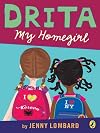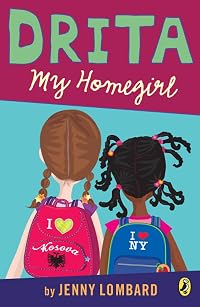
Drita, My Homegirl
by Jenny Lombard
On This Page
Description
When ten-year-old Drita and her family, refugees from Kosovo, move to New York, Drita is teased about not speaking English well, but after a popular student named Maxine is forced to learn about Kosovo as a punishment for teasing Drita, the two girls soon bond.Tags
Recommendations














Member Reviews
Ok, pluses here (there are a lot): alternating viewpoint between Drita's Albanian refugee family and Maxie's New York African American family, who is about 3 years out from the loss of her mother in a car accident. Does a fabulous job on both viewpoints -- the shock and strangeness of a small New York apartment after the sudden exit from Kosova, the fear and despair that Drita's mom succumbs to, the difficulties of many people in a small space just trying to cope. And then Maxie -- who is having a lot of difficulty in her grief, acting out, getting in fights and mischief and seriously having a hard time with her dad's new girlfriend. Her new friendship (assigned to her by a caring teacher) with Drita ends up steadying her. I love that show more both families have a caring grandmother who lives with them and takes on a lot of the heavy emotional work that lets the families function. I love that the refugee family is white and Muslim and the welcoming American family is black -- and comes through when Drita's mom hits a crisis in a big way -- they are absolutely the heroes in this story, but it's not presented as a story about race, it's a school story about 4th graders. Also, I really like that Drita is talented at basketball.
Minuses -- I did find it a little slow to get into. It's 135 pages, but I feel like most of the action happens in the last 3rd of the book, so there's a little patience required to engage. show less
Minuses -- I did find it a little slow to get into. It's 135 pages, but I feel like most of the action happens in the last 3rd of the book, so there's a little patience required to engage. show less
What a treat. This goes far beyond the "typical" friendship stories aimed at 3rd through 5th graders. A refugee from Kosovo, Drita has just arrived in America with her family. She is excited about attending school, but her first day in Miss Salvato's fourth grade classroom proves challenging: even though she does not speak English, she can tell that one of the girls is making fun of her. Miss Salvato turns the tables on this class clown, though, when she suggests that Maxie's social studies project can be to learn about Kosovo and about Drita's journey to America. The chapters alternate between Drita's voice and Maxie's, and through the two perspectives, readers quickly appreciate the girls' differences and commonalities: both girls are show more struggling with difficult family situations. Their friendship develops slowly and believably, and readers will cheer for both girls as they and their families grow through the connections they make. While most children at this grade level probably are not familiar with the conflict that has torn the former Yugoslavian region for so long, Lombard weaves in current events in a way that middle graders will understand. The liberal use of Albanian phrases may be intimidating to some readers, and no glossary is included, although the meanings of most of the phrases can be inferred from the text. Students who do not let the unfamiliar phrases deter them, however, will be glad that they stayed with the story. show less
Drita and her family are newly arrived refugees to New York City from Kosovo. Drita is happy to be in America but despite her efforts isn't fully welcomed by the other kids at school. Maxie is a black girl in her class who wants to be a comedian someday although right now her irresponsible humor mostly gets her in trouble. Despite the language and cultural differences the two become unlikely friends when a teacher assigns Maxie to do her social studies project on Kosovo and interview Drita. Concerns at home occupy them as well. Drita's mother has sunk into a deep depression and Maxie, still grieving her late mother, is unwilling to accept her father's new female friend. An upbeat, readable story with genuine dialog.
I'm very divided on this book. The story and characters were wonderful - I truly enjoyed this unique look at immigration and it was refreshing for the person assisting the newcomer to be something other than "the great white hero".
The dialogue (internal and external) however, was... offensive. Especially coming from someone who isn't a native or immigrant to the culture. Internally, Drita spoke in overly perfected, choppy English (which makes no sense since her internal dialogue is/should be her native speech translated to English -therefore it should be natural and free-flowing). The opening line of the book is a good example of this: "For three days, before I am coming to this country, I can't eat."
Internally and externally, Maxie show more spoke in what could be perceived as a caricature of inner-city idiomatic ebonics (incorrect tenses, incorrect plurality (for instance, "I gots")). Her father corrects her for speaking "slang" at one point, but his language isn't much better (especially considering he's some hotshot at a bank). show less
The dialogue (internal and external) however, was... offensive. Especially coming from someone who isn't a native or immigrant to the culture. Internally, Drita spoke in overly perfected, choppy English (which makes no sense since her internal dialogue is/should be her native speech translated to English -therefore it should be natural and free-flowing). The opening line of the book is a good example of this: "For three days, before I am coming to this country, I can't eat."
Internally and externally, Maxie show more spoke in what could be perceived as a caricature of inner-city idiomatic ebonics (incorrect tenses, incorrect plurality (for instance, "I gots")). Her father corrects her for speaking "slang" at one point, but his language isn't much better (especially considering he's some hotshot at a bank). show less
Starred Review. Grade 3-5–In alternating chapters, two fourth graders tell about the development of their unlikely friendship. Drita is a refugee from Kosova who, along with her family, is finally joining her father in New York City. In a cramped apartment and without connections or language skills, her mother sinks into a serious depression, while the girl struggles to find her place in school. Maxie, a precocious African-American child who lives with her supportive grandmother and her widowed father, struggles, too; shes in constant trouble in school for her comedic efforts since her mother died. When she sees a news report on Kosova, she decides to do a project on Albanian refugees, focusing on Drita. The girls find common ground, show more and when Maxies grandmother, a retired nurse, sweeps in to rescue Dritas mother, the families forge a bond as well. Maxies attempts to help Drita understand American ways are touching, and Dritas understanding of her friends loss is a testament to the emotional intelligence of children. Dritas story resonates with the bravery of an individual determined to become part of her new country while retaining the love of her homeland. Maxie has the cocky voice of a girl who is trying too hard to disguise her pain. More a tale of the power of love than of refugees, this first novel is imbued with the language and customs of Kosova as well as the efforts of a family attempting to regain balance. Read it aloud to groups and let the conversations begin. show less
This book tackles a whole bunch of subjects: grieving, refugeeism, immigration, bullying, friendship, and more. I am pleased to find that while the book reviewer side of me acknowledges this, the reader in me didn't pay any attention to anything except for the delightful and touching and heartwarming story.
Drita is a refugee from war-torn Kosovo, newly arrive in New York City. Maxie is a popular girl with a bit of an attitude. In this short book with chapters alternating from first-person Drita to first-person Maxie, these two unlikely girls become the closest of friends. We also spend time with each family. Maxie, who lives with her father and grandmother, her mother having been killed in a car accident a few years prior, and Drita, whose father struggles to support his family driving a cab, while his engineering degree seems useless in the US, her grandmother, and her mother, who is not handling the transition to a new country well at all.
It's a beautiful story of friendship and families.
It's a beautiful story of friendship and families.
Members
- Recently Added By
Author Information
2 Works 851 Members
Awards and Honors
Awards
Common Knowledge
- People/Characters
- Drita Kelmendi; Gjyshe Kelmendi; Dashi Kelmendi; Maxie Nichols; Lisa; Grandma Nichols (show all 14); Cupcake; Miss Mirfue; Hashim Kelmendi; Mr. Littman; Miss Salvato; Brandee; Gerald Nichols; Adem Kelmendi
- Important places
- Prishtina, Kosova (Kosovo); New York, New York, USA; PS 18, Brooklyn, New York, New York, USA; Roosevelt Hospital, New York, New York, USA
- Dedication
- For my students
- First words
- For three days, before I am coming to this country, I can't eat.
- Last words
- (Click to show. Warning: May contain spoilers.)"I don't know, Drita, but something tells me you're about to have a lot of new friends."
- Blurbers
- Feiffer, Jules
Classifications
Statistics
- Members
- 837
- Popularity
- 33,006
- Reviews
- 14
- Rating
- (3.69)
- Languages
- English
- Media
- Paper, Audiobook, Ebook
- ISBNs
- 11
- ASINs
- 4