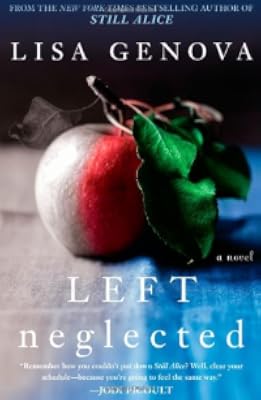
Left Neglected
by Lisa Genova
On This Page
Description
Sarah, a career-driven young mother, suffers a traumatic brain injury in a car accident that leaves her unable to perceive left-side information. The disability causes her to struggle through an uncertain recovery as she adapts to her new life.Tags
Recommendations































Member Reviews
I was very impressed with Genova's debut novel Still Alice, a story focused on the main character's decent into Alzheimer's, and have been waiting impatiently for her second book to come out. Left Neglected was well worth the wait.
Sarah Nickerson is a thirty-something high powered career woman, mother of three and wife to an equally upwardly mobile husband. 80-hour work weeks and constant multitasking are what Sarah's life is all about - everything driven by a mental scorecard, tracking and capitalizing on every minute as if her life, and her family's lives, are managed by an air traffic controller. I am not an obsessive A-type personality so Sarah's idea of life isn't one I share with her. One fateful day, Sarah's high powered, and show more dare I say frantic life, takes a drastic turn when she attempts to make a phone call while driving to work and crashes her vehicle in the process. due to the crash, she suffers a traumatic brain injury to the right hemisphere of the brain. The outcome of this brain injury is a neurological syndrome known as Left Neglect, with Sarah's brain ignoring information on the left side of the world, including the left side of her own body.
This is where the story shifts from good fiction to fascinating fiction for me. Genova, a PhD in neuroscience, has an amazing skill at conveying neurological disabilities/dysfunctions from a patient's point of view while still presenting an interesting story that is easy for the reader to connect with. As a left handed individual with a fascination with how the human brain is 'wired', this story was a great page-turner for me. Imagine having to force yourself, though conscious effort, to look left, because as far as your brain is concerned, there is no left. Left hand, what left hand? Same goes for the your left leg. Oh, and for the food lovers out there, you think you have eaten everything on your dinner plate only to have the plate turned clockwise 180 degrees and, low and behold, the other half of your dinner magically appears!
Candid, informative and at times humorous, Sarah's experiences after this life altering experience with all its ups and downs has left me appreciating how difficult living with Left Neglect can be and has left me wanting to learn more about this fascinating neurological syndrome.
A fascinating and insightful story about a neurological syndrome that is for the most part is still not well understood by the scientific community and about making important, life altering choices and connections. Highly recommended! show less
Sarah Nickerson is a thirty-something high powered career woman, mother of three and wife to an equally upwardly mobile husband. 80-hour work weeks and constant multitasking are what Sarah's life is all about - everything driven by a mental scorecard, tracking and capitalizing on every minute as if her life, and her family's lives, are managed by an air traffic controller. I am not an obsessive A-type personality so Sarah's idea of life isn't one I share with her. One fateful day, Sarah's high powered, and show more dare I say frantic life, takes a drastic turn when she attempts to make a phone call while driving to work and crashes her vehicle in the process. due to the crash, she suffers a traumatic brain injury to the right hemisphere of the brain. The outcome of this brain injury is a neurological syndrome known as Left Neglect, with Sarah's brain ignoring information on the left side of the world, including the left side of her own body.
This is where the story shifts from good fiction to fascinating fiction for me. Genova, a PhD in neuroscience, has an amazing skill at conveying neurological disabilities/dysfunctions from a patient's point of view while still presenting an interesting story that is easy for the reader to connect with. As a left handed individual with a fascination with how the human brain is 'wired', this story was a great page-turner for me. Imagine having to force yourself, though conscious effort, to look left, because as far as your brain is concerned, there is no left. Left hand, what left hand? Same goes for the your left leg. Oh, and for the food lovers out there, you think you have eaten everything on your dinner plate only to have the plate turned clockwise 180 degrees and, low and behold, the other half of your dinner magically appears!
Candid, informative and at times humorous, Sarah's experiences after this life altering experience with all its ups and downs has left me appreciating how difficult living with Left Neglect can be and has left me wanting to learn more about this fascinating neurological syndrome.
A fascinating and insightful story about a neurological syndrome that is for the most part is still not well understood by the scientific community and about making important, life altering choices and connections. Highly recommended! show less
Left Neglected by Lisa Genova
Gallery Books (2011), Paperback, 352 pages
As I was reading this I had to keep reminding myself it was FICTION, not clinical history. Written by a neuroscientist it is much closer to fact than one might think.
As someone who experienced a TBI (Traumatic Brain Injury) in 1986, a stroke in 2007 and a spinal cord injury in 2011 I could relate intimately to this story.
The process of identifying and internalizing the nature and extent of the injury is just the beginning of a Physio/Rehab process that may be life long. Lisa Genova describes the experience and emotion with vivid (and amazingly accurate) intensity. She relates enormously complex processes with such detail that I'm willing to believe there's a real show more Sarah out there and I can find her exactly where the author says she is.
A very strong work which gets into your head – in more ways than one. There is so much taken for granted in the way that we think and function a sudden upset of that process makes everything go sideways. How you interact with family and colleagues – and how they interact with you – will be totally changed, and everyone has to find where the new common ground lies.
** While the specific condition (Left Neglect) described in the book is, in fact, very rare, the process of identification and adaptation is true of many types of sudden onset neurological deficit. I would not hesitate to share this with family members and intend to suggest it be added to the resources at the Physio/Rehab facility that provided my own excellent care. show less
Gallery Books (2011), Paperback, 352 pages
As I was reading this I had to keep reminding myself it was FICTION, not clinical history. Written by a neuroscientist it is much closer to fact than one might think.
As someone who experienced a TBI (Traumatic Brain Injury) in 1986, a stroke in 2007 and a spinal cord injury in 2011 I could relate intimately to this story.
The process of identifying and internalizing the nature and extent of the injury is just the beginning of a Physio/Rehab process that may be life long. Lisa Genova describes the experience and emotion with vivid (and amazingly accurate) intensity. She relates enormously complex processes with such detail that I'm willing to believe there's a real show more Sarah out there and I can find her exactly where the author says she is.
A very strong work which gets into your head – in more ways than one. There is so much taken for granted in the way that we think and function a sudden upset of that process makes everything go sideways. How you interact with family and colleagues – and how they interact with you – will be totally changed, and everyone has to find where the new common ground lies.
** While the specific condition (Left Neglect) described in the book is, in fact, very rare, the process of identification and adaptation is true of many types of sudden onset neurological deficit. I would not hesitate to share this with family members and intend to suggest it be added to the resources at the Physio/Rehab facility that provided my own excellent care. show less
I am asked what a good book would be for a book club and I hesitate. I want to be able to recommend a book that 1) has the power to transform or alter perception 2) is written well 3) is clean enough that I can look the ladies in the eye at church after they have read it. This one passes all three of my requirements.
I'm going to work backwards.
The book is clean. Yes, there is swearing but I don't recall anything blatantly offensive. Yes, there is sex as Sarah reconnects with that portion of herself and her husband. In fact, that was one of my favorite parts of the book in regard to Sarah's healing.
The book is written well. It struck me, in fact, that Genova is more than a novelist but also an essayist. She writes each chapter so it show more connects with the book but the chapters are like well written essays. Each one addresses something in particular while following the chronology of Sarah's life. On top of this, I loved the protagonist. She is snarky, spunky, intelligent, high achieving, and juggling the demands of career and home. Genova describes the ins and outs of motherhood and appointments in a way that I didn't know if I wanted to laugh or cry. The constant struggle of balancing these aspects often do have me either mentally writing a blog post in my head or curling up in fetal position when I hit my tipping point. Genova seems to understand this very well.
The content makes the reader think. The story is about a woman who suffers TBI and maintains her memories, her speech, hearing, sight, taste, touch, most of her neurological function and all of her wit and intellect. What she loses is the connection to the left side of her body. It still works. It's still connected to her brain. She simply does not recognize it. There is no left. She doesn't own a left leg because it doesn't exist. On the other hand, if someone taps her left leg or scratches her left arm, she feels it or it hurts. She has to retrain herself to pay attention to the parts of her body that don't exist to her anymore. Her progress or lack thereof could be viewed as tedious as it is slow and, like real life, a neurological injury does not fully heal. On the other hand, if reading the chapters like essays, each chapter offers wisdom and growth. On a personal note, it gave me a huge insight and respect for my father's brain surgery which caused neurological damage 16 years ago and his tenacity to retrain his brain.
Abstractly, the book is about neglect. In one part of the book, Sarah remembers an article that explains the 20% rule. We only need to understand 20% of something to be effective doing 80% of it. Trying to understand something 100% is a waste of time and we will neglect something else in our life of import. The story nudges the reader to look at her own life and assess what she may be neglecting that is important? What can be simplified and scaled back to manageable bite sizes in order to concentrate on what is important? What can be forsaken?
This is an awesome read. It is funny, moving, and cerebral. show less
I'm going to work backwards.
The book is clean. Yes, there is swearing but I don't recall anything blatantly offensive. Yes, there is sex as Sarah reconnects with that portion of herself and her husband. In fact, that was one of my favorite parts of the book in regard to Sarah's healing.
The book is written well. It struck me, in fact, that Genova is more than a novelist but also an essayist. She writes each chapter so it show more connects with the book but the chapters are like well written essays. Each one addresses something in particular while following the chronology of Sarah's life. On top of this, I loved the protagonist. She is snarky, spunky, intelligent, high achieving, and juggling the demands of career and home. Genova describes the ins and outs of motherhood and appointments in a way that I didn't know if I wanted to laugh or cry. The constant struggle of balancing these aspects often do have me either mentally writing a blog post in my head or curling up in fetal position when I hit my tipping point. Genova seems to understand this very well.
The content makes the reader think. The story is about a woman who suffers TBI and maintains her memories, her speech, hearing, sight, taste, touch, most of her neurological function and all of her wit and intellect. What she loses is the connection to the left side of her body. It still works. It's still connected to her brain. She simply does not recognize it. There is no left. She doesn't own a left leg because it doesn't exist. On the other hand, if someone taps her left leg or scratches her left arm, she feels it or it hurts. She has to retrain herself to pay attention to the parts of her body that don't exist to her anymore. Her progress or lack thereof could be viewed as tedious as it is slow and, like real life, a neurological injury does not fully heal. On the other hand, if reading the chapters like essays, each chapter offers wisdom and growth. On a personal note, it gave me a huge insight and respect for my father's brain surgery which caused neurological damage 16 years ago and his tenacity to retrain his brain.
Abstractly, the book is about neglect. In one part of the book, Sarah remembers an article that explains the 20% rule. We only need to understand 20% of something to be effective doing 80% of it. Trying to understand something 100% is a waste of time and we will neglect something else in our life of import. The story nudges the reader to look at her own life and assess what she may be neglecting that is important? What can be simplified and scaled back to manageable bite sizes in order to concentrate on what is important? What can be forsaken?
This is an awesome read. It is funny, moving, and cerebral. show less
Sarah Nickerson has it all. An MBA from Harvard Business School. A great job, a great husband who has a great job, three great kids. She and her husband have a beautiful big house in a suburb of Boston, and a vacation house in Vermont. She works eighty hours a week, but is occasionally able to squeeze in attendance at t-ball and soccer games. If she feels overwhelmed from time to time, she shuts her office door and allows herself to cry for five minutes. Maybe Sarah and Bob are overbooked and overextended, with two mortgages and two student loans and very little time for themselves (and each other), but isn't that the price you pay for having it all?
Rushing to work after dropping the kids at school one morning, running late on a day show more packed with important meetings and conference calls and trying to make up for lost time by answering e-mails and texts as she drives, Sarah loses control of her car. When she comes to she's in the hospital, half her head shaved, and about to discover that she has suffered a traumatic brain injury that's left her with a disorder known as Left Neglect. Unable to perceive the left half of the world, Sarah has to reinvent herself, both physically--learning to look left again, painstakingly developing coping techniques and ways to get around--and as a person. No longer the most capable person in the room, Sarah has to learn to depend on others to help her make her way in the world.
While Sarah's still in the hospital rehabilitation unit, her mother, who checked out of Sarah's life after her younger brother died in an accident when Sarah was still a child, checks back in. Resentful at having to depend on the mother who was incapable of ushering her from childhood through adolescence and on into adulthood, Sarah balks. Undaunted, her mother stays, helping Bob keep it together, taking care of the household, ferrying the kids back and forth to school and activities, and ultimately taking over Sarah's rehabilitation.
There is a tearful, late-in-the-game reconciliation.
Synopsized thusly, Left Neglected, the second novel by Lisa Genova, who holds a Ph.D. in neuroscience from Harvard University, sounds suspiciously like a movie of the week. And it often veers unnervingly close to being a typical melodrama about redemption through overcoming a handicap. But Genova's unflinching eye and the deft first person narration (laced liberally throughout with self-deprecating humor) saves the novel from this fate. Left Neglected is certainly ripe for the book club circuit, packed as it is with mother-daughter issues, questions about when just enough becomes too much, and--of course--the delicious theme of adversity overcome. And yes, this reader did, indeed, cry with satisfaction at the end. But don't let these things deter you, as Left Neglected is so much more. It is nicely written and thought provoking. Lisa Genova obviously knows her neurological disorders, and her insight into this condition (which, a note at the end, tells us is also known as unilateral neglect or hemispatial neglect) is absolutely fascinating, and not a little chilling. show less
Rushing to work after dropping the kids at school one morning, running late on a day show more packed with important meetings and conference calls and trying to make up for lost time by answering e-mails and texts as she drives, Sarah loses control of her car. When she comes to she's in the hospital, half her head shaved, and about to discover that she has suffered a traumatic brain injury that's left her with a disorder known as Left Neglect. Unable to perceive the left half of the world, Sarah has to reinvent herself, both physically--learning to look left again, painstakingly developing coping techniques and ways to get around--and as a person. No longer the most capable person in the room, Sarah has to learn to depend on others to help her make her way in the world.
While Sarah's still in the hospital rehabilitation unit, her mother, who checked out of Sarah's life after her younger brother died in an accident when Sarah was still a child, checks back in. Resentful at having to depend on the mother who was incapable of ushering her from childhood through adolescence and on into adulthood, Sarah balks. Undaunted, her mother stays, helping Bob keep it together, taking care of the household, ferrying the kids back and forth to school and activities, and ultimately taking over Sarah's rehabilitation.
There is a tearful, late-in-the-game reconciliation.
Synopsized thusly, Left Neglected, the second novel by Lisa Genova, who holds a Ph.D. in neuroscience from Harvard University, sounds suspiciously like a movie of the week. And it often veers unnervingly close to being a typical melodrama about redemption through overcoming a handicap. But Genova's unflinching eye and the deft first person narration (laced liberally throughout with self-deprecating humor) saves the novel from this fate. Left Neglected is certainly ripe for the book club circuit, packed as it is with mother-daughter issues, questions about when just enough becomes too much, and--of course--the delicious theme of adversity overcome. And yes, this reader did, indeed, cry with satisfaction at the end. But don't let these things deter you, as Left Neglected is so much more. It is nicely written and thought provoking. Lisa Genova obviously knows her neurological disorders, and her insight into this condition (which, a note at the end, tells us is also known as unilateral neglect or hemispatial neglect) is absolutely fascinating, and not a little chilling. show less
Barnes and Noble are return Nazis. When I tried to return a Christmas gift for store credit (no receipt - it was a gift), the clerk was quite nasty about it. So I conceived an evil scheme: I would buy a book I was only mildly interested in (Lisa Genova's Left Neglected), read it, and then return it. Take that, B & N!
A problem arose.
Lisa Genova's book is...really good. Fascinating, actually. Sarah, the hard-driving, consulting-firm executive and mother of three, wins the daily gamble with her husband and gets to drive to work without dropping the kids at daycare. Her mind spinning with her endless to-do list, she allows her attention to stray for a vital instant, and suffers a horrific accident, including a traumatic brain injury. When show more she awakens, she finds she has lost all awareness of anything on her left - Left Neglect.
This could have been a recipe for a somber, bitter novel, or perhaps an unrealistically inspirational one, but it is neither. Sarah, her husband Bob, Sarah's formerly neglectful, now eager-to-make-amends mother, are all fully-formed characters who are also immensely likable. (Thank you for that, Lisa Genova! I detest spending time with ugly people, even if they are well-drawn.) The decidedly peculiar problems faced by those suffering from this unusual condition are - well, they were just so interesting. At one point, Sarah's husband is urging her to "look left" and she asks him to describe the room to her, which he does. Then she asks him, "Okay, now what if I told you that everything your see is only half of everything that's really here? What if I told you to turn your head and look at the other half? Where would you look?"
Ouch. But also, really well done, Lisa Genova! I really GOT that. Left Neglected is fast-moving, intellectually engaging, emotionally powerful, and really got me thinking about my own tendency to think there is only "one best way" to navigate the world. So I guess I'll have to revenge myself on B & N some other way. show less
A problem arose.
Lisa Genova's book is...really good. Fascinating, actually. Sarah, the hard-driving, consulting-firm executive and mother of three, wins the daily gamble with her husband and gets to drive to work without dropping the kids at daycare. Her mind spinning with her endless to-do list, she allows her attention to stray for a vital instant, and suffers a horrific accident, including a traumatic brain injury. When show more she awakens, she finds she has lost all awareness of anything on her left - Left Neglect.
This could have been a recipe for a somber, bitter novel, or perhaps an unrealistically inspirational one, but it is neither. Sarah, her husband Bob, Sarah's formerly neglectful, now eager-to-make-amends mother, are all fully-formed characters who are also immensely likable. (Thank you for that, Lisa Genova! I detest spending time with ugly people, even if they are well-drawn.) The decidedly peculiar problems faced by those suffering from this unusual condition are - well, they were just so interesting. At one point, Sarah's husband is urging her to "look left" and she asks him to describe the room to her, which he does. Then she asks him, "Okay, now what if I told you that everything your see is only half of everything that's really here? What if I told you to turn your head and look at the other half? Where would you look?"
Ouch. But also, really well done, Lisa Genova! I really GOT that. Left Neglected is fast-moving, intellectually engaging, emotionally powerful, and really got me thinking about my own tendency to think there is only "one best way" to navigate the world. So I guess I'll have to revenge myself on B & N some other way. show less
Ever since I read Lisa Genova's saga of an Alzheimer's victim, "Still Alice", I've been anxious to get to this one. Although written as fiction, the story of this more common than we realize neurological condition known as "Left Neglect" is compelling, frightening, encouraging, discouraging, depressing, and uplifting all at once.
The main character, Sara Nickerson, is portrayed as an over-achieving, multi-tasking, high powered executive, mother of three who thinks she can have it all--and almost does, until a momentary lapse of judgement (trying to dial a cell-phone while barreling along a crowded turnpike at 70mph) results in a horrific accident, and a traumatic brain injury. When she awakes in the hospital, she is confronted with the show more fact that the entire left side of her experience is missing. She can't see on her left, she can't use her left arm or leg, she can't hear on her left--in essence, she is missing half her reality. She can't dress, bath or toilet herself, she can't read, she can't use a computer, she can't walk, she can't feed herself, and the outlook is less than optimistic for a full recovery.
For about 60% of this book, I wanted to smack this woman. She is obnoxious, arrogant, demanding, selfish, and totally unlikable. But..............she is suffering an incredible challenge, and an almost impossible obstacle course to recover her previous life, so I continued reading, praying for a change of heart. On top of the physical issues she had to deal with, she is confronted with having her mother moving in to her household to help out with day to day chores, with her daughter's physical needs (dressing, bathing, moving etc) and with childcare - particularly for the toddler. Apparently, Sara has not been on speaking terms with her mother for most of her adult life, and the psychic energy she must expend on re-building (or tearing down) that relationship is an additional trauma to her system. On top of everything, the family has to face a precipitous drop in its very affluent life-style if Sara is unable to return to work.
Genova has given us a powerful portrayal of the physical, mental, psychological and spiritual challenges of this type of injury --not just to the victim, but to the family and friends who also are impacted by its devastation. In the end, it is a story of the power of the human spirit to rise above adversity and get on with life. It is a story that will stick with the reader for years. show less
The main character, Sara Nickerson, is portrayed as an over-achieving, multi-tasking, high powered executive, mother of three who thinks she can have it all--and almost does, until a momentary lapse of judgement (trying to dial a cell-phone while barreling along a crowded turnpike at 70mph) results in a horrific accident, and a traumatic brain injury. When she awakes in the hospital, she is confronted with the show more fact that the entire left side of her experience is missing. She can't see on her left, she can't use her left arm or leg, she can't hear on her left--in essence, she is missing half her reality. She can't dress, bath or toilet herself, she can't read, she can't use a computer, she can't walk, she can't feed herself, and the outlook is less than optimistic for a full recovery.
For about 60% of this book, I wanted to smack this woman. She is obnoxious, arrogant, demanding, selfish, and totally unlikable. But..............she is suffering an incredible challenge, and an almost impossible obstacle course to recover her previous life, so I continued reading, praying for a change of heart. On top of the physical issues she had to deal with, she is confronted with having her mother moving in to her household to help out with day to day chores, with her daughter's physical needs (dressing, bathing, moving etc) and with childcare - particularly for the toddler. Apparently, Sara has not been on speaking terms with her mother for most of her adult life, and the psychic energy she must expend on re-building (or tearing down) that relationship is an additional trauma to her system. On top of everything, the family has to face a precipitous drop in its very affluent life-style if Sara is unable to return to work.
Genova has given us a powerful portrayal of the physical, mental, psychological and spiritual challenges of this type of injury --not just to the victim, but to the family and friends who also are impacted by its devastation. In the end, it is a story of the power of the human spirit to rise above adversity and get on with life. It is a story that will stick with the reader for years. show less
Sarah Nickerson works at a high-powered job, has 3 children and is stretched thin. Her husband works for a start-up company anxious to get to solid footing, also putting in lots of hours. On a rainy day in heavy traffic Sarah reaches for her phone, taking her eyes off the road and ending up in a serious car accident. The result is a traumatic brain injury, more specifically hemispatial neglect. Her brain does not recognize anything to the left including that side of her body. She thinks she and her world are complete, when it is not. The book covers a year while she learns all the adjustments, figures out what things she can improve on and what things will always need to be done differently and how to ask for help. This condition is show more really well explained. Sarah has only one version of it. Many people who suffer right side strokes get some level of this. My mother had a bit of this with her stroke, so this was an interesting read for me. Highly recommended. show less
Members
- Recently Added By
Published Reviews
ThingScore 88
Lisa Genova holds a doctorate in neuroscience from Harvard. She knows her way around the human brain, and it shows....
Genova is a master of getting into the heads of her characters, relating from the inside out what it's like to suffer from a debilitating disease. How she does it we don't know, but she does, and brilliantly....This is a well-told tale from a keen medical mind. Picking up show more anything written by Genova is quickly becoming, well, a no-brainer. show less
Genova is a master of getting into the heads of her characters, relating from the inside out what it's like to suffer from a debilitating disease. How she does it we don't know, but she does, and brilliantly....This is a well-told tale from a keen medical mind. Picking up show more anything written by Genova is quickly becoming, well, a no-brainer. show less
added by vancouverdeb
If Lisa Genova’s objective is to shed light, from inside the brain, on rarely looked at neurological conditions, as she did in her bestselling first novel, Still Alice, then she succeeds with Left Neglected....If there’s a weakness at all in Left Neglected, it’s that the novel doesn’t feel as vital and immediate as Still Alice, which may be attributed to the first novel having been show more born out of Genova’s intense feelings about her grandmother’s Alzheimer’s. Or it could just be the usual sophomoric tendency to put your all into your first project. While the empathy she is intent on showing is never clunky, the story is a touch clichéd in places and it would be a shame in the future to see Genova err on the side of the formulaic. show less
added by vancouverdeb
Lists

New England Books
101 works; 10 members

Female Author
1,234 works; 67 members

Top Five Books of 2015
811 works; 240 members

Top Five Books of 2016
795 works; 228 members

Favorite Audiobooks Listened to in 2011
33 works; 11 members

Five star books
1,767 works; 110 members

Indie Next Picks
196 works; 4 members

Books Read in 2012
816 works; 34 members

Biggest Disappointments
606 works; 163 members

Books Read in 2013
1,630 works; 51 members
Author Information

12+ Works 13,214 Members
Lisa Genova (born November 11, 1970) has a degree in Biopsychology, from Bates College, and a Ph.D. in Neuroscience from Harvard University. Genova is the author of the New York Times Bestselling novel STILL ALICE, which is now a major feature film with Julianne Moore. She is also the author of the novel LEFT NEGLECTED and LOVE ANTHONY. She also show more made the New York Times Best Seller List with her title's: Inside the O'Briens and Every Note Played. She will be at the Adelaide Writers' Week for the 2016 festival. (Bowker Author Biography) show less
Common Knowledge
- Canonical title*
- Puolinainen
- Original title
- Left Neglected
- Original publication date
- 2011-01-04
- People/Characters
- Sarah Nickerson; Bob Nickerson; Charlie Nickerson; Lucy Nickerson; Linus Nickerson; Abby (show all 15); Jessica; Ms. Gavin; Dr. Kwon; Helen; Martha; Heidi; Richard Levine; Nate; Mike Green
- Important places
- Boston, Massachusetts, USA; Vermont, USA
- Dedication
- For Chris and Ethan
- First words
- I think some small part of me knew I was living an unsustainable life.
- Last words
- (Click to show. Warning: May contain spoilers.)Hush.
- Blurbers
- Picoult, Jodi
*Some information comes from Common Knowledge in other languages. Click "Edit" for more information.
Classifications
Statistics
- Members
- 2,025
- Popularity
- 10,352
- Reviews
- 145
- Rating
- (3.91)
- Languages
- 10 — Czech, Dutch, English, Finnish, French, German, Norwegian (Bokmål), Portuguese, Russian, Swedish
- Media
- Paper, Audiobook, Ebook
- ISBNs
- 37
- ASINs
- 14