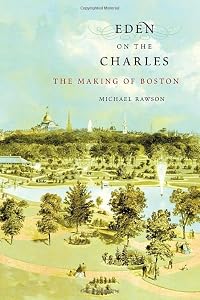
Eden on the Charles: The Making of Boston
by Michael Rawson
On This Page
Description
In Eden on the Charles: The Making of Boston, Michael Rawson examines how the city's relationship with its natural surroundings informed its early growth and development. His compelling, well-researched narrative touches on several milestones on Boston's road to modernity, including the Common's conversion from a place of labor to a place of leisure, the emergence of pastoral suburbs as a respite from an increasingly urbanized landscape, and the long fight over a proposed municipal water show more system to bring fresh water to those who needed it most.Perhaps the book's most important lesson comes from a frustrated mariner who, upset over the maltreatment of the harbor, laments that "the past seems to be forgotten, the present only is regarded as of importance, and a veil is drawn over the future." Eden on the Charles is a valiant effort to combat such shortsightedness, reminding us that the key to building a successful community lies in respecting the natural resources that provide for it and in understanding our responsibility to our fellow citizens. show lessTags
Recommendations











Member Reviews
This wonderfully researched and well-written history, explores the making of Boston by focusing on the social and environmental factors that shaped the city, it's human ecology. There are five sections of the book:
1. Enclosing the Common - the effort of prosperous Bostonians to enclose Boston Common, changing it from a place of work (pasturing cows and digging up turf) to a place of recreation.
2. Constructing water - the contentious development of a public waterworks, a means by which reformers hoped to improve both the health and morality of the populace, but a process that also forever changed the role of municipal government.
3. Inventing the suburbs - people move from the city, seeking pastoral cities and escape taxation, but they show more also miss the public works that the city provides. Some suburbs are annexed by Boston (willingly or otherwise) while some become cities in their own right.
4. Making the harbor - the modern Boston Harbor is human-made not natural, and the processes of landmaking, dredging, damming, et al that modified it so much were a contentious issue in the 19th century when many mariners thought the harbor would be lost with natural water movement.
5. Recreating the wilderness - suburban green spaces such as the Middlesex Fells and the Blue Hills are created as a connection to the colonial forbears and the lost wilderness.
This book is a terrific means of grasping the process of urbanism for modern cities and a unique approach to the history of Boston. It pairs well with Walter Muir Whitehill's classic Boston: A Topographical History.
Favorite Passages:
1. Enclosing the Common - the effort of prosperous Bostonians to enclose Boston Common, changing it from a place of work (pasturing cows and digging up turf) to a place of recreation.
2. Constructing water - the contentious development of a public waterworks, a means by which reformers hoped to improve both the health and morality of the populace, but a process that also forever changed the role of municipal government.
3. Inventing the suburbs - people move from the city, seeking pastoral cities and escape taxation, but they show more also miss the public works that the city provides. Some suburbs are annexed by Boston (willingly or otherwise) while some become cities in their own right.
4. Making the harbor - the modern Boston Harbor is human-made not natural, and the processes of landmaking, dredging, damming, et al that modified it so much were a contentious issue in the 19th century when many mariners thought the harbor would be lost with natural water movement.
5. Recreating the wilderness - suburban green spaces such as the Middlesex Fells and the Blue Hills are created as a connection to the colonial forbears and the lost wilderness.
This book is a terrific means of grasping the process of urbanism for modern cities and a unique approach to the history of Boston. It pairs well with Walter Muir Whitehill's classic Boston: A Topographical History.
Favorite Passages:
"What made that agenda so contentious was that reformers wanted to expand the role of government to achieve it. Since government had never played a serious role in structuring how Bostonians interacted with their water supply, transferring responsibility for finding adequate water from the individual to the city seemed to some like a radical and potentially dangerous move. Instead, early experiments in municipal water like Boston's would prove to be the leading edge of a wave of change in municipal government. As the century progressed, cities would expand their power to fund larger public works, often through borrowing, and they would pay the cost through general taxes rather than special assessments. Event the cost of smaller projects that did not require bond issues would increasingly be spread out among all residents of a city. Public water would encourage urban residents, in Boston and elsewhere, to expand their vision of the public good." - p. 104show less
"The Fells and Blue Hills were designed to store information about colonial people and events and prompt visitors to recall the collected stories. The existence of such places implies a relationship of permanence, lest the memories disappear with the monument..." - p. 269
An excellent account of Boston's built environment, focusing on the creation of the municipal water system, the enclosure of Boston Common, the struggle over Boston's expansion into the suburbs, the reshaping of Boston Harbor over time, and the creation of wilderness preserves near the city. A great read, particularly if you're familiar with Boston and its history.
If you've ever lived in Boston, Michael Rawson's Eden on the Charles is a great book to help understand how Boston developed in the 19th Century. You may know the basic transformation of Boston from a small ithsmus surrounded by shallow flats to the larger bustling city of today. For a book labeling a city as Eden, it's mostly about conflict. Conflict between the classes and conflict between different visions of the city. It uses those conflicts to highlight five developments in the city.
The first conflict is over the use of the Boston Common. In the early days of the city it was a common pasture. As the city grew, the common became a spot for recreation. That transformation increased as the affluent residents began calling Beacon Hill show more home. The conflict arose between those looking to keep agriculture in the city and those who wanted more recreation in the city (and didn't enjoy dodging cow patties).
The second conflict was over potable water. For centuries, residents were able to supply water through wells in the city. By the middle of the 19th century, wells became inadequate. The conflict was between those who thought water should be delivered by the government or by private parties. By this time in the city's history there were a few companies privately supplying water. Once the decision fell in favor of the government, the conflict was over how to pay for it. On one side was a movement to have it paid through general tax revenue. On the other was those who wanted it paid through a usage charge. Anyone who has paid a water bill knows how this was finally resolved.
The third conflict was over the suburbs. Boston offered water, streetlights, and police protection. The outlying communities ( West Roxbury and Brookline in particular) offered a rural lifestyle, allowing you to escape from the frenzy of the city. While residents enjoyed the idyllic lifestyle in the more rural communities, they also enjoyed the peace that came from good roads, streetlights, and clean water supplied by the city. Ultimately, West Roxbury failed to deliver the services wanted by the residents and they agreed to be annexed by Boston. Brookline did a better job implementing resident services and managed to avoid the lure of annexation.
The fourth conflict discussed in the book was over filling the harbor. Throughout its history Boston has slowly grown as landowners began filling in the flats that surrounded the isthmus. By the middle of the 19th century mariners became concerned that the harbor's shipping lanes were getting filled with debris. The conflict ended up being one that turned on scientific reasoning and political will. Little was understood about the hydrological forces taking place in the harbor that made it such a good harbor for that time period.
The last topic had the least conflict. Everyone wanted to preserve some wilderness in the outlying regions of the city. The biggest targets were Blue Hills, Lynn Woods, and Middlesex Fells.
This is a serious book. It was a finalist in for the 2011 Pulitzer Prize for History. It's well written. At times, it's breezy and easy to read. At other times, it slogs through the topics.
If you have an interest in the history of Boston or enjoying reading about the environmental history you will find lots of good reading in Eden on the Charles. If you don't have those interests... Well that's probably not you because they would have stopped reading well before this point in this essay. show less
The first conflict is over the use of the Boston Common. In the early days of the city it was a common pasture. As the city grew, the common became a spot for recreation. That transformation increased as the affluent residents began calling Beacon Hill show more home. The conflict arose between those looking to keep agriculture in the city and those who wanted more recreation in the city (and didn't enjoy dodging cow patties).
The second conflict was over potable water. For centuries, residents were able to supply water through wells in the city. By the middle of the 19th century, wells became inadequate. The conflict was between those who thought water should be delivered by the government or by private parties. By this time in the city's history there were a few companies privately supplying water. Once the decision fell in favor of the government, the conflict was over how to pay for it. On one side was a movement to have it paid through general tax revenue. On the other was those who wanted it paid through a usage charge. Anyone who has paid a water bill knows how this was finally resolved.
The third conflict was over the suburbs. Boston offered water, streetlights, and police protection. The outlying communities ( West Roxbury and Brookline in particular) offered a rural lifestyle, allowing you to escape from the frenzy of the city. While residents enjoyed the idyllic lifestyle in the more rural communities, they also enjoyed the peace that came from good roads, streetlights, and clean water supplied by the city. Ultimately, West Roxbury failed to deliver the services wanted by the residents and they agreed to be annexed by Boston. Brookline did a better job implementing resident services and managed to avoid the lure of annexation.
The fourth conflict discussed in the book was over filling the harbor. Throughout its history Boston has slowly grown as landowners began filling in the flats that surrounded the isthmus. By the middle of the 19th century mariners became concerned that the harbor's shipping lanes were getting filled with debris. The conflict ended up being one that turned on scientific reasoning and political will. Little was understood about the hydrological forces taking place in the harbor that made it such a good harbor for that time period.
The last topic had the least conflict. Everyone wanted to preserve some wilderness in the outlying regions of the city. The biggest targets were Blue Hills, Lynn Woods, and Middlesex Fells.
This is a serious book. It was a finalist in for the 2011 Pulitzer Prize for History. It's well written. At times, it's breezy and easy to read. At other times, it slogs through the topics.
If you have an interest in the history of Boston or enjoying reading about the environmental history you will find lots of good reading in Eden on the Charles. If you don't have those interests... Well that's probably not you because they would have stopped reading well before this point in this essay. show less
Pulitzer Prize nominee. Again, great topic but not much talk about it. Seems worth looking into, particularly since there's bound to be discussion of my beloved Franklin Park.
The Harvard Museum of Natural History will host an Eden on the Charles author talk and book signing with Michael Rawson on Saturday, December 11, 2:00 pm.
Ratings
Members
- Recently Added By
Lists

A Boston Reading List
120 works; 10 members
Author Information

2 Works 98 Members
Awards and Honors
Awards
Common Knowledge
- Important places
- Charles River; Boston, Massachusetts, USA
Classifications
- Genres
- Nonfiction, History, Science & Nature, General Nonfiction
- DDC/MDS
- 974.4 — History & geography History of North America Northeastern United States (New England and Middle Atlantic states) Massachusetts
- LCC
- F73.44 .R39 — Local History of the United States, Canada and Latin America United States local history Massachusetts
- BISAC
Statistics
- Members
- 88
- Popularity
- 362,667
- Reviews
- 5
- Rating
- (4.00)
- Languages
- English
- Media
- Paper, Ebook
- ISBNs
- 4