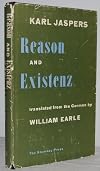
Reason and Existenz; five lectures
by Karl Jaspers
On This Page
Description
The intent of Jaspers' philosophizing then is simply to recall us to our authentic situation. This recall is not itself a doctrine; it is only the stimulus to an inward action each must perform for himself in communication with others. Jaspers' Existenz-philosophy is thus an attempt to consider and enact human honesty; it is philosophy, not as wisdom, but as the love of wisdom.Tags
Recommendations







































Member Reviews
ER-1
Nov 28, 2020Catalan
Ratings
Members
- Recently Added By
Lists

Filosofía - Clásicos
217 works; 1 member
Author Information

193+ Works 4,397 Members
Karl Jaspers was one of the originators of German existentialism. He began his career as a psychiatrist but was increasingly concerned about philosophical and moral issues. His was "a lucid and flexible intelligence in the service of a genuine and passionate concern for mankind." Removed from his professorship at the University of Heidelberg by show more the Nazis in 1937, he was reinstated in 1945 on the approval of the American occupation forces. In 1949 he went to the University of Basel. The New York Times wrote of him in his lifetime: "Jaspers shows himself . . . to be one of the most diligent and sensitive students of contemporary history. He has a good eye for the present because he knows what to fear in it---particularly the loss of individual freedom." Jaspers was deeply concerned about the human condition, and in his book The Future of Mankind (1957), entitled in its updated edition The Atom Bomb and the Future of Man (1961), he attempted to arouse conscience in the face of the deadly danger of atomic warfare "at the same time . . . attempt[ing] to apply the principles of his philosophy to a new field, and to lay the foundations of a political philosophy" (Times Literary Supplement). After the German publication of this book, Jaspers was awarded the German Peace Prize at the 1958 Frankfurt Book Fair. Hannah Arendt, who had been his student and a translator of some of his works, made the presentation. Jaspers's multivolume work, The Great Philosophers---edited by Hannah Arendt, translated by Ralph Manheim, and published in English from 1962 to 1966---was hailed by the Library Journal as "a major work, a brilliant book . . . Jaspers defends the unity of philosophy and his aim is to make philosophy available to all, to provide the serous reader with a guide "to the thinking of the great philosophers and to a personal encounter with them." The obituary of Jaspers in the New York Times said in assessing him: "With Soren Kierkegaard, Martin Heidegger, and Jean-Paul Sartre, Karl Jaspers was one of the makers and shapers of existentialist philosophy. For almost 50 years, in books, essays and lectures, he strove to give a personalist answer to modern man's questions about his own nature and the nature of existence." (Bowker Author Biography) show less
Some Editions
Common Knowledge
- Original publication date
- 1935
Classifications
Statistics
- Members
- 197
- Popularity
- 166,265
- Reviews
- 2
- Rating
- (3.78)
- Languages
- 5 — English, French, German, Italian, Polish
- Media
- Paper
- ISBNs
- 8
- ASINs
- 9