On This Page
Description
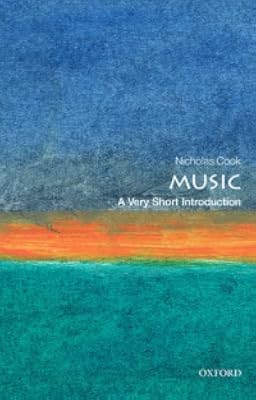
Nicholas Cook explores the nature of music, how we think about it, its social and cultural dimensions, and its history. He discusses the many musical traditions across the world and the interactions between them. He also considers performance, how composers create music, and the position of music in today's globalized society.Tags
Recommendations





Member Recommendations
a20008137 puede servir especie de complemento musicológico a este libro, para la gente que recién se inicia en el estudio de la música, e incluso para quienes están ya metidos en ello.
Member Reviews
The author sets out his aims very early in the piece: He "wants to spread out a map that all music could, in principle be put onto".....To talk about music in general is to talk, not about staves and quavers but about what music means.....I love the quote, attributed to Elvis Costello, that "Writing about music is like dancing about architecture". (So why am I reading this book?)
He talks about the role of authors and interpreters of music and points out that classical music has promoted its performers as stars, just as in pop music. And he suggests that the main message of the book is "that we have inherited from the past a way of thinking about music that cannot do justice to the diversity of practices and experiences which that small show more word 'music' signifies in today's world".
Since Beethoven's time it has become the normal expectation that great music should continue to be performed, long after the death of the composer. (That wasn't always so). There is an intuition that music is a kind of a window into an esoteric spiritual world ...dating back to Pythagoras. Today, entering a concert hall is like entering a cathedral. Within the inner sanctum a strict code of audience etiquette prevails. And the confident distinction between high and low art (in music) still persists in the standard format of musical history or appreciation Textbooks.....totally eurocentric ...ignoring the contribution of other cultures..Asian, African. Though since the 1980's a sea change has taken hold in the academic disciplines of Musicology.
He suggests that all descriptions of music involve metaphor and when we study music, we aren't just studying something separate from us, something 'out there': there is a sense in which we are studying ourselves too.
The history of music has been very much about the constructionist view of art ...that the important part is the composing and performing but Cook draws attention to the "reception-based' approaches to music. He suggests that the two approaches have to work in harmony. But the reception based approach is inclusive rather than exclusive; that we can best understand music by being in the middle of it.
Beethoven wanted to produce a complete and authoritative edition of his music but this never eventuated. A consequence for his music, and virtually all the composers, is that their work was copied and reproduced with errors or corrected and redrafted so that what we have today is more or less a bit of a guess at what the composer intended.
A historical performance movement emerged where the objective was to perform music the way it was originally performed for/by the composers (eg with harpsichord rather than piano) but in most conservatories these days you can hear historical and unhistorical performances of Bach....it's just become a fact of life.
There's an interesting mention of ethnomusicologists working in Ethiopia with the Beta Israel community who consider their origins to be Jewish but the ethnomusicologist's study of their liturgy placed them as of Christian origins. It became a political question rather than a musical issue whether to reveal this.And with modern critical theory analysis of musicology one really big issue has been gender and music. Women were allowed to play music (in some societies) but certainly not encouraged to compose it or play professionally. And there are arguments that strong, assertive music is masculine and soft more flexible music is feminine......and gay composers write gay music etc. As Cook says, "You can read the same stereotypes into nineteenth century composers Beethoven and Schubert". And interpretations of music open up its ability to function as an arena for the negotiation of gender politics, and indeed, of other personal and interpersonal values.
I thought when I first read this book that it was easily understood. Yes, Cook writes clearly in a way that is easy to understand but on re-reading, I've realised that it's very difficult to capture the essence of what he's written. There are just so many different threads running there. He ends up (as he'd begun) with a kind of warning about the seductive power of music (though advertising) to seduce us. Hence advocates maintaining vigilance and an eternal critical attitude towards music and its ideologies.
Four stars from me. show less
He talks about the role of authors and interpreters of music and points out that classical music has promoted its performers as stars, just as in pop music. And he suggests that the main message of the book is "that we have inherited from the past a way of thinking about music that cannot do justice to the diversity of practices and experiences which that small show more word 'music' signifies in today's world".
Since Beethoven's time it has become the normal expectation that great music should continue to be performed, long after the death of the composer. (That wasn't always so). There is an intuition that music is a kind of a window into an esoteric spiritual world ...dating back to Pythagoras. Today, entering a concert hall is like entering a cathedral. Within the inner sanctum a strict code of audience etiquette prevails. And the confident distinction between high and low art (in music) still persists in the standard format of musical history or appreciation Textbooks.....totally eurocentric ...ignoring the contribution of other cultures..Asian, African. Though since the 1980's a sea change has taken hold in the academic disciplines of Musicology.
He suggests that all descriptions of music involve metaphor and when we study music, we aren't just studying something separate from us, something 'out there': there is a sense in which we are studying ourselves too.
The history of music has been very much about the constructionist view of art ...that the important part is the composing and performing but Cook draws attention to the "reception-based' approaches to music. He suggests that the two approaches have to work in harmony. But the reception based approach is inclusive rather than exclusive; that we can best understand music by being in the middle of it.
Beethoven wanted to produce a complete and authoritative edition of his music but this never eventuated. A consequence for his music, and virtually all the composers, is that their work was copied and reproduced with errors or corrected and redrafted so that what we have today is more or less a bit of a guess at what the composer intended.
A historical performance movement emerged where the objective was to perform music the way it was originally performed for/by the composers (eg with harpsichord rather than piano) but in most conservatories these days you can hear historical and unhistorical performances of Bach....it's just become a fact of life.
There's an interesting mention of ethnomusicologists working in Ethiopia with the Beta Israel community who consider their origins to be Jewish but the ethnomusicologist's study of their liturgy placed them as of Christian origins. It became a political question rather than a musical issue whether to reveal this.And with modern critical theory analysis of musicology one really big issue has been gender and music. Women were allowed to play music (in some societies) but certainly not encouraged to compose it or play professionally. And there are arguments that strong, assertive music is masculine and soft more flexible music is feminine......and gay composers write gay music etc. As Cook says, "You can read the same stereotypes into nineteenth century composers Beethoven and Schubert". And interpretations of music open up its ability to function as an arena for the negotiation of gender politics, and indeed, of other personal and interpersonal values.
I thought when I first read this book that it was easily understood. Yes, Cook writes clearly in a way that is easy to understand but on re-reading, I've realised that it's very difficult to capture the essence of what he's written. There are just so many different threads running there. He ends up (as he'd begun) with a kind of warning about the seductive power of music (though advertising) to seduce us. Hence advocates maintaining vigilance and an eternal critical attitude towards music and its ideologies.
Four stars from me. show less
This "Very Short Introduction" to music invites us to think about music and the values and qualities we ascribe to it, but in a rather "popped-up" manner. The world teems, it states, with different kinds of music - traditional, folk, classical, jazz, rock, pop - and each type of music tends to come with its own way of thinking. Drawing on a wealth of overly accessible examples ranging from Beethoven to the Spice Girls to Chinese zither music, Nicholas Cook attempts to provide a framework for thinking about all music. By examining the personal, social, and cultural values that music embodies, the book controversially asserts the shortcomings of traditional conceptions of music, and sketches a more inclusive (for this, substitute "dumbed show more down") approach emphasising the role of performers and listeners. show less
The recurring themes of this book are that the performer and listener are just as important as the composer and that what music does is more important that what music is. These approaches are more easily generalisable beyond the Western musical canon (an idea that is very bound up with the 19th century) into music from other cultures and into different traditions and types of music within Western culture.
Brevity demands focus or superficiality. Here, Nicholas Cook's essay is largely about a philosophy of music. Eschewing any more than passing consideration of the international history of music, he acknowledges the diversity of music but starts his intellectual journey with Beethoven and his more detailed examples are drawn more from 'Classical' music than Rock or Pop. Despite this, the main thrust of his argument is about our response to music and its creation; there is nothing here about musical structures or forms. As this idea of involvement and perception develops, the book becomes increasingly academic. This is a short sharp introduction for the intelligent articulate non-musicologist who might consider studying further. I imagine show more that someone seeking such a grounding would prefer this to be the opening of a larger book while those to whom brevity is critical would prefer a broader more superficial approach. show less
If you are expecting a book about different types of music, how to read music, or the lives of composers, this book is not for you; it is largely concerned with the philosophy of music. Nonetheless it is a very interesting read, particularly in the discussion of the role of a classical musician vs. that of a manufactured pop singer.
I quite enjoyed this little book – and in general find the idea of the Very Short Introduction series a good one. I’m trying to learn about music, a topic which I know almost nothing about, and this was probably a good place to start. It doesn’t review any formal topics, more esoteric ones – the concept of the composer/artist as primary source, authenticity and relative importance of one genre vs. another. I don’t feel well versed enough to analyze things any further at this point, but I plan to reread once I’ve got some more knowledge. But here are some quotes I found interesting:
“Words do work because they do not simply reflect how things are. We do work with words by using them to change things, to make things the way show more they are. Or to put it more abstractly, language constructs reality rather than merely reflecting it. And this means that the languages we use of music, the stories that we tell about it, help to determine what music is – what we mean by it, and what it means to us. The values wrapped up in the idea of authenticity, for example, are not simply there in the music; they are there because the way we think about music puts them there, and of course the way we think about music also affects the way we make music, and so the process becomes circular. It is this kind of continuity in thinking about things that creates what we call ‘traditions’, whether in music or anything else.”
“High art or ‘art’ music, meant the notation-based traditions of the leisured classes, … Low art meant everything else, that is to say the limitless variety of popular and mainly non-notated – and hence historically irretrievable – musical traditions. Some low art, according to this view, might have valuable qualities of its own, in particular the rural folksongs … such folksongs were seen as conveying something of the unspoilt national character of the countryside and its inhabitants. But that did not stop them being seen as low art, because they did not spring from the individual vision of an inspired composer. The voice of the people might be heard through them, but hardly the voice of Music.”
“students are being inducted into the world of Western musicianship, in which music is made up of ‘things’ to hear, constructed out of notes in the same sense that houses are constructed out of bricks. And this has two results. The first is that music is transformed from being primarily something you do (but do not necessarily know how you do) to something you know (but may not necessarily do); … The second is that it becomes increasingly difficult to conceive that music might work in other ways, or to hear it properly if it does; the harder you listen, the more you hear it in terms of the notes and chords and formal types of the Western tradition, and the less you can understand music that works primarily in terms of timbre and texture, say.” show less
“Words do work because they do not simply reflect how things are. We do work with words by using them to change things, to make things the way show more they are. Or to put it more abstractly, language constructs reality rather than merely reflecting it. And this means that the languages we use of music, the stories that we tell about it, help to determine what music is – what we mean by it, and what it means to us. The values wrapped up in the idea of authenticity, for example, are not simply there in the music; they are there because the way we think about music puts them there, and of course the way we think about music also affects the way we make music, and so the process becomes circular. It is this kind of continuity in thinking about things that creates what we call ‘traditions’, whether in music or anything else.”
“High art or ‘art’ music, meant the notation-based traditions of the leisured classes, … Low art meant everything else, that is to say the limitless variety of popular and mainly non-notated – and hence historically irretrievable – musical traditions. Some low art, according to this view, might have valuable qualities of its own, in particular the rural folksongs … such folksongs were seen as conveying something of the unspoilt national character of the countryside and its inhabitants. But that did not stop them being seen as low art, because they did not spring from the individual vision of an inspired composer. The voice of the people might be heard through them, but hardly the voice of Music.”
“students are being inducted into the world of Western musicianship, in which music is made up of ‘things’ to hear, constructed out of notes in the same sense that houses are constructed out of bricks. And this has two results. The first is that music is transformed from being primarily something you do (but do not necessarily know how you do) to something you know (but may not necessarily do); … The second is that it becomes increasingly difficult to conceive that music might work in other ways, or to hear it properly if it does; the harder you listen, the more you hear it in terms of the notes and chords and formal types of the Western tradition, and the less you can understand music that works primarily in terms of timbre and texture, say.” show less
O problema dessa introdução razoavelmente curta ao tópico geral "música" é que o autor está muito preocupado demais com a musicologia, não apenas como o que dá nome aos entendimentos do que é música, mas como disciplina, e com isso não consegue evitar de se deter em controvérsias na área, que de fato demorou a estudar seu assunto como uma prática, uma arte, algo social e histórico. Nesse movimento, é antipático porque quer nos convencer (e talvez isso seja um sinal de euro-eua-centrismo) de que estávamos seguindo teorias erradas e concepções muito restritas do que era música. Nisso, há um euro-EUA-centrismo: pressupõe que levamos a sério todo aquele corpus a ponto de ser essencial ele aparecer numa introdução show more ao assunto; pressupõe que uma introdução deve cuidar do herdeiro do universal - o multicultural; mas leva isso a cabo pincelado primeiro como "estivemos equivocados". Dito isso, não é um livro ruim, mas como disse, antipático - com frases exageradas sendo corrigidas logo após o dito, além de uma interessante discussão inicial sobre como música e obra musical não coincidem e não precisam coincidir. show less
Oct 25, 2023 (Edited)Portuguese
Members
- Recently Added By
Lists

Eton's list - the books every bright 16 year-old should read
40 works; 6 members
Author Information

21+ Works 815 Members
Some Editions
Series

Common Knowledge
- Canonical title
- Music: A Very Short Introduction
- First words
- 'I want to be . . . a musician.'
- Last words
- (Click to show. Warning: May contain spoilers.)And in order to do that, we need to be able not just to hear music but to read it too: not in literal, notational terms, to be sure, but for its significance as an intrinsic part of culture, of society, of you and me.
Classifications
- Genres
- Music, Nonfiction, General Nonfiction, History
- DDC/MDS
- 780 — Arts & recreation Music Music
- LCC
- MT6 .C775 .M89 — Music Instruction and study Instruction and study Music theory
- BISAC
Statistics
- Members
- 458
- Popularity
- 66,494
- Reviews
- 7
- Rating
- (3.66)
- Languages
- 6 — English, French, Italian, Polish, Slovenian, Spanish
- Media
- Paper, Audiobook, Ebook
- ISBNs
- 17
- UPCs
- 1
- ASINs
- 7