
On This Page
Description
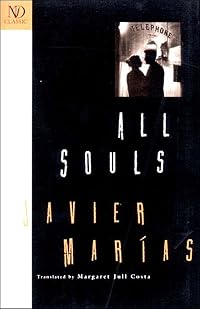
Part spy novel, part romance, part Henry James,Your Face Tomorrow is a wholly remarkable display of the immense gifts of Javier Marias. WithFever and Spear, Volume One of his unfolding novelYour Face Tomorrow, he returns us to the rarified world of Oxford (the delightful setting ofAll Souls andDark Back of Time), while introducing us to territory entirely new--espionage. Our hero, Jaime Deza, separated from his wife in Madrid, is a bit adrift in London until his old friend Sir Peter show more Wheeler--retired Oxford don and semi-retired master spy--recruits him for a new career in British Intelligence. Deza possesses a rare gift for seeing behind the masks people wear. He is soon observing interviews conducted by Her Majesty's secret service: variously shady international businessmen one day, would-be coup leaders the next. Seductively, this metaphysical thriller explores past, present, and future in the ever-more-perilous 21st century. This compelling and enigmatic tour de force from one of Europe's greatest writers continues with Volume Two,Dance and Dream. show lessTags
Recommendations





















Member Reviews
What a crazy book - like James Bond written by Proust!
There's almost no action - the first half of the book consists of man with binoculars watching a neighbour dancing by himself, an Oxford buffet dinner, and a bloodstain. The rest is meandering musings. By the end of the book there hadn't been much more action, but a lot more musings. I learned useful stuff about the Spanish civil war, which was good, but not what I came here for. And in total breach of Chekhov's law, the bloodstain is never resolved.
The first part of a trilogy. I'm a very doubtful starter for the next two volumes.
There's almost no action - the first half of the book consists of man with binoculars watching a neighbour dancing by himself, an Oxford buffet dinner, and a bloodstain. The rest is meandering musings. By the end of the book there hadn't been much more action, but a lot more musings. I learned useful stuff about the Spanish civil war, which was good, but not what I came here for. And in total breach of Chekhov's law, the bloodstain is never resolved.
The first part of a trilogy. I'm a very doubtful starter for the next two volumes.
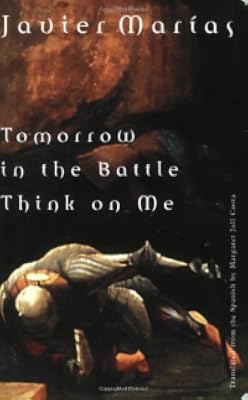
I knew from reading A heart so white and Tomorrow in the battle... that Marías is a writer who says interesting things in an original and sometimes very elegant way, but it's tough to slog through a full-length novel that never steps outside the narrator's circling, recursive thought processes. Fever and spear makes things a bit easier for us by introducing a second major character — a barely disguised portrait of the late spy and Oxford hispanist Professor Sir Peter Russell, who seems to have been amused and flattered to find himself immortalised in this way — and staging a significant part of the book as a discursive, digressive dialogue between him and the narrator.
It's a nice joke to bring in espionage, normally the subject of show more fast-paced action thrillers, and slow it down to a speed which even John Le Carré (who appears in the margins of the story, together with Ian Fleming) would consider absurdly slow. But it's not done purely as a joke: Marías is using the conventions of espionage fiction — secrecy, deception, betrayal — to illustrate further his usual themes of how much or how little we can really know about other people, or even about ourselves, and how we use imagination and story-telling to explore what we do know.
It's an even nicer joke, of course, to end with that corniest of all narrative tricks, the cliffhanger. show less
It's a nice joke to bring in espionage, normally the subject of show more fast-paced action thrillers, and slow it down to a speed which even John Le Carré (who appears in the margins of the story, together with Ian Fleming) would consider absurdly slow. But it's not done purely as a joke: Marías is using the conventions of espionage fiction — secrecy, deception, betrayal — to illustrate further his usual themes of how much or how little we can really know about other people, or even about ourselves, and how we use imagination and story-telling to explore what we do know.
It's an even nicer joke, of course, to end with that corniest of all narrative tricks, the cliffhanger. show less
After "Hear so White" -my first Marias-, I was so smitten that I was disappointed by almost anything I would read, even other of Marias' books.
The book is written in Marias' usual style, using and re-using the same sentences in different contexts until, by accumulation, their meaning becomes incredibly dense and the words acquire a gravity that does not allow your mind to wander off. You might stop reading to think, but it will be about the ideas of the book, its characters or the action in it, your mind will really leave this book until a good time after you have stopped reading it.
SPOILERS
The main character of this book can foretell how people will act in the future. He does so by reading their actions and their speech even without show more interacting with them. This skill sets forth the case for the validity of first impressions. It delves into how our first impressions, when lacking of any interest on our part, are usually right and how we receive a lot of information that we will just not process because we are unwilling to do so. The protagonist's willingness to accept this information, to correctly judge people without knowing too much, brings him into contact with an agency of what seem to be spies where he analyses people taking his intuitions to the extreme.
SPOILERS' END
Being this the first volume of a trilogy, the book ends just before the „real“ events start taking place, which can be somewhat disappointing but the collection of interesting characters, spies and brilliant thoughts make up for it and keep you going for days while wondering how the story will go on. show less
The book is written in Marias' usual style, using and re-using the same sentences in different contexts until, by accumulation, their meaning becomes incredibly dense and the words acquire a gravity that does not allow your mind to wander off. You might stop reading to think, but it will be about the ideas of the book, its characters or the action in it, your mind will really leave this book until a good time after you have stopped reading it.
SPOILERS
The main character of this book can foretell how people will act in the future. He does so by reading their actions and their speech even without show more interacting with them. This skill sets forth the case for the validity of first impressions. It delves into how our first impressions, when lacking of any interest on our part, are usually right and how we receive a lot of information that we will just not process because we are unwilling to do so. The protagonist's willingness to accept this information, to correctly judge people without knowing too much, brings him into contact with an agency of what seem to be spies where he analyses people taking his intuitions to the extreme.
SPOILERS' END
Being this the first volume of a trilogy, the book ends just before the „real“ events start taking place, which can be somewhat disappointing but the collection of interesting characters, spies and brilliant thoughts make up for it and keep you going for days while wondering how the story will go on. show less
I read a review of this years ago, and vaguely thought about reading it, then opted not to. When I read a review of the third volume I finally caved in and decided to buy it. I only got round to reading it when Philip Roth had made me so disgusted with writers of English that I felt the need to clean out my brain.
I originally thought I wouldn't read it because people said it was like Sebald. Well yes, inasmuch as Marias is concerned with style and ideas. The difference is that Marias' ideas and style are good, rather than fatuous. Who would have thought that would make all the difference? A beguiling narrator, devastating criticisms of contemporary thought and culture (post-war Europeans becoming simultaneously terrified of and show more obsessed with certainty; simultaneously suspicious of and enamored of language), and a fabulous cliff-hanger 'ending'... it's great.
But there are also real barriers to enjoying this book. Proust, for instance, starts with story and then, after a while, gets into philosophy; this starts with the philosophy and then gets into story. There's no time-line at all; nearly 400 pages of text includes only three real scenes- a party, a conversation and a walk home. But the narrator's memories and thoughts are truly gripping.
It's entirely possible that the rest of the novel (in three parts) will betray me, and this will turn out to be some kind of sub-Pynchonian, sub-Borgesian eye-roll inducing garbage. But right now he seems to be treading the thin line of genius quite well.
And I particularly want to praise the translator. One of the reasons I avoid non-English language novels is that so few translators manage to make their source-authors sound like human beings rather than journalists. There are a few exceptions- John Woods' Mann, for instance- but generally... it's just pain. Margaret Jull Costa has done an incredible, amazing job here. It's up there with the Moncrief/Kilmartin/Enright Proust; and there are French people who think Moncrief improved on the original. All hail Costa! Thankyou! show less
I originally thought I wouldn't read it because people said it was like Sebald. Well yes, inasmuch as Marias is concerned with style and ideas. The difference is that Marias' ideas and style are good, rather than fatuous. Who would have thought that would make all the difference? A beguiling narrator, devastating criticisms of contemporary thought and culture (post-war Europeans becoming simultaneously terrified of and show more obsessed with certainty; simultaneously suspicious of and enamored of language), and a fabulous cliff-hanger 'ending'... it's great.
But there are also real barriers to enjoying this book. Proust, for instance, starts with story and then, after a while, gets into philosophy; this starts with the philosophy and then gets into story. There's no time-line at all; nearly 400 pages of text includes only three real scenes- a party, a conversation and a walk home. But the narrator's memories and thoughts are truly gripping.
It's entirely possible that the rest of the novel (in three parts) will betray me, and this will turn out to be some kind of sub-Pynchonian, sub-Borgesian eye-roll inducing garbage. But right now he seems to be treading the thin line of genius quite well.
And I particularly want to praise the translator. One of the reasons I avoid non-English language novels is that so few translators manage to make their source-authors sound like human beings rather than journalists. There are a few exceptions- John Woods' Mann, for instance- but generally... it's just pain. Margaret Jull Costa has done an incredible, amazing job here. It's up there with the Moncrief/Kilmartin/Enright Proust; and there are French people who think Moncrief improved on the original. All hail Costa! Thankyou! show less
After "Heart so White" -my first Marias-, I was so smitten that I was disappointed by almost anything I would read, even other of Marias' books.
The book is written in Marias' usual style, using and re-using the same sentences in different contexts until, by accumulation, their meaning becomes incredibly dense and the words acquire a gravity that does not allow your mind to wander off. You might stop reading to think, but it will be about the ideas of the book, its characters or the action in it, your mind will really leave this book until a good time after you have stopped reading it.
SPOILERS
The main character of this book can foretell how people will act in the future. He does so by reading their actions and their speech even without show more interacting with them. This skill sets forth the case for the validity of first impressions. It delves into how our first impressions, when lacking of any interest on our part, are usually right and how we receive a lot of information that we will just not process because we are unwilling to do so. The protagonist's willingness to accept this information, to correctly judge people without knowing too much, brings him into contact with an agency of what seem to be spies where he analyses people taking his intuitions to the extreme.
SPOILERS' END
Being this the first volume of a trilogy, the book ends just before the „real“ events start taking place, which can be somewhat disappointing but the collection of interesting characters, spies and brilliant thoughts make up for it and keep you going for days while wondering how the story will go on. show less
The book is written in Marias' usual style, using and re-using the same sentences in different contexts until, by accumulation, their meaning becomes incredibly dense and the words acquire a gravity that does not allow your mind to wander off. You might stop reading to think, but it will be about the ideas of the book, its characters or the action in it, your mind will really leave this book until a good time after you have stopped reading it.
SPOILERS
The main character of this book can foretell how people will act in the future. He does so by reading their actions and their speech even without show more interacting with them. This skill sets forth the case for the validity of first impressions. It delves into how our first impressions, when lacking of any interest on our part, are usually right and how we receive a lot of information that we will just not process because we are unwilling to do so. The protagonist's willingness to accept this information, to correctly judge people without knowing too much, brings him into contact with an agency of what seem to be spies where he analyses people taking his intuitions to the extreme.
SPOILERS' END
Being this the first volume of a trilogy, the book ends just before the „real“ events start taking place, which can be somewhat disappointing but the collection of interesting characters, spies and brilliant thoughts make up for it and keep you going for days while wondering how the story will go on. show less
Myriad readers of the Essays by Montaigne have remarked, how'd he know? This implies some spooky insight into our interior motivations that the Mayor of Bordeaux anticipated 400 years ago. It translates into vanity. That said, I felt often over the last few days that Javier Marias was privy to many of my own streams of though. This is an astonishing treatise on language, memory and history.
I bought this several years ago for a world fiction reading challenge I’d set myself (see here), but only managed to get halfway through it before giving up. It had come highly recommended, so perhaps my expectations were too high… But even on this second read I found it all a bit of a chore. The prose is discursive to an extent that made my eyes glaze, and I like discursive prose. The narrator is a Spaniard working in the UK, who, thanks to contacts at Oxford University, secures a position as a “translator” with an enigmatic member of the British establishment whose role may or may not be officially sanctioned. He’s not really a translator, because the narrator is excellent at reading faces, and it is his interpolation of the show more mind-set of interviewees in which his employer is chiefly interested. There’s a good brainstorming sequence involving the Spanish Civil War, Orwell, Fleming, and the narrator’s own family history, but much as I wanted to like this novel I didn’t take to it enough to want to read the remaining two books of the trilogy. A shame. show less
Members
- Recently Added By
Lists

1001 Books You Must Read Before You Die
1,448 works; 1,134 members

Recommend the 20 best books you've read in the last five years
2,168 works; 601 members

Los 100 mejores libros en español de los últimos 25 años
26 works; 1 member

España en cien libros
100 works; 1 member

.
184 works; 1 member
Author Information

156+ Works 13,301 Members
Javier Marias, a literary phenomenon worldwide, is still in the process of being discovered in America. Among his awards are the Premio Ciudad de Barcelona, The Spanish Critics' Award, the Prix L'Oeil et la Lettre, the Premio Mondello, the Premio Internacional de Novela Romulo Gallegos, the Prix Femina Etranger, the Nelly-Sachs Prize, and the show more Dublin International IMPAC Award. He is also King Xavier I of Redonda. show less
Some Editions
Awards and Honors
Series

Belongs to Publisher Series
Debolsillo Contemporánea (606/9)
Work Relationships
Is contained in
Common Knowledge
- Canonical title
- Your Face Tomorrow, Volume 1: Fever and Spear
- Original title
- Tu Rostro Mañana: Fiebre y Lanza; Tu rostro mañana, 1: Fiebre y lanza
- Original publication date
- 2002
- People/Characters
- Jacques Deza; Luisa Deza; Sir Peter Wheeler; Bertram Tupra; Pérez Nuix; Toby Rylands (show all 8); Rafita de la Garza; Comendador
- Important places
- Oxford, Oxfordshire, England, UK; London, England, UK; Spain; England, UK
- Original language
- Spanish
- Disambiguation notice
- This is only volume 1 of Your Face Tomorrow.
Classifications
Statistics
- Members
- 1,125
- Popularity
- 22,456
- Reviews
- 30
- Rating
- (3.88)
- Languages
- 9 — Dutch, English, French, German, Italian, Polish, Portuguese, Spanish, Turkish
- Media
- Paper, Audiobook, Ebook
- ISBNs
- 35
- ASINs
- 12