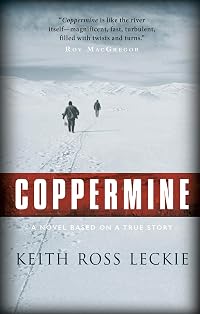
Coppermine
by Keith Ross Leckie
On This Page
Description
Part epic adventure, part romance, and part true-crime thriller, Coppermine is a dramatic, compelling, character-driven story set in 1917 in the extremes of Canada's far north and the boom town of Edmonton. The story begins when two missionaries disappear in the remote Arctic region known as the Coppermine. North West Mounted Police officer Jack Creed and Angituk, a young Copper Inuit interpreter, are sent on a year-long odyssey to investigate the fate of the lost priests. On the shores of show more the Arctic Ocean near the mouth of the Coppermine River, they discover their dismembered remains. Two Inuit hunters are tracked and apprehended, and the four begin an arduous journey to Edmonton, to bring the accused to justice. Instructing the jury to "think like an Eskimo," the defence counsel sets out to prove the Inuit acted in self-defence. They hear how the hunters believed the priests were possessed by demons about to kill them, and how, acting on this belief, they killed the men and ate their livers. The jury finds them not guilty. The hunters become celebrities, a parade is held for them, they visit a movie theatre and an amusement park, and become guests of honour at socialite dinners. They are given new suits, fine cigars, and champagne. But Rome is outraged that the murderers of its martyred priests will go free. As secrets of Jack Creed's past in the trenches of Europe are revealed, Jack tries to save his two friends, and himself. show lessTags
Recommendations












Member Recommendations
LynnB Story about the clash between Inuit and new Canadian cultures.
Member Reviews
Based on a true story, this book tells of the first jury trial of Inuit in Canada. In 1913, two Roman Catholic priests are murdered in the high Arctic. Royal Northwest Mounted Police officer Jack Creed travels there to investigate, with an interpretor (Angituk McAndrew). The self-confessed murderers, Sinnisiak and Uluksuk are brought south to Edmonton to stand trial.
The author tells the story in a very complex and compelling way, showing the development of an understanding and friendship between Jack Creed and his prisoners on their months-long trek to Edmonton. We also get a glimpse of "frontier justice" and a perseptive examiniation of the clash of Inuit and European cultures.
We also have an adventure story of survival, danger and show more love. A great read! show less
The author tells the story in a very complex and compelling way, showing the development of an understanding and friendship between Jack Creed and his prisoners on their months-long trek to Edmonton. We also get a glimpse of "frontier justice" and a perseptive examiniation of the clash of Inuit and European cultures.
We also have an adventure story of survival, danger and show more love. A great read! show less
What an absolutely intriguing read Coppermine was! It's a period piece, set in 1917 Canada. Jack Creed of the Royal North West Mounted Police (RNWMP) has just returned from patrol in the far north to boom town Edmonton. Having barely arrived, he volunteers for what will be at the least, a year long assignment even farther north, up to the area known as Coppermine. Two priests hoping to convert the Eskimos haven't been heard from in two years. Creed is to find them or find out what happened to them. If it's foul play, he is to bring the perpetrators back to Edmonton to face charges.
"It's never been charted. No police posts. No credible maps at all beyond the mouth of the Dease River, except for a few sketches from Franklin. He's the show more last white man we know of to get up there."
Accompanied by Angituk, a young Inuit interpreter, he strikes out. Discovering the bodies of the priests, he apprehends two Copper Inuit and strikes out back to Edmonton. It is over a year later when he and his prisoners finally arrive.
Keith Ross Leckie has lots of experience in writing historical screenplays and it shows in Coppermine. He's done a phenomenal job of bringing this time period and setting to life. I found myself looking up early references to the Coppermine River and it's bloody history and discovering they were all fact based. I then discovered that the entire book is based on actual events in Canadian history.
They mystery of the death of the priests is slowly revealed once the foursome returns to Edmonton and the two Inuit are put on trial. I was keen to know the reasons for the priest's death and the outcome of the trial, but it was the interaction between all the different players that really drew me in. Jack and his relationship to the north - the passages describing the peace he feels travelling in the wilderness are affecting. Angituk is of mixed race - half white, half Inuit. I found the burgeoning relationship between the two especially well drawn.
But it is the two Inuit - Uluksuk and Sinnisiak who completely captured me. Their beliefs and approach to life was engrossing. Again - lots of facts woven in. Leckie has vividly depicted the union between man and nature. Seeing Edmonton and 'civilization' from Uluksuk and Sinnisiak's view and Edmonton society's perception of them was no less eye opening.
I found the following discourse by one of the Mounties worth quoting here. It's long, but says a lot.
"You see, the Eskimo is a nomadic hunting society while ours is a stationary accumulative society. They are polar opposites, no pun intended. In our society is it the accumulation of material goods and land and currency which is the measure of a man's success. And then this system then requires government and taxes and banks, the creation of class structures, competition, suppression of the poor and of women. But in Eskimo society, success comes from a productive hunt and to do that they require mobility, adaptability, skill and planning, and an intuitive understanding of land and sea conditions, animal behaviour and weather patterns. And it has always been the case that settled culture seeks to change nomadic hunting cultures, to make them stop and stay in one place and embrace their brand of civilization, but it is the very egalitarian nature of the nomadic society that defends against that. They have no real leaders as such. No organizations! Each Eskimo makes his own decisions. The best hunter leads by example. Others watch. No questions are asked. No one tells anyone else what to do. If anyone tried to give orders, it would be considered rude and improper. And you see, this individualism is an effective barricade against organized domination by one man, one class, or by an outside civilization like....ourselves."
Leckie has successfully combined history, mystery, adventure and yes, romance along with some thought provoking ideas to produce a memorable read. Very much recommended. show less
"It's never been charted. No police posts. No credible maps at all beyond the mouth of the Dease River, except for a few sketches from Franklin. He's the show more last white man we know of to get up there."
Accompanied by Angituk, a young Inuit interpreter, he strikes out. Discovering the bodies of the priests, he apprehends two Copper Inuit and strikes out back to Edmonton. It is over a year later when he and his prisoners finally arrive.
Keith Ross Leckie has lots of experience in writing historical screenplays and it shows in Coppermine. He's done a phenomenal job of bringing this time period and setting to life. I found myself looking up early references to the Coppermine River and it's bloody history and discovering they were all fact based. I then discovered that the entire book is based on actual events in Canadian history.
They mystery of the death of the priests is slowly revealed once the foursome returns to Edmonton and the two Inuit are put on trial. I was keen to know the reasons for the priest's death and the outcome of the trial, but it was the interaction between all the different players that really drew me in. Jack and his relationship to the north - the passages describing the peace he feels travelling in the wilderness are affecting. Angituk is of mixed race - half white, half Inuit. I found the burgeoning relationship between the two especially well drawn.
But it is the two Inuit - Uluksuk and Sinnisiak who completely captured me. Their beliefs and approach to life was engrossing. Again - lots of facts woven in. Leckie has vividly depicted the union between man and nature. Seeing Edmonton and 'civilization' from Uluksuk and Sinnisiak's view and Edmonton society's perception of them was no less eye opening.
I found the following discourse by one of the Mounties worth quoting here. It's long, but says a lot.
"You see, the Eskimo is a nomadic hunting society while ours is a stationary accumulative society. They are polar opposites, no pun intended. In our society is it the accumulation of material goods and land and currency which is the measure of a man's success. And then this system then requires government and taxes and banks, the creation of class structures, competition, suppression of the poor and of women. But in Eskimo society, success comes from a productive hunt and to do that they require mobility, adaptability, skill and planning, and an intuitive understanding of land and sea conditions, animal behaviour and weather patterns. And it has always been the case that settled culture seeks to change nomadic hunting cultures, to make them stop and stay in one place and embrace their brand of civilization, but it is the very egalitarian nature of the nomadic society that defends against that. They have no real leaders as such. No organizations! Each Eskimo makes his own decisions. The best hunter leads by example. Others watch. No questions are asked. No one tells anyone else what to do. If anyone tried to give orders, it would be considered rude and improper. And you see, this individualism is an effective barricade against organized domination by one man, one class, or by an outside civilization like....ourselves."
Leckie has successfully combined history, mystery, adventure and yes, romance along with some thought provoking ideas to produce a memorable read. Very much recommended. show less
I throughly enjoyed the author's portrayal of this story based on a true story.
The period piece based in the early 1900's describes a corporal's journey to the arctic circle to investigate a murder and bring back the accused to face justice in an Edmonton court room. The story shares the lives and culture of the Inuit while detailing how the officer begins to appreciate their ways of life. This is a very well told story that combines historical fact with mystery, adventure and even a love story. I would certainly recommend this book.
The period piece based in the early 1900's describes a corporal's journey to the arctic circle to investigate a murder and bring back the accused to face justice in an Edmonton court room. The story shares the lives and culture of the Inuit while detailing how the officer begins to appreciate their ways of life. This is a very well told story that combines historical fact with mystery, adventure and even a love story. I would certainly recommend this book.
Missionairies
Ratings
Members
- Recently Added By
Author Information
7 Works 97 Members
Common Knowledge
- People/Characters
- Jack Creed; Angituk McAndrew; Nicole Harvey; Sinnisiak; Uluksuk
- Important places
- Canadian Arctic; Coppermine, NWT, Canada
- Important events
- First jury trial of an Inuit in Canada
- Epigraph
- To love another person is to know the fact of God -- Victor Hugo
- Dedication
- To Mary, for her love and support, and for giving me all my best ideas. Thank you, baby.
- First words
- The young priest stood on the rough planks of the Hudson's Bay Company dock at Fort Norman feeling the thousand-mile thrum of the Mackenzie River against the haphazard structure of spruce logs, nails, and ropes under his boot... (show all)s.
- Last words
- (Click to show. Warning: May contain spoilers.)The Roman Catholics hired their own ship and built a church a year later to engage in a robust competition with the Anglicans, but the town of Coppermine, now known as Kugluktuk, remains predominately Anglican, the Christian religion folded well into the ancient, non-exclusive, and adaptable beliefs of the Copper Inuit who sill live in tune with their own mataphors and love of the land.
- Blurbers
- MacGregor, Roy; Fraser, Marian Botsford; Boyden, Joseph
Classifications
Statistics
- Members
- 51
- Popularity
- 591,981
- Reviews
- 4
- Rating
- (3.88)
- Languages
- English
- Media
- Paper, Ebook
- ISBNs
- 3