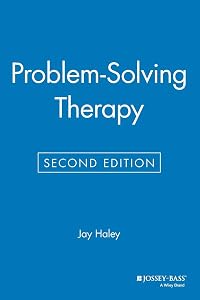
Problem-Solving Therapy, Second Edition
by Jay Haley
On This Page
Description
A classic that teaches you how to think in a contextually sensitive, directive, and goal-focused way. A highly readable and practical volume that focuses on solving problems within the context of the entire social unit--the family, the school, the community.Tags
Recommendations


















Member Reviews
The strategic therapy that flourished in the 1980s was centered in three unique and creative groups: MRI's brief therapy center (Weakland, Watzlawick, and Fisch); Mara Selvini Palozzoli and her colleagues in Milan; and, of course, Jay Haley and his colleagues at the Family Therapy Institute of Washington, D.C. The master, Milton Erickson, was a school unto himself. What made strategic therapy so popular was that it offered a simple framework for understanding how families get stuck and a clever set of techniques to help them get unstuck.
According to the cybernetic metaphor, families become trapped in dysfunctional patterns when they cling to solutions that don't work. The trick is to get them to try something different. If the essence show more of neurotic behavior is stubbornly continuing to behave in self-defeating ways, the essence of strategic therapy is getting people to try something different. To accomplish this, strategic therapists introduced a number of techniques, many of them paradoxical, designed to break up homeostatic ("problem-maintaining") solutions and get families moving and on their way. show less
According to the cybernetic metaphor, families become trapped in dysfunctional patterns when they cling to solutions that don't work. The trick is to get them to try something different. If the essence show more of neurotic behavior is stubbornly continuing to behave in self-defeating ways, the essence of strategic therapy is getting people to try something different. To accomplish this, strategic therapists introduced a number of techniques, many of them paradoxical, designed to break up homeostatic ("problem-maintaining") solutions and get families moving and on their way. show less
Haley promotes a view of the individual , the family context, and the therapeutic perspective, a triad
150 HAL 1
Ratings
Members
- Recently Added By
Author Information
30+ Works 911 Members
Classifications
- Genres
- Nonfiction, General Nonfiction
- DDC/MDS
- 616.8 — Applied science & technology Medicine & health Diseases, Allergies, Skin Conditions Nervous Disorders: Autism, Anorexia, OCD
- LCC
- RC488.5 .H32 — Medicine Internal medicine Internal medicine Neurosciences. Biological psychiatry. Neuropsychiatry Psychiatry Therapeutics. Psychotherapy
- BISAC
Statistics
- Members
- 187
- Popularity
- 176,100
- Reviews
- 3
- Rating
- (4.50)
- Languages
- English, Spanish
- Media
- Paper
- ISBNs
- 7
- ASINs
- 2