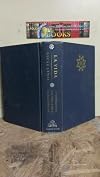
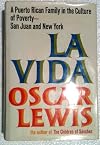
La Vida; A Puerto Rican Family in the Culture of Poverty—San Juan and New York
by Oscar Lewis
On This Page
Description
"La Vida: A Puerto Rican Family in the Culture of Poverty" is a 1966 book by Oscar Lewis that explores the lives of a Puerto Rican family in San Juan and New York City through a series of in-depth interviews and observations. The book, part of a series on Puerto Rican slum families, offers a detailed look into the experiences of a mother and her grown children within the context of poverty. Lewis's work is notable for its focus on the individuals' perspectives and the transmission of show more cultural traits associated with poverty from one generation to the next. show lessTags
Recommendations



















Member Reviews
Members
- Recently Added By
Lists

National Book Award winners
65 works; 11 members
Author Information

Oscar Lewis, an American anthropologist, was renowned for his studies of poverty in Mexico and Puerto Rico and for his controversial concept of "the culture of poverty." After graduating from Columbia University, where he studied under Ruth Benedict, Franz Boas, and Margaret Mead, his first major book, Life in a Mexican Village (1951), was a show more restudy of Robert Redfield's village of Tepoztlan, which reached a number of conclusions opposed to those reached by Redfield. Much of the controversy over the culture of poverty disappeared when Lewis labeled it a subculture; ironically, reactionaries have used the concept to blame the poor for their poverty, whereas Lewis believed the poor to be victims. Many of his books are based on tape recordings of family members, a technique in which Lewis was a pioneer. (Bowker Author Biography) show less
Some Editions
Awards and Honors
Awards
Distinctions
Series
Belongs to Publisher Series
Common Knowledge
- Canonical title
- La Vida; A Puerto Rican Family in the Culture of Poverty—San Juan and New York
- Original title
- La Vida. A Puerto Rican Family in the Culture of Poverty—San Juan and New York
- Original publication date
- 1966 (1e édition originale américaine) (1e édition originale américaine); 1969-03-17 (1e traduction et édition française ∙ Témoins ∙ Gallimard) (1e traduction et édition française ∙ Témoins ∙ Gallimard)
- Important places*
- San Juan, Porto Rico; New York, Etats-Unis
- First words
- (Introduction)
In the course of my anthropological studies of poverty and family life in Mexico, a number of my Mexican and other Latin American friends have sometimes delicately suggested that I turn to a study of poverty... (show all) in my own country, the United States.
(Chapter 1)
On a Saturday morning in May 1964, Rosa González went into La Esmeralda to spend a day with Fernanda Fuentes. - Last words
- (Click to show. Warning: May contain spoilers.)But still, now that I live in a place like Villa Hermosa, I would like to have an operation to make me straight.
- Blurbers
- Harrington, Michael; Maloff, Saul; Fitzpatrick, Joseph P.; Hentoff, Nat; Wagenheim, Kal; Wolf, Eric R.
- Original language*
- Anglais (Etats-Unis) (Etats-Unis)
*Some information comes from Common Knowledge in other languages. Click "Edit" for more information.
Classifications
- Genres
- Anthropology, Sociology, Nonfiction, General Nonfiction, History
- DDC/MDS
- 301.451607471 — Society, government, & culture Social sciences, sociology & anthropology Sociology and anthropology Formerly: Social structure
- LCC
- F128.9 .P8 .L4 — Local History of the United States, Canada and Latin America United States local history New York
Statistics
- Members
- 159
- Popularity
- 205,863
- Rating
- (3.60)
- Languages
- English, French, Spanish
- Media
- Paper
- ISBNs
- 8
- ASINs
- 10