On This Page
Description
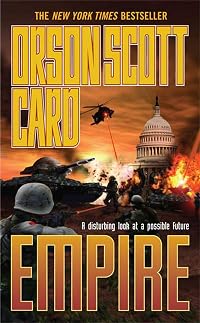
The American Empire has grown too fast, and the fault lines at home are stressed to the breaking point. The war of words between Right and Left has collapsed into a shooting war, though most people just want to be left alone. The battle rages between the high-technology weapons on one side, and militia foot-soldiers on the other, devastating the cities, and overrunning the countryside. But the vast majority, who only want the killing to stop, and the nation to return to more peaceful days, show more have technology, weapons and strategic geniuses of their own. When the American dream shatters into violence, who can hold the people and the government together? And which side will you be on? show lessTags
Recommendations
Member Reviews
I liked this book not so much for the action but for the heroes it portrayed, and some of the random ideas he throws out comparing the US to Rome. You might not agree with him (I'm not sure I do) but they were thought-provoking.
A number of people have written about how the US might follow the Roman Republic to a loss of democracy and turn into an empire. This is Orson Scott Card's view on how it could happen--on the beginning of the transition, anyway. It's hard to explain without giving spoilers, but let's just say that the heroes in this book wind up getting used to promote the remarkable ascendancy of someone who just might turn out to be a Caesar--and at the end of the book, we're still not sure if that's a good thing or not. The show more book starts out with a truly great, moral hero, a man you really admire, and then follows things from someone who was basically his sidekick, but who has to step up when things go horribly wrong.
Card tried, I think, to be somewhat balanced in this book, portraying both the left and right as threats to democracy. I'm not sure his portrayal succeeds here. Well, it succeeds at being balanced, but maybe not plausible. It makes for a pretty good story, anyway. This didn't detract much from the story. After all, you usually don't care *that* much where the bad guys came from; you mostly care where the good guys are going to. show less
A number of people have written about how the US might follow the Roman Republic to a loss of democracy and turn into an empire. This is Orson Scott Card's view on how it could happen--on the beginning of the transition, anyway. It's hard to explain without giving spoilers, but let's just say that the heroes in this book wind up getting used to promote the remarkable ascendancy of someone who just might turn out to be a Caesar--and at the end of the book, we're still not sure if that's a good thing or not. The show more book starts out with a truly great, moral hero, a man you really admire, and then follows things from someone who was basically his sidekick, but who has to step up when things go horribly wrong.
Card tried, I think, to be somewhat balanced in this book, portraying both the left and right as threats to democracy. I'm not sure his portrayal succeeds here. Well, it succeeds at being balanced, but maybe not plausible. It makes for a pretty good story, anyway. This didn't detract much from the story. After all, you usually don't care *that* much where the bad guys came from; you mostly care where the good guys are going to. show less
I'm a big fan of Card and picked this up only on that basis. The dust jacket blurb didn't sound promising but, hey, its Orson Scott Card. Well, very disappointed is what I am. The character dialog was not believable and the opening set-up wasn't making much sense. But I thought it really started going south when the mechanical soldiers showed up in New York and Our Heroes just happened to be there! The Liberal-Conservative conflict at the base of this story was hard for me to resolve in the beginning. Not because Card wasn't beating me over the head with it but because I kept thinking there has to be more to this story. It was an easy read so I kept at it. The afterword says Card wrote this as the setting of a video game. Well, I guess show more it was plotted like a video game. I don't really know anything about Card's politics. He comes across as a right wing nut case in the afterward which explains the right wing nut case conspiracy theory of the book. show less
Orson Scott Card has written many excellent books. This is not one of them.
It is clear from the author's Afterword, that the book was contrived to fit with a video game, and that roughly describes the sophistication of this plot which is well below Card's normal standard.
Reuben Malich is a major in the US Army working on secret assignments in Washington. He is joined by captain Bartholomew Coleman (Cole) just as an act of treachery takes a plan he wrote for the president's protection to carry out an assassination on the same. The success of this and other operations triggers a civil war, where members of the American democratic party, still smarting over the appointment of George Bush as president, when Al Gore won the vote - start a show more civil war.
In his afterword, Card indicates that it was all to easy to conceive of events that would lead to a civil war - but like "Shadow of the Hegemon", we see in this book that Card does not really do politics too well. For him, great events can be flawlessly shaped by the outrageous plans of a few. Compare with Tolstoy who says that those few are merely puppets of the greater circumstances, and you see the flaws in this plot laid bare. Frankly the whole plot is preposterous, and lacks the depth and strength of feeling required to make the preposterous plausible.
Could a stable democracy like the USA have another civil war? Certaily it is possible - but not over anything so petty as in this book! Civil wars have to be fomented over a period of time, a sharp division, and a growing sense of outrage that allows people to conceive of actions that are otherwise treasonable. The mistake that Card makes is to think that the differences between American Republicans and American Democrats are large enough for anyone to fight over. For anyone to destroy their deomcracy and country over. Much as they may dislike the other side, it is clear that the deomcratic ideal trumps the other ideology in their mind.
He almost recognises this early in the book, where in a university class discussion, Major Malich makes that very point in a voice we recognises as one of reason. He simply ignores the "conservative v liberal" debate and answers more intelligently as though those distinctions have no real existence of themselves. But then Card blows it by making the issues something that people really are willing to fight with bullets over - and it is not all clear why! To me there is a fundamental misunderstanding of the American political situation there.
I was reminded of "Shadow of the Hegemon" that read more like a game of "Risk" than anything close to real politics. And thus this book might make a reasonable game plot, but its not an intelligent book plot.
But so what? If it makes an enjoyable plot, what does it matter if the politics in Card's books are so black and white - so simplistic?
But there are other problems with this book too. One annoyance for someone who has probably read all of Card's books and short stories, is that he has recycled language, characters and plot elements from other works - and to poor effect. For instance, for me the word "jeesh" now refers to battle school kids - not a mature army combat unit. Ideas such as the double password on the PDA came from the short story "Dogwalker". And it went on!
Someone new to Card though would miss those references, but might still hate this book because the dialogue is so unconvincing. They might hate it because the plot is rather predictable (other than the odd choice to kill off ... well maybe I shouldn't say to avoid spoilers - but anyone reading the book is likely to know what I mean and agree it's an odd choice).
One of the things I have historically liked about Card is the way he focuses his books widely, incorporating foreign languages and cultures. Also the way he makes you think about issues. But in this book his cultural references are right out of an American right wing chat room, and show a remarkable lack of critical thinking!
When I read "European news media tells you what to think. American news media shows you enough so you make your own opinions", I was flabergasted, as should any other european who has numbed their mind watching the news on visits to that country! Not that I have a vested interest in news media, and not that I have any rosy spectacled view of European orgaisations. It just made me think that I was reading some American neo-con and not the Orson Scott Card who I have respected for very many years.
It seems to me that in recent years there has been a marked decline in the quality of Card's output. I suspect that this is an excellent writer with just too many projects with too short deadlines on the go.
Card completists (like me) will read this book whatever I say. Anyone else - avoid this one. show less
It is clear from the author's Afterword, that the book was contrived to fit with a video game, and that roughly describes the sophistication of this plot which is well below Card's normal standard.
Reuben Malich is a major in the US Army working on secret assignments in Washington. He is joined by captain Bartholomew Coleman (Cole) just as an act of treachery takes a plan he wrote for the president's protection to carry out an assassination on the same. The success of this and other operations triggers a civil war, where members of the American democratic party, still smarting over the appointment of George Bush as president, when Al Gore won the vote - start a show more civil war.
In his afterword, Card indicates that it was all to easy to conceive of events that would lead to a civil war - but like "Shadow of the Hegemon", we see in this book that Card does not really do politics too well. For him, great events can be flawlessly shaped by the outrageous plans of a few. Compare with Tolstoy who says that those few are merely puppets of the greater circumstances, and you see the flaws in this plot laid bare. Frankly the whole plot is preposterous, and lacks the depth and strength of feeling required to make the preposterous plausible.
Could a stable democracy like the USA have another civil war? Certaily it is possible - but not over anything so petty as in this book! Civil wars have to be fomented over a period of time, a sharp division, and a growing sense of outrage that allows people to conceive of actions that are otherwise treasonable. The mistake that Card makes is to think that the differences between American Republicans and American Democrats are large enough for anyone to fight over. For anyone to destroy their deomcracy and country over. Much as they may dislike the other side, it is clear that the deomcratic ideal trumps the other ideology in their mind.
He almost recognises this early in the book, where in a university class discussion, Major Malich makes that very point in a voice we recognises as one of reason. He simply ignores the "conservative v liberal" debate and answers more intelligently as though those distinctions have no real existence of themselves. But then Card blows it by making the issues something that people really are willing to fight with bullets over - and it is not all clear why! To me there is a fundamental misunderstanding of the American political situation there.
I was reminded of "Shadow of the Hegemon" that read more like a game of "Risk" than anything close to real politics. And thus this book might make a reasonable game plot, but its not an intelligent book plot.
But so what? If it makes an enjoyable plot, what does it matter if the politics in Card's books are so black and white - so simplistic?
But there are other problems with this book too. One annoyance for someone who has probably read all of Card's books and short stories, is that he has recycled language, characters and plot elements from other works - and to poor effect. For instance, for me the word "jeesh" now refers to battle school kids - not a mature army combat unit. Ideas such as the double password on the PDA came from the short story "Dogwalker". And it went on!
Someone new to Card though would miss those references, but might still hate this book because the dialogue is so unconvincing. They might hate it because the plot is rather predictable (other than the odd choice to kill off ... well maybe I shouldn't say to avoid spoilers - but anyone reading the book is likely to know what I mean and agree it's an odd choice).
One of the things I have historically liked about Card is the way he focuses his books widely, incorporating foreign languages and cultures. Also the way he makes you think about issues. But in this book his cultural references are right out of an American right wing chat room, and show a remarkable lack of critical thinking!
When I read "European news media tells you what to think. American news media shows you enough so you make your own opinions", I was flabergasted, as should any other european who has numbed their mind watching the news on visits to that country! Not that I have a vested interest in news media, and not that I have any rosy spectacled view of European orgaisations. It just made me think that I was reading some American neo-con and not the Orson Scott Card who I have respected for very many years.
It seems to me that in recent years there has been a marked decline in the quality of Card's output. I suspect that this is an excellent writer with just too many projects with too short deadlines on the go.
Card completists (like me) will read this book whatever I say. Anyone else - avoid this one. show less
Reminiscent of Tom Clancy political thrillers, this novel imagines what a 2nd American civil war might look like. Generally speaking, the storyline was interesting and believable. This book is about the battle of words in politics, and the author's voice is readily apparent in calling for moderation rather than fanaticism.
Not bad for a book written to go along with a video game. Very suspenseful and thought provoking, and more enjoyable than I usually find stories with as much political opinion as is found here.
The message is clear, especially in the first part of the book & the afterword by Card - the screamers on the left & right of our 2 party system are becoming the icons & dividing the country. Thus, Card portrays his opinion of one possible lead-in to an American Civil War II. Empire is a fun read. Lots of action. The narrator murders some location names and author believes that potatoes are grown in Northern Idaho (they're not--it's wheat and timber country). Further, authori's use of the word "jeesh" as a substitute for "team" reminds the reader of Ender's Game.
Orson Scott Card is a fascinating writer and person. The first book of his I read was Songmaster. I was in my teens or twenties, and I couldn't put the book down. I finished it in the wee hours of the morning and then it haunted me so that I couldn't get to sleep. The Ender's Game series is one of the best series in the English language, in my opinion, though I liked the later books in the series better than the original. When I was active in science fiction fandom in the 80s, I attended and was delighted by Card's Secular Humanist Revival, held in a tent near the hotel pool. So I was rather startled to find out that Card is a devout Mormon, and that his views on homosexuality were despised, I think with justification, by gays I show more knew.
And after that I didn't read him as much as previously. I did read several of the Alvin Maker series and liked them, though was not as impressed as I had been by some of his work. Other books didn't sound like things I'd be particularly interested in. I never forgot, however, that some of his works haunted me.
So when it is easy I've occasionally been picking some of his books up. I started one several months ago that I didn't finish for lack of time, and then read one written by someone else but based on one of his ideas. And I just picked up and read Empire.
Did not think I would stay with it, as there was lots of politics that really got up my nose. Ridiculous to think that there would be a coup from the left against the government. For one thing, those of us on the left are too anti-authoritarian to have the discipline to stage such a thing. Then I suddenly remembered the French revolutionaries, and the Communists, and maybe it wasn't totally far-fetched... but still unlikely.
I did keep reading, though. One reason is that I have been concerned about the chances of another civil war in this country, although I see the danger coming from the right. Card's speculation on how such a thing might happen is deft and as thorough in its knowledge of the human heart and mind as many of his other works - there is much confusion over what is right and wrong, who the villains are, and how to handle the desperate situation the country finds itself in.
One of the things that hit me hardest was a comment by one of the characters that people on both sides see people on the other side as stupid and deceived. That made me take notice, because I had been wondering how Card, who I know to be well-read and intelligent (see his official web site, http://www.hatrack.com/, for proof) could be saying some of the things that to me just sound stupid - such as some of the characters expressing admiration for our current president.
In the end, what affected me the most was the afterward, in which Card expresses concern about our polarization, and how difficult it is for a moderate voice to be heard, telling of his experience in being viciously attacked by those of both the left and the right. Here's an example of what he has to say:
"Yet neither side can see any connection between their own fanaticism and the historical examples that might apply to them. People insisting on a Christian America simply cannot comprehend that others view them as a Taliban-in-waiting; those who insist on progressive exclusivism in America are outraged at any comparison between them and Communist totalitarianism. Even as they shun or fire or deny tenure to those who disagree with them, everybody thinks it's the other guy who would be the oppressor, while OUR side would simply "set things to rights". Rarely do people set out to start a civil war. Invariably, when such wars break out both sides consider themselves to be the aggrieved ones.".
I'm not entirely convinced, and still hold to my political beliefs. But I hope that I can see my adversaries as human with their own ideas and needs, and to be willing to listen to them.
In other words, this book made me THINK... and what else does a good book do, whether fiction or non-fiction? show less
And after that I didn't read him as much as previously. I did read several of the Alvin Maker series and liked them, though was not as impressed as I had been by some of his work. Other books didn't sound like things I'd be particularly interested in. I never forgot, however, that some of his works haunted me.
So when it is easy I've occasionally been picking some of his books up. I started one several months ago that I didn't finish for lack of time, and then read one written by someone else but based on one of his ideas. And I just picked up and read Empire.
Did not think I would stay with it, as there was lots of politics that really got up my nose. Ridiculous to think that there would be a coup from the left against the government. For one thing, those of us on the left are too anti-authoritarian to have the discipline to stage such a thing. Then I suddenly remembered the French revolutionaries, and the Communists, and maybe it wasn't totally far-fetched... but still unlikely.
I did keep reading, though. One reason is that I have been concerned about the chances of another civil war in this country, although I see the danger coming from the right. Card's speculation on how such a thing might happen is deft and as thorough in its knowledge of the human heart and mind as many of his other works - there is much confusion over what is right and wrong, who the villains are, and how to handle the desperate situation the country finds itself in.
One of the things that hit me hardest was a comment by one of the characters that people on both sides see people on the other side as stupid and deceived. That made me take notice, because I had been wondering how Card, who I know to be well-read and intelligent (see his official web site, http://www.hatrack.com/, for proof) could be saying some of the things that to me just sound stupid - such as some of the characters expressing admiration for our current president.
In the end, what affected me the most was the afterward, in which Card expresses concern about our polarization, and how difficult it is for a moderate voice to be heard, telling of his experience in being viciously attacked by those of both the left and the right. Here's an example of what he has to say:
"Yet neither side can see any connection between their own fanaticism and the historical examples that might apply to them. People insisting on a Christian America simply cannot comprehend that others view them as a Taliban-in-waiting; those who insist on progressive exclusivism in America are outraged at any comparison between them and Communist totalitarianism. Even as they shun or fire or deny tenure to those who disagree with them, everybody thinks it's the other guy who would be the oppressor, while OUR side would simply "set things to rights". Rarely do people set out to start a civil war. Invariably, when such wars break out both sides consider themselves to be the aggrieved ones.".
I'm not entirely convinced, and still hold to my political beliefs. But I hope that I can see my adversaries as human with their own ideas and needs, and to be willing to listen to them.
In other words, this book made me THINK... and what else does a good book do, whether fiction or non-fiction? show less
Members
- Recently Added By
Lists

Books Read in 2015
3,299 works; 129 members

Post-Apocalyptic Fiction
57 works; 3 members
Author Information

575+ Works 214,080 Members
Orson Scott Byron Walley Card, was born in 1951 and studied theater at Brigham Young University. He received his B.A. in 1975 and his M.A. in English in 1981. He wrote plays during that time, including Stone Tables (1973) and the musical, Father, Mother, Mother and Mom (1974). A Mormon, Scott served a two-year mission in Brazil before starting show more work as a journalist in Utah. He also designed games at Lucas Film Games, 1989-92. He is best known for his science fiction novels, including the popular Ender series. Well known titles include A Planet Called Treason (1979), Treasure Box (1996), and Heartfire (1998). He has also written the guide called How to Write Science Fiction and Fantasy (1990). His novel Ender's Game and its sequel Speaker for the Dead, both won Hugo and Nebula awards, making Card the only author to win both prizes in consecutive years. His titles Shadows in Flight, Ruins and Ender's Game made The New York Times Best Seller List. He is also the author of The First Formic War Series, which includes the titles Earth Unaware, Earth Afire, and Earth Awakens. (Bowker Author Biography) show less
Some Editions
Awards and Honors
Awards
Series

Common Knowledge
- Canonical title
- Empire
- Original publication date
- 2006-11-28
- People/Characters
- Reuben Malich; Bartholomew Coleman; Cecily Malich; LaMonte Nielson; Averell Torrent; DeeNee Breen
- Important places
- Washington, D.C., USA
- Dedication
- To Cyndie and Jeremy
for finding the balance
between the law and the life
and for sharing Victor and Cataan - First words
- "Treason only matters when it is committed by trusted men."
- Last words
- (Click to show. Warning: May contain spoilers.)Cole got up from the sofa and stretched. "Let's have cookies."
- Original language
- English
Classifications
Statistics
- Members
- 1,675
- Popularity
- 13,331
- Reviews
- 62
- Rating
- (3.16)
- Languages
- Chinese, Czech, English, Spanish
- Media
- Paper, Audiobook, Ebook
- ISBNs
- 14
- ASINs
- 8