Romola
by George Eliot
On This Page
Description
Victorian-era novelist George Eliot (the pen name of female writer Mary Anne Evans) is best known for her multi-layered takes on nineteenth-century British society, such as the masterpiece Middlemarch. She takes on a similarly ambitious task in the engaging tale Romola, albeit one that is set in Renaissance Italy rather than her own era. This historical novel adroitly captures the social upheaval and cultural ferment that arose during this remarkable period..
Tags
Recommendations













Member Recommendations

Member Reviews
A landmark book in my reading life. It rumbles away in the background long after the end. George Eliot is an incomparable writer. She was well ahead of the field in the English Novelists Stakes.
A great historical novel about a turbulent time among the Italian states. Soundly researched wherein the reader is left in no doubt about her thoroughness. Expertly plotted, providing tension through 700 pages. I was riveted from the start, just as I was when I read Daniel Deronda.
A great historical novel about a turbulent time among the Italian states. Soundly researched wherein the reader is left in no doubt about her thoroughness. Expertly plotted, providing tension through 700 pages. I was riveted from the start, just as I was when I read Daniel Deronda.
Romola by George Eliot
Written in 1863, Romola was the fourth of George Eliot’s major novels and her only novel to be set in the Middle Ages. The story begins on April 9, 1492, in the marketplace of Florence, which is abuzz with the news of the death of the Medici ruler, Lorenzo the Magnificent. Most of Eliot’s other novels are set in England fifty years or so before her writing them and are fairly comfortable for me to get into. Romola, though, set in the last decade of the 15th century in Italy, required a good bit of patience at the beginning. But eventually the strangeness of time, place, and history became fascinating, and I found myself wanting to get back to my book quickly whenever I put it down.
Setting is a great strength in show more this novel. It gives a convincing depiction of Florence at one of the most chaotic times of its history. Lorenzo di Medici has just died at the beginning of the story, and his heir, Piero, is soon driven out after a miserable performance dealing with the invasion of the French army under Charles VIII. The power struggles begin, with more factions competing treacherously, even murderously, for power, than I can remember. The Dominican friar Girolamo Savonarola is at the peak of his power in his quest to stamp out corruption in the Church and in the people. Religious factions contribute much to the chaos. The conflict between religion and humanism, faith in God and faith in man, is brought out here and Eliot questions whether the two can exist peacefully together. The two scenes around Bonfires of the Vanities are frightening. Spectacles and crowd scenes such as these abound in Romola—festivals, executions, riots, huge crowds at the Duomo for Fra Savonarola’s sermons—and historical characters are everywhere. According to a biography of George Eliot I read, she spent years researching for this historical novel, and the result made me feel that I had actually seen the Florence of this era. (I would not have wanted to be there.)
Eliot’s familiar strengths as a novelist are all present from the beginning. Point of view is her customary 3rd person omniscient, her persona, the familiar guiding voice of the wise woman with much experience of life. The Proem is magnificent, and of course should be reread after finishing the book for insights into her theme. By this point you’ll know whether or not you agree.
Romola is the beautiful daughter of elderly, blind classical scholar, Bardo di Bardi. Not only compassionate, but extremely intelligent, she has been her father’s secretary since the departure of her older brother to join the Dominican friars. She has lived most of her life in seclusion, meeting only the elderly people, mostly scholars like her father, who visit their house. When young and handsome Tito Melema, a well educated and learned Greek recently arrived in the city, is employed by Bardo to also help in his work, Tito and Romola fall in love. Not long after meeting him we begin to understand the essential selfishness of Tito’s nature. His inability to “do the right thing” when it involves any sacrifice, or even discomfort, for himself becomes apparent to the reader. Romola’s struggle to free herself from this thieving, deceitful, treacherous man she has married forms the main conflict of the plot. Effective use of foreshadowing and symbolism help the reader to see more truly than Romola, setting up a sad irony. Here is an ominous scene that occurs on the very day of Tito’s arrival in Florence. He is in Nello’s barbershop, a popular center of conversation, mainly gossip. Tito encounters the painter Piero di Cosimo who requests that Tito sit for him for a painting of Sinon, the Greek who persuaded King Priam of Troy to receive the Trojan Horse into Troy. Nello objects that Tito has too beautiful and mild a countenance to represent the most famous traitor in the world. Piero replies:
“A perfect traitor should have a face which vice can write no marks on—lips that will lie with a dimpled smile—eyes of such agate-like brightness and depth that no infamy can dull them—cheeks that will rise from a murder and not look haggard. I say not this young man is a traitor: I mean, he has a face that would make him the more perfect traitor if he had the heart of one, which is saying neither more nor less than that he has a beautiful face, informed with rich young blood, that will be nourished enough by food, and keep its colour without much help of virtue.”
Hopefully the reader who at this point thinks that Tito may be the novel’s hero will think again.
Eliot’s skill with portraying and developing character is also an expected strength. Romola’s illusions about Tito are slow in giving way to a truer judgment of his nature. Her inner struggles to deny her uneasy suspicions and what she experiences in his behavior are shown through her words and actions as well as the comments of other characters and the narrator’s own comments. Tito’s deterioration into the thoroughly evil character he has become by the end of the story is shown in the same way. Many of the characters in the novel are figures from history, some with important roles to play in the story. The painter already mentioned is one. A more important one is Fra Girolamo Savanorola, Prior of the Domicans of San Marco. Eliot presents a finely balanced portrait of the single-minded Dominican. This view of him surprised me as I only knew enough about him to associate him with book burning. That Eliot would be even-handed and fair is no surprise at all. She shows the strength and purity of Savonarola’s quest. She makes him one of Romola’s most important supports. And toward the end when he has been executed by burning, having lost his battle against Pope Alexander VI, whom he wanted to depose, she sums up her opinion of Savonarola in these memorable words:
“There is no jot of worthy evidence that from the time of his imprisonment to the supreme moment, Savonarola thought or spoke of himself as a martyr. The idea of martyrdom had been to him a passion dividing the dream of the future with the triumph of beholding his work achieved. And now, in place of both, had come a resignation which he called by no glorifying name. But therefore he may the more fitly be called a martyr by his fellow-men to all time. For power rose against him not because of his sins, but because of his greatness—not because he sought to deceive the world, but because he sought to make it noble. And through that greatness of his he endured a double agony: not only the reviling, and the torture, and the death-throe, but the agony of sinking from the vision of glorious achievement into that deep shadow where he could only say, ‘I count as nothing: darkness encompasses me: yet the light I saw was the true light.’”
I am glad to have read Romola and will certainly be reading it again. I loved the setting and the story and I learned a lot of history. I’ve had to refrain from quoting on and on—George Eliot’s writing is so full of memorable passages. I’m hoping this year to get to Felix Holt the Radical, the last of her major novels I’ve yet to read. I rate Romola 5 stars.
Edit | More show less
Written in 1863, Romola was the fourth of George Eliot’s major novels and her only novel to be set in the Middle Ages. The story begins on April 9, 1492, in the marketplace of Florence, which is abuzz with the news of the death of the Medici ruler, Lorenzo the Magnificent. Most of Eliot’s other novels are set in England fifty years or so before her writing them and are fairly comfortable for me to get into. Romola, though, set in the last decade of the 15th century in Italy, required a good bit of patience at the beginning. But eventually the strangeness of time, place, and history became fascinating, and I found myself wanting to get back to my book quickly whenever I put it down.
Setting is a great strength in show more this novel. It gives a convincing depiction of Florence at one of the most chaotic times of its history. Lorenzo di Medici has just died at the beginning of the story, and his heir, Piero, is soon driven out after a miserable performance dealing with the invasion of the French army under Charles VIII. The power struggles begin, with more factions competing treacherously, even murderously, for power, than I can remember. The Dominican friar Girolamo Savonarola is at the peak of his power in his quest to stamp out corruption in the Church and in the people. Religious factions contribute much to the chaos. The conflict between religion and humanism, faith in God and faith in man, is brought out here and Eliot questions whether the two can exist peacefully together. The two scenes around Bonfires of the Vanities are frightening. Spectacles and crowd scenes such as these abound in Romola—festivals, executions, riots, huge crowds at the Duomo for Fra Savonarola’s sermons—and historical characters are everywhere. According to a biography of George Eliot I read, she spent years researching for this historical novel, and the result made me feel that I had actually seen the Florence of this era. (I would not have wanted to be there.)
Eliot’s familiar strengths as a novelist are all present from the beginning. Point of view is her customary 3rd person omniscient, her persona, the familiar guiding voice of the wise woman with much experience of life. The Proem is magnificent, and of course should be reread after finishing the book for insights into her theme. By this point you’ll know whether or not you agree.
Romola is the beautiful daughter of elderly, blind classical scholar, Bardo di Bardi. Not only compassionate, but extremely intelligent, she has been her father’s secretary since the departure of her older brother to join the Dominican friars. She has lived most of her life in seclusion, meeting only the elderly people, mostly scholars like her father, who visit their house. When young and handsome Tito Melema, a well educated and learned Greek recently arrived in the city, is employed by Bardo to also help in his work, Tito and Romola fall in love. Not long after meeting him we begin to understand the essential selfishness of Tito’s nature. His inability to “do the right thing” when it involves any sacrifice, or even discomfort, for himself becomes apparent to the reader. Romola’s struggle to free herself from this thieving, deceitful, treacherous man she has married forms the main conflict of the plot. Effective use of foreshadowing and symbolism help the reader to see more truly than Romola, setting up a sad irony. Here is an ominous scene that occurs on the very day of Tito’s arrival in Florence. He is in Nello’s barbershop, a popular center of conversation, mainly gossip. Tito encounters the painter Piero di Cosimo who requests that Tito sit for him for a painting of Sinon, the Greek who persuaded King Priam of Troy to receive the Trojan Horse into Troy. Nello objects that Tito has too beautiful and mild a countenance to represent the most famous traitor in the world. Piero replies:
“A perfect traitor should have a face which vice can write no marks on—lips that will lie with a dimpled smile—eyes of such agate-like brightness and depth that no infamy can dull them—cheeks that will rise from a murder and not look haggard. I say not this young man is a traitor: I mean, he has a face that would make him the more perfect traitor if he had the heart of one, which is saying neither more nor less than that he has a beautiful face, informed with rich young blood, that will be nourished enough by food, and keep its colour without much help of virtue.”
Hopefully the reader who at this point thinks that Tito may be the novel’s hero will think again.
Eliot’s skill with portraying and developing character is also an expected strength. Romola’s illusions about Tito are slow in giving way to a truer judgment of his nature. Her inner struggles to deny her uneasy suspicions and what she experiences in his behavior are shown through her words and actions as well as the comments of other characters and the narrator’s own comments. Tito’s deterioration into the thoroughly evil character he has become by the end of the story is shown in the same way. Many of the characters in the novel are figures from history, some with important roles to play in the story. The painter already mentioned is one. A more important one is Fra Girolamo Savanorola, Prior of the Domicans of San Marco. Eliot presents a finely balanced portrait of the single-minded Dominican. This view of him surprised me as I only knew enough about him to associate him with book burning. That Eliot would be even-handed and fair is no surprise at all. She shows the strength and purity of Savonarola’s quest. She makes him one of Romola’s most important supports. And toward the end when he has been executed by burning, having lost his battle against Pope Alexander VI, whom he wanted to depose, she sums up her opinion of Savonarola in these memorable words:
“There is no jot of worthy evidence that from the time of his imprisonment to the supreme moment, Savonarola thought or spoke of himself as a martyr. The idea of martyrdom had been to him a passion dividing the dream of the future with the triumph of beholding his work achieved. And now, in place of both, had come a resignation which he called by no glorifying name. But therefore he may the more fitly be called a martyr by his fellow-men to all time. For power rose against him not because of his sins, but because of his greatness—not because he sought to deceive the world, but because he sought to make it noble. And through that greatness of his he endured a double agony: not only the reviling, and the torture, and the death-throe, but the agony of sinking from the vision of glorious achievement into that deep shadow where he could only say, ‘I count as nothing: darkness encompasses me: yet the light I saw was the true light.’”
I am glad to have read Romola and will certainly be reading it again. I loved the setting and the story and I learned a lot of history. I’ve had to refrain from quoting on and on—George Eliot’s writing is so full of memorable passages. I’m hoping this year to get to Felix Holt the Radical, the last of her major novels I’ve yet to read. I rate Romola 5 stars.
Edit | More show less
Welp, I finally had to give up at page 395. Many pages left to go, and I just couldn't bring myself to finish. I was bored. I found myself inadvertently skimming, and then having to go back and reread because I couldn't remember the last five pages. It's too slow, and the Victorian wifely submissiveness was just getting on my nerves. It was only Eliot's pointed and sculpted prose which got me that far. And the thought of another notch on my bookcase wasn't enough to give up the amount of life it would take for me to finish.
Romola is tied with Daniel Deronda as my favorite Eliot novel. I really loved the look at Florence, its history and politics in that era, with the power vaccuum left by the death of Lorenzo the Magnificent. Tito's character was an absolutely fascinating study of corruption - how an innocent and decent person could devolve into a man who might have rivaled Dorian Gray. Romola herself irritated me a little, but literature of the period is full of spineless female characters, I've learned to just ignore them.
I give this book 3.5 stars based almost entirely on the historical setting (Florence in the days of Savonarola). Against this fascinating backdrop, our main characters come off pretty dull. The women are naive pushovers (though Eliot is clearly exploring themes of being a woman in a male-dominated world) and our charming villain is just banal and petty in his selfishness (which I suppose is the point). The nice little morality play that is the main plot pales in comparison to the glittering events that surround it – I kept wanting them to get out of the way so I could see the interesting stuff going on behind them.
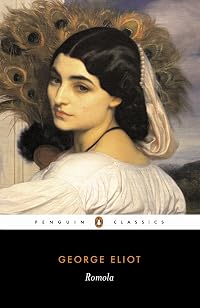
Before I critique this book, I have to critique this cover. Eliot could not make it clearer that Romola is a blonde. Her golden hair is referenced over and over again. Who is the dufus who chose this cover photo? Sorry, but all Italians must be raven-haired? I’m not thinking Eliot would have been impressed.
I have decided to DNF [b:Romola|835508|Romola|George Eliot|https://i.gr-assets.com/images/S/compressed.photo.goodreads.com/books/1352311525l/835508._SY75_.jpg|1581651] after 238 pages of forced reading. I cannot believe I am ditching a George Eliot novel, but this is
nothing like any of her other novels,
set in Italy and it would appear Eliot wanted to impress upon people that she had seen it, but I never got the feeling she knew show more it,
contains chapter after chapter of description and political exposition that doesn't move the plot forward even an inch,
has yet to present a single character for which I give a fig.
I was more than willing to give Eliot leaway in making a slow start, she generally does and then presents one with gold, making all those details count. I think [b:Middlemarch|19089|Middlemarch|George Eliot|https://i.gr-assets.com/images/S/compressed.photo.goodreads.com/books/1568307771l/19089._SY75_.jpg|1461747] and [b:The Mill on the Floss|20564|The Mill on the Floss|George Eliot|https://i.gr-assets.com/images/S/compressed.photo.goodreads.com/books/1394285531l/20564._SY75_.jpg|3277447] would number among the greatest books ever written. Perhaps if I had the patience and endurance to finish I would see some major revelation in this novel, but I am reminded of how much I had to push to get through some parts of [b:Daniel Deronda|304|Daniel Deronda|George Eliot|https://i.gr-assets.com/images/S/compressed.photo.goodreads.com/books/1320432000l/304._SY75_.jpg|313957], and I could see what she was trying to achieve there. The world will not stop spinning if I fail to like an Eliot novel--I know it will not--it really will not. Okay, permission to quit granted. show less
I have decided to DNF [b:Romola|835508|Romola|George Eliot|https://i.gr-assets.com/images/S/compressed.photo.goodreads.com/books/1352311525l/835508._SY75_.jpg|1581651] after 238 pages of forced reading. I cannot believe I am ditching a George Eliot novel, but this is
nothing like any of her other novels,
set in Italy and it would appear Eliot wanted to impress upon people that she had seen it, but I never got the feeling she knew show more it,
contains chapter after chapter of description and political exposition that doesn't move the plot forward even an inch,
has yet to present a single character for which I give a fig.
I was more than willing to give Eliot leaway in making a slow start, she generally does and then presents one with gold, making all those details count. I think [b:Middlemarch|19089|Middlemarch|George Eliot|https://i.gr-assets.com/images/S/compressed.photo.goodreads.com/books/1568307771l/19089._SY75_.jpg|1461747] and [b:The Mill on the Floss|20564|The Mill on the Floss|George Eliot|https://i.gr-assets.com/images/S/compressed.photo.goodreads.com/books/1394285531l/20564._SY75_.jpg|3277447] would number among the greatest books ever written. Perhaps if I had the patience and endurance to finish I would see some major revelation in this novel, but I am reminded of how much I had to push to get through some parts of [b:Daniel Deronda|304|Daniel Deronda|George Eliot|https://i.gr-assets.com/images/S/compressed.photo.goodreads.com/books/1320432000l/304._SY75_.jpg|313957], and I could see what she was trying to achieve there. The world will not stop spinning if I fail to like an Eliot novel--I know it will not--it really will not. Okay, permission to quit granted. show less
Under every guilty secret there is hidden a brood of guilty wishes, whose unwholesome infecting life is cherished by the darkness.
I chose to read Romola for the 2017 Back to the Classics Challenge as my "Classic set in a place you'd like to visit." The story takes place in Florence, Italy, which is one of my bucket-list destinations. Written by George Eliot in 1863, Romola transports the reader to Florence in 1492, where the main characters rub elbows with Niccolo Machiavelli, Girolamo Savonarola, members of the Medici family, and other historical figures of the time.
Tito Melema, a handsome young Greek scholar, finds himself in Florence after being shipwrecked. As he tries to work his way up the social and political ladder he meets show more Romola, the beautiful daughter of one of Florence's most distinguished scholars, Bardo de Bardi. But Tito is haunted by the knowledge that his adoptive father may have survived the shipwreck, and he is torn between the desire to succeed and his filial duty to search for his father. Romola knows knows nothing of Tito's past or of his plans to undercut her father's dying wish. Their story plays out against the backdrop of Renaissance Italy and its religious and political upheaval.
Romola is well worth a read, especially for those who enjoy Victorian literature and/or historical fiction. I particularly enjoyed the Florentine setting and Romola's efforts to deal with Tito's bad decisions. The characters are complex and interesting, and their dilemmas and conflicts are universal.
I didn't know much about the time period before I started the book, and I think that hindered my enjoyment and understanding of the novel. While I did enjoy Romola, I would have appreciated it a lot more if the notes in my Modern Library Kindle edition would have been linked to the text. There were dozens of historical notes that I didn't read simply because navigating to them without an internal hyperlink was too cumbersome and time consuming. So while I recommend Romola the book, I do not recommend the Modern Library Kindle edition. If you read it, get yourself a copy in print or an ebook with links to the notes. show less
I chose to read Romola for the 2017 Back to the Classics Challenge as my "Classic set in a place you'd like to visit." The story takes place in Florence, Italy, which is one of my bucket-list destinations. Written by George Eliot in 1863, Romola transports the reader to Florence in 1492, where the main characters rub elbows with Niccolo Machiavelli, Girolamo Savonarola, members of the Medici family, and other historical figures of the time.
Tito Melema, a handsome young Greek scholar, finds himself in Florence after being shipwrecked. As he tries to work his way up the social and political ladder he meets show more Romola, the beautiful daughter of one of Florence's most distinguished scholars, Bardo de Bardi. But Tito is haunted by the knowledge that his adoptive father may have survived the shipwreck, and he is torn between the desire to succeed and his filial duty to search for his father. Romola knows knows nothing of Tito's past or of his plans to undercut her father's dying wish. Their story plays out against the backdrop of Renaissance Italy and its religious and political upheaval.
Romola is well worth a read, especially for those who enjoy Victorian literature and/or historical fiction. I particularly enjoyed the Florentine setting and Romola's efforts to deal with Tito's bad decisions. The characters are complex and interesting, and their dilemmas and conflicts are universal.
I didn't know much about the time period before I started the book, and I think that hindered my enjoyment and understanding of the novel. While I did enjoy Romola, I would have appreciated it a lot more if the notes in my Modern Library Kindle edition would have been linked to the text. There were dozens of historical notes that I didn't read simply because navigating to them without an internal hyperlink was too cumbersome and time consuming. So while I recommend Romola the book, I do not recommend the Modern Library Kindle edition. If you read it, get yourself a copy in print or an ebook with links to the notes. show less
Members
- Recently Added By
Lists

Female Protagonist
1,056 works; 57 members

Books Set in Italy
167 works; 19 members
150 Best Novels Selected by Brander Matthews (1883)
150 works; 7 members

Best Revenge Stories
69 works; 9 members

Books featuring monks and/or nuns
166 works; 33 members

19th Century
190 works; 16 members
Out of Copyright
244 works; 14 members

Newark Public Library's 1904 List of a Thousand of the Best Novels
98 works; 6 members

Lesser known books of well known authors
39 works; 17 members

Fifty Representative Historical Novels
50 works; 2 members
Victorian Period
113 works; 10 members

real people in fiction circumstances
74 works; 10 members

1860s
25 works; 4 members

SHOULD Read Books!
354 works; 9 members
F. B. Perkins' List of 100 Best Fiction
100 works; 5 members

Novels featuring Fathers
56 works; 7 members

Europe
205 works; 6 members

Books Read in 2016
4,666 works; 199 members

Books set in Firenze (Florence, Italy)
35 works; 1 member

Biggest Disappointments
606 works; 168 members
Author Information

382+ Works 62,193 Members
George Eliot was born Mary Ann Evans on a Warwickshire farm in England, where she spent almost all of her early life. She received a modest local education and was particularly influenced by one of her teachers, an extremely religious woman whom the novelist would later use as a model for various characters. Eliot read extensively, and was show more particularly drawn to the romantic poets and German literature. In 1849, after the death of her father, she went to London and became assistant editor of the Westminster Review, a radical magazine. She soon began publishing sketches of country life in London magazines. At about his time Eliot began her lifelong relationship with George Henry Lewes. A married man, Lewes could not marry Eliot, but they lived together until Lewes's death. Eliot's sketches were well received, and soon after she followed with her first novel, Adam Bede (1859). She took the pen name "George Eliot" because she believed the public would take a male author more seriously. Like all of Eliot's best work, The Mill on the Floss (1860), is based in large part on her own life and her relationship with her brother. In it she begins to explore male-female relations and the way people's personalities determine their relationships with others. She returns to this theme in Silas Mariner (1861), in which she examines the changes brought about in life and personality of a miser through the love of a little girl. In 1863, Eliot published Romola. Set against the political intrigue of Florence, Italy, of the 1490's, the book chronicles the spiritual journey of a passionate young woman. Eliot's greatest achievement is almost certainly Middlemarch (1871). Here she paints her most detailed picture of English country life, and explores most deeply the frustrations of an intelligent woman with no outlet for her aspirations. This novel is now regarded as one of the major works of the Victorian era and one of the greatest works of fiction in English. Eliot's last work was Daniel Deronda. In that work, Daniel, the adopted son of an aristocratic Englishman, gradually becomes interested in Jewish culture and then discovers his own Jewish heritage. He eventually goes to live in Palestine. Because of the way in which she explored character and extended the range of subject matter to include simple country life, Eliot is now considered to be a major figure in the development of the novel. She is buried in Highgate Cemetery, North London, England, next to her common-law husband, George Henry Lewes. (Bowker Author Biography) show less
Some Editions
Awards and Honors
Series
Belongs to Publisher Series
Work Relationships
Is contained in
The Best-Known Novels of George Eliot: Adam Bede, The Mill on the Floss, Silas Marner, Romola by George Eliot
The Works of George Eliot: Vol. I - Adam Bede, The Mill on the Floss, Romola; Vol. II -- Middlemarch: A Study of Provincial life, Daniel Deronda; Vol. III -- Felix Holt, The Radical, Silas Marner, The Lifted Veil, Brother Jacob,Scenes from Clerical Life by George Eliot (indirect)
Classic British Fiction: Six novels by George Eliot, in a single file, improved 8/23/2010 by George Eliot
Works of George Eliot. The Mill on the Floss, Daniel Deronda, Adam Bede, Middlemarch, The Lifted Veil & more. (mobi) by George Eliot
George Eliot's Works: Adam Bede/Daniel Deronda/Felix Holt and Clerical Life/Middlemarch/Mill on the Floss/Romola (6 vols) by George Eliot
George Elliot Works: 7 books - Middlemarch, Adam Bede, Daniel Deronda, Romola, Impressions of Theophrastus Such..., Silas Marner, Felix Holt, the Radical (George Elliot Works, 7 of ? in set) by George Elliot
George Eliot Collection: The Complete Novels, Short Stories, Poems and Essays (Middlemarch, Daniel Deronda, Scenes of Clerical Life, Adam Bede, The Lifted Veil...) by George Eliot
The Spanish Gypsy and Other Poems. Scenes of Clerical Life, Adam Bede, Romola, Felix Holt The Radical., Daniel Deronda, Miscellaneous Essays: Impressions of Theophrastus Such, The Lifted Veil, and Brother Jacob by George Eliot
George Eliot's Works (Six Volumes): Adam Bede, Scenes of Clerical Life, Middlemarch, The Mill On the Floss, Daniel Deronda, Felix Holt (The Radical), The Spanish Gypsy, Jubal and Other Poems, Romola, Theophrastus Such by George Eliot
The Complete Novels of George Eliot - All 9 Novels in One Edition: Adam Bede, The Lifted Veil, The Mill on the Floss, Silas Marner, Romola, Brother Jacob, ... the Radical, Middlemarch & Daniel Deronda by George Eliot
Contains
Has the adaptation
Is abridged in
One hundred best novels condensed: 3 of 4 see note: Adam Bede; Tess of the D'Urbervilles; Don Quixote; East Lynne; Count of Monte Cristo; Paul and Virginia; Tom Brown's School Days; Waverley; Dombey and Son; Romola; Legend of Sleepy Hollow; Last of the Mohicans; Wreck of the "Grosvenor"; Right of Way; Coniston; Far from the Madding Crowd; Woman in White; Deemster; Waterloo; Hypatia; Kidnapped; Oliver Twist; Gil Blas; Peg Woffington; Virginians by Edwin Atkins Grozier
Common Knowledge
- Canonical title
- Romola
- Original publication date
- 1862 (Serialised in 14 parts from July 1862 - August 1864) (Serialised in 14 parts from July 1862 - August 1864)
- People/Characters
- Romola de' Bardi; Tito Melema; Baldassare Calvo; Fra' Gerolamo Savonarola da Ferrara; Tessa; Bardo de' Bardi (show all 12); Nello (the barber); Piero di Cosimo; Dino de' Bardi; Fra Luca; Bratti Ferravecchi; Niccolò Machiavelli
- Important places
- Florence, Tuscany, Italy; Rome, Italy
- Important events
- French-Italian Wars; Bonfire of Vanities; Italian Renaissance; Renaissance; 15th century; 1490s
- First words
- The Loggia de'Cerchi stood in the heart of old Florence, within a labyrinth of narrow streets behind the Badia, now rarely threaded by the stranger, unless in a dubious search for a certain severely simple door place, bearing... (show all) this inscription :—
QUI NACQUE IL DIVINO POETA. - Quotations
- Our deeds are like children that are born to us; they live and act apart from our own will. Nay, children may be strangled, but deeds never: they have an indestructible life both in and out of our consciousness.
- Last words
- (Click to show. Warning: May contain spoilers.)“... Perhaps I should never have learned to love him if he had not helped me when I was in great need.”
- Original language
- English
Classifications
Statistics
- Members
- 1,665
- Popularity
- 13,478
- Reviews
- 23
- Rating
- (3.68)
- Languages
- English, French, German, Italian
- Media
- Paper, Audiobook, Ebook
- ISBNs
- 117
- ASINs
- 108