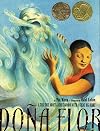
Doña Flor: A Tall Tale about a Giant Woman with a Great Big Heart
by Pat Mora
On This Page
Description
Doña Flor, a giant lady with a big heart, sets off to protect her neighbors from what they think is a dangerous animal, but soon discovers the tiny secret behind the huge noise.Tags
Recommendations

Member Reviews
The giant Doña Flor looks out for her smaller neighbors in this original Tall Tale, set in the American Southwest, from author Pat Mora and illustrator Raúl Colón. Whether reading to the children or baking massive tortillas that can be used as roofs or rafts, she is constantly working to help others. But when the whole neighborhood is frightened by the terrible roar of a massive puma, our greathearted heroine has trouble finding the threatening cat. Still, Doña Flor persists, and eventually finds someone else who needs a friend...
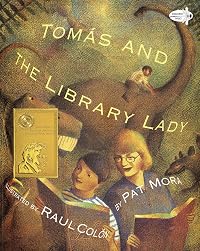
I greatly enjoyed Tomás and the Library Lady, the previous collaboration between this author and illustrator, so I picked up Doña Flor: A Tall Tale about a Giant Woman with a Great Big Heart with every show more expectation of loving it. I was not disappointed, as I discovered an engaging and heartwarming tale about a friendly giant, one in the best tradition of such American Tall Tale heroes as Paul Bunyan, and absolutely lovely artwork. It's easy to see why Raúl Colón won a Pura Belpré Medal for illustration! His use of color and shape, the soft but somehow well-defined figures in his paintings - they all combine to create beautiful scenes. Recommended to anyone who enjoys Tall Tales about friendly giants, or who is looking for picture-books with a Latino cultural setting. show less
I greatly enjoyed Tomás and the Library Lady, the previous collaboration between this author and illustrator, so I picked up Doña Flor: A Tall Tale about a Giant Woman with a Great Big Heart with every show more expectation of loving it. I was not disappointed, as I discovered an engaging and heartwarming tale about a friendly giant, one in the best tradition of such American Tall Tale heroes as Paul Bunyan, and absolutely lovely artwork. It's easy to see why Raúl Colón won a Pura Belpré Medal for illustration! His use of color and shape, the soft but somehow well-defined figures in his paintings - they all combine to create beautiful scenes. Recommended to anyone who enjoys Tall Tales about friendly giants, or who is looking for picture-books with a Latino cultural setting. show less
Pat Mora's, Doña Flor: A Tall Tale About a Giant Lady with a Big Heart, has the hallmarks of a classic tall tale, a multi-faceted heroine and rich details. Despite her overarching kindness, Dona Flor can be tired - as when the wind keeps her from sleep, angry - as she stomps off to find the puma that annoys the village, and indulgent - as she takes a "long, hot bubble bath," the smell of roses rising from the chimney. Her size and kindness are communicated expressively. "When she worked, Flor sang, and birds came and built nests in her hair."
"She gave the school band her hollyhocks to use as trumpets. The music smelled like spring."
Mora introduces multiple Spanish words in Doña Flor with varying techniques and effect. Literal show more translations are clear to the reader, but interrupt the story flow. "'¿Dónde estás? Where are you?' called her worried neighbors." Nonliteral translations include "Everyone called her Doña Flor because they respected her." and ""Mi casa es su casa," she said...so they knew they were always welcome." Most pleasing are the untranslated words, "Are you the chico who's causing all the trouble?" "Why, you're just a kitten to me, Pumito." These passages allow a smooth rhythm to the story with unfamiliar words fitting contextually into the sentence.
In addition to Spanish words, Doña Flor contains many textual references to the story's Southwest setting. Tortillas are prominently featured in the story; Flor makes tortillas with her huge "plate-sized" hands. The children use them as rafts and villagers use them as roofs for their homes. The village or pueblo is filled with adobe homes and is located near a tall mesa. Pumas, rattlers and coyotes inhabit the village.
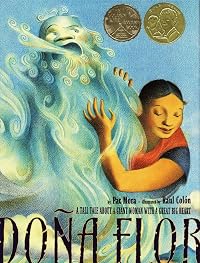
Raúl Colon's award winning illustrations are a "combination of watercolor washes, etching, and colored and litho pencils." The muted, yet varied colors, evoke the Southwest atmosphere - dry and serene, yet not without life. Dona Flor herself has skin the color of the Southwestern soil, lips the color of adobe walls, and luxurious long dark hair - wrapped in a braided bun for the day's work and flying loose in the starlight sky at night. She appears to be a child of the Southwest earth itself. Her benevolent brown eye peers in the doorway of a village family. The home is adorned with a woven rug, a clay pot, and a sombrero; and although her eye fills much of the doorway, it does not inspire fear. Her giant tortillas provide rafts for the children, and in the evening, she envelops herself in a woven blanket, cradling the village creatures in her arms. Next to Doña Flor, the sky is the prominent feature in most of Doña Flor's illustrations portraying the vastness of the Southwest; dwarfing the whitewashed adobe homes and tiny villagers dressed in long skirts, serapes, and sombreros.
Doña Flor is an inventive tall tale, beautifully illustrated and told with rich details. When the sun shines upon the giant tortilla roofs of the villagers, the reader can almost smell the corn baking. "Mmmm, the houses smelled corn-good when the sun was hot." It also is a story with deep connections to the earth. Flor's mother sings to her in a voice as "sweet as river music," and in the evening, Flor makes her bed, filling her arms "with clouds smelling of flowery breezes." This is not a retelling or variation of a traditional tale. Readers will enjoy the fresh plot and it's surprising ending, as Flor finds the littlest mountain lion making the biggest of noises.
CONNECTIONS
Read the Doña Flor audience-participation poems on Pat Mora's website. http://www.patmora.com/ideas_dona.htm This is suitable for very young children and public library storytime as well.
Read this story with other "tall-tale heroine" books -
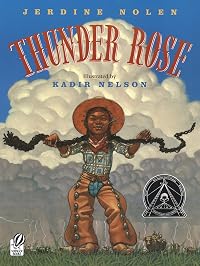
Thunder Rose, by Jerdine Nolan and Ill. by Kadidr Nelson and Sitka Rose by Shelley Gill and Ill. by Shannon Cartwright. show less
"She gave the school band her hollyhocks to use as trumpets. The music smelled like spring."
Mora introduces multiple Spanish words in Doña Flor with varying techniques and effect. Literal show more translations are clear to the reader, but interrupt the story flow. "'¿Dónde estás? Where are you?' called her worried neighbors." Nonliteral translations include "Everyone called her Doña Flor because they respected her." and ""Mi casa es su casa," she said...so they knew they were always welcome." Most pleasing are the untranslated words, "Are you the chico who's causing all the trouble?" "Why, you're just a kitten to me, Pumito." These passages allow a smooth rhythm to the story with unfamiliar words fitting contextually into the sentence.
In addition to Spanish words, Doña Flor contains many textual references to the story's Southwest setting. Tortillas are prominently featured in the story; Flor makes tortillas with her huge "plate-sized" hands. The children use them as rafts and villagers use them as roofs for their homes. The village or pueblo is filled with adobe homes and is located near a tall mesa. Pumas, rattlers and coyotes inhabit the village.
Raúl Colon's award winning illustrations are a "combination of watercolor washes, etching, and colored and litho pencils." The muted, yet varied colors, evoke the Southwest atmosphere - dry and serene, yet not without life. Dona Flor herself has skin the color of the Southwestern soil, lips the color of adobe walls, and luxurious long dark hair - wrapped in a braided bun for the day's work and flying loose in the starlight sky at night. She appears to be a child of the Southwest earth itself. Her benevolent brown eye peers in the doorway of a village family. The home is adorned with a woven rug, a clay pot, and a sombrero; and although her eye fills much of the doorway, it does not inspire fear. Her giant tortillas provide rafts for the children, and in the evening, she envelops herself in a woven blanket, cradling the village creatures in her arms. Next to Doña Flor, the sky is the prominent feature in most of Doña Flor's illustrations portraying the vastness of the Southwest; dwarfing the whitewashed adobe homes and tiny villagers dressed in long skirts, serapes, and sombreros.
Doña Flor is an inventive tall tale, beautifully illustrated and told with rich details. When the sun shines upon the giant tortilla roofs of the villagers, the reader can almost smell the corn baking. "Mmmm, the houses smelled corn-good when the sun was hot." It also is a story with deep connections to the earth. Flor's mother sings to her in a voice as "sweet as river music," and in the evening, Flor makes her bed, filling her arms "with clouds smelling of flowery breezes." This is not a retelling or variation of a traditional tale. Readers will enjoy the fresh plot and it's surprising ending, as Flor finds the littlest mountain lion making the biggest of noises.
CONNECTIONS
Read the Doña Flor audience-participation poems on Pat Mora's website. http://www.patmora.com/ideas_dona.htm This is suitable for very young children and public library storytime as well.
Read this story with other "tall-tale heroine" books -
Thunder Rose, by Jerdine Nolan and Ill. by Kadidr Nelson and Sitka Rose by Shelley Gill and Ill. by Shannon Cartwright. show less
Summary:
Doña Flor by Pat Mora is a classic literature book about a girl whose mother sang to her and her corn plants. Her corn plants grew tall as trees, as did Doña Flor. Some of the children laughed at Doña Flor because she was so big and tall. But soon the children realized Doña Flor could help them by giving them a ride to school. Doña Flor made tortillas. Once she was done making them, she would stack them on a rock table in front of her house. The people of the village would use the extra tortillas a roofs and the children would use them as rafts in the pond. One day Doña Flor was delivering stacks of fresh tortillas but no one was outside. She knocked on a door to find out what was wrong and why no one was outside. They show more whispered to Doña Flor, "¡El Puma!" which is the cognate for a puma. That night Flor and a mixture of animals went out searching for the huge cat, but could not find it. A few days went by and Doña Flor could still not find the puma. Everyone in the village was still worried about the puma and Doña Flor knew they were not happy. She made them a new river, which made her neighbors smile, however they still heard a loud roar. Doña Flor went searching for the puma and because she could speak every language, including animals, she asked the snake and a deer where to find the huge cat. Finally the rabbits told Doña Flor where she could find the puma. She then saw a small black puma roaring into a hollow tree stump which was making his roar louder. Doña Flor started petting the cat and he started licking Flor's face. She took the cat home with her and when she went to bed, the puma slept over her big toes.
Personal Reaction:
This book is very good because of the Spanish words mixed in with English. I like how it adds two different cultures into one book. I also liked how, even though Doña Flor was different than everyone else in the village, they soon realized she was nice and could actually help them. The plot of this book keeps readers on edge when Doña Flor cannot find the large puma cat. The theme of this book taught the village people a lesson when they realized Flor was nice and could help them even though she is a giant. I would use this book in my classroom to teach students some Spanish words and also about not judging people on how they look.
Classroom Extensions:
In my classroom, I would use this book to teach students certain Spanish words and easily recognizable cognates. This will help my students to be more understanding of people from different cultures. Another extension I would include is having each student draw, paint and color what they imagine Doña Flor looks like before looking at the book's illustrations. I will then teach them that what the children did in the book is that they made a judgement without basing it from facts and knowledge. show less
Doña Flor by Pat Mora is a classic literature book about a girl whose mother sang to her and her corn plants. Her corn plants grew tall as trees, as did Doña Flor. Some of the children laughed at Doña Flor because she was so big and tall. But soon the children realized Doña Flor could help them by giving them a ride to school. Doña Flor made tortillas. Once she was done making them, she would stack them on a rock table in front of her house. The people of the village would use the extra tortillas a roofs and the children would use them as rafts in the pond. One day Doña Flor was delivering stacks of fresh tortillas but no one was outside. She knocked on a door to find out what was wrong and why no one was outside. They show more whispered to Doña Flor, "¡El Puma!" which is the cognate for a puma. That night Flor and a mixture of animals went out searching for the huge cat, but could not find it. A few days went by and Doña Flor could still not find the puma. Everyone in the village was still worried about the puma and Doña Flor knew they were not happy. She made them a new river, which made her neighbors smile, however they still heard a loud roar. Doña Flor went searching for the puma and because she could speak every language, including animals, she asked the snake and a deer where to find the huge cat. Finally the rabbits told Doña Flor where she could find the puma. She then saw a small black puma roaring into a hollow tree stump which was making his roar louder. Doña Flor started petting the cat and he started licking Flor's face. She took the cat home with her and when she went to bed, the puma slept over her big toes.
Personal Reaction:
This book is very good because of the Spanish words mixed in with English. I like how it adds two different cultures into one book. I also liked how, even though Doña Flor was different than everyone else in the village, they soon realized she was nice and could actually help them. The plot of this book keeps readers on edge when Doña Flor cannot find the large puma cat. The theme of this book taught the village people a lesson when they realized Flor was nice and could help them even though she is a giant. I would use this book in my classroom to teach students some Spanish words and also about not judging people on how they look.
Classroom Extensions:
In my classroom, I would use this book to teach students certain Spanish words and easily recognizable cognates. This will help my students to be more understanding of people from different cultures. Another extension I would include is having each student draw, paint and color what they imagine Doña Flor looks like before looking at the book's illustrations. I will then teach them that what the children did in the book is that they made a judgement without basing it from facts and knowledge. show less
Ages 4-8.
Dona Flor is an original tall tale about a giant woman who loves to help her neighbors. She reads to children and animals as they climb over her, brings a river to the village, and plucks stars from the sky to light her neighbors’ way. When the village becomes frightened by the roar of what they imagine is a terrifying creature, Dona Flor sets off to save the day and discovers all is not as it seems.
Readers will be enchanted by the book’s wonderful imagery: roots so big people can hear them growing, roofs made out of tortillas that smell like corn in the warm sun, and musical notes trumpeting from giant flowers. Dona Flor shows children that even imaginary worlds need descriptions that engage the senses.
The text show more incorporates Spanish words and phrases, reflecting the culture of Dona Flor’s village in the American Southwest. Spanish text is either given next to the English equivalent, or is understood through context.
Colon uses a combination of watercolors, washes and etching to create visually arresting illustrations that complement the warmth and wonder of the text. The resulting mix of textures, shades, and hues will fascinate children and adults alike.
Readers will want to listen to Dona Flor’s big hearted adventures again and again. Highly recommended. show less
Dona Flor is an original tall tale about a giant woman who loves to help her neighbors. She reads to children and animals as they climb over her, brings a river to the village, and plucks stars from the sky to light her neighbors’ way. When the village becomes frightened by the roar of what they imagine is a terrifying creature, Dona Flor sets off to save the day and discovers all is not as it seems.
Readers will be enchanted by the book’s wonderful imagery: roots so big people can hear them growing, roofs made out of tortillas that smell like corn in the warm sun, and musical notes trumpeting from giant flowers. Dona Flor shows children that even imaginary worlds need descriptions that engage the senses.
The text show more incorporates Spanish words and phrases, reflecting the culture of Dona Flor’s village in the American Southwest. Spanish text is either given next to the English equivalent, or is understood through context.
Colon uses a combination of watercolors, washes and etching to create visually arresting illustrations that complement the warmth and wonder of the text. The resulting mix of textures, shades, and hues will fascinate children and adults alike.
Readers will want to listen to Dona Flor’s big hearted adventures again and again. Highly recommended. show less
Dona Flor is a great tale. I loved the page where she finally finds the ferocious cat, who is actually a normal sized cat who is growling through a hollow log. The illustrations were just great. I love folk tales like this and am always excited to find new ones. This would be a great addition to any folktale or tall tale unit. As well as a good teaching tool about friendship, diversity, and bullying. There are also several Spanish words with translation.
Pat Mora begins this story by introducing a woman who sang to the land and sang to her daughter everyday, with a voice that was sweet like river music. Just like the plants in the land, the little girl never stopped growing and grew to be taller than the tallest trees. She was loved by everyone in her community and took care of everyone on the land. She read stories to the kids and animals and plants, and she made the biggest tortillas ever that the people used for roofs and even little rafts. One day the people heard a loud roar from somewhere in the village and went into hiding. Everyone was too scared to come to Flor's story times, and they continued to run home scared when they heard the roar day after day. Flor was beginning to get show more frustrated with the roar, because she couldn't find where it was coming from, and didn't like that her animal and people friends were scared. She seeked help from her friends and they pointed her to the tallest mountain in the area, where Flor found a little tiny puma, roaring loud into a big tree trunk. When the puma roared at Flor she laughed with relief because he wasn't a big scary puma, after all. She ran to the village, proclaiming what she had discovered, and all her friends were happy! She fluffed a super soft cloud bed that night and went to sleep. I especially love that this story shows love and kindness from Flor. She is frustrated when her friends are upset and seeks help to figure out how to make them less scared. The story also hints at the idea that it's always better to have people there. Flor helped her friends to be less scared with her confidence, and they helped her to reveal the puma's true identity. In the end, they both helped each other. show less
This is a story about a Giant Woman who was very different from the rest but was very generous with the people in her neighbourhood. She sets off to protect her neighbors from what they think is a dangerous animal, but they soon discover the tiny secret behind the huge noise.
Grade: 2nd-4th
The book had great illustrations and a unique medium for the illustrations that helped enhance the story and understanding of the tale. The story’s incorporation of the Spanish language enriches the cultural setting in a natural, inviting way. The author does a beautiful job of representing Dona Flor as a beautiful example of how strength and gentleness can coexist.
Grade: 2nd-4th
The book had great illustrations and a unique medium for the illustrations that helped enhance the story and understanding of the tale. The story’s incorporation of the Spanish language enriches the cultural setting in a natural, inviting way. The author does a beautiful job of representing Dona Flor as a beautiful example of how strength and gentleness can coexist.
Members
- Recently Added By
Author Information

70+ Works 8,945 Members
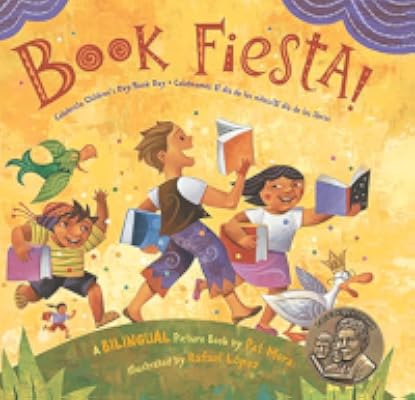
Pat Mora is a bilingual author with a special focus on children's literature. Among her awards are Honorary Doctorates from North Carolina State University and SUNY Buffalo, Honorary Membership in the American Library Association, Life-Time Membership in USBBY, a Civitella Ranieri Fellowship to write in Umbria, Italy, and a Distinguished Alumni show more Award from the University of Texas at El Paso. She was a recipient and judge of a Poetry Fellowship from the National Endowment for the Arts and a recipient and advisor of the Kellogg National Leadership Fellowships. Her children's books include: Water Rolls, Water Rises/El agua rueda, el agua sube. With her daughter, Libby Martinez, Pat also recently wrote I Pledge Allegiance and Bravo, Chico Canta! Bravo!. A literacy advocate, Pat founded Children's Day, Book Day, El día de los niños, El día de los libros often known as Día. The year-long commitment promotes creatively linking all children and families to books, and establishing annual April Children's Day, Book Day celebrations across the country. April 2016 will be Día's 20th Anniversary. Pat's Book Fiesta captures the Día spirit. A former teacher, university administrator, museum director, and consultant, Pat is a popular national speaker who promotes creativity, inclusivity and bookjoy. (Bowker Author Biography) show less
All Editions
Awards and Honors
Awards
Distinctions
Common Knowledge
- Canonical title
- Doña Flor: A Tall Tale about a Giant Woman with a Great Big Heart
Classifications
Statistics
- Members
- 515
- Popularity
- 58,180
- Reviews
- 55
- Rating
- (3.97)
- Languages
- English, Spanish
- Media
- Paper, Audiobook, Ebook
- ISBNs
- 19
- ASINs
- 4