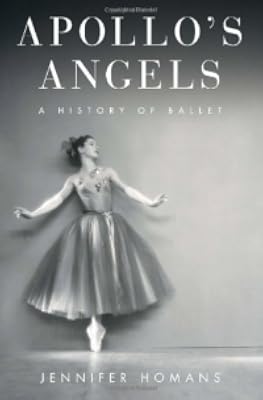
Apollo's Angels : A History of Ballet
by Jennifer Homans
On This Page
Description
Unique among the arts, ballet has no written texts or standardized notation. It is a storytelling art passed on from teacher to student. A ballerina dancing today is a link in a long chain of dancers stretching back to sixteenth-century Italy and France: Her graceful movements recall a lost world of courts, kings, and aristocracy, but her steps are also marked by the dramatic changes in dance and culture that followed. From ballet's origins in the Renaissance and the codification of its show more basic steps and positions under France's Louis XIV (himself an avid dancer), the art form wound its way through the courts of Europe, from Paris and Milan to Vienna and St. Petersburg. Jennifer Homans, a historian and critic who was also a professional dancer, traces the evolution of technique, choreography, and performance in clear prose, drawing readers into the intricacies of the art with vivid descriptions of dances and the artists who made them.--From publisher description. show lessTags
Recommendations















Member Recommendations
Member Reviews
This well written history of classical ballet suffers from the author's frustration that her story arc does not pay off. In her view, ballet was born in France (helped by an Italian midwife). At the end of the 19th century, the Russians took up the torch and even through the Soviet years carried ballet forward. Finally, the winners of the Cold War and God's chosen country, the United States of America was supposed to take over the mantle and reign supreme in the world of ballet. Alas, it didn't happen. Despite all the struggles of George Balanchine, ballet never became an American art. This might have given pause to the author and venture into a deeper analysis of the success factors of ballet.
One factor is structural. Ballet requires show more high inequality to thrive, an impoverished mass to supply the bodies to be trained, a factor well matched in the US. The next factor is barely achieved in the US: A localized court that dominates the fashion and entertainment discourse. The cultural influence of New York, Chicago, LA and Washington D.C. on the rest of the country is trivial compared to the magnetism of Paris, St. Petersburg and Moscow in their heyday. Americans coming to town are much more likely to watch a musical or go to Radio City Music Hall. a classical ballet is a hard sell. Most audiences, furthermore, lack the necessary knowledge to appreciate the dancer's skills and moves beyond an emotional reaction. Even in Europe, ballet tickets are usually shuffled into opera season tickets. Finally, the training of ballet dancers requires government support to dedicated institutions. The end of the Cold War has reduced the need for the US government for showcase investments.
Given the limited contemporary influence of classical ballet, one way out of the dilemma would have been to develop the connections of ballet to modern dance and the supporting function of ballet dancers in opera and musical productions. The smaller venues of modern dance allow for more artistic and innovative expression. Homans, however, restricts her view to the wedding cake part of ballet, the big stand alone evening attraction. Her own book shows that for most of its history, ballet was always integrated into a wider show business block. Like classical music, ballet is pushed either towards established repertoire fare or into a supporting function.
A chapter about modern European ballet is certainly missing, as is a chapter on the early renaissance spectacles in Italy. Read it for the non-American chapters. show less
One factor is structural. Ballet requires show more high inequality to thrive, an impoverished mass to supply the bodies to be trained, a factor well matched in the US. The next factor is barely achieved in the US: A localized court that dominates the fashion and entertainment discourse. The cultural influence of New York, Chicago, LA and Washington D.C. on the rest of the country is trivial compared to the magnetism of Paris, St. Petersburg and Moscow in their heyday. Americans coming to town are much more likely to watch a musical or go to Radio City Music Hall. a classical ballet is a hard sell. Most audiences, furthermore, lack the necessary knowledge to appreciate the dancer's skills and moves beyond an emotional reaction. Even in Europe, ballet tickets are usually shuffled into opera season tickets. Finally, the training of ballet dancers requires government support to dedicated institutions. The end of the Cold War has reduced the need for the US government for showcase investments.
Given the limited contemporary influence of classical ballet, one way out of the dilemma would have been to develop the connections of ballet to modern dance and the supporting function of ballet dancers in opera and musical productions. The smaller venues of modern dance allow for more artistic and innovative expression. Homans, however, restricts her view to the wedding cake part of ballet, the big stand alone evening attraction. Her own book shows that for most of its history, ballet was always integrated into a wider show business block. Like classical music, ballet is pushed either towards established repertoire fare or into a supporting function.
A chapter about modern European ballet is certainly missing, as is a chapter on the early renaissance spectacles in Italy. Read it for the non-American chapters. show less
It has taken me a while to read 'Apollo's Angels' as there is a lot of it. It's heavy, both literally and figuratively. Quite a lot of effort, but worth it. Although I have a long standing fascination with ballet, my knowledge of its past was extremely sketchy and largely based on novels I read before I turned 13. Homans provides a thorough and erudite account of ballet's five hundred year history. The chapters are divided between different national ballet traditions, ranging across France, Italy, Denmark, Russia, Britain, and finally the US. In general, I found the most rewarding parts those that analysed ballet's link with politics and culture. I was fascinated to learn how both the French and Russian Revolutions recast a royal art show more into new forms. The interplay between different national traditions was likewise interesting. Homans, a professional ballet dancer herself, has a lot of excellent insight into the complex and ambiguous meanings of ballet. On the other hand, the book was quite slow when concentrating on portraits of specific dancers and choreographers. Homans is more adept at historical narrative and analysis than biography, I think. Or perhaps that is just my personal preference.
The chapters about ballet in pre-revolutionary France and post-revolutionary Russia are perhaps the most compelling. I found this very striking:
A very interesting set of questions. George Orwell memorably wrote in The Prevention of Literature that poetry, art, architecture, and music can all be twisted to glorify totalitarianism, but literature cannot. Dance, it seems, can thrive in the same conditions that brutally suppressed prose fiction. I wondered if this peculiarity is linked to ballet's origins in the stifling hierarchy of the French Court? Perhaps ballet is an art that was born in such a narrow place that it suffers when offered too much freedom? Such an interpretation accords with Homans analysis of why Kenneth MacMillan failed to successfully lead the British Royal Ballet in the late 20th century:
The waxing and waning of ballet's popularity is worthy of study in itself, as it has a distinct and quite rigid aesthetic that seems to suit certain points in history better than others. There is an elitist and masochistic air about it, combining cultural markers of classical music and professional sport. Personally I enjoy it on a very simplistic level: the dancing just looks beautiful to me. I love Swan Lake most of all, and enjoyed the Matthew Bourne version so much that I went to see it several times. This book didn't so much shed light on why I enjoy ballet as provide exhaustive historical context for it.
Although Homans' own love of ballet comes through clearly, her tone is not at all celebratory. She has written an elegy, as she feels ballet is a dying art in the 21st century. She argues that the middle ground, between dancing only the classics and avant garde dance forms, is increasingly deserted. Less convincingly, she comments that for ballet to regain its former popularity, 'Honour and decorum, civility and taste would have to make a comeback'. This is hard to square with its success in Russian under Stalin, surely a time of dishonour, indecorousness, incivility, and tastelessness. Stalin loved ballet, of course. Perhaps ballet has not (yet?) found a niche in the 21st century. It is a nostalgic art, ideal for fables and fairytales; beautiful escapist spectacles are certainly not without appeal at the present time. Maybe at some point it will be rediscovered as an art form whose narrow limits enable a constrained but intricate creativity? While turgid at times, and rather too focused on specific 'masters' of choreography, 'Apollo's Angels' is an impressively thorough and thought-provoking work of history. show less
The chapters about ballet in pre-revolutionary France and post-revolutionary Russia are perhaps the most compelling. I found this very striking:
We are left with a seeming paradox: dance and dancers thrived in a repressive, ideologically driven police state. Worse, as we shall see, they produced their best and most lasting art in its cruellest years. It is easy to assume that art demands freedom, that creativity and the human spirit flourish only when individuals can openly express themselves, unfettered by outside authority and an oppressive state. But the Soviet example suggests otherwise: dance succeeded because of the state, not in spite of it. And if Soviet ballet did finally lapse into an artistic coma, paralysed by years of political pressure and sloganeering, we must nonetheless recognise that even then, at its lowest point, the Soviet system continued to produce some of the world's greatest dancers and most impressive ballets. Where did they come from? What was it that nourished their art?
A very interesting set of questions. George Orwell memorably wrote in The Prevention of Literature that poetry, art, architecture, and music can all be twisted to glorify totalitarianism, but literature cannot. Dance, it seems, can thrive in the same conditions that brutally suppressed prose fiction. I wondered if this peculiarity is linked to ballet's origins in the stifling hierarchy of the French Court? Perhaps ballet is an art that was born in such a narrow place that it suffers when offered too much freedom? Such an interpretation accords with Homans analysis of why Kenneth MacMillan failed to successfully lead the British Royal Ballet in the late 20th century:
It remains the central fact of MacMillan's career that he consistently sacrificed his talent to an obsessive desire to make ballet something it was not. He wanted ballet to be brutal and realistic, a theatrical art that could capture a generation's disillusionment and chart the depths of his own troubled emotions. It was an understandable impulse, but MacMillan completely misread the tradition he had inherited; or perhaps he believed in it too much. Instead of pushing ballet in new directions, he revealed its fundamental limits - and then failed to recognise them. Classical ballet is an art of formal principles; take those away and it disintegrates into crude pantomime. This does not mean that ballet cannot portray inner pain or even social despair, but it can only do so on its own terms, within its own bounds. MacMillan's ballets showed too many lapses in judgement and taste. By the end, he had reduced ballet's eloquent language to a series of barely audible grunts.
The waxing and waning of ballet's popularity is worthy of study in itself, as it has a distinct and quite rigid aesthetic that seems to suit certain points in history better than others. There is an elitist and masochistic air about it, combining cultural markers of classical music and professional sport. Personally I enjoy it on a very simplistic level: the dancing just looks beautiful to me. I love Swan Lake most of all, and enjoyed the Matthew Bourne version so much that I went to see it several times. This book didn't so much shed light on why I enjoy ballet as provide exhaustive historical context for it.
Although Homans' own love of ballet comes through clearly, her tone is not at all celebratory. She has written an elegy, as she feels ballet is a dying art in the 21st century. She argues that the middle ground, between dancing only the classics and avant garde dance forms, is increasingly deserted. Less convincingly, she comments that for ballet to regain its former popularity, 'Honour and decorum, civility and taste would have to make a comeback'. This is hard to square with its success in Russian under Stalin, surely a time of dishonour, indecorousness, incivility, and tastelessness. Stalin loved ballet, of course. Perhaps ballet has not (yet?) found a niche in the 21st century. It is a nostalgic art, ideal for fables and fairytales; beautiful escapist spectacles are certainly not without appeal at the present time. Maybe at some point it will be rediscovered as an art form whose narrow limits enable a constrained but intricate creativity? While turgid at times, and rather too focused on specific 'masters' of choreography, 'Apollo's Angels' is an impressively thorough and thought-provoking work of history. show less
To my surprise, this appears to be the first general history of ballet ever written. That's a real shame, because as Homans shows, ballet is more than just another slowly dying elite artform like opera. Not only is it intimately linked to the other cornerstones of Western culture like music, theater, and film, it continues to set the standard for demonstrating how the movement of the body can produce beauty. You don't have to be a ballet fanatic to enjoy this book, but some familiarity helps, as she deeply explores the history of the form; its artistic movements; the cultural influence of France, Italy, and especially Russia; the major composers, choreographers, and dancers; and of course the actual ballets themselves, explaining much show more of the symbolism that a layman like myself would not have noticed otherwise. Homans danced with George Balanchine's School of American Ballet for several years, and so her intimate understanding of ballet's appeal to both the head and the heart is apparent on every page, and even though she writes with sadness of the passing of ballet's glory years, your "to watch" list will still be quite large after finishing.
My own history with ballet is basically limited to seeing performances of The Nutcracker at Christmas when I was a kid, although I have a fairly extensive musical background. I was in marching band in high school, which gave me an appreciation for the difficulty involved in coordinating many people's motions to produce an aesthetic effect, we performed many pieces which were originally written to accompany ballets, and as a big classical music fan I've always loved many of the scores to famous ballets like Sleeping Beauty, Romeo and Juliet, or The Firebird. What originally led to me this book, though, was reading Andrei Tarkovsky's autobiography Sculpting in Time, with his opinionated ranting about the purity of film. Since I've always thought of film as a composite art form (usually requiring not only camera work itself but also screenwriting, makeup, costuming, scenery, lighting, music, sound effects, editing, etc), I immediately thought to contrast film with another art form that also involves many of the same elements, but I realized I didn't actually know anything about ballet as an art form itself. Since only being familiar with the score to a ballet is like only having heard the soundtrack to a movie, I figured it was best to actually read something about it. Homans talks about the dances, but also the men and women who put them on, and what animated them.
Dancing itself is of course older than civilization, but ballet as we understand it dates from the 16th century, as Catherine de Medici imported some of her native Italian culture of dance to her new home in France when she became Queen. Initially centered around the French royal court, it gradually absorbed more popular influences and spread across Europe and the rest of the world due to the force of French prestige. Interestingly, the conventions of ballet were very male-dominated for a long time, since monarchs like Louis XIV used dancing skill as a way to control their courts, where poor form could lead to embarrassment or even demotion. Women's roles gained more importance later on, as ballets like Giselle or La Sylphide, which prominently featured what we now think of as the beautiful, graceful, feminine ballerina, became popular, but at first ballet was an inward, aristocratic art which wasn't so strongly focused on drama and narrative. That association of ballet with elites both helped and hurt it: ballet can be very expensive to create and perform, so appealing to the tastes of the rich and powerful was a practical necessity. However, that elevated position not only left ballet perilously exposed to political turbulence, it also left it in an uneasy artistic dialogue with other art forms like pantomime, which could claim more popular appeal, even if ballet has had the more lasting appeal precisely because of its association with the aristocracy.
Elite-driven nationalism has played a large role in ballet from the beginning. While France made the art glamorous, particularly once the ballerina became an icon of beauty, it didn't own the art exclusively and in fact for a time Vienna rivaled Paris as an artistic center, particularly because of its traditional dominance in classical music. Dancers like Marie Taglioni, born in Stockholm to an Italian choreographer, perfecting her art in Vienna, before moving on to Paris, were emblematic of how the art crossed national boundaries as each country attempted to one-up its rivals. There's a chapter on Danish and Scandinavian ballet that makes this clear: choreographer August Bournonville, who had a French father and mastered dancing in Paris, returned to his native Copenhagen to lead the Danish Royal Ballet, even as the French Romantic style, as exemplified by his version of La Sylphide, continued to be his ideal. Yet even as he worked to create a Danish idiom modeled on the French one, the work he felt most passionate about was Napoli, whose exotic rendering of Italian dancing styles was based on a romanticized memory of a vacation to Naples. Yet despite this attempt to absorb foreign influence, the end of his life was marked by an increasing artistic conservativism. However, his rigid aesthetic did in fact give Denmark a distinct style, which it might not have had without his nationalism. Even Hans Christian Andersen was encouraged to become a ballet dancer (Bournonville suggested his concentrate on his writing instead).
That entanglement of politics and dance is most prominent in the Russian chapters, but it applies to Italy as well. The chapter in Italian ballet raises and answers a great question I'd never thought of before: why did Italy, which produced many great operas, not produce much great ballet, and then mainly through expatriates and their descendants like Marie Taglioni? Homans' answer is that turmoil in Italy's fragmented political structure at crucial moments in the history of ballet were crippling for its ability to grow its own traditions, and that of the higher arts ballet was uniquely vulnerable due to its lack of a universal written notation to preserve dances, efforts by Pierre Beauchamp and Raoul-Auger Feuillet notwithstanding. Whereas it's easy to preserve the score to an opera or symphony and then reconstitute an orchestra to play it, the same is not true with a ballet and its dancers: a ballet's steps are primarily passed down from dancer to dancer, and therefore much more vulnerable to the ravages of time (hence the great importance and influence of "schools" under particular instructors). Countries like France had centralized aristocracies to preserve favored forms, but as each Italian principality underwent revolution or invasion in the 18th and 19th centuries, they had fewer resources to preserve dances, instructors, traditions, etc. So even though in good times ballets used to be performed right alongside operas, after the revolutionary chaos died down the ballets didn't come back.
Russia, of course, escaped this post-revolutionary artistic death in a peculiar way. Though ballet has many classical Greco-Roman aspects to it (hence the book's title, a reference to the 9 Muses), and was primarily French for several centuries, the Francophile Russians eventually came to own the artform due to Imperial patronage and the relentless pressure to make Russia a world power. There's a fascinating discussion of how choreographers like Marius Petipa, originally from France, and composers like Pyotr Tchaikovsky struggled with the idealized native Russian culture and the European influences they were attempting to absorb and transcend (this same conflict was famously fictionalized in Tolstoy's War and Peace). For example, here's one short section about artistic innovation in Sleeping Beauty, one of the most enduring of the Russian ballets:
"Petipa, however, did more than just repeat the tricks he learned from these Italians. He had a concrete, technical mind - he was interested in the mechanics of the steps and readily grasped the Italian innovations, particularly in pointe work - but he also had a deep appreciation of the architecture and physics of ballet, and he knew, or learned, how to refine and discipline their bombast and enthusiasm to give them a depth and dimension they lacked hitherto. In the Rose Adagio, for example, in which the princess is courted by four princes hoping to win her hand in marriage, the ballerina must balance on one leg as each of her suitors takes her hand and then leaves her to make way for the next. This kind of balance, in which the ballerina is left standing perilously alone on a single pointe, was a typical Italian stunt. But Petipa transformed it into a poetic metaphor. Sustained by the lyricism of Tchaikovsky's music, the ballerina's balance represents her independence and strength of character: it was no longer a trick but a test of free will."
A confluence of skilled dancers, talented choreographers, and inventive musicians ensured that the pre-revolutionary ballets like Sleeping Beauty, Swan Lake, The Nutcracker, and more have defined ballet for most modern aficionados. However, after the Communist revolution the art had the same issues with censorship as all others. The section on the refusal of Serge Diaghilev and his Ballets Russes company to return to the country after 1917 reminded me strongly of Richard Stites' Revolutionary Dreams, where many talented authors who were full of enthusiasm for revolution and progress in the abstract were eventually ground down by the horror of the actual revolutionary government. This artistic turmoil only intensified in the Stalin years, even though being a ballet dancer in the USSR carried great prestige and privileges. Homans explains what that pressure from the leadership meant to the dancers (the discussions of the artistic differences between the Western-minded Leningrad-based Kirov Theater and the more nativist Moscow-based Bolshoi are very interesting), but she never forgets to return to the dancing. Take her explanation of the appeal of Maya Plisetskaya versus her artistic rival Galina Ulanova:
"As a performer, Plisetskaya excelled in the hard-edged, technically demanding roles that Ulanova eschewed: Raymonda, the black swan in Swan Lake, Kitri in Don Quixote. She never danced the role of Giselle ("something in me opposed it, resisted, argued with it"), but instead played the iron-willed queen of the wilis. She was also the jealous, seductive harem girl - not the "good" Maria - in The Fountain of Bakhchisarai. Physically this made sense: Plisetskaya was beefy and strong, with thick legs and a muscular back. Stylistically, her movements were hard and unyielding, never elegant or polite. Her technique was raw but powerful - she lacked the refinement of the Kirov school, but could save a step or pull herself back into alignment from a dangerously off-balance position by dint of sheer force. Films of Plisetskaya's performances show her throwing herself into dancing with an abandon few ballerinas would dare, and in her sharp light, Ulanova's restrained purity can take on the paler glow of piety. She was brazen and often moved with questionable taste. "I knew some things, others I stole, some I figured out myself, took advice, blundered through. And it was all haphazard, random." But there was also something appealing about her garishness: she was unpretentious, refreshing, direct. She did not hold back."
While Plisetskaya, like the majority of ballet artists, stayed in the Soviet Union, many of them availed themselves of the time-honored option of so many Russians throughout history, and simply left. This was bad for Russian ballet, but great for world ballet: "There was a certain poetic logic to the situation: if the Russians had spent the better part of the nineteenth century absorbing French and Italian ballet and making it Russian, the Europeans in turn spent the twentieth century absorbing Russian ballet and making it their own. The twentieth century in dance did not belong to the Soviets, but it did belong to the Russians - not at home, but in exile in the West."
I had known vaguely of some British connection to ballet - chiefly that the great economist John Maynard Keynes had married a ballerina - but Homans' treatment of how the postwar British government promoted ballet as a classical art was quite revealing, both in how different the modern version of "creating a national ballet culture" worked in the 20th century than the 19th, and also in showing how personal the connection to ballet was for Keynes and the rest of his circle. Ballet is a highly sensual art, not only for the performers but also for the viewers, and the sexual fluidity of the elite Bloomsbury Circle that Keynes was a member of juxtaposed with the high-minded rhetoric about encouraging public appreciation for the arts is amusing but also enlightening, especially in how it was reflected in the dancers themselves, who always seem to have had fairly eventful sex lives. Ballet was beginning to take on its modern form of a primarily female audience (the loss of many male dancers to the draft in World War 2 seems to have permanently altered ballet's appeal and fanbase in the West), yet the primarily male members of the British elite still thought of it as a valuable cultural patrimony. Unfortunately, they were fighting against an unseen cultural revolution, and though they managed to produce forces like Ninette de Valois, Frederick Ashton, and Kenneth MacMillan, the grim malaise of the Thatcher years would soon permanently steal the energy from British ballet.
It was different in the United States. Homans spends by far the most time discussing the American ballet scene and its works, not only because of her personal connection to George Balanchine, but because even though the Soviet Union bragged about its dominance, it was continually shedding many of its greatest talents to America. While she does talk about American attempts to fashion a homegrown ballet culture, the US had the most success in either adapting foreign talent to American themes (e.g. West Side Story) or following their own artistic voices (e.g. most of Balanchine's oeuvre). She's particularly insightful about Balanchine's more modern dances like Agon, with their abstract themes, lack of narrative, and unconventional dances. That rejection of the traditional in the pursuit of situating the heritage of ballet in a contemporary context perhaps explains his attitude towards explanation of his works: "Must everything be defined by words?" he once complained. "When you place flowers on a table, are you affirming or denying or disproving anything? You like flowers because they are beautiful.... I only wish to prove the dance by dancing." That "res ipsa loquitur" philosophy makes for a neat contrast to that of Lincoln Kirstein, with Balanchine a cofounder of the New York City Ballet:
"In dance, he despised what he took to be the self-indulgent excesses of Romanticism - exemplified by the nightly "ritual suicides" of diva ballerinas in Giselle - and was equally unforgiving of contemporary American modern dance, which seemed to him a flagrant display of ego masquerading as art; Martha Graham's dances, he once said, were "a cross between shitting and belching." He would similarly scoff at abstract expressionism in painting, seeing in it a willful rejection of the skill and tradition that he took to be the premise of artistic endeavor. Representation and the human figure, he insisted, were the ground zero of Western art. Classical ballet seemed to stand for everything that Kirstein cared about."
Unfortunately, as the melancholy epilogue opines, ballet seems to be a dying art, or at least to be in a hibernation period until it becomes popular again (yes, she uses the Sleeping Beauty metaphor). I wish she would have discussed hard numbers - she doesn't quote company revenues, attendance figures, or dance class enrollment statistics - but I think she's right that ballet has in many ways become limited to what I experienced, namely Christmas trips to see The Nutcracker. One reason that Shakespeare has lasted so long is that actors love him since he gives them such good lines, but the same isn't true for dance: as the old choreographers die off, it's hard to dance their old steps. Modern technology solves the notation problem by allowing for recordings of steps and choreography, yet that can paradoxically freeze the art in time, which isn't the right answer either. I'm not sure whether ballet is still as lively as ever or if it's like Frank Zappa once said about jazz, that "it's not dead, it just smells funny". But a true fan should have hope. Zappa is also often credited with the line that "writing about music is like dancing about architecture", and though to my knowledge no one ever took up the challenge of writing a ballet about Art Deco or the International Style, it turns out that it's perfectly possible to write about dance with insight, appreciation, and grace. Nothing replaces seeing a performance, but Homans does her best to explain dance, its history, and why it matters. show less
My own history with ballet is basically limited to seeing performances of The Nutcracker at Christmas when I was a kid, although I have a fairly extensive musical background. I was in marching band in high school, which gave me an appreciation for the difficulty involved in coordinating many people's motions to produce an aesthetic effect, we performed many pieces which were originally written to accompany ballets, and as a big classical music fan I've always loved many of the scores to famous ballets like Sleeping Beauty, Romeo and Juliet, or The Firebird. What originally led to me this book, though, was reading Andrei Tarkovsky's autobiography Sculpting in Time, with his opinionated ranting about the purity of film. Since I've always thought of film as a composite art form (usually requiring not only camera work itself but also screenwriting, makeup, costuming, scenery, lighting, music, sound effects, editing, etc), I immediately thought to contrast film with another art form that also involves many of the same elements, but I realized I didn't actually know anything about ballet as an art form itself. Since only being familiar with the score to a ballet is like only having heard the soundtrack to a movie, I figured it was best to actually read something about it. Homans talks about the dances, but also the men and women who put them on, and what animated them.
Dancing itself is of course older than civilization, but ballet as we understand it dates from the 16th century, as Catherine de Medici imported some of her native Italian culture of dance to her new home in France when she became Queen. Initially centered around the French royal court, it gradually absorbed more popular influences and spread across Europe and the rest of the world due to the force of French prestige. Interestingly, the conventions of ballet were very male-dominated for a long time, since monarchs like Louis XIV used dancing skill as a way to control their courts, where poor form could lead to embarrassment or even demotion. Women's roles gained more importance later on, as ballets like Giselle or La Sylphide, which prominently featured what we now think of as the beautiful, graceful, feminine ballerina, became popular, but at first ballet was an inward, aristocratic art which wasn't so strongly focused on drama and narrative. That association of ballet with elites both helped and hurt it: ballet can be very expensive to create and perform, so appealing to the tastes of the rich and powerful was a practical necessity. However, that elevated position not only left ballet perilously exposed to political turbulence, it also left it in an uneasy artistic dialogue with other art forms like pantomime, which could claim more popular appeal, even if ballet has had the more lasting appeal precisely because of its association with the aristocracy.
Elite-driven nationalism has played a large role in ballet from the beginning. While France made the art glamorous, particularly once the ballerina became an icon of beauty, it didn't own the art exclusively and in fact for a time Vienna rivaled Paris as an artistic center, particularly because of its traditional dominance in classical music. Dancers like Marie Taglioni, born in Stockholm to an Italian choreographer, perfecting her art in Vienna, before moving on to Paris, were emblematic of how the art crossed national boundaries as each country attempted to one-up its rivals. There's a chapter on Danish and Scandinavian ballet that makes this clear: choreographer August Bournonville, who had a French father and mastered dancing in Paris, returned to his native Copenhagen to lead the Danish Royal Ballet, even as the French Romantic style, as exemplified by his version of La Sylphide, continued to be his ideal. Yet even as he worked to create a Danish idiom modeled on the French one, the work he felt most passionate about was Napoli, whose exotic rendering of Italian dancing styles was based on a romanticized memory of a vacation to Naples. Yet despite this attempt to absorb foreign influence, the end of his life was marked by an increasing artistic conservativism. However, his rigid aesthetic did in fact give Denmark a distinct style, which it might not have had without his nationalism. Even Hans Christian Andersen was encouraged to become a ballet dancer (Bournonville suggested his concentrate on his writing instead).
That entanglement of politics and dance is most prominent in the Russian chapters, but it applies to Italy as well. The chapter in Italian ballet raises and answers a great question I'd never thought of before: why did Italy, which produced many great operas, not produce much great ballet, and then mainly through expatriates and their descendants like Marie Taglioni? Homans' answer is that turmoil in Italy's fragmented political structure at crucial moments in the history of ballet were crippling for its ability to grow its own traditions, and that of the higher arts ballet was uniquely vulnerable due to its lack of a universal written notation to preserve dances, efforts by Pierre Beauchamp and Raoul-Auger Feuillet notwithstanding. Whereas it's easy to preserve the score to an opera or symphony and then reconstitute an orchestra to play it, the same is not true with a ballet and its dancers: a ballet's steps are primarily passed down from dancer to dancer, and therefore much more vulnerable to the ravages of time (hence the great importance and influence of "schools" under particular instructors). Countries like France had centralized aristocracies to preserve favored forms, but as each Italian principality underwent revolution or invasion in the 18th and 19th centuries, they had fewer resources to preserve dances, instructors, traditions, etc. So even though in good times ballets used to be performed right alongside operas, after the revolutionary chaos died down the ballets didn't come back.
Russia, of course, escaped this post-revolutionary artistic death in a peculiar way. Though ballet has many classical Greco-Roman aspects to it (hence the book's title, a reference to the 9 Muses), and was primarily French for several centuries, the Francophile Russians eventually came to own the artform due to Imperial patronage and the relentless pressure to make Russia a world power. There's a fascinating discussion of how choreographers like Marius Petipa, originally from France, and composers like Pyotr Tchaikovsky struggled with the idealized native Russian culture and the European influences they were attempting to absorb and transcend (this same conflict was famously fictionalized in Tolstoy's War and Peace). For example, here's one short section about artistic innovation in Sleeping Beauty, one of the most enduring of the Russian ballets:
"Petipa, however, did more than just repeat the tricks he learned from these Italians. He had a concrete, technical mind - he was interested in the mechanics of the steps and readily grasped the Italian innovations, particularly in pointe work - but he also had a deep appreciation of the architecture and physics of ballet, and he knew, or learned, how to refine and discipline their bombast and enthusiasm to give them a depth and dimension they lacked hitherto. In the Rose Adagio, for example, in which the princess is courted by four princes hoping to win her hand in marriage, the ballerina must balance on one leg as each of her suitors takes her hand and then leaves her to make way for the next. This kind of balance, in which the ballerina is left standing perilously alone on a single pointe, was a typical Italian stunt. But Petipa transformed it into a poetic metaphor. Sustained by the lyricism of Tchaikovsky's music, the ballerina's balance represents her independence and strength of character: it was no longer a trick but a test of free will."
A confluence of skilled dancers, talented choreographers, and inventive musicians ensured that the pre-revolutionary ballets like Sleeping Beauty, Swan Lake, The Nutcracker, and more have defined ballet for most modern aficionados. However, after the Communist revolution the art had the same issues with censorship as all others. The section on the refusal of Serge Diaghilev and his Ballets Russes company to return to the country after 1917 reminded me strongly of Richard Stites' Revolutionary Dreams, where many talented authors who were full of enthusiasm for revolution and progress in the abstract were eventually ground down by the horror of the actual revolutionary government. This artistic turmoil only intensified in the Stalin years, even though being a ballet dancer in the USSR carried great prestige and privileges. Homans explains what that pressure from the leadership meant to the dancers (the discussions of the artistic differences between the Western-minded Leningrad-based Kirov Theater and the more nativist Moscow-based Bolshoi are very interesting), but she never forgets to return to the dancing. Take her explanation of the appeal of Maya Plisetskaya versus her artistic rival Galina Ulanova:
"As a performer, Plisetskaya excelled in the hard-edged, technically demanding roles that Ulanova eschewed: Raymonda, the black swan in Swan Lake, Kitri in Don Quixote. She never danced the role of Giselle ("something in me opposed it, resisted, argued with it"), but instead played the iron-willed queen of the wilis. She was also the jealous, seductive harem girl - not the "good" Maria - in The Fountain of Bakhchisarai. Physically this made sense: Plisetskaya was beefy and strong, with thick legs and a muscular back. Stylistically, her movements were hard and unyielding, never elegant or polite. Her technique was raw but powerful - she lacked the refinement of the Kirov school, but could save a step or pull herself back into alignment from a dangerously off-balance position by dint of sheer force. Films of Plisetskaya's performances show her throwing herself into dancing with an abandon few ballerinas would dare, and in her sharp light, Ulanova's restrained purity can take on the paler glow of piety. She was brazen and often moved with questionable taste. "I knew some things, others I stole, some I figured out myself, took advice, blundered through. And it was all haphazard, random." But there was also something appealing about her garishness: she was unpretentious, refreshing, direct. She did not hold back."
While Plisetskaya, like the majority of ballet artists, stayed in the Soviet Union, many of them availed themselves of the time-honored option of so many Russians throughout history, and simply left. This was bad for Russian ballet, but great for world ballet: "There was a certain poetic logic to the situation: if the Russians had spent the better part of the nineteenth century absorbing French and Italian ballet and making it Russian, the Europeans in turn spent the twentieth century absorbing Russian ballet and making it their own. The twentieth century in dance did not belong to the Soviets, but it did belong to the Russians - not at home, but in exile in the West."
I had known vaguely of some British connection to ballet - chiefly that the great economist John Maynard Keynes had married a ballerina - but Homans' treatment of how the postwar British government promoted ballet as a classical art was quite revealing, both in how different the modern version of "creating a national ballet culture" worked in the 20th century than the 19th, and also in showing how personal the connection to ballet was for Keynes and the rest of his circle. Ballet is a highly sensual art, not only for the performers but also for the viewers, and the sexual fluidity of the elite Bloomsbury Circle that Keynes was a member of juxtaposed with the high-minded rhetoric about encouraging public appreciation for the arts is amusing but also enlightening, especially in how it was reflected in the dancers themselves, who always seem to have had fairly eventful sex lives. Ballet was beginning to take on its modern form of a primarily female audience (the loss of many male dancers to the draft in World War 2 seems to have permanently altered ballet's appeal and fanbase in the West), yet the primarily male members of the British elite still thought of it as a valuable cultural patrimony. Unfortunately, they were fighting against an unseen cultural revolution, and though they managed to produce forces like Ninette de Valois, Frederick Ashton, and Kenneth MacMillan, the grim malaise of the Thatcher years would soon permanently steal the energy from British ballet.
It was different in the United States. Homans spends by far the most time discussing the American ballet scene and its works, not only because of her personal connection to George Balanchine, but because even though the Soviet Union bragged about its dominance, it was continually shedding many of its greatest talents to America. While she does talk about American attempts to fashion a homegrown ballet culture, the US had the most success in either adapting foreign talent to American themes (e.g. West Side Story) or following their own artistic voices (e.g. most of Balanchine's oeuvre). She's particularly insightful about Balanchine's more modern dances like Agon, with their abstract themes, lack of narrative, and unconventional dances. That rejection of the traditional in the pursuit of situating the heritage of ballet in a contemporary context perhaps explains his attitude towards explanation of his works: "Must everything be defined by words?" he once complained. "When you place flowers on a table, are you affirming or denying or disproving anything? You like flowers because they are beautiful.... I only wish to prove the dance by dancing." That "res ipsa loquitur" philosophy makes for a neat contrast to that of Lincoln Kirstein, with Balanchine a cofounder of the New York City Ballet:
"In dance, he despised what he took to be the self-indulgent excesses of Romanticism - exemplified by the nightly "ritual suicides" of diva ballerinas in Giselle - and was equally unforgiving of contemporary American modern dance, which seemed to him a flagrant display of ego masquerading as art; Martha Graham's dances, he once said, were "a cross between shitting and belching." He would similarly scoff at abstract expressionism in painting, seeing in it a willful rejection of the skill and tradition that he took to be the premise of artistic endeavor. Representation and the human figure, he insisted, were the ground zero of Western art. Classical ballet seemed to stand for everything that Kirstein cared about."
Unfortunately, as the melancholy epilogue opines, ballet seems to be a dying art, or at least to be in a hibernation period until it becomes popular again (yes, she uses the Sleeping Beauty metaphor). I wish she would have discussed hard numbers - she doesn't quote company revenues, attendance figures, or dance class enrollment statistics - but I think she's right that ballet has in many ways become limited to what I experienced, namely Christmas trips to see The Nutcracker. One reason that Shakespeare has lasted so long is that actors love him since he gives them such good lines, but the same isn't true for dance: as the old choreographers die off, it's hard to dance their old steps. Modern technology solves the notation problem by allowing for recordings of steps and choreography, yet that can paradoxically freeze the art in time, which isn't the right answer either. I'm not sure whether ballet is still as lively as ever or if it's like Frank Zappa once said about jazz, that "it's not dead, it just smells funny". But a true fan should have hope. Zappa is also often credited with the line that "writing about music is like dancing about architecture", and though to my knowledge no one ever took up the challenge of writing a ballet about Art Deco or the International Style, it turns out that it's perfectly possible to write about dance with insight, appreciation, and grace. Nothing replaces seeing a performance, but Homans does her best to explain dance, its history, and why it matters. show less
Homans has written an amazing comprehensive history of ballet. I mostly appreciated the clear history she told between ballet and politics. Homans succinctly tells not just the story of ballet but the story of nations and how art is used for political gains as well as communal enrichment. This text illustrates how ballet and dance in general reflects our collective psychology and pushes us towards a future imagination.
My only misgiving is what appeared to me a contradiction in Homans point of view concerning ballet as an influencer of other dance forms and its ability to evolve. In chapter 10 Homans rips Kenneth McMillan's choreographic choices apart, stating:
"He wanted ballet to be brutal and realistic, a theatrical art that could show more capture a generation's dissalusionment.... Instead of pushing ballet in new directions, he revealed its fundamental limits-... Classical ballet is an art of formal principles; take those away and it disintegrates into crude pantomime. "
She then contradicts this statement in the following chapter with;
"...ballet was the more radically experimental art. It is no accident that modern dancers were becoming increasingly serious students of ballet, which they saw not just as a base of technique but also a source of innovation"
This last statement completely leaves out the serious advancements of other dance forms without which ballet would not have been able to evolve. Modern dance was a direct statement against ballet as the central base for dance technique AND an answer to ballet's rigid limitations. Without the modern dance pioneers there would be no contemporary ballet. It was Isadora Duncan who inspired Fokine and Nijinsky to try new things; Duncan turned Nijinsky into a contemporary choreographer. It was Laban who made it possible for William Forsythe to forge new technical pathways in ballet; ballet will never be the same again. Balanchine would not have been the iconic ballet choreographer revered today if it were not for jazz dance and African-American dancers and choreographers who gave him new knowledge about the body's movement potential. Ballet is indebted to modern, contemporary, and cultural dance forms, not the other way around.
For this white gaze faux pas, I give this book 4 stars. show less
My only misgiving is what appeared to me a contradiction in Homans point of view concerning ballet as an influencer of other dance forms and its ability to evolve. In chapter 10 Homans rips Kenneth McMillan's choreographic choices apart, stating:
"He wanted ballet to be brutal and realistic, a theatrical art that could show more capture a generation's dissalusionment.... Instead of pushing ballet in new directions, he revealed its fundamental limits-... Classical ballet is an art of formal principles; take those away and it disintegrates into crude pantomime. "
She then contradicts this statement in the following chapter with;
"...ballet was the more radically experimental art. It is no accident that modern dancers were becoming increasingly serious students of ballet, which they saw not just as a base of technique but also a source of innovation"
This last statement completely leaves out the serious advancements of other dance forms without which ballet would not have been able to evolve. Modern dance was a direct statement against ballet as the central base for dance technique AND an answer to ballet's rigid limitations. Without the modern dance pioneers there would be no contemporary ballet. It was Isadora Duncan who inspired Fokine and Nijinsky to try new things; Duncan turned Nijinsky into a contemporary choreographer. It was Laban who made it possible for William Forsythe to forge new technical pathways in ballet; ballet will never be the same again. Balanchine would not have been the iconic ballet choreographer revered today if it were not for jazz dance and African-American dancers and choreographers who gave him new knowledge about the body's movement potential. Ballet is indebted to modern, contemporary, and cultural dance forms, not the other way around.
For this white gaze faux pas, I give this book 4 stars. show less
Jennifer Homan’s comprehensive look at the history of ballet, when I discovered it via The New York Time’s Sunday Book Review (it later made the list of the NYT’s 10 best books of 2010), was a long-awaited treat. The book is structured in two parts; part 1, “France and the Classical Origins of Ballet”, devotes the first chapter to Louis XIV. The second part of the book is almost entirely dedicated to the Russians, starting with Peter the Great, and ending with the Russian influence on ballet in America. Homans places ballet squarely in historical, political and philosophical contexts, and presents the most influential European personalities who transformed it, according to their own life experiences and physical aptitudes, the show more teachings of their mentors, their training, and what was most likely to appeal to the public.
Classical ballet, originating in Italy’s courts in the 15th century, was famously adopted in the 17th century by France’s King Louis XIV, The Sun King, thus named after his role as Apollo in a famous ballet performance for which he wore a golden costume covered with glowing gems. Making his début as a dancer at age 13, Louis XIV elevated his passion for ballet to a matter of state:
“Under Louis XIV, dance became much more than a blunt instrument with which to display royal opulence and power. He made it integral to life at court, a symbol and requirement of aristocratic identity so deeply ingrained and internalized that the art of ballet would be forever linked to his reign. It was at Louis's court that the practices of royal spectacle and aristocratic social dance were distilled and refined; it was under his auspices that the rules and conventions governing the art of classical ballet were born.”
The last two chapters are dedicated to ballet in the U.S.A. where the contributions of 20th Century choreographers Jerome Robbins (1918-1998) and George Balanchine (1904-1983) are discussed at length. Balanchine’s legacy is immense; he made ballet a 20th century art form, founded the New York City Ballet and the School of American Ballet, and created groundbreaking choreographies which are still performed by ballet companies around the world today. Sadly, most of the 400 ballets Balanchine conceived did not survive; as Homans explains, before the advent of film and video, there had never been a satisfactory system devised which could faithful record the complexity of dances, which for the most part lived on only in the creator’s minds.
As an amateur—though by no means a connoisseur—of ballet, I found this book to be a fascinating and thorough examination of an art form which has always had a special place in my heart. One of it’s great merits is that it touched on many other areas of interest. The lengthy passages on specific dances and choreographies would probably best appeal to a more specialized audience, but this should not be a deterrent. Homans, with her background as a professional dancer and her thorough understanding and appreciation for the craft, backed with the solid research of a conscientious journalist (she has written for a number of reputable publications, such as The New York Times and is a dance critic as The New Republic), has written a book which deserves to be considered the authoritative work on ballet. To my mind, she has perfectly captured the essence and spirit of an art form which is by nature ephemeral, and she has done so in a way that makes for interesting—a pleasurable—reading.
A more comprehensive version of this review can be found right here. show less
Classical ballet, originating in Italy’s courts in the 15th century, was famously adopted in the 17th century by France’s King Louis XIV, The Sun King, thus named after his role as Apollo in a famous ballet performance for which he wore a golden costume covered with glowing gems. Making his début as a dancer at age 13, Louis XIV elevated his passion for ballet to a matter of state:
“Under Louis XIV, dance became much more than a blunt instrument with which to display royal opulence and power. He made it integral to life at court, a symbol and requirement of aristocratic identity so deeply ingrained and internalized that the art of ballet would be forever linked to his reign. It was at Louis's court that the practices of royal spectacle and aristocratic social dance were distilled and refined; it was under his auspices that the rules and conventions governing the art of classical ballet were born.”
The last two chapters are dedicated to ballet in the U.S.A. where the contributions of 20th Century choreographers Jerome Robbins (1918-1998) and George Balanchine (1904-1983) are discussed at length. Balanchine’s legacy is immense; he made ballet a 20th century art form, founded the New York City Ballet and the School of American Ballet, and created groundbreaking choreographies which are still performed by ballet companies around the world today. Sadly, most of the 400 ballets Balanchine conceived did not survive; as Homans explains, before the advent of film and video, there had never been a satisfactory system devised which could faithful record the complexity of dances, which for the most part lived on only in the creator’s minds.
As an amateur—though by no means a connoisseur—of ballet, I found this book to be a fascinating and thorough examination of an art form which has always had a special place in my heart. One of it’s great merits is that it touched on many other areas of interest. The lengthy passages on specific dances and choreographies would probably best appeal to a more specialized audience, but this should not be a deterrent. Homans, with her background as a professional dancer and her thorough understanding and appreciation for the craft, backed with the solid research of a conscientious journalist (she has written for a number of reputable publications, such as The New York Times and is a dance critic as The New Republic), has written a book which deserves to be considered the authoritative work on ballet. To my mind, she has perfectly captured the essence and spirit of an art form which is by nature ephemeral, and she has done so in a way that makes for interesting—a pleasurable—reading.
A more comprehensive version of this review can be found right here. show less
Last year, I heard an interview with Homans on Fresh Air (NPR) and knew I had to read this book. The first half of the book focuses on France primarily, with diversions to Denmark and Italy. Homans discusses ballet's role in society, politics, and the arts, but can't truly make the reader see what ballet must have looked like because it simply isn't known. I think she describes it as well as anyone could, but it's still hard to visualize.Ballet is a hard topic to write about for the same reason that it didn't really get its cultural footing established until the 1900s - because it has never had a reliable notation system. For that reason, it was only handed down by mentor to student and seems to not have been able to build upon itself show more or add rich resources and influences from other cultures. I was definitely surprised and dismayed to see how tied up ballet was with pantomime - really, most of it sounds like it would have been just ridiculous to watch. When I started reading this book, I wondered why, as a person having a Masters in music, I couldn't really recall much about ballet and its music (except for Gluck) until you get to the 1900s and Russia. Well, now I know it's because the music wasn't really that great or the focus. Once ballet left the aristocracy and court life, it was more about trying to pantomime a story and used simple form music or street music.
In the second half of the book, the focus shifts to Russia. Here is where ballet as we think of it really takes hold. Tchaikovsky begins to compose for ballet and some of the most famous ballets (Swan Lake, the Nutcracker, Sleeping Beauty) are created. This tradition is followed by great composers like Stravinsky, Prokoviev, Debussy, Ravel, Bernstein, Copland, Delibes, etc. Some of these composers create specifically for ballet, and some have their music "appropriated" later. For me, knowing the music really helped me to envision the dancing innovations she describes. And, of course, starting as early as the 1940s, you can find clips online of many of the dancers and choreography that she describes. This really added to the experience of reading this book. The final chapters of the book describe the different schools of ballet in America, with an overwhelming emphasis on Balanchine (over people like Jerome Robbins, Joffrey, etc.). In this section, I started to really feel the author's personal biases. The manner in which she describes and critiques dancers, ballets, and choreographers starts to feel more personal and less historical. I guess this is partially to be expected; she is after all an American ballerina and lived and performed through this era. In some ways, the tone made the section more readable, but I was a bit uncomfortable not knowing enough about ballet to completely understand the bias. Also in this section, Homans sticks to describing ballet performers and ballets rather than talking much about the tradition of learning ballet. It's a topic that she discusses a lot in the first section. I wondered if it was maybe too personal for her to write about? She also doesn’t talk much about recording ballet, and the lack of a notation discussion ends, but instead she focuses on the thought that ballet reflects the period it’s written in and dancers it’s written for and really can’t truly be reproduced accurately. Balanchine definitely believed this and passed the thought on to his students.
And that thought leads to the Epilogue. The Epilogue may be the main reason this book has been talked about as much as it has. In it she states that ballet is a dying art and that she sees no way for it to be revived. There is a lack of innovation and talent and lack of interest from the public and she sees it all coming to a close. Today's ballet companies soullessly reproduce old works instead of coming up with new works to reflect their generation.
This is a much longer review than I normally write, but I really enjoyed this book and found it very thought-provoking. I know that many people will be turned away from it because they don't know much about ballet. I'd just like to say that I know very little (I've only seen The Nutcracker and The Rite of Spring live) and it still really meant something to me. I do think you need some knowledge of the arts to truly appreciate the book. My music background definitely helped me a deeper understanding of many of the ballets she writes about, but Homans does a good job, particularly in the first half, of tying ballet to many different aspects of life such as literature, visual arts, music, politics, court-life, and government, and knowledge of any of these areas will aid in understanding and connecting with the book. I highly recommend this book and will be passing it on to several friends. show less
In the second half of the book, the focus shifts to Russia. Here is where ballet as we think of it really takes hold. Tchaikovsky begins to compose for ballet and some of the most famous ballets (Swan Lake, the Nutcracker, Sleeping Beauty) are created. This tradition is followed by great composers like Stravinsky, Prokoviev, Debussy, Ravel, Bernstein, Copland, Delibes, etc. Some of these composers create specifically for ballet, and some have their music "appropriated" later. For me, knowing the music really helped me to envision the dancing innovations she describes. And, of course, starting as early as the 1940s, you can find clips online of many of the dancers and choreography that she describes. This really added to the experience of reading this book. The final chapters of the book describe the different schools of ballet in America, with an overwhelming emphasis on Balanchine (over people like Jerome Robbins, Joffrey, etc.). In this section, I started to really feel the author's personal biases. The manner in which she describes and critiques dancers, ballets, and choreographers starts to feel more personal and less historical. I guess this is partially to be expected; she is after all an American ballerina and lived and performed through this era. In some ways, the tone made the section more readable, but I was a bit uncomfortable not knowing enough about ballet to completely understand the bias. Also in this section, Homans sticks to describing ballet performers and ballets rather than talking much about the tradition of learning ballet. It's a topic that she discusses a lot in the first section. I wondered if it was maybe too personal for her to write about? She also doesn’t talk much about recording ballet, and the lack of a notation discussion ends, but instead she focuses on the thought that ballet reflects the period it’s written in and dancers it’s written for and really can’t truly be reproduced accurately. Balanchine definitely believed this and passed the thought on to his students.
And that thought leads to the Epilogue. The Epilogue may be the main reason this book has been talked about as much as it has. In it she states that ballet is a dying art and that she sees no way for it to be revived. There is a lack of innovation and talent and lack of interest from the public and she sees it all coming to a close. Today's ballet companies soullessly reproduce old works instead of coming up with new works to reflect their generation.
This is a much longer review than I normally write, but I really enjoyed this book and found it very thought-provoking. I know that many people will be turned away from it because they don't know much about ballet. I'd just like to say that I know very little (I've only seen The Nutcracker and The Rite of Spring live) and it still really meant something to me. I do think you need some knowledge of the arts to truly appreciate the book. My music background definitely helped me a deeper understanding of many of the ballets she writes about, but Homans does a good job, particularly in the first half, of tying ballet to many different aspects of life such as literature, visual arts, music, politics, court-life, and government, and knowledge of any of these areas will aid in understanding and connecting with the book. I highly recommend this book and will be passing it on to several friends. show less
Not as good as it could have been; not as good as it should have been. Jennifer Homans’ Apollo’s Angels: A History of Ballet is a well-researched history of ballet. It is heavily footnoted and her Bibliography is over 30 pages long!
While most of the book is very good, there are parts that drag and, at times, there is a great deal more information than the reader needs to know to understand her point. Another problem I had is that Homans uses several stock phrases throughout the book. Over and over and over and over. A good editor should have caught this…..and didn’t.
She spends a lot of pages on some aspects of the history of ballet while reducing others to mere paragraphs. This, to me, belies her prejudices for and interest in show more certain aspects of her art at the expense of others – she just cannot muster up much interest in certain eras and especially certain dancers.
Quite often her timelines vary dramatically, often on the same page. Now we’re discussing a choreographer/dancer/whatever and it’s 1955 – several paragraphs later, while still discussing that choreographer/dancer/whatever, and it’s 1925. It’s a though while writing a thought popped into her head and she had to get it down before she lost it……then she can go back to whatever it was she was writing about. Quite often I found myself stopping, rereading and then going back a page or two to make sure I was reading about the same thing….very disconcerting. Again, a good editor would have caught this….and didn’t.
She completely misses out on several very important people in ballet. Not a word about Gelsey Kirkland – very strange considering Kirkland’s relationship with Balanchine. Very little about Nureyev even though he, along with Margot Fonteyn, revitalized ballet in the 60s and 70s and became truly international stars. Without saying so in so many words she seems to dismiss Nureyev as just another homosexual dancer of very little importance.
Homans may claim otherwise, however, her homophobia screams very loudly in this book. Whenever she actually tells the reader that a choreographer or dancer (always male) is gay it is in the “he was a homosexual” you know fashion; quite often also making sure to alert the reader to the fact that he married a woman, so……. Here she shows a complete lack of knowledge and understanding of the era about which she is writing. How one can spend all the years she has surrounded by gay men and not absorb even a bit of their history is beyond me. (Yes, Ms. Homans, in a great part of the 20th century, gay men often married women….it was a cover….get it? They feared for their lives and livelihood….best to toe the line….and survive.)
Enough has been written about her Epilogue….by many people. After the exhaustive history we have just read to learn that the author believes that ballet is, if not dead already, it’s well on the way to the grave!! Ballet is dead --- this from a dance critic for The New Republic? It leaves one with the feeling that she was never good enough a dancer to make it to the “big time” and boy, is she still jealous that she didn’t make it there!
Skip this one – it’s not worth the time. show less
While most of the book is very good, there are parts that drag and, at times, there is a great deal more information than the reader needs to know to understand her point. Another problem I had is that Homans uses several stock phrases throughout the book. Over and over and over and over. A good editor should have caught this…..and didn’t.
She spends a lot of pages on some aspects of the history of ballet while reducing others to mere paragraphs. This, to me, belies her prejudices for and interest in show more certain aspects of her art at the expense of others – she just cannot muster up much interest in certain eras and especially certain dancers.
Quite often her timelines vary dramatically, often on the same page. Now we’re discussing a choreographer/dancer/whatever and it’s 1955 – several paragraphs later, while still discussing that choreographer/dancer/whatever, and it’s 1925. It’s a though while writing a thought popped into her head and she had to get it down before she lost it……then she can go back to whatever it was she was writing about. Quite often I found myself stopping, rereading and then going back a page or two to make sure I was reading about the same thing….very disconcerting. Again, a good editor would have caught this….and didn’t.
She completely misses out on several very important people in ballet. Not a word about Gelsey Kirkland – very strange considering Kirkland’s relationship with Balanchine. Very little about Nureyev even though he, along with Margot Fonteyn, revitalized ballet in the 60s and 70s and became truly international stars. Without saying so in so many words she seems to dismiss Nureyev as just another homosexual dancer of very little importance.
Homans may claim otherwise, however, her homophobia screams very loudly in this book. Whenever she actually tells the reader that a choreographer or dancer (always male) is gay it is in the “he was a homosexual” you know fashion; quite often also making sure to alert the reader to the fact that he married a woman, so……. Here she shows a complete lack of knowledge and understanding of the era about which she is writing. How one can spend all the years she has surrounded by gay men and not absorb even a bit of their history is beyond me. (Yes, Ms. Homans, in a great part of the 20th century, gay men often married women….it was a cover….get it? They feared for their lives and livelihood….best to toe the line….and survive.)
Enough has been written about her Epilogue….by many people. After the exhaustive history we have just read to learn that the author believes that ballet is, if not dead already, it’s well on the way to the grave!! Ballet is dead --- this from a dance critic for The New Republic? It leaves one with the feeling that she was never good enough a dancer to make it to the “big time” and boy, is she still jealous that she didn’t make it there!
Skip this one – it’s not worth the time. show less
Members
- Recently Added By
Published Reviews
ThingScore 100
So what is one to do now, having seen, having known, a thing of such beauty that is facing imminent extinction? Jennifer Homans has put her mourning into action and has written its history, an eloquent and lasting elegy to an unlasting art. It is, alas, a eulogy.
added by Shortride
Lists

2008-2012 Notable Books for Adults
127 works; 10 members
Author Information

2+ Works 710 Members
Awards and Honors
Awards
Common Knowledge
- Canonical title
- Apollo's Angels : A History of Ballet
- Original publication date
- 2010
- People/Characters
- Diaghilev, Sergej; Vaslav Nijinsky; Maria Taglioni; Anna Pavlovna; Mikhail Baryshnikov; Louis XIV, 1638-1715 (show all 7); George Balanchine
- Important places
- Paris, France; St. Petersburg, Russia; Moscow, Russia; Vienna, Austria; Milan, Lombardy, Italy; Copenhagen, Denmark (show all 7); New York, New York, USA
- Epigraph
- ...I am the necessary angel of earth,
Since, in my sight, you see the earth again.
Wallace Stevens
"Angel Surrounded by Paysans"
A young Apollo, golden-haired,
Stands dreaming on the verge of strife,
Magnificently unprepared
For the long littleness of life.
Frances Cornford
"Youth" - Dedication
- For Tony
- Blurbers
- Wieseltier, Leon; Sennett, Richard; D'Amboise, Jacques
- Original language
- English
Classifications
Statistics
- Members
- 613
- Popularity
- 47,781
- Reviews
- 14
- Rating
- (3.99)
- Languages
- English, Portuguese
- Media
- Paper, Audiobook, Ebook
- ISBNs
- 12
- ASINs
- 4